- Company Articles
- Products and Technology
- Product knowledge
- How to select the Right Four Way Straight Lean Pipe Joint: 5 Key Factors to Consider

How to select the Right Four Way Straight Lean Pipe Joint: 5 Key Factors to Consider
Related Product
Four Way Straight Lean Pipe Joint
Four way lean pipe joint for 4 pcs 28MM lean pipe connection in straight angle, which used widely in workbench, flow rack, hand trolley frame connection.
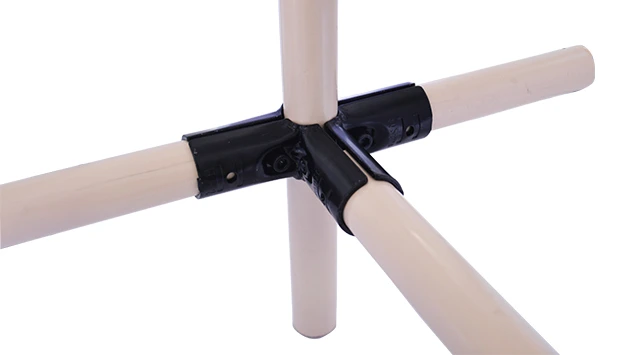
Imagine walking through a bustling production floor—conveyor belts hum softly, workbenches are organized with precision, and materials glide smoothly from one station to the next. Behind this seamless flow is a silent hero: the lean pipe system. And at the heart of that system? Joints. Not just any joints, but the unsung connectors that hold everything together, ensuring stability, flexibility, and efficiency. Among these, the four way straight lean pipe joint stands out as a workhorse, used in everything from material racks to assembly workbenches, where it connects pipes in multiple directions to build robust, customizable structures.
But here's the thing: not all four way straight lean pipe joints are created equal. Choose the wrong one, and you could be looking at wobbly workstations, frequent breakdowns, or even safety hazards. On the flip side, the right joint becomes an invisible partner, supporting your team's productivity day in and day out. So how do you pick the perfect fit for your operation? Let's dive into the five key factors that will guide you to the best decision—no engineering degree required, just practical insights tailored to real-world needs.
Factor 1: Material Compatibility – Matching Joints to Your Pipes
First things first: your four way straight lean pipe joint has to play nice with the pipes you're using. Lean pipe systems come in a variety of materials—think PE coated steel, aluminum profile, stainless steel, and even aluminum lean pipe—and each demands a joint that's designed to grip, support, and last. Mismatching materials is like trying to fit a square peg in a round hole: it might work temporarily, but it won't hold up to the daily grind.
| Pipe Material | Recommended Joint Material | Key Benefit | Common Applications |
|---|---|---|---|
| PE Coated Lean Pipe | Zinc-Plated Steel or Nylon-Coated Joints | Prevents scratches on PE coating; strong grip without damaging the pipe surface | Light-duty workbenches, turnover trolleys, basic material racks |
| Aluminum Profile (e.g., 2020, 3030 Series) | Aluminum Alloy Joints | Same material minimizes galvanic corrosion; lightweight yet durable | ESD workbenches, cleanroom setups, modular assembly lines |
| Stainless Steel Pipe | Stainless Steel Joints | Resists rust and corrosion; ideal for wet or chemical-exposed environments | Food processing lines, pharmaceutical manufacturing, outdoor storage racks |
Let's take aluminum profile pipes as an example. These are popular in modern factories for their lightweight, sleek design, and compatibility with T-slot accessories. If you pair an aluminum profile with a cheap plastic joint, you're asking for trouble: the plastic might crack under stress, or the grip might loosen over time, leading to wobbly structures. An aluminum alloy joint, on the other hand, shares the same thermal expansion rate as the pipe, so it won't loosen when temperatures fluctuate—critical in environments like warehouses with varying heat and cold.
Another scenario: PE coated lean pipes. These are budget-friendly and widely used in general manufacturing. But their soft plastic coating can be easily damaged by sharp or rough joints. A zinc-plated steel joint with a smooth inner surface? That's the way to go. It clamps securely without scratching the coating, ensuring the pipe stays protected and the joint stays tight for years.
Factor 2: Load Capacity – Don't Skimp on Strength
Here's a hard truth: a joint is only as good as its ability to carry weight. Whether you're building a material rack stacked with heavy components or a roller track where boxes slide by, the four way straight joint must handle both static loads (weight that stays put) and dynamic loads (weight that moves, like items rolling on a conveyor). Underestimating load capacity is a recipe for disaster—think collapsed racks, damaged inventory, or worse, workplace injuries.
So how do you calculate what you need? Start by asking: What's the maximum weight this structure will hold, and how is that weight distributed? For example, a material rack B (3 row and 3 floor) might hold 50kg per shelf, with three shelves—so each joint supporting that rack needs to handle a portion of that total weight, plus the weight of the pipes themselves. Dynamic loads add another layer: if you're using roller track to move 20kg boxes, the joint must withstand not just the box's weight but also the momentum as it slides, bumps, or stops suddenly.
Most reputable lean pipe suppliers list load capacities for their joints, usually in kilograms or pounds. But don't just take the number at face value. Look for test data: has the joint been tested under repeated stress? Does the supplier specify "static load" vs "dynamic load"? A joint rated for 100kg static might only handle 70kg dynamically—important if your application involves movement.
Pro tip: Always factor in a safety margin. If your calculations say you need a joint that holds 50kg, opt for one rated for 75kg. Production lines evolve—next month, you might need to store heavier parts, and you don't want to rebuild the entire structure just because the joints can't keep up.

Factor 3: Assembly Flexibility – Adaptability for the Long Haul
Lean manufacturing is all about adaptability—responding quickly to changing production needs, reconfiguring workstations, or scaling up (or down) as demand shifts. Your four way straight lean pipe joint should embody that spirit of flexibility. After all, what good is a joint that's rock-solid but impossible to adjust when you need to rearrange your workflow?
Look for joints with features that make assembly and disassembly a breeze. For example, some joints use a setscrew design: tighten a hex key to secure the pipe, loosen it to reposition. Others might have a cam-lock mechanism for tool-free adjustments. The goal? Minimizing downtime when you need to tweak your setup. If your team spends 20 minutes wrestling with a stuck joint every time they rearrange a workbench, that's 20 minutes of lost productivity—multiply that by weekly changes, and the cost adds up fast.
Another aspect of flexibility is compatibility with accessories. Can the joint work with roller track placon mounts? What about caster wheels if you want to turn a stationary rack into a mobile trolley? A good four way straight joint should play well with other components in your lean system, acting as a hub that connects pipes, brackets, and accessories without requiring custom adapters. For example, aluminum guide rail A or B should slot into the joint seamlessly, allowing you to add roller tracks for material flow without extra hassle.
Let's say your current setup is a single-deck workbench (Workbench E, without casters), but next quarter, you need to add a second level for tools. A flexible joint will let you attach an extra aluminum pipe vertically without drilling or welding—simply loosen the setscrew, add the new pipe, and tighten. No special tools, no downtime, no stress.

Factor 4: Environmental Conditions – Joints That Thrive Where You Work
Your factory floor isn't a one-size-fits-all environment. Maybe you work in electronics manufacturing, where static electricity can fry sensitive components. Or perhaps you're in a food processing plant, where moisture and sanitation are non-negotiable. Whatever the case, the four way straight lean pipe joint must hold up to the unique conditions of your workspace—otherwise, it'll degrade, corrode, or fail when you least expect it.
ESD (Electrostatic Discharge) is a prime example. In environments where ESD workbenches are standard (think circuit board assembly or semiconductor production), even a small static charge can ruin thousands of dollars of components. That's why ESD-safe joints are a must. Look for joints made with conductive materials (like stainless steel) or coated with anti-static additives that dissipate static charges, keeping your products—and your profits—safe.
Moisture and chemicals are another enemy. If your workspace has frequent washdowns (e.g., beverage production) or exposure to oils and solvents (automotive repair), stainless steel joints are your best bet. Unlike regular steel, stainless steel resists rust and corrosion, ensuring the joint stays tight and functional even after repeated exposure to water or chemicals. For less harsh environments, like a dry warehouse, zinc-plated steel joints might suffice—but check the plating thickness. A thin zinc layer will wear off faster, leaving the joint vulnerable.
Temperature extremes also matter. In a foundry or bakery, where temperatures soar, plastic or nylon joints might warp or melt. In a cold storage facility, brittle materials could crack. Opt for metal joints (aluminum or stainless steel) in these cases—they handle temperature swings better than plastic alternatives.
Factor 5: Long-Term Durability and Supplier Support – Invest in Reliability
It's tempting to cut costs by buying the cheapest four way straight lean pipe joint you can find. After all, a joint is a small part, right? Wrong. A low-quality joint might save you a few dollars upfront, but it'll cost you far more in the long run: frequent replacements, downtime for repairs, and even damage to products or equipment. When it comes to lean pipe systems, durability isn't a luxury—it's a necessity.
So what makes a joint durable? Start with the material quality. A stainless steel joint should be made from 304 or 316 grade stainless (316 is better for corrosion resistance). Aluminum joints should use high-strength alloys (like 6063-T5) that resist bending or warping. Avoid joints with thin walls or flimsy screws—these are red flags for poor durability.
Next, look at the finish. A smooth, consistent coating (like nickel-plated or powder-coated) not only looks professional but also adds a layer of protection against scratches and corrosion. Rough edges or uneven plating? Those are signs of shoddy manufacturing, and they'll only get worse with use.
But durability isn't just about the joint itself—it's also about the supplier behind it. A reliable lean pipe supplier will stand by their products with warranties, technical support, and replacement parts. Do they have a track record of quality? Can they provide references from other customers in your industry? What's their lead time for replacements if a joint fails? A supplier who ghost you after the sale isn't worth the initial savings.
Think of it this way: a high-quality joint might cost 50% more than a cheap one, but it lasts 3x longer. Over time, you're saving money, not to mention the headache of constant repairs. Plus, a good supplier can help you choose the right joint in the first place, offering insights based on their experience with similar applications.
Wrapping It Up: Your Joint, Your Productivity
Selecting the right four way straight lean pipe joint might seem like a small decision, but it's one that ripples through your entire operation. A joint that's compatible with your pipes, strong enough for your loads, flexible for changes, tough enough for your environment, and backed by a reliable supplier isn't just a component—it's an investment in smoother workflows, fewer disruptions, and a production line that grows with your business.
So take the time to assess your needs: walk your production floor, talk to your team about pain points (wobbly racks? hard-to-adjust workbenches?), and don't be afraid to ask your lean pipe supplier tough questions. After all, the best joint is the one that works so well, you forget it's there—letting you focus on what really matters: making great products, efficiently.