- Company Articles
- Products and Technology
- Technology Sharing
- Industry 4.0: How Four Way Straight Lean Pipe Joint Supports Data-Driven Production Optimization

Industry 4.0: How Four Way Straight Lean Pipe Joint Supports Data-Driven Production Optimization
Related Product
Four Way Straight Lean Pipe Joint
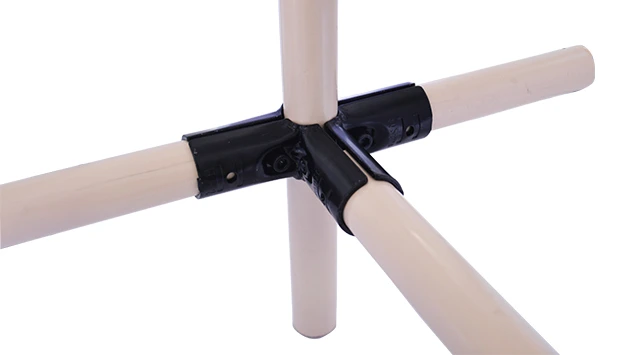
Four way lean pipe joint for 4 pcs 28MM lean pipe connection in straight angle, which used widely in workbench, flow rack, hand trolley frame connection.
Walk into any modern factory today, and you'll notice something different from the rigid, static production lines of the past. The hum of machinery is still there, but there's a new energy—one of adaptability. Workers adjust workbenches with a few twists of a joint, flow racks reconfigure to handle new products in hours, not weeks, and managers pull up real-time dashboards showing exactly where bottlenecks are forming. This is Industry 4.0 in action: where data isn't just collected, but actively shapes how physical spaces operate. And at the heart of this transformation? Surprisingly, it's often a small, unassuming component: the four way straight lean pipe joint.
You might be thinking, "A pipe joint? How does that tie into data-driven optimization?" Let's start with the basics. Industry 4.0 isn't just about smart machines or big data—it's about creating systems that can respond to data. If your production line is bolted down or welded into place, even the best data won't help you change course quickly. But when your infrastructure is built on modular, flexible components—like lean pipes and their connectors—suddenly, data becomes actionable. And among these components, the four way straight lean pipe joint stands out as a quiet workhorse, enabling the kind of 3D adaptability that modern manufacturing demands.
The Evolution of Lean Manufacturing: From Waste Reduction to Data Harmony
Lean manufacturing has always been about efficiency—eliminating waste, streamlining workflows, and making the most of every resource. But in the era of Industry 4.0, "lean" has evolved. It's no longer enough to optimize a single production line for a fixed set of products. Today's factories need to optimize for change . Customer demands shift overnight, supply chains fluctuate, and new regulations emerge. To keep up, production systems must be as agile as the data guiding them.
This is where lean pipe systems come into play. For decades, lean pipes—lightweight, durable tubes often coated in plastic or made of aluminum—have been used to build everything from workbenches to material racks. But what makes them indispensable in Industry 4.0 is their modularity. Unlike traditional metal framing, which requires welding or specialized tools to modify, lean pipes connect using simple joints. Need to extend a flow rack? Add a pipe and a joint. Want to lower a workbench to fit a new machine? Swap out a shorter pipe. It's tool-free, fast, and accessible to anyone on the shop floor.
But not all joints are created equal. Two-way joints connect pipes in a straight line; three-way joints add a perpendicular branch. The four way straight lean pipe joint, however, takes this a step further: it connects four pipes in a single, sturdy node—two along one axis, two along another. Think of it as the intersection point of a grid, allowing you to build up, out, and across with equal stability. This might sound like a minor detail, but in practice, it's the difference between a system that can handle simple adjustments and one that can transform entire production layouts based on real-time data.
Anatomy of a Game-Changer: What Makes the Four Way Straight Lean Pipe Joint Unique?
Let's get up close with this unassuming hero. A typical four way straight lean pipe joint is a compact, often cylindrical component with four connection points—one at each end of two perpendicular axes. It's designed to clamp onto lean pipes (usually 28mm or 30mm in diameter) using a setscrew or lever, requiring no tools beyond a hex key (and sometimes not even that). Made from materials like aluminum or high-strength plastic, it's lightweight but surprisingly strong, supporting loads of up to 50kg or more per joint, depending on the design.
But its real genius isn't in its strength—it's in its simplicity. Traditional production setups rely on welded steel frames. If you need to move a workbench six inches to the left to reduce operator reach time (a data-driven insight from ergonomic studies), you'd need a welder, hours of downtime, and possibly a whole new frame. With a four way joint? Loosen the setscrews, slide the pipes, retighten. Done in 10 minutes. That's the difference between a system that resists change and one that embraces it.
Consider this: A mid-sized electronics manufacturer recently shifted to producing a new smartphone model. Their old assembly line, with fixed workbenches and welded flow racks, took three weeks to reconfigure—costing them valuable time in a competitive market. Today, they use lean pipe systems built with four way joints. When the new product specs came in, their team used data from past launches (how long similar reconfigurations took, which joints were most used) to plan the change. They reconfigured the entire line—adjusting workbench heights, adding new flow rack lanes, and rerouting material transport—in just two days. And because the joints allowed for precise, repeatable adjustments, the new layout matched the digital simulation perfectly, with no trial-and-error delays. Data told them what to change; the four way joint made the change possible.

Data-Driven Adaptability: How the Four Way Joint Turns Insights into Action
Let's break down the cycle: Data identifies a problem or opportunity → The production system needs to adjust → The adjustment must be quick and precise to capture the opportunity. Without flexible infrastructure, this cycle breaks down at step two. The four way joint fixes that by acting as a bridge between digital insights and physical action.
1. Real-Time Bottleneck Resolution
Imagine a flow rack feeding parts to an assembly station. Sensors on the rack track how long parts take to move from the first to the last bin. One morning, data shows parts are piling up at the third bin—workers are taking 30% longer to retrieve them than expected. The root cause? The bin is too low, forcing operators to bend down. With a traditional rack, you'd need to order a new shelf or shim the existing one. With a lean pipe rack built using four way joints? The team adjusts the height of the third bin by adding a few extra pipe segments and repositioning the joints. By the end of the shift, data shows retrieval time is back to normal. No downtime, no extra cost—just a quick response to data.
2. Product Mix Flexibility
Modern factories rarely produce one product in bulk anymore. They're making 10 variations of a widget, each with different components and workflows. Data helps predict demand for each variation, but without a flexible setup, you're stuck with dedicated lines for each product—wasting space and resources. Enter the four way joint. A single lean pipe workbench can be reconfigured to assemble Product A in the morning (with tool holders on the left, parts bin on the right) and Product B in the afternoon (tool holders swapped, bin height adjusted) by simply rearranging the pipes and joints. No need for multiple workbenches—just one that adapts to the data on product mix.
3. Scalability Without Overhead
When demand spikes, data tells you to scale up. But scaling traditionally means buying new equipment or expanding floor space. With modular lean systems, scaling often means repurposing existing components. Suppose a toy manufacturer sees a 50% surge in demand for a popular doll. Their data dashboard flags that the packaging station is now the bottleneck. Using four way joints, they take sections from an underused material rack, add a few new lean pipes, and build a second packaging workbench in a day. Once demand subsides, they disassemble it and return the parts to their original use. No capital expenditure, no wasted space—just scalability on demand.
Case Study: Auto Parts Supplier Cuts Changeover Time by 75% with Four Way Joints
The Challenge: A supplier of brake components to major automakers was struggling with changeover times between product models. Their old system used welded steel flow racks, which took 8 hours to reconfigure—costing them $2,000 per hour in downtime. Data from their ERP system showed that changeovers were responsible for 15% of all production delays.
The Solution: They replaced their rigid racks with lean pipe flow racks built using four way straight lean pipe joints. The new racks featured adjustable shelves, tool-free joints, and standardized pipe lengths.
The Result: The first changeover with the new system took just 2 hours. As workers became more familiar with the joints, that dropped to 1.5 hours—an overall reduction of 75%. Data now shows that changeover-related delays are down to 3%, and the supplier has since expanded the system to their assembly workbenches, seeing similar gains in flexibility.

Traditional vs. Modular: A Comparison Table
| Feature | Traditional Production Setup (Welded/Static) | Modular Lean System (with Four Way Joints) |
|---|---|---|
| Reconfiguration Time | Days to weeks (requires welding, specialized labor) | Minutes to hours (tool-free, worker-operated) |
| Data Integration | Limited (changes require physical overhauls, hard to test with data) | Seamless (quick adjustments let teams test data-driven hypotheses in real time) |
| Scalability | Fixed (requires new equipment for growth) | Adaptive (reuse components to scale up/down as data demand changes) |
| Cost Over Time | High (initial welding, ongoing maintenance, replacement costs) | Low (one-time component purchase, reusable parts, minimal maintenance) |
| Worker Empowerment | Low (workers wait for specialists to make changes) | High (teams adjust their own workspaces based on data insights) |
Beyond the Joint: Building a Holistic Lean System
The four way straight lean pipe joint doesn't work in isolation. It's part of a larger ecosystem of lean components—lean pipes, flow racks, workbenches, and accessories—that together create a production system as flexible as the data guiding it. Let's take a closer look at how these pieces fit together.
Lean Pipes: The Backbone
Lean pipes (or "lean tubes") are the foundation. Made from steel with a plastic coating (or aluminum for lighter applications), they're strong yet lightweight, easy to cut to length, and compatible with all types of lean joints. In Industry 4.0, they're often paired with the four way joint to create 3D structures—think of them as the "bones" of the production system, with joints as the "joints" (fitting, right?).
Flow Racks: Moving Materials with Precision
Flow racks are a perfect example of the system in action. Built using lean pipes and four way joints, they use gravity or rollers to move materials from the back to the front, ensuring a steady supply to workers. But with four way joints, the angle of the rollers, the height of the shelves, and even the width of the rack can be adjusted to match data on material flow. If sensors show that parts are moving too slowly, tilt the rack slightly by adjusting the joint positions. If a new part is taller, raise the shelf height—no need for a new rack.
Workbenches: Where Data Meets the Worker
Workbenches are where the rubber meets the road in manufacturing. A well-designed workbench reduces fatigue, cuts down on wasted motion, and speeds up assembly. With four way joints, workbenches become customizable to each worker and task. Data from ergonomic studies might show that a 90cm height works best for most operators—so set the bench to 90cm. But if a new operator joins who's taller, adjust the legs using the joints to 95cm. Add tool hooks, parts bins, or monitor mounts by connecting extra pipes to the four way joints. It's a workspace that adapts to people, not the other way around.
The Ripple Effect: Why Small Components Drive Big Results
It's easy to overlook components like the four way joint, but their impact ripples through the entire production ecosystem. When reconfiguration takes hours instead of weeks, downtime drops. When workers can adjust their own workbenches, satisfaction rises. When you can reuse components instead of buying new ones, sustainability improves. And when data translates into action quickly, the entire business becomes more resilient.
Consider sustainability: Traditional production lines generate tons of waste when they're replaced or modified. Welded steel frames end up in landfills, and new materials are mined or manufactured to replace them. Lean pipe systems, by contrast, are designed for reuse. A four way joint bought today can still be connecting pipes 10 years from now, moving from a flow rack to a workbench to a turnover trolley as needs change. Data from one manufacturer showed that switching to modular lean systems reduced their annual waste from production line overhauls by 60%—a win for both the planet and the bottom line.
Then there's employee engagement. In a recent survey, 78% of manufacturing workers said they felt more valued when their employers invested in tools that made their jobs easier. Modular workbenches and flow racks, with their tool-free adjustability, give workers a sense of ownership over their space. When a worker notices a bottleneck, they don't have to wait for maintenance—they can grab a hex key, adjust the four way joint, and fix it themselves. And when that change is validated by data (faster assembly times, fewer errors), it reinforces that their input matters. It's a culture shift driven, in part, by a simple pipe joint.
Looking Ahead: The Future of Lean Pipes in Industry 4.0
As Industry 4.0 matures, the line between physical and digital systems will blur even further. We're already seeing "digital twins"—virtual replicas of production lines that let managers test changes before implementing them in the real world. Imagine designing a new flow rack layout in a digital twin, tweaking the joint positions based on simulated data, then sending the exact configuration to the shop floor. Workers then use the four way joints to replicate the virtual design precisely—no guesswork, no errors.
Smart joints are also on the horizon. Imagine a four way joint with a built-in sensor that tracks how often it's adjusted, how much weight it's supporting, or even if it's starting to loosen. This data could predict maintenance needs before a joint fails, or show which configurations are most effective. Pair that with AI, and the system might even suggest optimal joint positions based on historical data—"Based on past demand spikes, reconfiguring this flow rack with joints at 45° angles reduces bottlenecks by 15%."
But even without sensors or AI, the four way straight lean pipe joint is already a cornerstone of Industry 4.0. It's a reminder that the most powerful technologies aren't always the flashiest. Sometimes, they're the ones that quietly connect the digital and physical worlds—turning data into action, and action into results.
Conclusion: The Joint That Connects Data to Done
Industry 4.0 is often talked about in terms of robots, AI, and big data. But none of these matter if your production line can't bend to their will. The four way straight lean pipe joint is proof that innovation often starts small—with a component that makes the complex simple, the rigid flexible, and the impossible possible. It's the bridge between the data on a screen and the hands on the factory floor, turning insights into action, and action into success.
So the next time you walk through a modern factory, take a closer look at those pipes and joints. They might not have screens or algorithms, but they're every bit as critical to Industry 4.0 as the smartest machine. Because in the end, data can tell you where to go—but it takes flexible, adaptable tools to get you there. And the four way straight lean pipe joint? It's one tool that's already there, ready to build the future of manufacturing, one connection at a time.