- Company Articles
- Products and Technology
- Product knowledge
- Innovations in Aluminum Profile 3 Way Connector Locking Mechanisms

Innovations in Aluminum Profile 3 Way Connector Locking Mechanisms
Related Product
Aluminum Profile 3 Way Connector
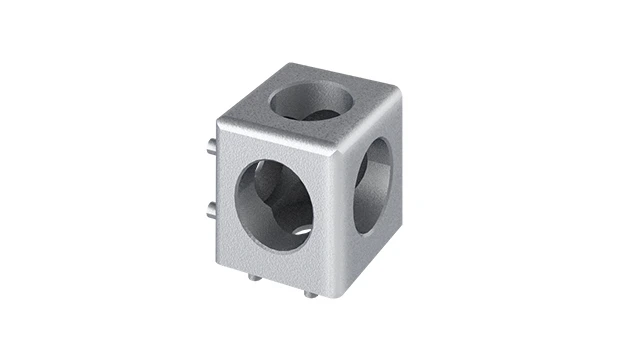
The 3 way - squared corner connector is an external fastening method that is typically used to create a corner connection between three profiles. It is a heavy-duty connection that is simple to use and provides a polished look.
Walk into any modern manufacturing facility, warehouse, or even a tech startup's prototyping lab, and you'll likely spot a common sight: sleek, modular structures made from aluminum profile . These versatile frameworks form workbenches, material racks, conveyor systems, and assembly lines, quietly powering the efficiency of today's production environments. But what holds these structures together—what turns a pile of aluminum tubes and panels into a stable, functional workspace? The answer lies in the unsung heroes of modular design: connectors. And among these, the 3 way aluminum profile connector stands out as a critical component, enabling the creation of complex, multi-directional structures with precision and reliability.
In recent years, advancements in locking mechanisms for these 3 way connectors have transformed how industries approach modular construction. From time-consuming bolted joints to intuitive, tool-free systems, these innovations aren't just about convenience—they're about unlocking the full potential of lean system principles: flexibility, adaptability, and continuous improvement. In this article, we'll dive deep into the evolution of 3 way connector locking mechanisms, explore the cutting-edge designs reshaping industrial workflows, and examine how they're empowering businesses to build smarter, more responsive workspaces.
Why 3 Way Connectors Matter: The Heart of Modular Design
Before we delve into locking mechanisms, let's first understand why 3 way connectors are so vital. Aluminum profiles, typically extruded into T-slot designs, are prized for their strength-to-weight ratio, corrosion resistance, and ease of customization. But their true power lies in modularity— the ability to connect, disconnect, and reconfigure components without welding or permanent modifications. This is where connectors come in, acting as the "joints" that link profiles at various angles.
3 way connectors, as the name suggests, enable the connection of three profiles at a single point, forming T-junctions or Y-shapes. Think of a workbench with a side shelf, a material rack with horizontal and vertical supports, or a conveyor that splits into two paths—all these require 3 way connections to maintain structural integrity. Unlike 2 way connectors (which handle straight or 90° angles) or 4 way connectors (for cross junctions), 3 way connectors balance complexity and utility, making them indispensable in most modular setups.
But here's the catch: a connector is only as good as its locking mechanism. A weak or cumbersome lock can turn a modular dream into a maintenance nightmare—wobbly structures, frequent re-tightening, or time wasted on assembly. For lean system practitioners, where every second of downtime and every ounce of inefficiency eats into profitability, the reliability and speed of these locks are non-negotiable. That's why manufacturers and engineers have poured resources into reimagining how these connectors secure aluminum profiles, leading to a new generation of locking technologies.
From Bolts to Breakthroughs: The Evolution of Locking Mechanisms
To appreciate today's innovations, it helps to look back at the humble beginnings of aluminum profile connectors. Early designs, dating back to the mid-20th century, relied heavily on bolted joints. A typical 3 way connector would feature threaded holes, requiring users to drill into the aluminum profile, align the connector, and tighten bolts with wrenches—a process that was time-consuming, error-prone, and often permanent. If a structure needed reconfiguration, the bolts would often strip the threads in the profile, rendering the components unusable.
As modular design gained popularity in the 1980s and 1990s, the industry shifted to set-screw mechanisms. These connectors used a small screw that, when tightened, pressed against the inner wall of the T-slot in the aluminum profile, creating friction to hold the joint. This was a step forward—no drilling required—but it still had flaws. Over time, vibration from machinery would loosen the set screws, leading to wobbly structures. Tightening them required tools, and over-tightening risked damaging the profile's T-slot edges.
The 2000s brought another leap: cam-action locks. These mechanisms used a rotating cam inside the connector that, when turned, expanded to grip the T-slot walls. This design reduced assembly time and improved stability, but early versions still needed a hex key or special tool. It wasn't until the last decade that the industry truly embraced tool-free locking mechanisms —a game-changer for lean systems, where rapid reconfiguration is key to adapting to changing production demands.

Modern Innovations: 5 Locking Mechanisms Redefining Modular Construction
Today's 3 way aluminum profile connectors boast a range of locking mechanisms, each tailored to specific needs—from heavy-duty industrial applications to lightweight, frequently reconfigured setups. Let's explore the most impactful innovations reshaping the market:
1. Quick-Release Cam-Lock Systems: Speed Meets Stability
One of the most widely adopted innovations is the quick-release cam-lock mechanism. Unlike earlier cam designs, modern versions feature an ergonomic lever or knob that can be operated by hand, eliminating the need for tools. Here's how it works: when the lever is rotated 90°, an internal cam expands outward, pressing against the T-slot's sidewalls with uniform force. This creates a tight, vibration-resistant bond that can withstand significant loads—often up to 500 kg per connector in high-quality models.
What makes this design stand out is its balance of speed and security. Assembly takes seconds: align the connector, insert it into the T-slot, and flip the lever. Disassembly is just as easy, allowing workers to reconfigure a workbench or material rack in minutes instead of hours. For lean system environments, where production lines might need to shift from assembling smartphones in the morning to tablets in the afternoon, this flexibility is invaluable.
Manufacturers have refined this design further by using high-strength materials like hardened steel for the cam and aluminum alloy for the connector body, ensuring durability without adding excess weight. Some models even include a secondary locking feature—a small set screw that can be tightened (with a basic tool) for applications where extreme vibration or heavy loads are a concern, offering the best of both worlds: tool-free speed and bolt-like security.
2. Spring-Loaded Pin Locks: Precision Alignment for Repeatable Setups
For applications where precision is critical—think of laboratory workbenches or automated assembly lines where alignment errors can lead to product defects—spring-loaded pin locks have emerged as a top choice. These connectors feature spring-loaded pins that engage with pre-drilled holes or notches in the aluminum profile, ensuring exact positioning every time.
The mechanism is surprisingly simple yet effective. When inserting the connector into the profile, the pins retract against the spring tension. Once aligned with the profile's holes, the pins snap into place with an audible "click," confirming a secure connection. To disconnect, a small release button or lever retracts the pins, allowing the connector to be removed smoothly.
The key advantage here is repeatability. In environments where structures are disassembled and reassembled frequently—such as trade show booths or temporary production cells—spring-loaded pin locks ensure that components line up exactly as they did before. This eliminates the need for re-measurement and reduces human error, a boon for lean system efficiency. Additionally, the metal-to-metal contact between the pins and profile holes provides excellent torsional stability, making these connectors ideal for setups that require minimal flexing, like robotic workstations.
3. Threaded insert Locking: Heavy-Duty Reliability for Industrial Environments
While tool-free systems dominate in agile settings, some applications demand the ultimate in load capacity and permanence. Enter threaded insert locking mechanisms. These connectors feature a threaded metal insert (often brass or stainless steel) that is embedded into the connector body. When a bolt is screwed into the insert, it pulls the connector tightly against the profile, creating a rigid joint that can handle loads exceeding 1000 kg in some cases.
What's new here isn't the concept of threaded joints, but the materials and engineering that make them more user-friendly. Modern threaded insert connectors use self-tapping bolts with ergonomic heads, allowing for easier tightening by hand (though a wrench can be used for final torque). The inserts themselves are precision-machined to prevent stripping, even after multiple assemblies and dis assemblies—a common issue with older bolted designs.
These connectors are a staple in heavy manufacturing, such as automotive or aerospace, where structures must support heavy machinery or raw materials. They're also popular in outdoor applications, where exposure to weather makes vibration resistance critical. While they lack the speed of cam-locks, their reliability makes them irreplaceable in high-stakes environments.
4. Magnetic-Assisted Alignment: Simplifying the "Fumble Factor"
A newer entrant to the market, magnetic-assisted locking mechanisms, addresses a common frustration in modular assembly: aligning connectors with T-slots, especially when working alone or with large, unwieldy profiles. These connectors integrate small, powerful neodymium magnets into their base, which adhere to the aluminum profile's surface during assembly. This holds the connector in place temporarily, freeing up the user's hands to engage the main locking mechanism—whether it's a cam-lock or pin lock.
The magnets are strong enough to support the connector's weight but weak enough to allow easy repositioning before final locking. This might seem like a small improvement, but in practice, it reduces assembly time by up to 30% in studies conducted by manufacturing consultancies. For workers assembling tall material racks or overhead conveyor supports, the "third hand" provided by the magnets minimizes the risk of dropped components and reduces fatigue.
Magnetic-assisted connectors are particularly popular in industries with high turnover rates, such as logistics or e-commerce fulfillment centers. New employees can master assembly faster, reducing training time and errors—another win for lean system efficiency.
5. Integrated Sensor Locks: Smart Monitoring for Predictive Maintenance
Pushing the boundaries of innovation, some manufacturers are now integrating sensors into 3 way connectors, creating "smart" locking mechanisms. These connectors feature built-in strain gauges or proximity sensors that monitor the tightness of the joint. If a lock begins to loosen due to vibration or wear, the sensor sends an alert to a central system, allowing maintenance teams to address the issue before it leads to structural failure.
While still relatively niche, smart connectors are gaining traction in industries where downtime is costly, such as semiconductor manufacturing or automotive assembly. Imagine a production line where a loose connector on a conveyor system could cause a bottleneck—with sensor locks, managers receive real-time alerts, enabling proactive maintenance instead of reactive repairs. This aligns perfectly with the lean system principle of "preventive maintenance," reducing waste and improving overall equipment effectiveness (OEE).

Real-World Impact: How Locking Mechanisms Transform Lean System Efficiency
To understand the tangible benefits of these innovations, let's look at a case study from a mid-sized electronics manufacturer that recently upgraded its aluminum profile accessories —including 3 way connectors with quick-release cam-locks—to revamp its assembly line.
Case Study: XYZ Electronics Reduces Changeover Time by 65% with Tool-Free Connectors
XYZ Electronics, a producer of smart home devices, faced a challenge common in consumer electronics: frequent product launches required its assembly lines to reconfigure every 4–6 weeks. Previously, the line used bolted 3 way connectors, which took two technicians 8 hours to disassemble and rebuild. This downtime cut into production targets and increased labor costs.
In 2023, XYZ switched to 3 way connectors with quick-release cam-locks. The results were striking: the same reconfiguration now takes one technician just 2.8 hours, a 65% reduction in changeover time. Additionally, the new connectors eliminated stripping issues, reducing the need to replace damaged profiles by 80%. Workers reported higher satisfaction, noting that the tool-free design reduced hand fatigue during long shifts.
The ROI was clear: within six months, the savings from reduced labor and material costs offset the investment in new connectors. "We used to dread product launches because of the line reconfig," said Maria Gonzalez, XYZ's production manager. "Now, it's just another part of the week—we can pivot quickly and keep up with customer demand without sacrificing quality."
This example highlights a broader trend: the right locking mechanism doesn't just improve assembly speed—it enhances the entire workflow, from labor efficiency to product quality. In lean system terms, it reduces "non-value-added" time (the hours spent bolting and unbolting connectors) and allows workers to focus on what matters: building products.
Choosing the Right Mechanism: A Comparison Guide
With so many options available, selecting the best 3 way connector locking mechanism depends on your specific needs. To help, we've compiled a comparison of the five mechanisms discussed, evaluating key factors like assembly time, load capacity, and ideal use cases:
| Locking Mechanism | Assembly Time (per connector) | Max Load Capacity (per connector) | Tool Requirement | Ideal Application | Best For Lean Systems? |
|---|---|---|---|---|---|
| Quick-Release Cam-Lock | 10–15 seconds | 300–500 kg | Tool-free | Workbenches, material racks, frequent reconfigurations | ★★★★★ (Best overall for flexibility) |
| Spring-Loaded Pin Lock | 15–20 seconds | 200–400 kg | Tool-free (release button) | Precision alignment (laboratories, automated lines) | ★★★★☆ (Great for repeatable setups) |
| Threaded insert Lock | 60–90 seconds | 500–1000+ kg | Basic tool (wrench optional) | Heavy machinery, outdoor structures | ★★★☆☆ (Good for fixed, heavy-duty setups) |
| Magnetic-Assisted | 12–18 seconds | 250–450 kg | Tool-free (magnetic assist) | Large structures, solo assembly | ★★★★☆ (Ideal for large-scale lean environments) |
| Smart Sensor Lock | 20–30 seconds | 300–600 kg | Tool-free + app/sensor | High-precision, high-cost environments | ★★★☆☆ (Emerging tech with future potential) |
As the table shows, quick-release cam-locks are the top choice for most lean systems, offering the best balance of speed, load capacity, and tool-free operation. However, it's important to assess your unique needs: if your facility deals with extremely heavy loads, threaded inserts might be necessary. If precision alignment is critical, spring-loaded pins could be the better fit.
The Future of 3 Way Connectors: What's Next?
The evolution of 3 way aluminum profile connector locking mechanisms shows no signs of slowing down. Looking ahead, several trends are poised to shape the next generation of these critical components:
Eco-Friendly Materials: As sustainability becomes a priority, manufacturers are exploring recycled aluminum alloys and bio-based plastics for connector bodies. Some are even experimenting with bamboo-reinforced composites for lightweight, low-load applications, reducing the carbon footprint of modular systems.
3D-Printed Customization: While mass-produced connectors work for most applications, 3D printing is enabling the creation of custom 3 way connectors tailored to unique geometries. This is particularly useful for niche industries, such as aerospace or medical device manufacturing, where standard connectors might not fit specialized profiles.
Integration with Digital Twins: Smart connectors with sensors could soon feed data into digital twin systems—virtual replicas of physical production lines. This would allow engineers to simulate reconfigurations digitally before making physical changes, further reducing downtime and errors in lean system setups.
Ergonomic Enhancements: Future designs will likely focus on making connectors even easier to use, with features like larger levers for workers with gloves, color-coded locking indicators, and tactile feedback (e.g., a textured grip) to improve usability in low-light environments.
Conclusion: Connectors as Catalysts for Lean System Excellence
At first glance, 3 way aluminum profile connectors might seem like simple hardware—small pieces of metal that hold bigger structures together. But as we've explored, their locking mechanisms are anything but simple. They are the critical link between raw materials and operational excellence, enabling the flexibility, speed, and reliability that modern lean systems demand.
From the days of bolted joints that required hours of labor to today's tool-free cam-locks that snap into place in seconds, the innovation in this space reflects a broader shift in manufacturing: a focus on empowering workers, reducing waste, and building systems that can adapt as quickly as the market changes. As aluminum profiles continue to be the backbone of modular design, and as 3 way connectors evolve to meet new challenges, one thing is clear: the future of industrial efficiency will be built, quite literally, on these small but mighty components.
So the next time you walk through a factory or lab and admire a sleek aluminum workstation, take a moment to appreciate the 3 way connector holding it all together. It's more than just a piece of hardware—it's a symbol of how even the smallest innovations can unlock massive gains in productivity, sustainability, and human-centric design. And in the world of lean systems, that's something worth celebrating.