- Company Articles
- Products and Technology
- Installation And Maintenance
- Installation Mistakes to Avoid with 3030 National Standard Profile A Structures

Installation Mistakes to Avoid with 3030 National Standard Profile A Structures
Related Product
3030 National Standard Profile A
Workbench, production line, logistic rack, warehouse rack Industry: Manufacturer workshop, Automobile, Electronic, Assembling, logistic
If you've spent any time in a workshop, manufacturing plant, or even a DIY garage, you've probably encountered aluminum profiles. These versatile, modular building blocks are the backbone of everything from workbenches and material racks to conveyor systems and machine guards. Among the most popular options is the 3030 National Standard Profile A —a workhorse known for its balance of strength, flexibility, and cost-effectiveness. But here's the thing: even the best materials can fail if installed incorrectly. Whether you're a seasoned engineer or a weekend builder, skipping small steps during installation can lead to wobbly structures, safety hazards, or premature wear and tear. Let's dive into the most common mistakes people make when installing 3030 National Standard Profile A structures, and more importantly, how to avoid them.
Why 3030 National Standard Profile A Deserves Your Attention
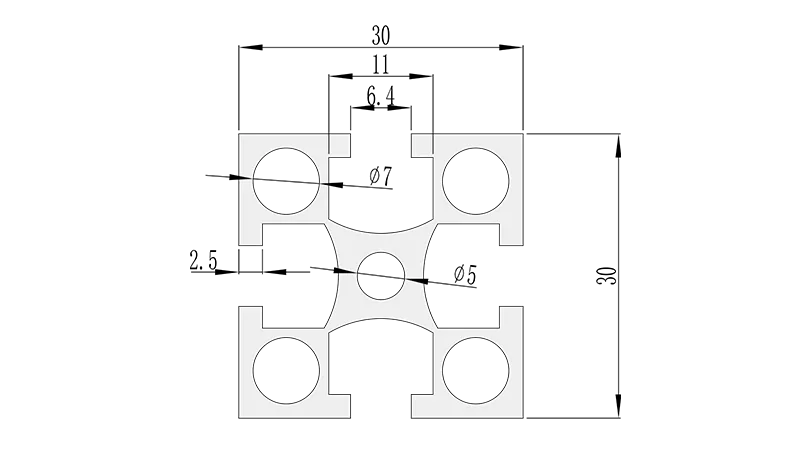
First, let's get clear on what makes this profile so widely used. The 3030 National Standard Profile A is a type of aluminum extrusion with a 30mm x 30mm cross-section, featuring T-slots along its length. These slots allow for easy attachment of aluminum profile accessories like brackets, angle codes, and end caps, making it a favorite for custom builds. From simple workbenches to complex material handling systems (think material rack B (3 row and 3 floor) setups), this profile adapts to almost any need. But its versatility is a double-edged sword: without careful installation, all that potential can quickly turn into frustration.
The stakes are higher than you might think. A poorly installed structure isn't just an eyesore—it can compromise workplace safety, slow down production, or even damage expensive equipment. Imagine a workbench that wobbles while you're using power tools, or a material rack that sags under the weight of inventory. These aren't just inconveniences; they're accidents waiting to happen. The good news? Most installation mistakes are avoidable with a little knowledge and attention to detail.
Mistake #1: Using the Wrong Aluminum Profile Accessories
Let's start with the basics: accessories. The T-slots on 3030 profiles are designed to work with specific hardware, and using the wrong parts is like trying to fit a square peg in a round hole. Common culprits include mismatched angle codes, bolts that are too short, or low-quality plastic end caps that crack under pressure. For example, some builders reach for generic small iron corner codes instead of profile-specific aluminum angle yards , assuming "a bracket is a bracket." Big mistake.
Aluminum angle yards (also called angle brackets) are engineered to distribute weight evenly across the profile's T-slots. The 3030 National Standard Profile A, for instance, requires angle yards with a 30mm spacing to align with its slot pattern. Using a smaller bracket (like a 20# aluminum corner code meant for 2020 profiles) leaves gaps, creating weak points where the structure can flex or loosen over time. I once saw a workshop where someone used plastic zip ties instead of proper aluminum pipe clamps to secure a shelf to their 3030 workbench. Within a month, the shelf had tilted, and tools had slid off onto the floor.
How to avoid it: Always check the manufacturer's specs for your 3030 profile. Look for accessories labeled "compatible with 3030 National Standard Profile A" and invest in quality parts. When in doubt, ask your supplier—reputable lean pipe supplier or aluminum profile vendors will happily guide you to the right brackets, bolts, and end caps. And remember: skimping on accessories now will cost you more in repairs (or replacements) later.
Mistake #2: Skipping Alignment Checks (Or Relying on "Eyeballing It")
You've gathered your profiles, sorted your accessories, and you're ready to build. The excitement takes over, and you start bolting pieces together without grabbing a level. Sound familiar? Relying on "eyeballing" alignment is one of the easiest ways to end up with a wonky structure. Even a 1-degree misalignment over a 1-meter span can create a noticeable tilt, putting stress on joints and making surfaces uneven.
Consider this scenario: A team was assembling a workbench E (single deck-without caster) using 3030 profiles. They attached the legs to the tabletop frame but didn't check if the legs were plumb (vertical). Once the workbench was upright, one corner sat 1.5cm lower than the others. At first, they shrugged it off—"it's close enough." But over time, the uneven weight caused the T-slot bolts to loosen, and the tabletop began to warp. By the time they noticed, the damage was done, and they had to rebuild the entire frame.
How to avoid it: Slow down and use the right tools. A spirit level (digital or bubble) is non-negotiable for checking both horizontal and vertical alignment. For longer structures (like a conveyor support frame), string a line between two points to ensure straightness. When attaching cross-braces or shelves, double-check that they're square to the main frame using the 3-4-5 triangle method (measure 3 units along one side, 4 along the adjacent side, and the diagonal should be 5 units). Taking 5 extra minutes to align each piece will save hours of frustration later.
Mistake #3: Ignoring Load Capacity Limits
The 3030 National Standard Profile A is strong, but it's not indestructible. Every aluminum profile has a load capacity rating—how much weight it can safely support over a given span. Ignore this, and you're asking for trouble. I've seen people stack heavy machinery on a 3030 workbench without considering that the profile's load rating drops as the span between supports increases. For example, a 3030 profile can handle around 50kg per linear meter when supported every 50cm, but that drops to 20kg if the supports are 1 meter apart. Overloading leads to sagging, bending, or even snapping—especially at the joints.
Another common error is underestimating dynamic loads. If you're building a turnover trolley and rack that will be moved around a warehouse, the weight isn't just static—it shifts during transport. A trolley loaded with 100kg of parts might feel stable when stationary, but hit a bump, and that load could spike to 150kg or more, stressing the frame beyond its limits. The same goes for workbenches used with power tools: the vibrations from a drill or sander add extra force to the structure over time.
How to avoid it: Start by checking the manufacturer's load capacity chart for your 3030 profile. These charts usually list safe loads for different spans and mounting configurations. If you're unsure, calculate the maximum weight your structure will need to support (including dynamic forces) and add a 20% safety margin. When in doubt, add extra supports—cross-braces, vertical struts, or additional legs can drastically improve load-bearing capacity. And remember: material rack B (3 row and 3 floor) or other multi-level systems need extra reinforcement at the connections between shelves and uprights.
Mistake #4: Mishandling Aluminum Angle Yards and Fasteners
Even if you've chosen the right aluminum angle yards (good job!), improper installation of these critical components can undo all your hard work. Two extremes are common here: overtightening and undertightening. Overtightening bolts can strip the T-slots or warp the angle yard, weakening the connection. Undertightening leaves gaps, allowing the structure to shift and vibrate loose over time.
Let's talk about torque. Most aluminum profile bolts (M5 or M6 for 3030 profiles) require a specific torque setting—usually around 2-3 Nm for M5 bolts and 4-5 Nm for M6. Without a torque wrench, it's easy to guess wrong. A friend of mine, a hobbyist woodworker, once tightened the bolts on his 3030 workbench so hard that the T-slots deformed, making it impossible to adjust or replace the brackets later. On the flip side, I've seen production lines where workers "finger-tightened" bolts to save time, only to have a shelf collapse under a load of components a week later.
Another issue is using the wrong fastener type. For example, using standard hex bolts instead of T-slot bolts (which have a rounded head that fits into the T-slot) can cause the bolt to pop out under stress. Or neglecting to use washers—without them, the bolt head can dig into the aluminum, weakening the profile over time.
How to avoid it: Invest in a small torque wrench (they're affordable and worth every penny). Follow the manufacturer's torque recommendations for your bolts and angle yards. If you don't have a torque wrench, use the "two-finger rule": tighten until you can't turn the wrench with two fingers—any more, and you're risking damage. Always use T-slot-specific bolts with washers, and check connections periodically (especially on structures that vibrate) to ensure they're still tight.
Mistake #5: Forgetting About Environmental Factors
Aluminum is corrosion-resistant, but it's not immune to the elements. Installing a 3030 structure in a humid workshop, a dusty warehouse, or an outdoor area without protective measures can lead to premature wear. For example, in a food processing plant with frequent washdowns, uncoated aluminum profiles can develop white rust (oxidation) if not dried properly. In a woodworking shop, sawdust can build up in T-slots, making it hard to adjust accessories later.
Temperature changes are another hidden enemy. Aluminum expands and contracts with heat and cold. A structure built in a warm garage in summer might develop gaps in winter as the profiles shrink, or bow in summer if the installation didn't leave room for movement. I once saw a 3030-framed window guard installed in a warehouse without expansion gaps—it warped so badly in the summer heat that it couldn't close properly.
How to avoid it: Start by choosing the right finish. Anodized 3030 profiles offer extra corrosion resistance for humid or outdoor environments. For dusty areas, use aluminum profile rubber strip or T-slot covers to seal the slots and prevent debris buildup. In temperature-fluctuating spaces, leave small gaps (1-2mm) between profile ends when joining long sections—this allows for expansion without warping. And if you're installing near chemicals or moisture, consider stainless steel fasteners instead of standard aluminum ones to prevent galvanic corrosion.
A Quick Reference: Common Mistakes vs. Solutions
| Mistake | Impact | Solution |
|---|---|---|
| Using wrong aluminum profile accessories | Weak joints, instability, stripped T-slots | Choose accessories labeled for 3030 National Standard Profile A; use aluminum angle yards instead of generic brackets |
| Skipping alignment checks | Wobbly structures, uneven surfaces, warped frames | Use a spirit level, string line, and 3-4-5 method to ensure plumb, level, and square |
| Ignoring load capacity | Sagging, bending, or structural failure | Check manufacturer load charts; add supports for longer spans; include a 20% safety margin |
| Overtightening/undertightening fasteners | Stripped slots, loose joints, warped angle yards | Use a torque wrench; follow 2-3 Nm (M5) or 4-5 Nm (M6) torque specs; use washers |
| Neglecting environmental factors | Corrosion, debris buildup, warping from temperature changes | Use anodized profiles for moisture; add rubber strips to seal T-slots; leave expansion gaps |
Case Study: From Wobbly to Rock-Solid—A Workbench Redemption Story
Let's wrap up with a real-world example. A small electronics manufacturer recently reached out for help with a 3030 National Standard Profile A workbench they'd built in-house. The goal was to create a stable surface for assembling circuit boards, but the bench wobbled so badly that workers were struggling to solder components accurately. Upon inspection, we found three critical mistakes:
-
Wrong accessories: They'd used small iron corner codes instead of aluminum angle yards designed for 3030 profiles. The iron brackets didn't fit snugly in the T-slots, leaving play in the joints.
-
Poor alignment: The legs weren't plumb, and the tabletop frame wasn't square—measuring diagonally, one corner was 2cm longer than the opposite, causing the wobble.
-
Missing cross-braces: The bench had no horizontal cross-braces between the legs, so it lacked lateral stability.
The fix was straightforward: We replaced the iron brackets with proper 3030 aluminum angle yards, realigned the frame using a spirit level and 3-4-5 method, and added cross-braces at mid-height on all sides. The result? A rock-solid workbench that now supports sensitive assembly work without a hint of movement. The team was shocked at how much difference those small changes made—and they've since rebuilt their other 3030 structures using the same principles.
Final Thoughts: Installation = Foundation
Building with 3030 National Standard Profile A is all about precision. It's easy to get excited and rush through installation, but cutting corners now leads to headaches later. By choosing the right aluminum profile accessories , checking alignment, respecting load limits, torquing fasteners properly, and accounting for the environment, you'll create structures that are safe, durable, and built to last.
Remember: The best aluminum profiles are only as good as their installation. Whether you're building a simple workbench or a complex material handling system, take your time, use the right tools, and don't hesitate to consult your supplier if you're unsure. Your back (and your budget) will thank you.