- Company Articles
- Products and Technology
- Application Cases
- Key Applications of 3060 National Standard Profile A in 3C Assembly Lines

Key Applications of 3060 National Standard Profile A in 3C Assembly Lines
Related Product
3060 National Standard Profile A
Workbench, production line, logistic rack, warehouse rack Industry: Manufacturer workshop, Automobile, Electronic, Assembling, logistic
Walk into any modern 3C (Computer, Communication, Consumer Electronics) factory, and you'll notice a world that moves at lightning speed. Smartphones, laptops, and wearables roll off assembly lines in the millions, each requiring hundreds of tiny, precise components to come together flawlessly. But behind that seamless flow lies a hidden challenge: flexibility . With new models launching every few months, assembly lines can't stay static—they need to reconfigure, adapt, and scale quickly. That's where 3060 National Standard Profile A comes in. This unassuming aluminum extrusion has quietly become the backbone of many 3C assembly floors, and today, we're diving into why it's become so indispensable.
The 3C Industry's Secret Pain Point: Rigidity in a Fast-Changing World
Let's start with the basics: 3C manufacturing isn't just about speed—it's about precision and adaptability. Imagine assembling a smartphone: you're working with components smaller than a fingernail, like microchips and camera modules, which demand stable, vibration-free work surfaces. At the same time, if the next model has a slightly larger screen or a rearranged internal layout, the assembly line needs to shift—fast. Traditional assembly setups, often built with heavy steel or fixed wooden workbenches, struggle here. They're durable, sure, but moving or modifying them? That can take days, if not weeks, and downtime in 3C manufacturing costs big money.
Then there's the issue of material flow. Parts need to glide from one station to the next—circuit boards from soldering to testing, housings from molding to assembly—without getting stuck or damaged. Old-school conveyor belts or static shelving often can't keep up with the frequent changes in part sizes or production volumes. And let's not forget ergonomics: workers spend 8+ hours a day at these stations, so height, reach, and tool placement matter for both productivity and well-being. Rigid setups rarely prioritize that.
Why 3060 National Standard Profile A? It's All in the Design
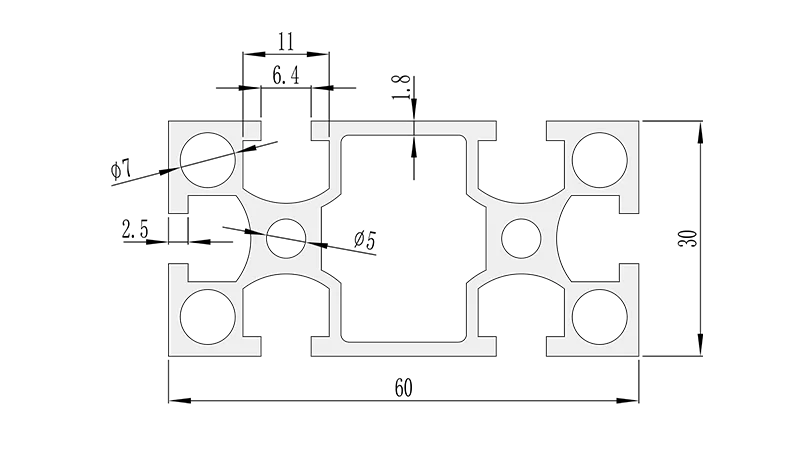
So, what makes 3060 National Standard Profile A different? Let's break it down. First, it's aluminum—lightweight but surprisingly strong. At 30mm wide and 60mm tall, its cross-section is engineered to balance load capacity with versatility. Unlike custom steel frames, it's a standardized profile, meaning every piece you buy fits with every other piece. No more hunting for custom brackets or welding parts together—this is modularity at its finest.
But the real magic is in the aluminum profile accessories that pair with it. Think T-slot nuts, corner brackets, end caps, and hinges—all designed to snap or bolt into the profile's built-in grooves. Want to add a shelf? Slide in a bracket. Need to adjust the height of a workbench? Loosen a few bolts, reposition, and tighten. It's like building with high-tech Legos, but for factories. And because it's aluminum, it's resistant to corrosion (important in clean manufacturing environments) and won't weigh down your line—so even large structures can be moved with minimal effort.
Key Application 1: Workbenches That Keep Up with Precision
Let's zoom in on one of the most critical spots in any assembly line: the workbench. In 3C manufacturing, a workbench isn't just a table—it's a command center. Workers here solder microchips, attach screens, and test circuit boards, requiring stable surfaces, built-in tool storage, and sometimes even ESD (Electrostatic Discharge) protection to avoid frying sensitive components.
Traditional workbenches, often made of solid wood or steel, fall short here. They're heavy, hard to adjust, and if you need to add a shelf or a tool rail? You're drilling holes or welding, which means downtime. 3060 National Standard Profile A changes the game. Take, for example, a workbench built with 3060 profiles as the frame. The aluminum extrusion provides a sturdy base, while aluminum profile accessories like T-slot brackets let you add a plywood or ESD laminate top in minutes. Need a tool holder? Slide a bracket into the T-slot and bolt it on. Want to adjust the height for a taller worker? Loosen the joints, raise the legs, and retighten—no power tools required.
One factory we visited last year was assembling smartwatches and had swapped out all their old steel workbenches for 3060-based ones. Their biggest win? They could reconfigure each station in under an hour when a new watch model launched. "Before, we'd have to build entirely new benches," said the plant manager. "Now, we just adjust the shelf heights, add a new tool rail, and we're ready." That's the flexibility 3C lines crave.
Key Application 2: Material Racks That Adapt to Changing Parts
Next up: storage. 3C assembly lines are drowning in parts—from tiny screws to larger components like batteries and screens. Keeping these organized, accessible, and easy to restock is a logistical puzzle. Enter the material rack. A well-designed rack ensures workers don't waste time hunting for parts, and that inventory levels stay visible at a glance.
Here's where Material Rack B (3 row and 3 floor) —a common setup in 3C plants—gets a boost from 3060 profiles. Traditional material racks are often fixed: three rows, three floors, and that's it. If a new component is taller than the shelf spacing? You're stuck. But with 3060 profiles as the frame, each shelf is adjustable. Using aluminum profile accessories like shelf brackets, you can slide shelves up or down in seconds to fit taller bins or stack smaller parts more densely. The 30x60mm cross-section of the profile provides enough strength to hold heavy bins of metal components, while the lightweight aluminum means the entire rack can be wheeled around the floor (with casters added via—you guessed it—more accessories) when the line layout changes.
A case in point: a tablet manufacturer we worked with was struggling with their old steel material racks. When they switched to 3060-based Material Rack B units, they reduced the time spent restocking by 25%. Why? Because the adjustable shelves let them group parts by assembly step, so workers didn't have to walk as far. Plus, since the racks were lighter, they could rearrange them overnight to accommodate a new production line layout—no forklift needed.
Key Application 3: Roller Tracks for Smooth Material Flow
Now, let's talk about moving parts from point A to point B. In 3C lines, components rarely stay in one place. A circuit board might start at the soldering station, move to testing, then to housing assembly, and finally to packaging. To keep this flow smooth, many lines use roller tracks—conveyor-like systems where parts glide along rollers from station to station.
Traditional roller tracks often rely on fixed steel frames, which are a nightmare to reconfigure. If you need to extend a track by a few feet or change its angle? You're looking at cutting and welding steel, which is time-consuming and imprecise. 3060 National Standard Profile A solves this with its modular design. The 30x60mm extrusion serves as the perfect base for roller track systems, with aluminum profile accessories like roller track placon mounts (flat or high) letting you attach rollers directly to the profile. Need to extend the track? Just add another section of 3060 profile and bolt it on. Want to create a 45-degree angle? Use a 45° aluminum profile connector—no cutting required.
A smartphone factory in Shenzhen shared a great example: they had a roller track system feeding parts to their screen assembly station. When they launched a new phone with a larger screen, the old steel track was too narrow. With their 3060-based track, they simply swapped out the side rails for wider ones (using T-slot brackets) and added a few extra rollers. The whole upgrade took two hours, compared to the two days it would have taken with steel. "We didn't even have to stop production," the line supervisor told us. "We did it during a lunch break."
Traditional vs. 3060 Profile Solutions: A 3C Factory Comparison
| Feature | Traditional Steel/Wood Setups | 3060 National Standard Profile A |
|---|---|---|
| Weight (per meter of frame) | ~8-10 kg (steel) | ~2.5-3 kg (aluminum) |
| Assembly Time (workbench frame) | 4-6 hours (drilling/welding) | 30-45 minutes (bolt-together with accessories) |
| Reconfiguration Time | 1-2 days (cutting/welding new parts) | 1-2 hours (adjusting brackets/joints) |
| Durability in 3C Environments | Prone to rust (steel); warping (wood) | Corrosion-resistant (aluminum); scratch-resistant |
| Cost Over 3 Years | Higher (replacement/modification costs) | Lower (reusable components; minimal modifications) |
Beyond the Basics: Custom Setups with Aluminum Profile Accessories
What really makes 3060 National Standard Profile A shine is how it plays well with others—specifically, aluminum profile accessories . These small, often overlooked parts turn basic extrusions into custom solutions tailored to 3C's unique needs. Let's take a quick tour of some game-changers:
- T-slot Nuts & Bolts: These slide into the 3060 profile's grooves, letting you attach shelves, brackets, or tools anywhere along the extrusion—no pre-drilled holes required.
- 90° Aluminum Profile Connectors: Perfect for building right angles in workbenches or racks, ensuring stability without welding.
- End Caps: Simple plastic or rubber caps that snap onto the ends of the profile, preventing dust buildup and protecting workers from sharp edges.
- Roller Track Placon Mounts: These brackets attach roller tracks directly to 3060 profiles, making it easy to build custom conveyor systems.
One factory we visited used these accessories to build a hybrid workstation: a 3060 frame with a roller track on one side (to feed parts in) and a tool rail on the other (for soldering irons and tweezers). They even added a small shelf above the work surface using 45° connectors—all without drilling a single hole. "It's like building with building blocks," the engineer laughed. "We can add or remove parts whenever we need."
The Bottom Line: 3060 Profile as a Catalyst for 3C Innovation
At the end of the day, 3060 National Standard Profile A isn't just a piece of aluminum—it's a tool that lets 3C factories keep up with the pace of innovation. In an industry where a new smartphone model can render an assembly line obsolete in months, flexibility isn't a luxury; it's survival. By combining strength, light weight, and modularity (thanks to aluminum profile accessories), 3060 profiles let factories build workbenches, material racks, and roller tracks that adapt, rather than hinder, progress.
And it's not just about speed. These profiles also improve worker satisfaction—adjustable workbenches reduce strain, lightweight racks are easier to move, and quick reconfigurations mean less downtime. When workers aren't fighting against rigid, outdated equipment, they can focus on what matters: building high-quality products.
So the next time you pick up a new gadget, take a moment to appreciate the unsung hero behind its assembly: the 3060 National Standard Profile A. It may not have a flashy name, but in the fast-moving world of 3C manufacturing, it's the backbone that keeps the line moving—one modular, adaptable section at a time.