- Company Articles
- Products and Technology
- Product knowledge
- Key Features of M10*56 Rubber Leveling Feet for Warehouse Storage Systems

Key Features of M10*56 Rubber Leveling Feet for Warehouse Storage Systems
Related Product
M10*56 Rubber Leveling Feet
Adjustable leveling feet are designed to keep machines level when placed on uneven or sloped ground. Otherwise known as adjustable equipment feet, they are available to order in a wide variety of size and load capacity combinations.
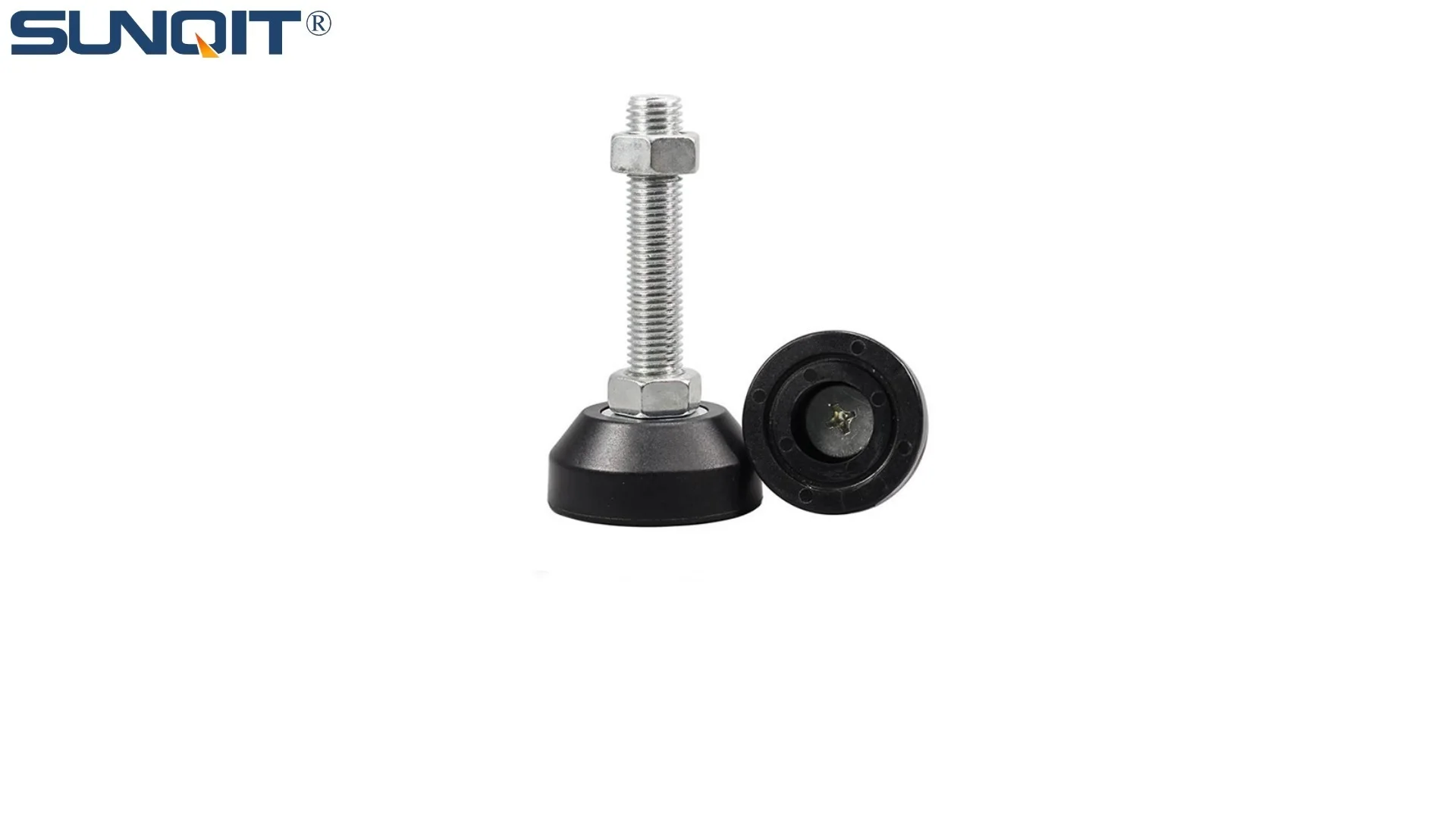
Walk into any modern warehouse, and you'll immediately sense the pulse of productivity: forklifts gliding down aisles, workers assembling components at workbenches, and products flowing seamlessly from storage racks to shipping zones. Behind this orchestrated efficiency lies a network of small but critical components—parts that often go unnoticed until something goes wrong. Among these unsung heroes are adjustable leveling feet, the quiet stabilizers that keep workbenches level, turnover trolleys steady, and material racks balanced. Today, we're shining a spotlight on one specific type that has become a staple in industrial settings: the M10*56 Rubber Leveling Foot. In this article, we'll explore its key features, why it stands out among other adjustable leveling feet, and how it enhances the reliability of warehouse storage systems.
The Role of Leveling Feet in Warehouse Operations
Before diving into the specifics of the M10*56 Rubber Leveling Foot, let's take a moment to appreciate why leveling feet matter in warehouses. Warehouses are dynamic environments, with floors that are rarely perfectly flat. Years of heavy traffic, uneven concrete pouring, or even minor shifts in the building's foundation can create small dips and bumps. These imperfections might seem trivial, but they can have a cascading effect on operations. A wobbly workbench, for example, can lead to misaligned assemblies, increased errors, and even safety hazards for workers. A leaning turnover trolley might tip, risking damage to products or injury to staff. Material racks that aren't level could cause items to slide off, leading to losses or disruptions in the supply chain.
This is where adjustable leveling feet come into play. Designed to compensate for uneven surfaces, these feet allow operators to fine-tune the height of equipment, ensuring stability and alignment. Among the various types available—from plastic to metal, short to long—the M10*56 Rubber Leveling Foot has earned a reputation for versatility, durability, and performance. Let's break down what makes it a top choice for warehouse managers and facility engineers.
Key Feature 1: Precision Adjustability for Uneven Floors
At the core of the M10*56 Rubber Leveling Foot's functionality is its exceptional adjustability. The "M10*56" designation refers to its specifications: an M10 metric thread (10mm in diameter) and a stem length of 56mm. This combination strikes a perfect balance between range and precision, allowing users to adjust the height of equipment by up to 56mm—more than enough to compensate for most floor irregularities in warehouses.
Imagine a scenario where a workbench is placed in a corner of the warehouse where the floor slopes slightly. Without adjustable feet, the workbench might rock back and forth, making it difficult for workers to assemble small parts or use precision tools. With the M10*56 Rubber Leveling Foot, however, the solution is simple: rotate the foot clockwise to extend the stem, raising that corner of the workbench, or counterclockwise to retract it, lowering the corner. The threaded stem screws into a mounting hole on the equipment's base, and the rubber foot at the bottom stays firmly in place as you adjust, ensuring no slippage during the process.
This level of precision is especially valuable for equipment like the "workbench E (single deck-without caster)," a common fixture in assembly lines. Without casters, this workbench relies entirely on its leveling feet for stability. The M10*56's adjustability ensures that even on the most uneven floors, the work surface remains flat, providing a reliable platform for tasks that demand accuracy.

Key Feature 2: Heavy-Duty Load Capacity for Industrial Use
Warehouse equipment isn't just about stability—it's about supporting weight. Workbenches hold tools, components, and sometimes heavy machinery. Turnover trolleys carry boxes of products, and material racks stack pallets or bulk items. A leveling foot that can't handle the load will bend, break, or sink into the floor, compromising safety and efficiency. The M10*56 Rubber Leveling Foot is built to withstand the demands of industrial environments, with a load capacity that typically ranges from 400kg to 600kg per foot (depending on the manufacturer and material quality).
What gives it this strength? The stem is usually made of high-grade steel, chosen for its rigidity and resistance to bending. Steel is an ideal material here because it can support heavy weights without deforming, even under constant pressure. The rubber foot, while softer than steel, is reinforced with a metal insert (often brass or steel) that connects to the stem, ensuring the load is distributed evenly across the foot's surface. This design prevents the rubber from tearing or compressing over time, even when supporting maximum weight.
Consider a "material rack B (3 row and 3 floor)," a multi-tiered storage unit used to hold small parts or tools. With three rows and three floors, this rack can carry hundreds of kilograms of materials. Each leg of the rack is fitted with an M10*56 Rubber Leveling Foot, which not only keeps the rack level but also bears the brunt of the weight. Without feet with this load capacity, the rack might sag in the middle or tip over, putting products and workers at risk.

Key Feature 3: Anti-Slip Rubber Base for Enhanced Safety
Stability isn't just about height adjustment and load capacity—it's also about grip. A leveling foot that slides on the floor is useless, no matter how well it adjusts or how much weight it can hold. This is where the "rubber" in M10*56 Rubber Leveling Foot becomes critical. The base is made of a high-friction rubber compound, specifically engineered to prevent slipping on smooth or slightly damp floors—common conditions in warehouses where spills, condensation, or dust can reduce traction.
Unlike metal feet, which can slide on concrete or tile, or plastic feet, which may harden and lose grip over time, rubber maintains its elasticity and friction even in harsh environments. The surface of the rubber foot is often textured with grooves or patterns, further enhancing its ability to "grip" the floor. This anti-slip design is why the M10*56 is often categorized as an "anti-slip adjustable leveling foot"—a feature that warehouse managers prioritize to reduce accidents.
Think about a turnover trolley and rack being pushed across a warehouse floor. If the trolley's feet slip, it could veer off course, collide with other equipment, or even tip over. With M10*56 Rubber Leveling Feet, the trolley stays on track, even when navigating slightly uneven surfaces or wet spots. The rubber feet act like mini suction cups, keeping the trolley stable and predictable—exactly what's needed in a fast-paced environment.

Key Feature 4: Durable Construction for Long-Term Reliability
Warehouses are tough on equipment. Dust, moisture, oils, and chemicals are part of daily life, and components that can't withstand these elements will need frequent replacement—costing time and money. The M10*56 Rubber Leveling Foot is built to last, with materials chosen for their resistance to wear and corrosion.
The steel stem is often coated with zinc or nickel, a process called galvanization, which creates a barrier against rust and corrosion. This is especially important in warehouses with high humidity or where liquids (like cleaning solutions or machine oil) might come into contact with the feet. The rubber base is made from industrial-grade synthetic rubber, which is resistant to oils, chemicals, and temperature fluctuations. Unlike natural rubber, which can degrade when exposed to oils, synthetic rubber maintains its integrity, ensuring the foot doesn't crack, harden, or soften over time.
Consider a warehouse that uses aluminum profiles to build custom workbenches or material racks. Aluminum is lightweight and strong, but it needs stable support to perform well. The M10*56 Rubber Leveling Foot, with its corrosion-resistant stem and chemical-resistant rubber, pairs perfectly with aluminum profiles. Even in environments where aluminum components might be exposed to moisture or cleaning agents, the leveling feet remain reliable, reducing the need for frequent maintenance.
Key Feature 5: Compatibility with Warehouse Equipment
A great leveling foot is only as good as its ability to work with existing equipment. The M10*56 Rubber Leveling Foot is designed to be compatible with a wide range of warehouse tools and systems, making it a versatile choice for facility managers. Its M10 thread is a standard size in industrial equipment, meaning it can be screwed into pre-drilled holes in workbenches, turnover trolleys, material racks, and even some types of conveyor systems.
Let's take a closer look at some common applications:
- Workbenches: As mentioned earlier, workbenches like "workbench E (single deck-without caster)" rely on leveling feet for stability. The M10*56 fits seamlessly into the bench's legs, allowing operators to adjust for floor unevenness and keep the work surface level.
- Turnover Trolleys: Turnover trolleys, used to transport goods between stations, often have four legs fitted with leveling feet. The M10*56's anti-slip base and adjustability ensure the trolley remains steady, even when loaded with heavy items.
- Material Racks: Racks like "material rack B (3 row and 3 floor)" use leveling feet to stay balanced, preventing items from sliding off. The M10*56's load capacity and durability make it ideal for this role.
- Aluminum Profile Structures: Many modern warehouses use aluminum profiles to build custom equipment, from shelving to workstations. The M10*56's stem can be easily attached to aluminum profile accessories, making it a go-to choice for these modular systems.
This compatibility reduces the need for custom parts or adapters, saving time and money during installation. Warehouse managers can stock a single type of leveling foot and use it across multiple pieces of equipment, simplifying inventory and maintenance.
Comparing M10*56 Rubber Leveling Feet to Other Options
To truly understand the value of the M10*56 Rubber Leveling Foot, it helps to compare it to other common leveling feet on the market. Below is a table highlighting how it stacks up against two alternatives: M8*40 Plastic Leveling Feet (a budget option) and M12*60 Metal-Only Leveling Feet (a heavy-duty but less safe choice).
| Feature | M10*56 Rubber Leveling Foot | M8*40 Plastic Leveling Foot | M12*60 Metal-Only Leveling Foot |
|---|---|---|---|
| Adjustment Range | 0–56mm (suitable for most floor unevenness) | 0–40mm (limited range for minor dips) | 0–60mm (wider range but less precise) |
| Load Capacity | 400–600kg per foot (ideal for workbenches, racks) | 100–200kg per foot (only for light-duty use) | 800–1000kg per foot (high capacity but overkill for most warehouse tools) |
| Anti-Slip Design | Yes (high-friction rubber base) | Yes (soft plastic, but loses grip over time) | No (smooth metal surface; prone to sliding) |
| Durability | High (zinc-plated steel stem, oil-resistant rubber) | Low (plastic stem cracks; base hardens) | High (stainless steel stem) but rubber-free |
| Compatibility | Wide (M10 thread fits workbenches, trolleys, aluminum profiles) | Limited (M8 thread fits only small, light equipment) | Limited (M12 thread requires larger mounting holes; not ideal for standard warehouse tools) |
As the table shows, the M10*56 Rubber Leveling Foot offers a balanced mix of adjustability, load capacity, safety, and compatibility that the other options lack. Plastic feet are cheap but unreliable for heavy use, while metal-only feet sacrifice safety for raw strength. For most warehouse applications, the M10*56 hits the sweet spot.
Real-World Applications: How M10*56 Feet Improve Daily Operations
To put these features into context, let's look at a few real-world examples of how M10*56 Rubber Leveling Feet enhance warehouse operations:
Case Study 1: Assembly Line Workbenches
A manufacturing plant produces small electronic components, with workers assembling circuit boards on "workbench E (single deck-without caster)" units. Initially, the plant used plastic leveling feet, but workers complained about wobbly surfaces and frequent adjustments. After switching to M10*56 Rubber Leveling Feet, the workbenches stayed level for longer periods, reducing errors in component placement. The anti-slip base also prevented the benches from shifting during use, making assembly faster and safer.
Case Study 2: Turnover Trolleys in a Distribution Center
A distribution center uses turnover trolleys to move packages from sorting stations to shipping docks. The trolleys often navigated uneven concrete floors, leading to spills and delays. By replacing the metal feet with M10*56 Rubber Leveling Feet, the center noticed a 30% reduction in trolley-related incidents. The rubber base provided better grip, and the adjustability ensured the trolleys stayed balanced, even when loaded with unevenly distributed packages.
Case Study 3: Material Racks in a Automotive Warehouse
An automotive parts warehouse uses "material rack B (3 row and 3 floor)" to store small engine components. The racks were frequently unbalanced due to uneven floors, causing parts to fall off. After installing M10*56 Rubber Leveling Feet, the racks remained stable, and the warehouse saw a 50% decrease in lost or damaged parts. The load capacity of the feet also allowed the racks to be stacked more densely, increasing storage space by 15%.
Conclusion: Why M10*56 Rubber Leveling Feet Are a Warehouse Essential
In the grand scheme of warehouse operations, leveling feet might seem like minor components. But as we've explored, they play a critical role in ensuring stability, safety, and efficiency. The M10*56 Rubber Leveling Foot stands out in this category, thanks to its precision adjustability, heavy-duty load capacity, anti-slip rubber base, durable construction, and compatibility with common warehouse equipment like workbenches, turnover trolleys, and material racks.
Whether you're setting up a new assembly line, upgrading existing equipment, or simply looking to reduce maintenance costs, investing in high-quality adjustable leveling feet like the M10*56 is a smart choice. It's a small part that delivers big results—keeping your warehouse running smoothly, your workers safe, and your bottom line healthy.
So the next time you walk through a warehouse, take a moment to look down. Chances are, the stability you see in every workbench, trolley, and rack is thanks to feet like the M10*56 Rubber Leveling Foot—proof that even the smallest components can make the biggest difference.