- Company Articles
- Products and Technology
- Product knowledge
- Lean Manufacturing: Reusable Design of 3030 National Standard Profile A Systems

Lean Manufacturing: Reusable Design of 3030 National Standard Profile A Systems
Related Product
3030 National Standard Profile A
Workbench, production line, logistic rack, warehouse rack Industry: Manufacturer workshop, Automobile, Electronic, Assembling, logistic
In the world of manufacturing, where every second and every resource counts, the difference between success and stagnation often lies in how well you can adapt. Lean manufacturing has long been the gold standard for cutting waste and boosting efficiency, but even the most carefully crafted lean strategies can hit a wall when the tools supporting them are rigid, outdated, or impossible to repurpose. That's where reusable design steps in—and few solutions embody this idea as effectively as the 3030 National Standard Profile A systems. These aluminum profile systems aren't just about building structures; they're about building a manufacturing environment that bends without breaking, evolves with your needs, and eliminates the waste of constant overhauls. Let's dive into how these unassuming aluminum beams are revolutionizing lean manufacturing floors around the globe.
The Core of Lean: Why Reusability Matters
Lean manufacturing isn't just a set of rules—it's a mindset. At its core is the relentless pursuit of eliminating waste (muda) in all forms: excess inventory, unnecessary movement, defects, waiting, overproduction, overprocessing, and unused talent. But here's the catch: even the most optimized processes can falter if the physical systems holding them together are fixed in place. Imagine designing a perfect assembly line, only to realize six months later that a new product requires a wider workspace. If your workbenches are welded steel or your racks are bolted to the floor, you're stuck: either spend weeks (and thousands) modifying them or scrap them entirely and start over. Both options mean waste—of time, money, and materials—and that's the opposite of lean.
Reusable design flips this script. It's about creating systems that can be reconfigured, repurposed, or reassembled with minimal effort. When your tools and structures are reusable, change becomes an opportunity, not a crisis. Need to shift a production line overnight for a rush order? Disassemble a few components, rearrange, and rebuild. Want to test a new workflow layout? Do it without permanently altering your facility. This flexibility doesn't just save money—it keeps your lean initiatives alive, ensuring your operations stay agile in a market that never stops changing.
3030 National Standard Profile A: The Building Block of Reusable Lean Systems
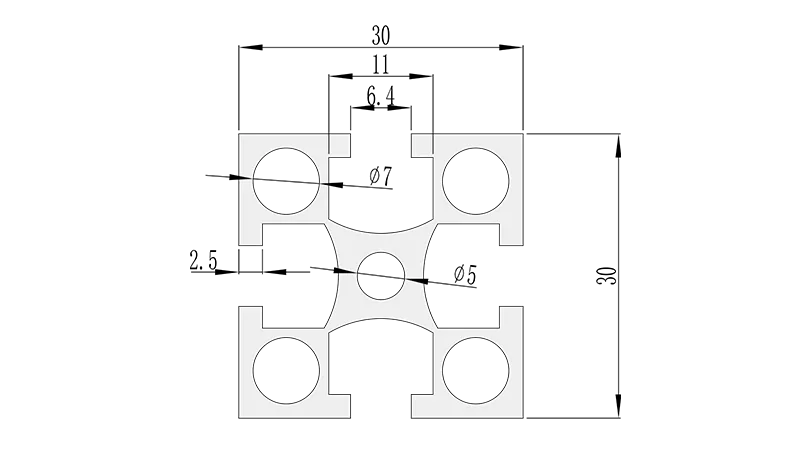
Enter the 3030 National Standard Profile A. If reusable design is the philosophy, this aluminum profile is the practical tool that brings it to life. Let's start with the basics: what is a 3030 National Standard Profile A? It's an extruded aluminum beam with a square cross-section (30mm x 30mm, hence "3030") and T-shaped slots running along all four sides. These slots aren't just decorative—they're the secret to its modularity. By sliding bolts, nuts, or specialized accessories into these slots, you can attach shelves, panels, wheels, tool holders, and just about anything else you need—no welding, no drilling, no permanent modifications.
But why aluminum? For starters, aluminum is lightweight yet strong . A 3030 profile can support heavy loads (think workbenches with machinery) without weighing so much that moving or reconfiguring it requires a forklift. It's also corrosion-resistant, which means it holds up in factory environments where moisture, oils, or chemicals might be present. And unlike steel, it doesn't rust, so your systems stay functional (and good-looking) for years. Plus, aluminum is recyclable, aligning with the sustainability goals that many modern lean programs prioritize.
The "National Standard" part is crucial, too. It means these profiles are made to consistent dimensions and tolerances across manufacturers. That means you're not locked into one supplier—you can mix and match components from different vendors, ensuring you always get the best price and availability. And "Profile A" typically refers to a specific groove design (the shape of the T-slot) and wall thickness, making it compatible with a wide range of aluminum profile accessories—connectors, end caps, rubber strips, and more. This standardization is key to its reusability: your components will always fit, no matter when or where you buy them.
Why 3030 Profiles Beat Traditional Materials
To truly appreciate 3030 National Standard Profile A, let's compare it to common alternatives:
| Feature | 3030 National Standard Profile A | Traditional Steel (Welded/Bolted) | Wooden Structures |
|---|---|---|---|
| Reusability | High: Disassemble and reassemble infinitely with no damage | Low: Modifications require cutting/welding; often irreparable after changes | Very Low: Nails/screws weaken wood; disassembly often breaks components |
| Weight | Lightweight (easy to move by hand) | Heavy (requires machinery for repositioning) | Moderate, but prone to warping/rotting over time |
| Durability | High: Resists corrosion, dents, and wear; lasts decades | High, but prone to rust without coating; heavy weight causes floor strain | Low: Susceptible to moisture, pests, and impact damage |
| Customization | Unlimited: T-slots allow easy attachment of accessories; adjust on the fly | Limited: Requires custom fabrication for changes | Basic: Limited to cutting/drilling; no modular accessories |
| Cost (Long-Term) | Lower: Reusability eliminates replacement costs; modularity reduces overbuying | Higher: Frequent replacements/modifications add up | High: Short lifespan means constant repurchasing |
The verdict? 3030 profiles aren't just better for lean—they're better for your bottom line, your team's productivity, and your ability to adapt. But don't just take our word for it—let's look at how they're actually used on the factory floor.
Practical Applications: 3030 Profiles in Action
3030 National Standard Profile A isn't a one-trick pony. It's the Swiss Army knife of manufacturing systems, capable of building just about anything your lean operation needs. Here are a few of the most common (and impactful) applications:
Workbenches: Where Precision Meets Flexibility
Workbenches are the backbone of any production line. A well-designed workbench minimizes motion, keeps tools within reach, and adapts to the task at hand. With 3030 profiles, you can build workbenches that do all that and more. Need a bench for electronics assembly with ESD protection? Attach an anti-static top via T-slot brackets. Want to add tool hooks, bin holders, or a monitor arm? Slide them into the T-slots and tighten—no drilling. And when your needs change? Adjust the height by swapping out leg profiles, add a shelf for extra storage, or even split the bench into two smaller ones for a new layout. Traditional workbenches force you to work around their limitations; 3030 profile workbenches adapt to your workflow.
Material Racks and Flow Systems: Keeping Parts Moving
In lean manufacturing, material flow is everything. Parts should move smoothly from storage to assembly to shipping, with minimal handling. 3030 National Standard Profile A excels here, too. Build gravity-fed flow racks by adding roller tracks (via T-slot connectors) to profile frames—parts glide right to the operator, eliminating the need to bend or reach. Need a rack for bulky items? Reinforce the profiles with cross-braces. Want to make it mobile? Attach casters (again, via T-slots) for easy movement. And when product sizes change? Adjust the shelf heights in minutes, not days. No more wasting space on racks that are too tall, too short, or too narrow—your storage systems grow with your inventory.
Turnover Trolleys: From Station to Station, Seamlessly
Turnover trolleys (or "material carts") are the unsung heroes of lean facilities, shuttling parts between stations. But traditional steel trolleys are heavy, hard to maneuver, and often too big (or too small) for the job. 3030 profile trolleys solve this. Build a lightweight frame with aluminum profiles, add a plywood or metal top, and attach swivel casters for easy movement. Need to carry fragile components? Line the shelves with foam padding held in place by T-slot clips. Want to customize the size for a specific part? Cut the profiles to length (with a simple hacksaw or miter saw) and reassemble. These trolleys are so easy to build and modify that many facilities keep extra profiles and accessories on hand—no more waiting for custom carts to be delivered.
Ergonomic Solutions: Putting People First
Lean isn't just about efficiency—it's about respecting your team. Fatigue, discomfort, and injury lead to wasted time and unhappy employees. 3030 profiles make ergonomic adjustments simple. Raise a workbench by 2 inches to reduce back strain? Swap the 600mm leg profiles for 650mm ones. Tilt a monitor to eye level? Attach an adjustable arm via T-slots. Add a footrest under a standing desk? Build one in an hour with scrap profiles. Because these changes are quick and reversible, you can experiment to find what works best for your team—no permanent commitments, no expensive consultants. When your operators are comfortable, they're more productive, more engaged, and less likely to miss work—all of which feeds into your lean goals.
The Role of Aluminum Profile Accessories: Making It All Work
3030 National Standard Profile A is powerful on its own, but it's the accessories that unlock its full potential. Aluminum profile accessories are the "glue" that holds your lean system together, allowing you to connect profiles, attach components, and customize your setup. Let's break down the essentials:
- Connectors: These join profiles at angles (90°, 45°, 135°) or in straight lines. From simple corner brackets to multi-way joints, they let you build frames, shelves, and structures of any shape.
- End Caps: These snap onto the ends of profiles, covering sharp edges and giving a clean, finished look—important for safety and aesthetics.
- T-Slot Nuts and Bolts: The foundation of modularity. Slide a T-slot nut into a profile's groove, align your accessory (like a shelf bracket), and tighten the bolt—secure and removable.
- Rubber Strips: insert into T-slots to reduce noise (when parts slide against the profile) or to seal out dust and debris.
- Roller Tracks: Attach to profiles to create gravity flow systems for racks or conveyor sections, ensuring smooth material movement.
The best part? These accessories are standardized, so you can mix and match from different suppliers. Need a specific connector for a custom angle? Chances are, there's an aluminum profile accessory for that. This variety means your 3030 system is never limited—you can always add new features as your needs evolve.
Sustainability: Lean and Green, Hand in Hand
Today's lean manufacturing isn't just about efficiency—it's about sustainability. Reducing waste and minimizing environmental impact are no longer optional; they're business imperatives. 3030 National Standard Profile A aligns perfectly with this. Aluminum is 100% recyclable, and because the profiles are reusable, you'll generate far less waste than with disposable wooden or steel structures. Even when a profile finally reaches the end of its life (decades down the line), it can be melted down and repurposed into new aluminum products. Plus, the lightweight nature of aluminum reduces transportation costs and energy use—shipping a truckload of 3030 profiles uses less fuel than shipping the same weight in steel. In short, reusable aluminum systems help you cut both waste and your carbon footprint—lean and green, working together.
Real-World Impact: A Case Study
Let's put this into perspective with a real example. A mid-sized electronics manufacturer we worked with was struggling with frequent product changes. Their old setup relied on fixed steel workbenches and custom wooden racks. Every time they launched a new device (which happened 4–5 times a year), they had to hire contractors to cut, weld, and modify their workstations—a process that took 2–3 weeks and cost $15,000–$20,000 per change. Worse, the downtime during these overhauls meant missed deadlines and rushed production, leading to more defects.
They switched to 3030 National Standard Profile A systems. The first step was building modular workbenches with adjustable heights, tool holders, and ESD tops. They added mobile flow racks on casters for material storage and turnover trolleys customized to each product size. The result? Their next product launch took 2 days instead of 3 weeks—they disassembled the old workbenches, reconfigured the profiles, and reassembled them with new accessories. Costs dropped to under $2,000 (mostly for new tops and a few extra profiles). Defects fell by 30% because operators weren't rushing, and employee satisfaction rose—team members loved that their workspaces adapted to their needs. Within a year, the initial investment in profiles and accessories was fully recouped, and they've since expanded the system to other departments.
Getting Started: Building Your First 3030 Profile System
Ready to bring 3030 National Standard Profile A into your lean system? Start small. Pick one pain point—a workbench that's too rigid, a rack that's always the wrong size—and build a simple solution. Most suppliers offer starter kits with profiles, connectors, bolts, and a basic instruction guide. Measure twice, cut once (though aluminum profiles are easy to trim to length), and don't be afraid to experiment. The beauty of these systems is that mistakes are reversible—if a design doesn't work, take it apart and try again.
As you get comfortable, scale up. replace one fixed structure at a time, and involve your team in the process—operators often have the best ideas for improving workspaces. And remember: reusable design is a journey, not a destination. Your 3030 systems will evolve as your lean initiatives do, growing more efficient, more flexible, and more aligned with your goals over time.
Conclusion: Lean Manufacturing for the Future
In a world where change is the only constant, reusable design isn't a luxury—it's a necessity. 3030 National Standard Profile A isn't just a material or a tool; it's a catalyst for lean transformation. It turns "we can't" into "we can," "it's too expensive" into "it pays for itself," and "we'll have to wait" into "let's do it today." By building your manufacturing systems around reusable aluminum profiles, you're not just investing in structures—you're investing in agility, sustainability, and the ability to thrive in an ever-shifting market.
So, what's next? Take a walk around your facility. Look for the fixed structures, the "this is how we've always done it" workspaces, the areas where change feels impossible. Imagine replacing them with systems that adapt, grow, and reuse. That's the power of 3030 National Standard Profile A. That's lean manufacturing—reimagined, reusable, and ready for whatever comes next.