- Company Articles
- Products and Technology
- Technology Sharing
- Lean Manufacturing with Free Flow Chain Conveyors: Waste Reduction Strategies

Lean Manufacturing with Free Flow Chain Conveyors: Waste Reduction Strategies
Related Product
Free Flow Chain Conveyor
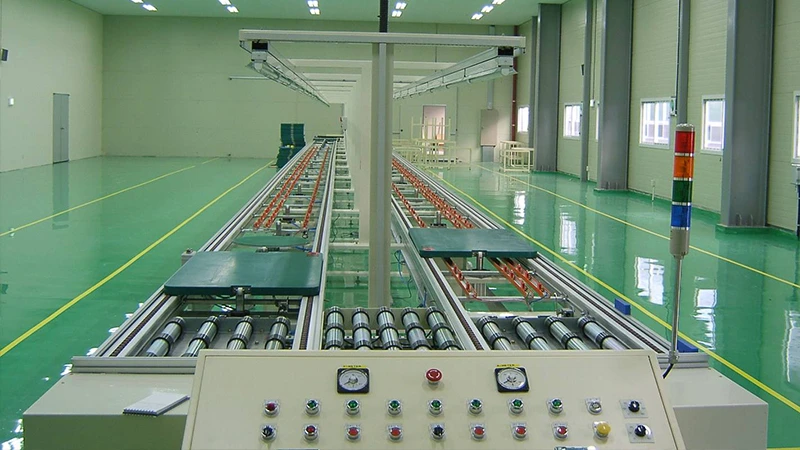
The free flow conveyor system uses a free flow chain that can increase the speed of the tooling board that supports the products. This can improve the efficiency and quality of the production process, as well as reduce the wear and tear of the system.
Introduction: The Heartbeat of Lean Manufacturing
Walk into any thriving manufacturing facility today, and you'll notice something different from the chaotic factories of the past. The floors are organized, tools are within arm's reach, and there's a rhythm to the workflow—parts move seamlessly from one station to the next, bottlenecks are rare, and workers seem focused, not frantic. This isn't magic; it's lean manufacturing in action. At its core, lean is about one thing: eliminating waste. Every unnecessary step, every idle minute, every excess part sitting on a shelf—these are drains on productivity, profits, and employee morale. And in the quest to root out waste, few tools are as transformative as the free flow chain conveyor.
But lean manufacturing isn't just a buzzword. It's a philosophy born from the Toyota Production System (TPS), where the goal is to create value for customers while minimizing everything else. Over the decades, it has evolved into a global standard, adopted by industries from automotive to electronics, food processing to pharmaceuticals. The challenge? Many manufacturers still struggle with the "how." They know waste is bad, but identifying it—and fixing it—requires the right strategies and tools. That's where material handling systems, particularly free flow chain conveyors, come into play. These unassuming systems are the unsung heroes of lean, quietly streamlining workflows, reducing manual labor, and ensuring that parts and products move exactly when and where they're needed.
In this article, we'll dive deep into how free flow chain conveyors fit into the lean manufacturing puzzle. We'll explore the types of waste they target, how they integrate with other lean systems like flow racks and workbenches, and real-world examples of businesses that have turned inefficiency into opportunity. Whether you're a plant manager looking to boost productivity or a lean enthusiast eager to learn more, this guide will show you why free flow chain conveyors are more than just equipment—they're a cornerstone of waste reduction.
The 8 Wastes: Why Lean Can't Succeed Without Addressing Material Flow
To understand why free flow chain conveyors are so critical to lean, we first need to identify the enemy: waste. The original TPS outlined seven wastes, often remembered by the acronym TIMWOOD (Transportation, Inventory, Motion, Waiting, Overproduction, Overprocessing, Defects). In recent years, an eighth waste has been added: Unused Talent—failing to leverage the skills and ideas of your team. While all eight are harmful, three of them—Transportation, Motion, and Waiting—are directly tied to how materials move through your facility. Let's break them down:
Transportation: When Movement Becomes a Burden
Transportation waste refers to moving materials, parts, or products more than necessary. Think about a worker pushing a heavy cart of components across the factory floor, only to have to push it back later because the next station isn't ready. Or parts being shuttled between warehouses, assembly lines, and quality control—each trip adding time and risk of damage. In some facilities, up to 30% of labor hours are spent on transportation alone. That's time that could be spent building, testing, or innovating.
Motion: The Hidden Cost of Reaching, Bending, and Searching
Motion waste is about the unnecessary movement of people, not just materials. A worker who has to walk 10 feet to grab a tool, then 15 feet to retrieve a part, then back to their station is wasting energy and time. A workbench cluttered with unused equipment forces employees to sift through items to find what they need. Even small movements add up: bending to lift a box, stretching to reach a shelf, or twisting to pass a part to a coworker. Over a shift, these motions lead to fatigue, errors, and even injuries—all of which chip away at productivity.
Waiting: The Silent Productivity Killer
Waiting waste happens when work stops because something is missing. A machine sits idle because the next batch of materials hasn't arrived. A team waits for a supervisor to approve a task. Parts pile up at a bottleneck station while the next station has nothing to do. Waiting is insidious because it's often invisible—until you track it. Studies show that in non-lean facilities, workers can spend up to 25% of their day waiting for materials, information, or equipment. That's a quarter of your workforce's time going to waste, and it's often linked to poor material flow.
The common thread here? All three wastes—Transportation, Motion, and Waiting—stem from inefficient material handling. When parts don't flow smoothly, everything breaks down. That's where free flow chain conveyors step in. By automating and optimizing the movement of materials, they attack these wastes at their source, turning chaos into order and inefficiency into opportunity.
Free Flow Chain Conveyors: How They Work and Why They Matter
At first glance, a free flow chain conveyor might look like any other conveyor system: a series of rollers or chains mounted on a frame, moving products from Point A to Point B. But looks can be deceiving. What sets free flow chain conveyors apart is their ability to enable "free flow" of materials—meaning items move continuously, without manual intervention, and often with precision control over speed and direction. This makes them ideal for lean environments where just-in-time (JIT) delivery and smooth workflow are priorities.
Anatomy of a Free Flow Chain Conveyor
Free flow chain conveyors typically consist of a few key components: a chain (usually made of metal or high-strength plastic), sprockets that drive the chain, a track or frame to support the chain, and sometimes guides to keep products aligned. Unlike gravity conveyors, which rely on inclines to move items, or roller conveyors, which use unpowered rollers, free flow chain conveyors are often motorized, allowing for consistent speed and control. Some are designed to operate on a flat surface, while others can handle inclines or declines, making them versatile for different facility layouts.
One of the biggest advantages of free flow chain conveyors is their adaptability. They can be customized to fit almost any space—curving around obstacles, integrating with existing equipment, or scaling up as production needs grow. They're also compatible with a wide range of product sizes and weights, from small electronic components to heavy automotive parts. And because they're designed for continuous movement, they eliminate the stop-and-start of manual handling, keeping production lines flowing like water.
Free Flow vs. Traditional Conveyors: A Critical Difference
To appreciate why free flow chain conveyors are a lean game-changer, let's compare them to two common alternatives: roller conveyors and manual carts. Roller conveyors are great for moving heavy items, but they often require workers to push products along, leading to motion waste. They also struggle with small or irregularly shaped parts, which can get stuck between rollers. Manual carts, on the other hand, are flexible but labor-intensive—each trip requires a worker, contributing to transportation waste and increasing the risk of delays.
Free flow chain conveyors solve these issues by automating the movement process. Once a product is placed on the conveyor, it moves steadily to its destination without human help. This reduces the need for workers to transport materials, freeing them up for higher-value tasks like assembly or quality control. It also ensures that parts arrive at the right station at the right time, minimizing waiting waste. And because the conveyor can be synchronized with production schedules, it prevents overproduction—another key lean waste—by only moving parts as they're needed.
| Feature | Manual Carts | Roller Conveyors | Free Flow Chain Conveyors |
|---|---|---|---|
| Labor Requirement | High (1 worker per cart) | Medium (pushing required) | Low (automated movement) |
| Waste Reduction Focus | None (increases transportation waste) | Motion waste (pushing) | Transportation, Motion, Waiting |
| Speed Control | Variable (depends on worker) | Limited (gravity or manual speed) | Precise (motorized, adjustable) |
| Product Compatibility | Broad (but limited by cart size) | Best for flat, stable items | Broad (handles small to large items) |
| Integration with Lean Systems | Low (hard to sync with JIT) | Medium (can pair with flow racks) | High (syncs with workbenches, flow racks, ERP systems) |
As the table shows, free flow chain conveyors outperform traditional methods in almost every category that matters for lean. They're not just a tool for moving things—they're a strategic asset for reducing waste and building a more efficient operation.
Targeting Waste: How Free Flow Chain Conveyors Transform Workflows
Now that we understand what free flow chain conveyors are, let's get practical: How exactly do they eliminate the three wastes we discussed—Transportation, Motion, and Waiting? Let's walk through real-world scenarios and see these conveyors in action.
Eliminating Transportation Waste: From Carts to Conveyors
Consider a mid-sized electronics manufacturer that produces circuit boards. Before implementing free flow chain conveyors, their process looked like this: Parts were delivered to a central warehouse, then loaded onto carts by material handlers. These handlers pushed the carts to each assembly station, where workers unloaded the parts. At the end of the shift, empty carts were pushed back to the warehouse. The problem? Each cart trip took 20 minutes round-trip, and with 10 stations, material handlers were spending 200 minutes (over 3 hours) a day just moving parts. That's transportation waste in its purest form.
After installing a free flow chain conveyor system, the process changed dramatically. Parts now arrive at the warehouse, are placed directly on the conveyor, and travel automatically to each station. Sensors at each workstation trigger the conveyor to stop when parts are needed, then resume once the bin is empty. Material handlers now spend their time restocking the conveyor and assisting with assembly, not pushing carts. The result? Transportation waste was cut by 75%, and the facility saved over 1,200 labor hours per month.
Reducing Motion Waste: Workbenches That Come to You
Motion waste often hides in the details of a workstation. Take a typical assembly line worker: their workbench is cluttered with tools, and parts are stored on a shelf 8 feet away. To build a product, they reach for a screwdriver (motion), walk to the shelf for a part (motion), walk back (motion), assemble (value-added work), then repeat. Over an 8-hour shift, this worker might walk 2-3 miles just to retrieve parts. That's motion waste, and it's exhausting.
Free flow chain conveyors solve this by bringing the parts to the worker, not the other way around. By integrating the conveyor directly with the workbench, parts are delivered right to the edge of the workstation. Workers no longer need to walk, stretch, or bend—everything they need is within arm's reach. In one case study, a medical device manufacturer paired free flow chain conveyors with adjustable-height workbenches, reducing motion waste by 60%. Workers reported less fatigue, and assembly errors dropped by 15% because they could focus on the task, not the movement.
Minimizing Waiting Waste: Just-In-Time Delivery in Action
Waiting waste thrives on unpredictability. If a station runs out of parts, the line stops. If parts arrive too early, they pile up, creating inventory waste. Free flow chain conveyors fix this by enabling true just-in-time (JIT) delivery. Using sensors and programmable logic controllers (PLCs), the conveyor can be synced with production schedules to deliver parts exactly when they're needed—no earlier, no later.
For example, a automotive parts supplier implemented a free flow chain conveyor system with barcode scanners at each station. When a worker finishes assembling a component, they scan a barcode, which triggers the conveyor to send the next part. If a station is running ahead, the conveyor slows down; if it's falling behind, it speeds up. This "pull" system ensures that no one is waiting for parts, and no parts are waiting for workers. In the first six months, waiting time between stations dropped by 40%, and inventory levels were reduced by 25% because there was no excess stock sitting on the floor.
Integration with Other Lean Systems: Flow Racks, Workbenches, and Beyond
Free flow chain conveyors are powerful on their own, but their true potential shines when they're part of a larger lean ecosystem. In the same way that a single instrument can't create a symphony, a single conveyor can't transform a factory. To fully eliminate waste, conveyors need to work in harmony with other lean tools—flow racks, workbenches, and even digital systems. Let's explore how these integrations create a seamless, waste-free workflow.
Flow Racks: The Perfect Partner for Conveyor Systems
Flow racks are another staple of lean material handling. These tilted racks use gravity to slide parts forward as they're used, ensuring that the oldest parts (first in) are used first (first out), reducing inventory waste. But flow racks alone still require workers to unload parts from the rack and onto a cart or conveyor. When paired with a free flow chain conveyor, this step is eliminated.
Imagine a flow rack filled with plastic components at the start of an assembly line. As the conveyor moves empty bins toward the rack, workers load the bins with components, which then flow down the rack and onto the conveyor. The conveyor carries the bins to each workstation, where parts are used, and the empty bins continue to the end of the line, ready to be refilled. This closed-loop system—flow rack to conveyor to workstation to conveyor to flow rack—eliminates manual loading, reduces transportation waste, and ensures a steady supply of parts. One automotive supplier reported a 50% reduction in restocking time after integrating flow racks with their free flow chain conveyor system.
Workbenches: The Hub of Value-Added Work
Workbenches are where the magic happens—where raw materials become finished products. But a workbench is only as good as the materials and tools around it. A cluttered, disorganized workbench leads to motion waste; a bench with no nearby parts leads to waiting waste. Free flow chain conveyors turn workbenches into efficient hubs by delivering parts directly to the point of assembly.
Modern lean workbenches are often designed with cutouts or extensions that connect directly to the conveyor. Parts arrive on the conveyor, slide onto the bench, and are assembled. Once complete, the finished product is placed back on the conveyor to move to the next station. Some workbenches even include built-in tool storage and ergonomic features, further reducing motion waste. For example, a furniture manufacturer used this setup to assemble chairs: the conveyor delivered legs, seats, and backrests to each bench, and workers assembled the chairs without ever leaving their stations. Productivity increased by 25%, and worker satisfaction scores rose because the job felt less physically demanding.
Roller Conveyors: Complementary, Not Competitive
You might be wondering: If free flow chain conveyors are so effective, why use roller conveyors at all? The answer is that they serve different purposes. Roller conveyors are ideal for moving heavy, flat items over short distances, like pallets or large boxes. Free flow chain conveyors excel at moving smaller, lighter items over longer distances with precision. Together, they create a comprehensive material handling network.
For instance, a distribution center might use roller conveyors to move pallets from the warehouse to a sorting area, then transfer the boxes onto free flow chain conveyors for delivery to individual packing stations. The roller conveyors handle the heavy lifting, while the free flow chain conveyors ensure precise, gentle movement of smaller items. This hybrid approach reduces waste across the entire supply chain, from receiving to shipping.
Real-World Success Stories: Lean Manufacturing in Action
Numbers and theories are powerful, but nothing illustrates the impact of free flow chain conveyors like real-world results. Let's look at two case studies of companies that embraced these systems and transformed their operations—one a small electronics manufacturer, the other a large automotive parts supplier. Both faced common lean challenges, and both found solutions in free flow chain conveyors.
Case Study 1: Small Electronics Manufacturer Cuts Waste by 40%
A family-owned electronics company with 50 employees was struggling with growth. As orders increased, their manual material handling system couldn't keep up. Workers were spending 3 hours a day moving parts between stations, and waiting waste was rampant—stations often ran out of components, leading to 2-3 hours of downtime per week. The company's lean consultant recommended a free flow chain conveyor system paired with flow racks and ergonomic workbenches.
The installation took two weeks, and the results were immediate. Parts now moved automatically from the warehouse to each workstation, eliminating the need for dedicated material handlers. Workers reported a 70% reduction in walking, and waiting time dropped to less than 30 minutes per week. Within six months, the company had increased production by 35% without hiring additional staff, and customer lead times shortened from 10 days to 5. The ROI on the conveyor system? Just 8 months.
Case Study 2: Automotive Supplier Eliminates 20,000 Labor Hours Annually
A large automotive parts supplier with 500 employees was drowning in transportation waste. Their facility spanned 100,000 square feet, and material handlers were using forklifts and carts to move parts between 20 assembly stations. The process was slow, error-prone, and costly—forklift maintenance alone was $50,000 per year. The company invested in a free flow chain conveyor system with integrated sensors and PLC controls to automate material flow.
The new system connected all 20 stations, with separate conveyor lines for different part types. Sensors at each station tracked inventory levels, triggering automatic restocking from the warehouse. Forklift use dropped by 90%, and material handlers were retrained as assembly workers, increasing production capacity. The company estimates that the system eliminated over 20,000 labor hours of transportation waste annually, saving $300,000 in labor costs. Plus, the reduction in manual handling reduced part damage by 40%, cutting scrap costs by $75,000 per year.
Choosing the Right Free Flow Chain Conveyor: Key Considerations
Investing in a free flow chain conveyor is a big decision, and it's not one-size-fits-all. To maximize waste reduction and ROI, you need to choose a system that fits your facility, products, and goals. Here are the key factors to consider:
Product Characteristics: Size, Weight, and Fragility
The first step is to understand your products. Are you moving small electronic components (light, fragile) or heavy engine parts (large, durable)? Free flow chain conveyors come in different load capacities—some handle up to 50 pounds per linear foot, others up to 500 pounds. Fragile items may require soft-chain options or padded tracks to prevent damage, while heavy items need reinforced frames and robust motors.
Facility Layout: Space, Inclines, and Obstacles
Take a close look at your factory floor. Is there space for a straight conveyor, or do you need curves to navigate around machines? Do you need to move parts up or down between floors (requiring incline/decline capabilities)? A good conveyor supplier will conduct a site survey to design a system that fits your space, even in tight or irregular layouts.
Speed and Throughput: Matching Production Demands
How many parts do you need to move per hour? A slow-moving conveyor might work for low-volume production, but high-volume facilities need faster speeds. Look for conveyors with adjustable speed controls, so you can scale up or down as demand changes. Also, consider peak times—will the conveyor handle your busiest shifts without bottlenecks?
Integration Capabilities: Sensors, PLCs, and ERP Systems
For true lean integration, your conveyor should work with digital tools. Sensors can track part flow and trigger alerts when inventory is low. PLCs allow for programmable logic, so the conveyor syncs with production schedules. Some systems even integrate with ERP (Enterprise Resource Planning) software, giving you real-time data on material flow and waste reduction. These features turn the conveyor from a passive tool into an active part of your lean management system.
Conclusion: The Future of Lean Manufacturing is Flowing Freely
Lean manufacturing isn't a destination—it's a journey of continuous improvement. And in that journey, the tools you choose matter. Free flow chain conveyors are more than just a way to move parts—they're a catalyst for change. They attack waste at its roots, empower workers to focus on value-added tasks, and create a foundation for a more efficient, profitable, and sustainable operation.
From reducing transportation waste by automating material flow to minimizing motion waste by bringing parts to the worker, these systems deliver tangible results. When paired with flow racks, workbenches, and digital tools, they become part of a lean ecosystem that transforms chaos into order, waste into value, and frustration into pride.
So, whether you're just starting your lean journey or looking to take your existing system to the next level, consider the free flow chain conveyor. It's not just equipment—it's a commitment to respecting your workers' time, your customers' needs, and your company's potential. In the end, lean manufacturing is about creating more with less, and with free flow chain conveyors, that "more" is within reach.