- Company Articles
- Products and Technology
- Product knowledge
- Lean Pipe Clamp B Chrome vs. Galvanized Clamps: Which is Better for Outdoor Use?

Lean Pipe Clamp B Chrome vs. Galvanized Clamps: Which is Better for Outdoor Use?
Related Product
Lean Pipe Clamp B Chrome
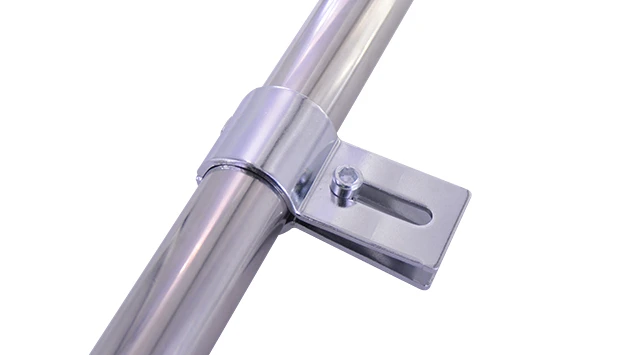
Lean pipe clamp is used for turnover trolley, workbench, flowrack adjust the frame or fix some accessory.
Introduction: The Hidden Challenge of Outdoor Lean Pipe Systems
Walk through any outdoor worksite—whether it's a construction yard, a warehouse loading dock, or a farm storage facility—and you'll likely spot modular structures built with lean pipes: workbenches holding tools, flow racks organizing materials, or turnover trolleys shuttling goods. These setups rely on a simple yet genius idea: lightweight pipes connected by clamps (or lean pipe joint components) to create flexible, customizable systems. But here's the catch: when these structures live outdoors, they're not just holding up pipes—they're battling the elements.
Rain, humidity, UV rays, and even temperature swings can turn a sturdy indoor lean system into a corroded, wobbly mess in no time. And while the pipes themselves get a lot of attention (aluminum? stainless steel? galvanized steel?), it's the clamps—the unsung heroes that hold everything together—that often make or break outdoor durability. Today, we're zeroing in on two popular options: the sleek lean pipe clamp B chrome and the tried-and-true galvanized clamp. Which one actually stands up to the chaos of outdoor use? Let's dive in.
First Things First: What Even Are Lean Pipe Clamps, and Why Do They Matter Outdoors?
Before we compare, let's get clear on what we're talking about. Lean pipe systems (sometimes called "kitchen pipe systems" for their early use in food factories) are all about modularity. You take pipes—usually steel, aluminum, or stainless steel pipe series options—and connect them with clamps to build almost anything: a workbench one day, a material rack the next. The clamps (or joints) are the linchpin here. They're the pieces that let you twist, turn, and lock pipes into place, giving the system its "lean" flexibility.
Indoors, this is straightforward. The environment is controlled: no rain, minimal humidity, and little direct sunlight. But outdoors? It's a different story. Imagine a lean pipe flow rack sitting in a warehouse yard in Florida—soaked by afternoon thunderstorms, baked by 90°F sun, and coated in salt air if it's near the coast. Or a turnover trolley in a Minnesota farm, frozen solid in winter and drenched in spring thaw. In these spots, clamps don't just need to be strong—they need to resist rust, UV damage, and the slow-but-sure breakdown caused by Mother Nature.
So, when we ask "which is better for outdoor use," we're really asking: Which clamp can keep your lean system tight, safe, and functional when the weather tries to tear it apart? Let's start by understanding each contender.
Meet the Contenders: Lean Pipe Clamp B Chrome
First up: the lean pipe clamp B chrome . If you've seen a shiny, silver-colored clamp on a lean system, chances are it's chrome-plated. These clamps are popular for a reason: they look sharp, feel sturdy, and are marketed as "corrosion-resistant." But what's actually in that shiny finish?
Most lean pipe clamp B chrome starts as a base of low-carbon steel. Steel is strong and cheap, but left unprotected, it rusts faster than a nail in a rain barrel. So manufacturers add a layer of chrome plating to save the day. The process goes like this: first, the steel clamp is cleaned to remove dirt and oil. Then, it's dipped in a series of chemicals to etch the surface (this helps the chrome stick). Finally, it's placed in a chrome plating bath, where an electric current deposits a thin layer of chromium onto the steel. The result? A mirror-like finish that's hard, smooth, and (in theory) protective.
But here's the thing about chrome plating: it's a thin layer—usually just 0.0005 to 0.002 inches thick. Think of it like a suit of armor for the steel. If the armor stays intact, the steel underneath stays safe. But if the armor gets scratched (say, from a dropped tool or a bump during transport), the steel is suddenly exposed. And once that happens, rust can start eating away at the clamp from the inside out.
Still, chrome has perks. That smooth surface makes it easy to clean—just wipe off dirt or rain with a cloth. It's also resistant to minor scratches (the chromium layer is harder than steel), and it doesn't fade much in sunlight. For indoor use, this is a home run. But outdoors? Let's hold that thought and meet the other contender.
The Rival: Galvanized Clamps
Galvanized clamps are the old reliable of the lean pipe world. You've probably seen them: dull gray, slightly rough to the touch, and maybe with a faint "zinc" smell if they're brand new. Unlike chrome, which is a plating, galvanization is all about zinc—a metal that's famous for its ability to fight rust.
There are two main ways to galvanize a clamp: hot-dip galvanizing and electro-galvanizing. Hot-dip is the heavy-duty option. Here, the steel clamp is dipped into a bath of molten zinc (about 860°F!) which bonds to the steel, forming a thick, uneven layer (usually 0.003 to 0.010 inches thick—way thicker than chrome). Electro-galvanizing is more like chrome plating: the clamp is placed in a zinc solution, and an electric current deposits a thinner layer of zinc (0.0002 to 0.001 inches). For outdoor use, hot-dip is the way to go—the thicker zinc layer is like a raincoat versus a light jacket.
Zinc's magic lies in something called "sacrificial protection." Here's how it works: zinc is more reactive than steel. So when water and oxygen hit the clamp, the zinc corrodes first—slowly, over time—instead of the steel underneath. It's like the zinc is taking one for the team. Even if the zinc layer gets scratched, the remaining zinc around the scratch will still protect the exposed steel. That's a big difference from chrome, which only protects where the plating is intact.
But galvanized clamps aren't perfect. That dull gray finish can chalk (turn white and powdery) in direct sunlight, which is harmless but not pretty. And while zinc is tough, it's softer than chrome—so galvanized clamps can scratch more easily if they're banged around. Still, for outdoor use, that sacrificial protection is a game-changer. Now, let's pit them head-to-head.
Head-to-Head: How They Perform in Outdoor Conditions
To really see which clamp works better outdoors, we need to test them in the scenarios that matter most. Let's break it down by the biggest outdoor threats and see how each contender holds up.
| Outdoor Threat | Lean Pipe Clamp B Chrome | Galvanized Clamp (Hot-Dip) | Winner for This Threat |
|---|---|---|---|
| Rain & Humidity | Chrome plating repels water initially, but scratches or chips expose steel, leading to rust spots. High humidity can (speed up) corrosion under the plating if there's a pinhole. | Zinc layer acts as a barrier and sacrifices itself—even small scratches won't lead to immediate rust. Performs well in damp climates like the Pacific Northwest. | Galvanized |
| UV Exposure (Sunlight) | Chrome finish resists fading and doesn't chalk, but prolonged heat can cause the plating to expand/contract, leading to tiny cracks over time. | Zinc may develop a white, powdery "chalk" layer, but this is just the zinc oxidizing—it doesn't harm the underlying protection. Handles direct sun better long-term. | Tie (Chrome for looks, Galvanized for function) |
| Salt Air/Coastal Areas | Salt accelerates corrosion—even minor scratches will rust quickly. Chrome plating can't stand up to salt spray for more than 1–2 years without maintenance. | Zinc is more resistant to salt corrosion than chrome. In coastal areas, hot-dip galvanized clamps can last 5–7 years before needing replacement. | Galvanized |
| Physical Wear & Tear | Chrome plating is hard (about 800–1000 HV on the hardness scale), so it resists scratches from tools or impacts better than galvanized. | Zinc is softer (about 40–50 HV), so it scratches more easily. Heavy use (e.g., frequent disassembly/reassembly) can wear down the zinc layer faster. | Chrome |
| Temperature Swings | Steel and chrome expand/contract at similar rates, but extreme cold (below 0°F) can make the plating brittle, leading to cracks. | Zinc is more malleable, so it handles temperature swings (freezing to hot) without cracking. Performs well in continental climates with big seasonal changes. | Galvanized |
| Maintenance Needs | Requires regular cleaning to remove dirt (which can trap moisture under the plating). If rust spots appear, they need to be sanded and painted to stop spreading. | Minimal maintenance—just hose off dirt occasionally. The zinc chalk can be wiped away, but it's not necessary for protection. | Galvanized |
So, what does this table tell us? Galvanized clamps win in most outdoor threat categories—especially when it comes to corrosion from rain, salt, and humidity. Chrome clamps have the edge in scratch resistance and aesthetics, but those perks matter less when the clamp is rusting away.
Real-World Stories: How They Perform on the Job
Tables are helpful, but nothing beats hearing how these clamps work in real life. Let's look at two scenarios where outdoor lean systems are put to the test.
Scenario 1: Coastal Warehouse in South Carolina
A distribution center near Charleston, SC, uses lean pipe systems to build outdoor material racks for storing pallets of goods. The area is hot, humid, and gets hit with salt air from the Atlantic. The warehouse manager, Mike, decided to test both clamp types: 10 racks with lean pipe clamp B chrome and 10 with hot-dip galvanized clamps.
After 18 months, here's what he found: The chrome-clad racks looked great at first—shiny and professional. But by month 12, Mike noticed small rust spots on the clamps where they'd been scratched by pallet jacks. By month 18, those spots had grown into small pits, and some clamps were starting to loosen. The galvanized racks? They'd dulled a bit, and the zinc had developed a light chalky layer, but there was no red rust. The clamps still held tight, and Mike only needed to replace 2 out of 100 galvanized clamps (compared to 12 chrome ones).
"The chrome looked nicer, but in our environment, it just couldn't keep up," Mike said. "The galvanized ones aren't pretty, but they're still doing their job. We're switching all outdoor racks to galvanized now."
Scenario 2: Farm Workshop in Iowa
Sarah, a farmer in central Iowa, built a lean pipe workbench outside her barn to repair tractors and equipment. Iowa weather is extreme: -20°F winters, 100°F summers, and plenty of rain and snow. She chose chrome clamps because she liked the clean look, and she figured the barn roof would shelter the workbench from direct rain.
Two winters in, Sarah noticed the chrome clamps were starting to crack. The extreme cold had made the plating brittle, and when she tightened a loose joint with a wrench, the chrome chipped off, exposing the steel. By spring, that exposed steel had rusted, and the joint felt wobbly. "I thought chrome was 'tough,' but it couldn't handle our winters," she said. She replaced the clamps with hot-dip galvanized ones, and two years later, they're still solid—no cracks, no rust, even with the temperature swings.
Cost: The Upfront vs. Long-Term Tradeoff
Let's talk money. Chrome clamps are almost always more expensive upfront. On average, a lean pipe clamp B chrome costs $3–$5 per unit, while a hot-dip galvanized clamp is $1.50–$3. That might not sound like much, but if you're building a system with 50 clamps, that's a $75–$100 difference upfront.
But here's the thing: outdoor durability changes the math. Let's say you're using the clamps in a humid, coastal area. Chrome clamps might last 2–3 years before needing replacement. Galvanized clamps? 5–7 years. So over 5 years, you'd buy chrome clamps twice (total cost: $300–$500 for 50 clamps) versus galvanized once ($75–$150). Suddenly, the cheaper upfront option becomes the better long-term deal.
Maintenance costs add up too. Chrome clamps need occasional sanding and painting to fix rust spots, which takes time and materials. Galvanized clamps? Just hose them off once in a while. For businesses or hobbyists who don't have extra time for upkeep, that's a huge win.
Of course, there are exceptions. If you're using the lean system outdoors but in a covered area (like a shaded patio) with minimal exposure, chrome might last longer. Or if you need the system to look polished for client visits (e.g., a outdoor retail display), the aesthetic of chrome could be worth the extra cost. But for most outdoor work environments—where function matters most—galvanized clamps give you more bang for your buck.
What About Stainless Steel? A Quick Note on Materials
You might be wondering: Why not just use stainless steel pipe series clamps? Stainless steel is famous for resisting rust, after all. It's true—stainless steel clamps are incredibly durable outdoors, thanks to their chromium-nickel alloy. But they come with a steep price tag: $8–$12 per clamp, which is 2–4x more than galvanized. For most people, the cost isn't worth it unless they're in extremely harsh environments (like a chemical plant or marine setting). For the average outdoor lean system, galvanized clamps offer the best balance of cost and performance.
Conclusion: Which Clamp Should You Choose for Outdoor Use?
At the end of the day, the answer depends on your environment and priorities. If you need a clamp that looks sharp, resists scratches, and will be used in a mostly covered, low-exposure outdoor area, lean pipe clamp B chrome could work. But for the vast majority of outdoor settings—where rain, humidity, salt, or temperature swings are part of the daily grind—galvanized clamps (especially hot-dip) are the way to go.
They're tougher against corrosion, easier to maintain, and cheaper in the long run. They might not shine like chrome, but they'll keep your lean system stable, safe, and functional for years—no matter what the weather throws at them. So next time you're building a lean pipe setup outdoors, skip the flashy chrome and go for the reliable gray workhorse: galvanized clamps. Your future self (and your wallet) will thank you.