- Company Articles
- Products and Technology
- Product knowledge
- Lean Pipe Clamp B Chrome vs. Welded Joints: Flexibility in Lean Production

Lean Pipe Clamp B Chrome vs. Welded Joints: Flexibility in Lean Production
Related Product
Lean Pipe Clamp B Chrome
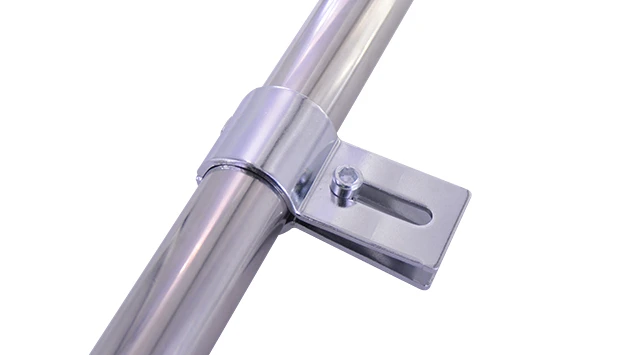
Lean pipe clamp is used for turnover trolley, workbench, flowrack adjust the frame or fix some accessory.
Why modern manufacturers are swapping rigid welds for modular, adaptable solutions
Walk into any manufacturing facility a decade ago, and you'd likely find rows of bulky, immovable workbenches, material racks, and assembly lines—all held together by welded joints that seemed as permanent as the concrete floors they stood on. Back then, "flexibility" was often an afterthought; production lines were designed for stability, not change. But today? The game has shifted. With consumer demands evolving faster than ever, and product life cycles shrinking by the month, manufacturers can't afford to be tied down by rigid structures. That's where tools like the lean pipe clamp B chrome come in—and why they're quickly replacing traditional welded joints as the backbone of lean production systems.
In this article, we're going to dive deep into the battle between two approaches: the old-school welded joints that once ruled factory floors, and the modern, modular lean pipe clamp B chrome systems that are redefining how we build and adapt production environments. We'll explore why flexibility isn't just a nice-to-have anymore, but a critical driver of efficiency, cost savings, and innovation. And yes—we'll even get into the nitty-gritty of how these clamps work, why they're so durable, and how they pair with components like lean pipe joints and aluminum profiles to create systems that grow and change with your business.
The Problem with Welded Joints: When "Permanent" Becomes a Liability
Let's start with the basics: welded joints have been around for centuries, and for good reason. They're strong. When done right, a weld fuses two pieces of metal into one, creating a bond that can withstand heavy loads and harsh conditions. In industries where production lines rarely change—think large-scale automotive manufacturing in the 1990s, or appliance production with decades-long product runs—welded structures made sense. You build it once, and it lasts for years.
But here's the catch: most manufacturers don't live in that world anymore. Today, a single factory might produce 10 different product variants in a week, or switch from assembling smartphones to smartwatches in a matter of days. Customer orders fluctuate, seasonal demands spike, and new regulations (like ESD requirements for electronics) can force sudden changes to workbench setups. In this environment, "permanent" becomes a problem.
Take a simple example: a welded workbench. Let's say your team designs it to hold a specific toolset for Product A. Six months later, Product B comes along, and it requires a longer surface area and extra shelving. With a welded bench, you have two options: either spend hours (or days) cutting, grinding, and rewelding the existing structure (risking damage to the metal and creating downtime), or build an entirely new bench from scratch. Both options cost time and money—and in lean manufacturing, time and money are the two resources you can least afford to waste.
Welded joints also have hidden costs. They require skilled labor (a certified welder isn't cheap), and they're prone to human error. A weak weld can compromise safety, while an overdone weld adds unnecessary weight. Plus, once a structure is welded, it's almost impossible to reuse the materials. If you need to rearrange your factory layout, that old welded rack isn't getting repurposed—it's getting hauled to the scrapyard. That's not just wasteful; it's a hit to your bottom line and your sustainability goals.
Enter Lean Pipe Clamp B Chrome: The Modular Alternative
So, what's the alternative? Enter the lean pipe clamp B chrome —a small but mighty component that's become the unsung hero of modern lean production. At first glance, it might look like just another metal clamp, but its design is genius in its simplicity. Made from high-grade steel with a chrome plating (for corrosion resistance and durability), this clamp is engineered to connect lean pipe joints , tubes, and profiles quickly and securely—no welding, no drilling, no specialized tools required.
Here's how it works: the clamp features a U-shaped design with a threaded bolt and nut. To assemble a structure, you slide the clamp over two intersecting pipes (often 28mm or 30mm in diameter, common in lean systems), tighten the bolt, and boom—you've got a solid connection. Need to adjust the angle? Loosen the bolt, reposition the pipes, and retighten. Want to disassemble it later? Just unscrew the nut, and the components are free to be reused elsewhere. It's modularity in its purest form.
But the lean pipe clamp B chrome isn't just about ease of assembly. It's about creating a system that's intentionally adaptable . Pair it with aluminum profiles (lightweight, strong, and compatible with a range of accessories), and you can build everything from workbenches and flow racks to turnover trolleys and material delivery systems—all in a fraction of the time it would take to weld equivalent structures.
Let's circle back to that workbench example. With a clamp-based system, if you need to add shelving or extend the surface, you don't need a welder. Your production team can do it themselves, in minutes. Grab a few extra pipes, some clamps, and a drill (for optional reinforcement), and you've got a customized bench tailored to Product B. When Product C comes along? Disassemble the extra parts and reuse them for the next project. No scrap, no downtime, no hassle.
Head-to-Head: Lean Pipe Clamp B Chrome vs. Welded Joints
To really understand why lean pipe clamp B chrome is winning over manufacturers, let's put it side by side with welded joints in a few key categories. The table below breaks down the differences in installation, cost, flexibility, and more:
| Feature | Lean Pipe Clamp B Chrome | Welded Joints |
|---|---|---|
| Installation Time | 5–15 minutes per connection (no specialized labor required) | 30–60 minutes per joint (requires certified welders and prep work like cleaning/degreasing metal) |
| Modification Ease | Adjustable in seconds: loosen the bolt, reposition, retighten | Nearly impossible without cutting/rewelding (destructive and time-consuming) |
| Cost (Short-Term vs. Long-Term) | Higher initial cost for clamps and components, but 80–90% of parts are reusable, lowering long-term costs | Lower initial material cost, but high labor costs and no reusability drive up long-term expenses |
| Weight Capacity | Up to 300kg per connection (with high-quality clamps and reinforced joints) | Similar or higher (depends on weld quality), but rigidity can lead to stress fractures under uneven loads |
| Maintenance | Minimal: occasional tightening of bolts; chrome plating resists rust | High: welds can crack over time (especially with vibration), requiring grinding and re-welding |
| Flexibility for Lean Production | Excellent: ideal for kanban systems, 5S, and quick changeovers | Poor: locks you into fixed layouts, limiting adaptability to new processes |
Let's unpack a few of these points. Take installation time: a typical workbench built with welded joints might take a full day to fabricate, including cutting pipes, welding, grinding down excess metal, and painting. With lean pipe clamp B chrome ? That same workbench can be assembled in 2–3 hours by a team with no welding experience. That's a 75% time savings—time that can be redirected to actual production, not setup.
Then there's long-term cost. Let's say you build a welded material rack for $500 (materials + labor). A year later, you need to resize it for a new product. You'll likely spend another $300–$400 to cut, reweld, and repaint. With a clamp-based rack, the initial cost might be $600 (clamps and pipes), but when you need to resize? You just disassemble it, add/remove pipes, and reassemble—no new materials needed. Over three years, the welded rack could cost $1,500+ in modifications, while the clamp-based system stays at $600. The math speaks for itself.
Real-World Impact: How One Factory Cut Downtime by 40% with Clamp-Based Systems
Numbers on a page are one thing—real-world results are another. Let's look at a case study from a mid-sized electronics manufacturer in Guangdong, China, that made the switch from welded workbenches to lean pipe clamp B chrome systems in 2023. The company, which produces circuit boards for consumer devices, was struggling with frequent product changes. Every time they launched a new board model, their old welded workbenches needed to be modified to fit new testing equipment—a process that took 2–3 days of downtime per line.
The Challenge
Their production lines had 12 welded workbenches, each customized for a specific board model. When a new model came in (which happened 4–5 times a year), the maintenance team had to: 1) Remove the old workbench, 2) Cut and weld a new frame, 3) Install new shelving, and 4) Test for stability. Each line was offline for 48–72 hours, costing the company an estimated $15,000 per downtime day in lost production.
The Solution
In early 2023, they replaced all 12 welded workbenches with modular systems built using lean pipe clamp B chrome , aluminum profiles , and adjustable lean pipe joints . The new workbenches featured removable shelves, adjustable heights, and casters for easy movement. They also added flow racks (using roller tracks and clamps) to streamline material delivery.
The Result
The first product change after installation was a revelation. Instead of taking 3 days, the team reconfigured all 12 workbenches in 6 hours . Downtime dropped from 72 hours to just 6, saving $135,000 per product launch. Over the year, with 5 launches, that's a total savings of $675,000. Plus, the team reported better ergonomics—workers could adjust bench heights on the fly to reduce strain—and a 20% reduction in material waste, since old components were reused instead of scrapped.
This isn't an isolated story. Across industries—from automotive to pharmaceuticals to aerospace—manufacturers are reporting similar gains. The key takeaway? Flexibility isn't just about adapting to change; it's about enabling change. When your production environment can evolve as quickly as your ideas, you're not just keeping up—you're getting ahead.
Beyond the Clamp: Building a Complete Lean Ecosystem
The lean pipe clamp B chrome is powerful on its own, but its true magic lies in how it plays with other components. Think of it as the "glue" that holds together a modular ecosystem of parts, all designed to work in harmony. Let's break down some of the key players:
- Lean Pipe Joints: These are the connectors that allow pipes to meet at angles (90°, 45°, 135°, etc.). Paired with clamps, they let you build everything from L-shaped workbenches to multi-tiered material racks.
- Aluminum Profiles: Lightweight but strong, aluminum profiles (like 2020 or 4040 series) are perfect for adding flat surfaces (think workbench tops) or mounting accessories like tool hooks. They slot into clamps easily, adding rigidity without weight.
- Casters and Wheels: Add casters to a clamp-based frame, and suddenly your stationary workbench becomes a mobile cart. Great for just-in-time material delivery or moving workstations to where they're needed most.
- Roller Tracks: Use clamps to attach roller tracks to aluminum profiles, and you've got a flow rack that lets materials glide smoothly from storage to assembly—no lifting required.
Together, these components create a system where the whole is greater than the sum of its parts. For example, you could build a mobile workbench with:
- Basic aluminum tubes as the frame, connected by lean pipe joints and clamped with lean pipe clamp B chrome .
- An aluminum profile top for the work surface, secured with profile accessories.
- Casters for mobility, bolted to the frame via caster accessories.
- Side-mounted roller tracks for holding tools or small parts bins.
And if next month you need that workbench to be taller? Loosen the clamps, add extension tubes, retighten, and you're done. No welding, no hassle, no waste.
Addressing the Skeptics: Is "Modular" Just a Fad?
We've all heard the arguments against modular systems: "Aren't clamps weaker than welds?" "Won't they loosen over time?" "Is this just a trendy solution that will fall apart under real use?" Let's tackle these head-on.
First, strength: Modern lean pipe clamp B chrome is engineered to meet industrial standards. A high-quality clamp, when properly tightened, can withstand loads of 200–300kg per connection—more than enough for most lean production tasks (like holding circuit boards, small parts, or tools). For heavier loads (think automotive engines), you can use reinforced clamps or double up on connections. And unlike welds, which can fail suddenly if they develop a crack, clamps loosen gradually—giving you time to retighten them before they become a problem.
Second, durability: Chrome plating isn't just for looks—it resists rust and corrosion, even in humid or oily factory environments. Many manufacturers offer clamps with zinc-plated or stainless steel options for extra durability. And since the components are modular, if a clamp does wear out (after years of use), you can replace just that clamp—no need to rebuild the entire structure.
Finally, longevity: This isn't a trend. The shift toward modularity is driven by fundamental changes in manufacturing—shorter product cycles, demand for customization, and the need to reduce waste. Welded joints will always have their place (in heavy machinery or high-heat environments, for example), but for the vast majority of lean production systems, modular clamps are here to stay.
Conclusion: Flexibility as a Competitive Advantage
At the end of the day, the choice between lean pipe clamp B chrome and welded joints isn't just about how you build a workbench or a rack—it's about how you build your business. In a world where change is the only constant, flexibility isn't a luxury; it's a competitive advantage. Welded joints lock you into the past, while modular clamps unlock the future—one where you can adapt, innovate, and grow without being held back by your own infrastructure.
So, if you're still relying on welded structures in your facility, ask yourself: How much time are you losing to rework? How many opportunities are you missing because you can't adjust quickly enough? And what would it mean for your team to have the power to redesign their workspace themselves, without waiting for maintenance or outside contractors?
The answers might surprise you. And if they do, maybe it's time to give the lean pipe clamp B chrome a closer look. After all, in lean production, the goal isn't just to work harder—it's to work smarter. And smarter, these days, means staying flexible.