- Company Articles
- Products and Technology
- Application Cases
- Lean Pipe Clamps in 3C Assembly: Applications & Efficiency Benefits

Lean Pipe Clamps in 3C Assembly: Applications & Efficiency Benefits
Related Product
Lean Pipe Clamp
Lean pipe clamp is used for rack system hang monitor or other panel for workbenck, flowrack in production daily use.
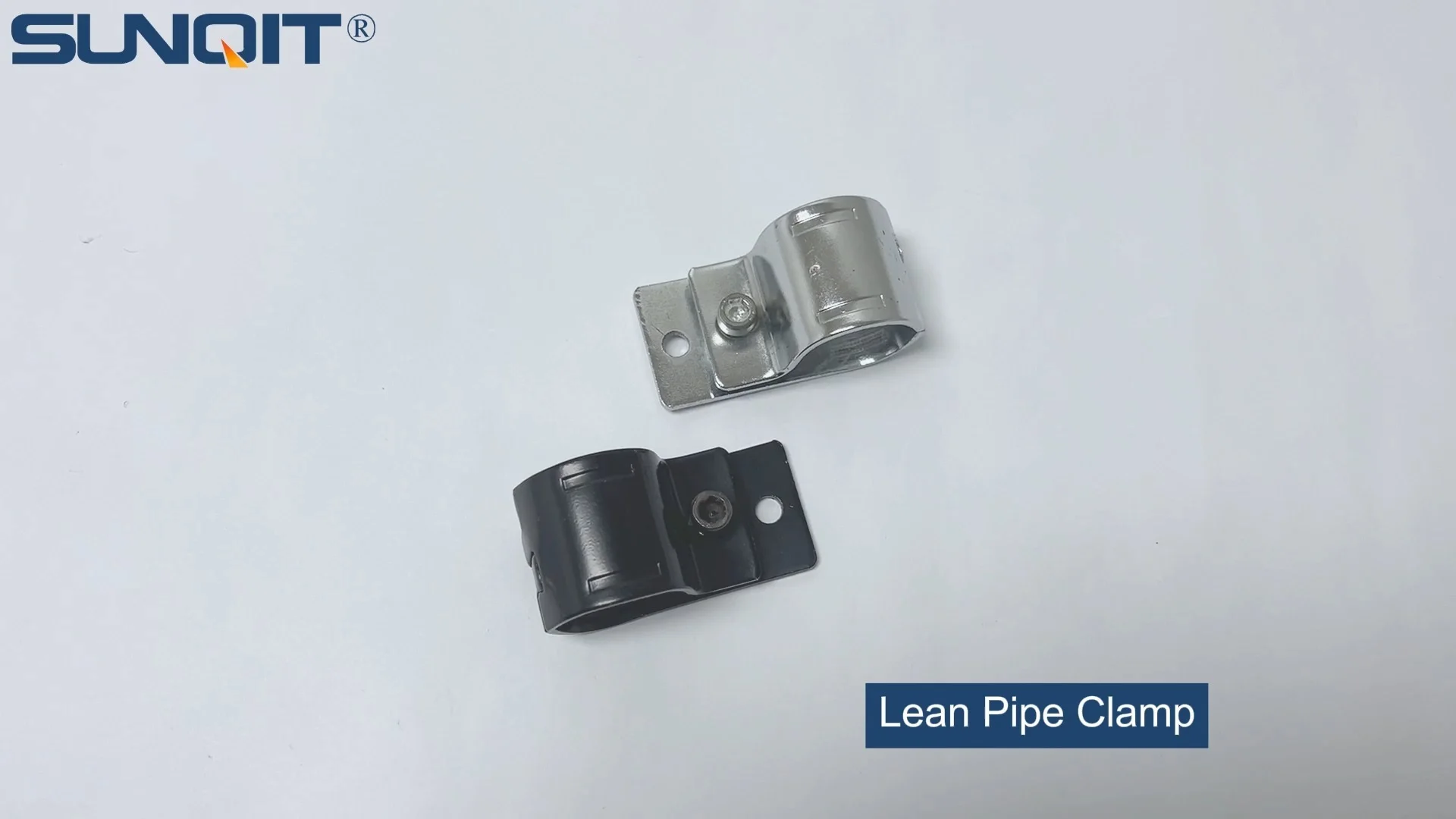
In the fast-paced world of 3C manufacturing—where consumer electronics like smartphones, laptops, and wearables are designed, prototyped, and mass-produced at breakneck speed—agility isn't just a buzzword; it's the backbone of survival. Assembly lines that once relied on rigid, one-size-fits-all infrastructure now struggle to keep up with shrinking product lifecycles and ever-evolving design specs. Enter lean pipe systems: modular, cost-effective, and infinitely adaptable solutions that have become the unsung heroes of modern 3C production floors. At the heart of these systems? Lean pipe clamps—the unassuming yet critical components that turn simple pipes and profiles into custom workstations, material racks, and conveyor setups. In this article, we'll dive into how lean pipe clamps are transforming 3C assembly, their real-world applications, and the tangible efficiency gains they deliver to manufacturers.
Understanding Lean Pipe Clamps: The "Connectors" of Agile Manufacturing
Before we explore their impact, let's demystify lean pipe clamps. Simply put, these are mechanical fasteners designed to join lean pipes (often aluminum, stainless steel, or plastic-coated steel) into stable, configurable structures. Unlike traditional welding or permanent bolts, lean pipe clamps enable tool-free assembly and disassembly, making them ideal for environments where change is constant. Think of them as the Lego bricks of industrial manufacturing—small, versatile, and capable of building almost anything when paired with the right pipes and accessories.
Most lean pipe clamps are made from durable materials like chrome-plated steel or aluminum, with some variants featuring ESD (electrostatic discharge) coatings to protect sensitive 3C components from static damage. They come in dozens of designs: fixed-angle clamps for rigid frames, rotating clamps for adjustable shelves, and even ESD-safe clamps for workstations handling microchips or circuit boards. What truly sets them apart, though, is their ability to balance strength and flexibility. A single clamp can securely hold pipes under the weight of heavy tools or materials, yet twist or detach in seconds when a production line needs a makeover.
Why 3C Assembly Needs Lean Pipe Clamps (and Why They're Non-Negotiable)
3C manufacturing is a unique beast. Unlike automotive or aerospace production, where parts are large and assembly steps are standardized for years, 3C assembly lines juggle tiny, delicate components (think: 0.5mm-thick circuit boards or 2mm camera lenses) and frequently shift between product models. A factory might produce 50,000 units of a flagship smartphone in Q1, then pivot to a budget model with a completely different chassis design by Q2. In this context, fixed infrastructure—like welded steel workbenches or permanent conveyor belts—becomes a liability. Lean pipe clamps solve this problem by turning production setups into "living systems" that evolve with demand.
Another critical factor? Cost. 3C profit margins are notoriously tight, and manufacturers can't afford to invest in new equipment every time a product line changes. Lean pipe clamps slash costs by making components reusable: a workbench built for assembling smartwatches can be disassembled, and its pipes and clamps repurposed into a material rack for tablet screens. This reusability not only reduces waste but also lowers the total cost of ownership over time—a win for both the bottom line and sustainability goals.

Key Applications of Lean Pipe Clamps in 3C Assembly Lines
Lean pipe clamps aren't just theoretical solutions—they're hard at work on factory floors worldwide, solving specific 3C assembly challenges. Let's break down their most impactful applications.
1. Custom Workbench Construction: Tailored to the Tiniest Component
Walk into any 3C assembly plant, and you'll notice one thing immediately: no two workstations look alike. Assembling a smartphone's logic board requires a compact, ESD-safe surface with built-in tool holders, while testing laptop hinges demands a larger, height-adjustable bench with room for torque meters. Lean pipe clamps make these custom setups possible without the need for custom fabrication.
Here's how it works: Manufacturers start with basic aluminum or steel lean pipes and use clamps to connect them into frames. For example, a "Workbench E (single deck-without caster)" (a common 3C setup) might use 90° fixed lean pipe clamps to join vertical and horizontal pipes, creating a stable base. Adjustable clamps then attach shelves at specific heights—say, 80cm for seated workers or 120cm for standing operations. ESD-safe clamps, often made with conductive plastic coatings, ensure the entire structure is grounded, preventing static electricity from frying sensitive microchips during assembly.
The beauty? When a new product launches with different assembly needs, workers can loosen the clamps, reposition the pipes, and have a workstation ready in under an hour. Compare that to traditional wooden or steel workbenches, which would require a carpenter or welder and days of downtime. For a 3C manufacturer producing 10+ product variants annually, this flexibility translates to thousands of saved hours and uninterrupted production.
2. Material Flow Optimization with Roller Tracks
In 3C assembly, time is lost not just in assembly itself, but in moving parts from one station to the next. A single phone might pass through 20+ workstations—from PCB soldering to screen mounting to final testing—and any delay in material flow can bottleneck the entire line. This is where lean pipe clamps shine in conjunction with roller tracks.
Roller tracks (another staple of lean manufacturing) are gravity-fed or motorized rails that let parts glide smoothly between stations. But to be effective, they need to be precisely aligned with workbenches and adjusted for height, angle, and load. Lean pipe clamps secure roller tracks to aluminum profiles or steel frames, ensuring they stay stable even when loaded with trays of circuit boards or component bins. For example, a "40 steel roller track with yellow wheels" (a popular 3C choice for lightweight parts) can be mounted to a frame using "roller track placon mount for aluminum profile flat" clamps, which attach directly to the T-slots of aluminum profiles without drilling.
Consider a scenario: A 3C plant needs to route battery packs from the charging station to the phone assembly line, 15 meters away. Using lean pipe clamps, workers can build a custom roller track with a 5° incline, ensuring batteries glide gently to the next station without jamming. If production shifts to larger tablet batteries, they can adjust the track's angle by loosening the clamps and repositioning the support pipes—no tools, no downtime, no hassle. This level of adaptability is why roller tracks paired with lean pipe clamps have replaced rigid conveyor belts in many 3C facilities.
3. ESD Workstation Safety: Protecting Sensitive Electronics
Static electricity is the silent killer of 3C components. A single electrostatic discharge—even one too weak for humans to feel—can damage a smartphone's CPU or render a smartwatch's display unresponsive. That's why ESD workstations are mandatory in 3C assembly, and lean pipe clamps play a starring role in making these stations both safe and functional.
ESD workstations require all conductive surfaces—including the frame, shelves, and tool holders—to be grounded. Lean pipe clamps designed for ESD protection are made with materials like nickel-plated steel or carbon-infused plastic, which conduct electricity and channel static charges to the ground. When building an ESD workstation, manufacturers use these clamps to connect aluminum or stainless steel pipes, ensuring every part of the structure is electrically continuous. For added safety, they might attach ESD mats to the work surface using "lean pipe clamp B" models, which grip the mat's edges and keep it grounded to the frame.
What makes this setup superior to traditional ESD tables? Again, flexibility. If a workstation needs to be expanded to accommodate a new tool (say, a precision screwdriver with an ESD wrist strap holder), workers can add a new pipe section using a swivel lean pipe clamp, ensuring the extension is also grounded. No need to buy a workstation—just reconfigure the existing one.
4. Material Racks and Turnover Trolleys: Organizing Chaos in High-Volume Production
3C assembly lines are drowning in small parts: screws, gaskets, adhesive strips, and micro-connectors, to name a few. Without proper organization, workers waste precious minutes hunting for components, and misplaced parts lead to costly delays. Lean pipe clamps solve this by enabling the construction of custom material racks and turnover trolleys that keep parts within arm's reach.
Take the "Material Rack B (3 row and 3 floor)" a common 3C storage solution. Built using vertical and horizontal lean pipes, this rack uses 180° fixed lean pipe clamps to create sturdy shelves, each adjustable to fit bins of different sizes. For example, a row holding 0.5-inch screws might use a shorter shelf (15cm), while a row for larger battery modules could be spaced 30cm apart—all achievable by repositioning the clamps. When production shifts to a new product, the same rack can be reconfigured with 60° or 45° clamps to create angled shelves, making it easier to access oddly shaped components like camera modules.
Turnover trolleys, used to transport parts between warehouses and assembly lines, benefit similarly. Lean pipe clamps attach casters (often "flat swivel castor wheel with brake" models) to trolley frames, ensuring smooth movement and secure braking. If a trolley needs to carry heavier loads (like stacks of laptop screens), workers can reinforce the frame with parallel lean pipe clamps, adding cross-braces for extra stability. It's a far cry from one-size-fits-all metal trolleys that rust or break when overloaded.

Efficiency Benefits: The Numbers Behind the Clamps
At this point, you might be thinking, "Lean pipe clamps sound great, but do they really move the needle on efficiency?" The answer, according to 3C manufacturers who've adopted them, is a resounding yes. Let's break down the quantifiable benefits.
| Efficiency Metric | Traditional Rigid Infrastructure | Lean Pipe Clamp Systems | Improvement |
|---|---|---|---|
| Line Changeover Time | 2–3 days (requires welding/fabrication) | 1–2 hours (tool-free reconfiguration) | 95% reduction |
| Workstation Customization Cost | $500–$1,000 per custom bench | $150–$300 (using reused pipes/clamps) | 60–70% cost savings |
| Material Handling Time per Part | 45–60 seconds (manual carrying) | 15–20 seconds (roller track + trolley) | 60% faster |
| ESD-Related Defects | 2–3% of total production | 0.5% or less (with ESD clamps) | 75% reduction |
These numbers come from real-world case studies. Take a mid-sized 3C manufacturer in Shenzhen that switched to lean pipe systems for its smartwatch assembly line. By using lean pipe clamps to build custom workstations and roller tracks, the company reduced line changeover time from 3 days to 90 minutes when launching a new watch model. Material handling errors—like dropped circuit boards—fell by 40%, and ESD-related defects dropped from 2.1% to 0.4%. The result? A 12% increase in monthly production volume and a 15% reduction in per-unit labor costs.
Beyond the Numbers: Ergonomics and Worker Satisfaction
Efficiency isn't just about speed and cost—it's also about people. 3C assembly is repetitive work, and poorly designed workstations lead to fatigue, injuries, and high turnover. Lean pipe clamps address this by enabling ergonomic customization. For example, a worker with a shoulder injury can have their workstation's height adjusted by loosening a few clamps and raising the tabletop by 10cm. A team assembling small sensors can angle their workbench using 30° or 45° clamps, reducing neck strain from hunching over. Over time, these small adjustments lead to happier, healthier workers—and lower absenteeism and turnover rates.

Choosing the Right Lean Pipe Clamps: A Quick Guide for 3C Manufacturers
Not all lean pipe clamps are created equal, and choosing the right ones depends on your specific needs. Here are a few key considerations for 3C applications:
- Material: For ESD-sensitive tasks (e.g., handling microchips), opt for ESD-safe clamps with conductive coatings. For heavy-duty applications (e.g., material racks), chrome-plated steel clamps offer better durability.
- Angle and Rotation: Fixed clamps (180°, 90°, 45°) work best for static structures like shelves. Rotating or swivel clamps are ideal for adjustable components, like tool holders that need to swing out of the way.
- Compatibility: Ensure clamps match your pipe diameter (common sizes in 3C are 28mm and 30mm). Aluminum pipes pair well with lightweight aluminum clamps, while stainless steel pipes may require heavier steel clamps.
- Supplier Reliability: Work with a reputable lean pipe supplier that offers consistent quality. Cheap, poorly made clamps can loosen over time, leading to wobbly workstations and safety risks.
Conclusion: Lean Pipe Clamps—Small Components, Big Impact
In the high-stakes world of 3C manufacturing, where every second and every cent counts, lean pipe clamps are more than just tools—they're strategic assets. By enabling custom, adaptable, and cost-effective production setups, they help manufacturers stay agile in the face of changing demand, reduce waste, and keep workers safe and productive. Whether you're building a simple workbench or a complex roller track system, these unassuming connectors deliver outsized returns, proving that sometimes the smallest components make the biggest difference.
As 3C technology continues to evolve—with foldable screens, AI-powered devices, and even smaller components on the horizon—one thing is clear: rigid infrastructure will only get left behind. Lean pipe clamps, with their endless versatility, are here to stay, ensuring that 3C manufacturers can build, adapt, and thrive in an industry that waits for no one.