
- Company Articles
- Products and Technology
- Application Cases
- Lean Pipe Clamps in 3C Industry: Enhancing Production Flexibility
The 3C Industry's Race for Flexibility
In the world of consumer electronics—where smartphones get redesigned yearly, laptops slim down by millimeters, and wearables pack more sensors into smaller frames—one thing is non-negotiable: production lines can't afford to stand still. The 3C industry (computers, communications, consumer electronics) thrives on speed. A new phone model might hit the market with a camera module that's 2mm thicker than its predecessor, or a laptop could require a completely different motherboard layout. For manufacturers, this means one constant challenge: how to keep up without breaking the bank on retooling.
Walk into a traditional 3C factory, and you might see rows of heavy, welded steel workbenches bolted to the floor, conveyor belts fixed in place with rigid brackets, and material racks that haven't changed configuration since the last product launch. When a new model comes in, reconfiguring these setups can take weeks—if not months. Welders are called in, custom brackets are ordered, and production grinds to a halt while the line is torn apart and rebuilt. For a mid-sized manufacturer, that downtime alone can cost tens of thousands of dollars in lost output.
But what if there was a way to build production lines that adapt as quickly as the products they assemble? That's where lean pipe clamps enter the picture. These unassuming connectors are quietly transforming 3C manufacturing floors, turning rigid, one-size-fits-all setups into modular, plug-and-play systems that keep pace with innovation.
What Are Lean Pipe Clamps, Anyway?
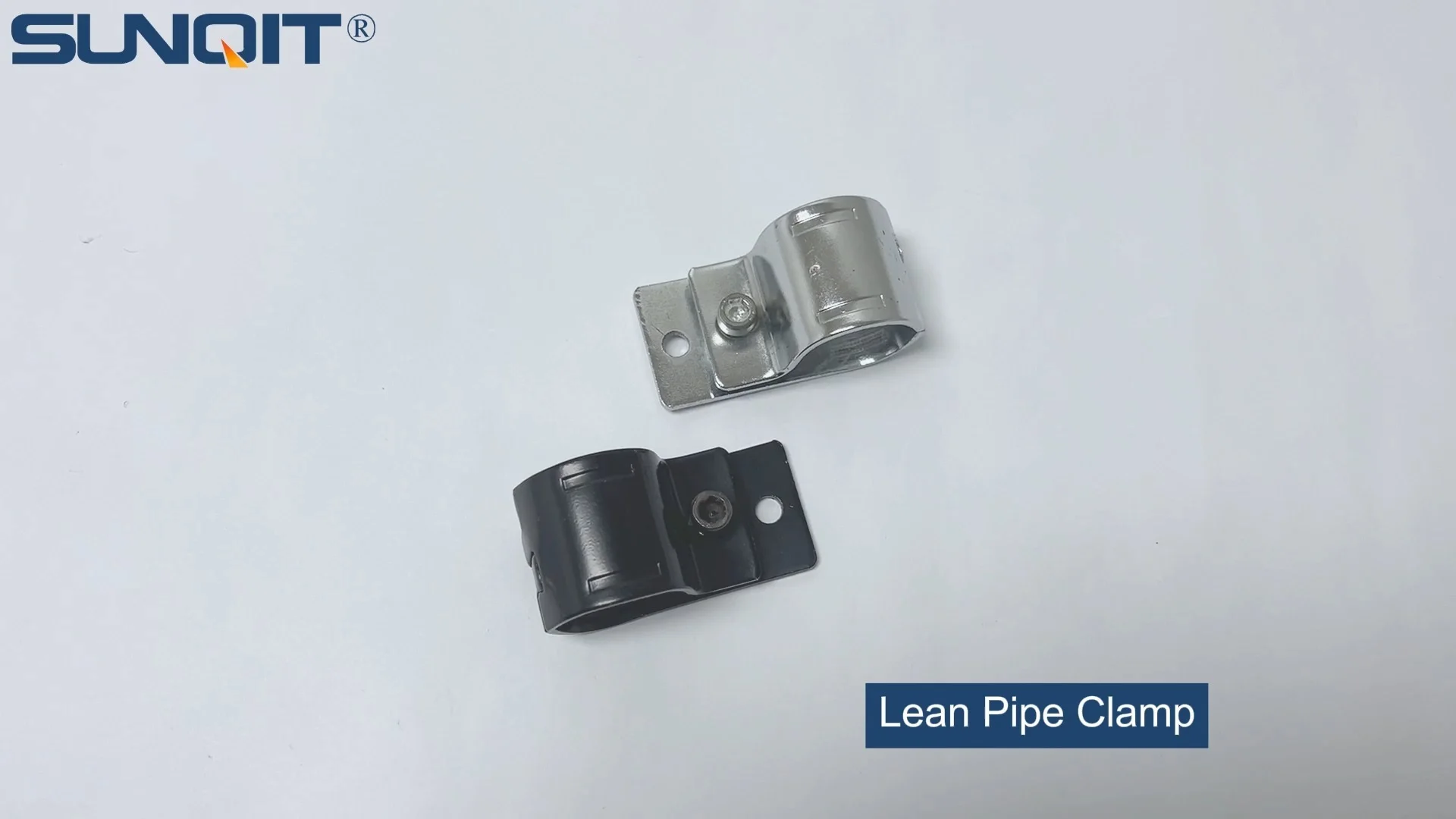
Let's start with the basics. Lean pipe clamps are the unsung heroes of modular manufacturing. Think of them as the "building blocks" that hold lean pipes (hollow tubes made of steel, aluminum, or plastic-coated materials) together. Unlike traditional welding or permanent fasteners, these clamps let you assemble, disassemble, and reassemble structures in minutes—no power tools, no specialized training, no leftover scrap metal from cutting old brackets.
Most lean pipe clamps are designed with a simple yet genius mechanism: a slot or groove that fits snugly around the pipe, secured by a bolt or lever. Twist the bolt, and the clamp tightens; loosen it, and you can reposition the pipe, add a new angle, or even swap out a section entirely. They come in all shapes—90-degree elbows for corners, T-joints for branching structures, swivel joints for adjustable angles—to fit any layout you can dream up.
But why does this matter for 3C production? Imagine a line assembling smartwatches today and fitness trackers tomorrow. With lean pipe clamps, the workbench that held watch batteries this morning can be adjusted to hold tracker straps this afternoon. The flow rack that fed phone screens last week can be reconfigured to feed laptop hinges next week. It's manufacturing on demand—and it's changing the game.

Lean Pipe Clamps: The Backbone of Modern Lean Systems
Lean manufacturing has always been about cutting waste—whether it's time, materials, or unnecessary movement. But in the 3C industry, waste often hides in plain sight: rigid production lines that can't adapt, leading to idle workers, delayed launches, and overstocked custom tooling. Lean pipe clamps tackle this waste head-on by making flexibility part of the system's DNA.
Here's how they tie into key lean principles:
- Continuous Improvement: With clamps, workers and supervisors can experiment with layouts in real time. If an assembly station feels cramped, they can adjust the height of the lean pipe workbench on the spot. If parts aren't flowing smoothly from the flow rack to the line, they can reangle the roller track (yes, those are often connected with clamps too) to reduce friction. No more waiting for engineering approval—improvements happen when they're needed.
- Just-In-Time Production: 3C products often have short lifecycles, so manufacturers can't afford to stockpile specialized equipment. Lean pipe clamps let you build exactly what you need, when you need it. A temporary conveyor for a limited-edition phone? Assemble it with clamps, use it for three months, then disassemble and repurpose the pipes and clamps for the next project.
- Respect for People: Rigid workstations force employees into awkward positions—stooping to reach parts, stretching to grab tools. With clamps, workbenches and material racks can be tailored to individual workers. A taller operator might raise their station by 6 inches; someone with a shoulder injury could adjust the angle of their tool holder. The result? Happier teams and fewer ergonomic injuries.
In short, lean pipe clamps don't just connect pipes—they connect lean principles to real-world production. They turn the abstract goal of "flexibility" into something tangible: a workbench that bends, a conveyor that twists, and a factory that can keep up with the next big thing.

Applications in 3C Production: Where Clamps Make the Difference
To understand the impact of lean pipe clamps, let's zoom into four critical areas of 3C manufacturing—where these small connectors are solving big problems.
1. Lean Pipe Workbenches: Customization at Your Fingertips
Assembly lines for 3C products are a symphony of small, precise tasks: soldering microchips, attaching camera lenses, testing touchscreens. Each task demands a workstation that fits the job—and the worker. Traditional workbenches, with fixed heights and built-in shelves, fall short here. A bench that's perfect for assembling phone cases might be terrible for testing laptop keyboards.
Enter lean pipe workbenches, built with—you guessed it—lean pipe clamps. Here's how they work: Start with a basic frame of aluminum or steel pipes. Use clamps to add shelves at 15cm intervals (so parts bins can slide in), attach tool hooks at shoulder height, or even mount ESD mats (critical for protecting sensitive electronics) to the surface. If a new product requires a larger workspace, loosen the clamps, add a few extra pipes, and you're done. No need to order a whole new bench.
Mark, a production manager at a Guangdong-based 3C factory, recalls the launch of their latest tablet model: "The old workbenches were welded steel, and the new tablet's battery module was bulkier, so operators had to lean over the edge. Within a day of switching to lean pipe clamps, we raised the benches by 10cm and added side shelves for the battery tools. Productivity went up 20% that week—no contractors, no downtime."
2. Flow Racks: Keeping Parts Moving Without the Fuss
In 3C assembly, time lost hunting for parts is time lost forever. Flow racks—those tilted shelves where bins glide forward as the front one is emptied—are supposed to fix this. But traditional flow racks are often built with fixed angles and permanent dividers. If a part bin is 5cm wider than expected? You're stuck with a rack that doesn't fit.
Lean pipe clamps change this. By connecting pipes and roller tracks (another modular essential), manufacturers can build flow racks that adapt to part sizes. Need to adjust the tilt angle for heavier bins? Loosen the clamps and reposition the legs. Want to add a third row for smaller screws? Screw in a few T-joint clamps and slide in new roller tracks. Even better, when the product line ends, the rack can be disassembled and rebuilt as a storage unit for spare parts.
At a Shanghai factory producing smart speakers, the team used to struggle with rigid flow racks that couldn't handle the variety of mesh grilles (some circular, some rectangular) for different models. "With clamps, we now have adjustable dividers," says Lin, the warehouse supervisor. "A new grille size comes in, and we reconfigure the rack in 10 minutes. No more bins falling over or parts getting stuck."
3. Conveyors: Rerouting Production in Hours, Not Weeks
Conveyors are the arteries of 3C factories, moving PCBs from soldering to testing, or finished phones from assembly to packaging. But when a new product changes the workflow—say, a phone that needs an extra quality check station—rerouting a traditional conveyor can mean shutting down the line for days while engineers redesign the path.
Lean pipe clamps simplify this with modular conveyors. Instead of heavy steel frames bolted to the floor, these conveyors use lightweight aluminum pipes connected by clamps. Need to add a 90-degree turn? Swap out a straight clamp for a swivel joint. Want to raise the conveyor by 30cm to align with a new testing machine? Adjust the leg clamps. Even better, these conveyors can be temporary: set up for a 3-month production run, then taken apart and stored until the next project.
"We used to spend $50,000 and two weeks reconfiguring our main conveyor for each new laptop model," says Zhang, a plant engineer in Shenzhen. "Now, with lean pipe clamps and aluminum pipes, we do it in a day with $2,000 in parts. The ROI was immediate."
4. ESD Workstations: Protecting Sensitive Electronics, Without the Rigidity
Static electricity is the silent enemy of 3C manufacturing. A single electrostatic discharge (ESD) can fry a $200 microchip, turning a nearly finished phone into scrap. ESD workstations—with grounded surfaces, wrist straps, and anti-static mats—are non-negotiable. But traditional ESD setups are often as rigid as they are protective, with fixed frames and permanent grounding wires.
Lean pipe clamps solve this by pairing ESD-safe materials (like conductive plastic-coated pipes) with modular design. Need to add a grounding point for a new testing tool? Attach a clamp-on grounding clip. Want to expand the workstation for a team of two? Add a crossbar with clamps and lay down an extra ESD mat. The best part? The grounding system stays intact even as the workstation changes—no need to call an electrician to rewire.
"We once had to halt production for three days because a traditional ESD bench broke and we couldn't replace the grounded surface quickly," says Wang, an ESD specialist at a Zhejiang factory. "Now, with lean pipe clamps, we keep spare pipes and mats on hand. A bench breaks? We rebuild it in an hour. No more lost production."

Traditional vs. Lean Pipe Clamp Setups: A Clear Winner
| Aspect | Traditional Production Setups | Lean Pipe Clamp Systems |
|---|---|---|
| Reconfiguration Time | 2–4 weeks (requires welding, custom fabrication, and contractor labor) | 1–2 days (tool-free assembly with basic hand tools) |
| Cost to Adapt | High ($10,000–$50,000 per line for new brackets, welding, and downtime) | Low ($500–$3,000 per line for additional pipes, clamps, and labor) |
| Flexibility | Rigid; designed for one product model or part size | Modular; can be adjusted for different product sizes, workflows, and worker needs |
| Ergonomics | One-size-fits-all; often leads to worker strain or fatigue | Customizable height, angle, and layout to match individual operators |
| ESD Compatibility | Limited; hard to modify without compromising grounding or anti-static protection | High; ESD-rated pipes and clamps maintain protection during reconfiguration |
Case Study: How a 3C Manufacturer Cut Retooling Costs by 70%
From Rigid to Responsive: A Year in the Life of a Smartphone Factory
In early 2023, a mid-sized 3C manufacturer in Jiangsu faced a dilemma: their flagship smartphone line was due for a redesign, and the production team estimated retooling the assembly line would cost $120,000 and take six weeks. With the launch date just three months away, this meant delaying the product—or taking a huge financial hit.
Instead, they opted to replace 80% of their welded steel workbenches, flow racks, and conveyor sections with lean pipe clamps and aluminum pipes. The results? Retooling took just 10 days, cost $36,000 (a 70% reduction), and the new line was able to handle both the old and new phone models simultaneously. By the end of the year, the factory had reconfigured the line three more times for seasonal product variations—each time in under a week, with no additional equipment purchases.
"The clamps paid for themselves in the first launch," says the factory's operations director. "Now, we're not just keeping up with competitors—we're beating them to market."
The Future of 3C Manufacturing: Lean Pipe Clamps and Beyond
As 3C products grow more complex (think foldable screens, AI-powered sensors, and eco-friendly materials), the need for flexible production will only intensify. Lean pipe clamps are already evolving to meet this demand: newer models feature quick-release levers (no bolts needed), corrosion-resistant coatings for cleanrooms, and even RFID tags to track components in smart factories.
But their biggest impact might be cultural. In an industry where "good enough" quickly becomes obsolete, clamps empower teams to think differently: to experiment, adapt, and iterate—without fear of wasting time or money. They turn production lines from static machines into living, breathing systems that grow with the products they build.
So the next time you unbox a new phone or laptop, take a moment to appreciate the unseen hero behind it: not just the engineers who designed it, but the lean pipe clamps that helped build it—one flexible, adaptable connection at a time.