- Company Articles
- Products and Technology
- Product knowledge
- Lean Pipe Workbench E Design: Integrating 3060 National Standard Profile A

Lean Pipe Workbench E Design: Integrating 3060 National Standard Profile A
Related Product
3060 National Standard Profile A
Workbench, production line, logistic rack, warehouse rack Industry: Manufacturer workshop, Automobile, Electronic, Assembling, logistic
Walk into any busy production floor, and you'll quickly realize that the workspace isn't just a collection of tools and machines—it's a living, breathing ecosystem. Every table, every rack, every inch of space plays a role in keeping the wheels of manufacturing turning. Among these, the workbench stands out as more than just a flat surface; it's the command center where precision meets productivity, where ideas take shape, and where the rhythm of assembly lines is set. Today, we're diving into a workbench that's redefining this role: the Lean Pipe Workbench E. What makes it special? Its seamless integration with the 3060 National Standard Profile A, a material that's quietly revolutionizing how we build, adapt, and optimize workspaces. Let's unpack why this combination isn't just a design choice, but a game-changer for lean manufacturing.
What is Lean Pipe Workbench E, Anyway?
First things first: let's get to know Lean Pipe Workbench E. If you've spent time in production or assembly environments, you've probably seen a variety of workbenches—some clunky, some too basic, some so rigid they can't keep up with changing needs. Lean Pipe Workbench E is different. Designed with the principles of lean manufacturing in mind, it's built to be efficient, adaptable, and ergonomic. The "E" here isn't just a random letter; think of it as shorthand for "efficiency," "ergonomics," and "ease of use."
One of its defining features, as noted in manufacturing specs, is its single-deck design without casters ("workbench e (single deck-without caster)" for those who love technical terms). At first glance, you might wonder: no casters? Isn't mobility key? But here's the insight: not every workbench needs to roll. In many setups—think dedicated assembly stations or quality control hubs—stability is far more critical than mobility. A fixed, sturdy base ensures that tools stay in place, parts don't shift unexpectedly, and workers can focus on the task at hand without worrying about a wobbly surface. That's where the 3060 National Standard Profile A comes into play, providing the backbone this workbench needs to deliver on its promise of stability and durability.
But Lean Pipe Workbench E isn't just about being stationary. It's about being strategically stationary—rooted in a spot where it can streamline workflow, reduce unnecessary movement, and become a hub for productivity. Whether it's in electronics manufacturing, small-parts assembly, or even lab settings, this workbench is designed to fit into the puzzle of lean systems, where every element has a purpose and nothing is wasted.
The Star of the Show: 3060 National Standard Profile A
Let's talk about the material that makes Lean Pipe Workbench E tick: the 3060 National Standard Profile A. If you're not familiar with aluminum profiles, think of them as the building blocks of modern industrial design—extruded aluminum shapes with precise dimensions and built-in features (like T-slots) that make customization a breeze. The 3060 profile, in particular, is a standout in this category.
What Makes 3060 "National Standard"?
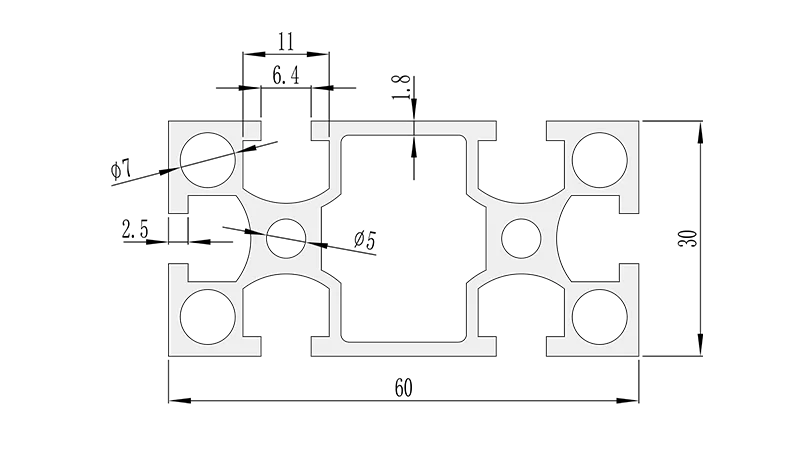
The term "national standard" here is key. It means this profile adheres to strict, standardized dimensions and quality benchmarks set by industry authorities. For manufacturers and facility managers, that translates to consistency. Whether you're ordering a 3060 profile from one supplier or another, you know the dimensions (30mm in width, 60mm in height) and the T-slot specifications will match, making replacements or expansions hassle-free. No more guessing if a part will fit—standardization takes the guesswork out of the equation.
Why 30x60mm? The Sweet Spot of Size and Strength
Aluminum profiles come in all shapes and sizes: 2020, 3030, 4040, and so on. So why 3060 for Lean Pipe Workbench E? Let's break it down. At 30mm wide and 60mm tall, this profile strikes a perfect balance between weight, strength, and versatility. It's not too bulky to handle during assembly, yet it's robust enough to support heavy tools, bins of parts, or even semi-finished products. For a single-deck workbench without casters, this strength is non-negotiable—you need a frame that can take daily use without bending or warping.
But it's not just about raw strength. The 3060 profile's height (60mm) gives it a higher moment of inertia, which means better resistance to bending when weight is applied to the workbench surface. In practical terms? You can place a heavy soldering station, a stack of PCBs, or a batch of mechanical parts on it, and it won't sag. That stability is crucial for precision work, where even a millimeter of flex can throw off measurements or assembly.
How Does 3060 Compare to Other Profiles?
Curious how 3060 stacks up against other common profiles? Let's put it side by side in a quick comparison:
| Profile Type | Dimensions (WxH) | Typical Weight Capacity (Per Linear Meter) | Best For |
|---|---|---|---|
| 2020 National Standard Profile | 20mm x 20mm | 50-80 kg | Light-duty shelves, small tool holders, desktop setups |
| 3030 National Standard Profile | 30mm x 30mm | 100-150 kg | Medium-duty workbenches, mobile carts, small material racks |
| 3060 National Standard Profile A | 30mm x 60mm | 180-250 kg | Heavy-duty workbenches (like Lean Pipe Workbench E), assembly stations, load-bearing frames |
| 4040 EU Standard Profile | 40mm x 40mm | 200-300 kg | Industrial machinery frames, large workbenches with multiple decks |
As you can see, 3060 hits that sweet spot between the smaller, lighter profiles (like 2020 and 3030) and the bulkier 4040. For Lean Pipe Workbench E, which needs to be sturdy but not overbuilt, this makes it the ideal choice. It's strong enough to handle daily use in production environments, but not so heavy that it's a hassle to assemble or reconfigure when needed.
Aluminum Profile Accessories: The Unsung Heroes of Customization
If the 3060 National Standard Profile A is the backbone of Lean Pipe Workbench E, then aluminum profile accessories are the joints, muscles, and connective tissue that bring it to life. You see, a profile alone is just a length of metal. It's the accessories that turn it into a workbench—one that can be tailored to fit your specific needs. Let's talk about some of these unsung heroes and how they make Lean Pipe Workbench E so adaptable.
Connectors: The Glue That Holds It All Together
At the top of the list: connectors. Aluminum profile accessories include a wide range of connectors, from simple 90° angle brackets to swivel joints and T-connectors. For Lean Pipe Workbench E, these connectors are critical because they allow the 3060 profiles to be joined together without welding. That's a big deal. Welding is permanent, time-consuming, and requires skilled labor. Connectors, on the other hand, let you assemble the workbench with basic tools—think hex keys or Allen wrenches—and take it apart just as easily if you need to reconfigure. This aligns perfectly with lean principles, where flexibility is key. Need to add a shelf? Swap out a connector. Want to adjust the height? Loosen a few bolts, move the profile, and tighten again.
One connector that deserves a shoutout is the internal rotatory aluminum joint (a specific type of lean pipe joint). Unlike fixed connectors, these allow for limited rotation, which can be a lifesaver in tight spaces or when you need to angle a component (like a tool holder) for better access. Imagine a scenario where a worker needs to reach a set of pliers mounted on the side of the workbench—with a rotatory joint, they can swing the holder toward them instead of leaning awkwardly. Small adjustment, big impact on ergonomics.
End Caps and Edge Protectors: Safety First
Ever run your hand along a metal profile and felt a sharp edge? Not fun. That's where end caps come in. Aluminum profile accessories like 3060 National Standard Profile end caps slide onto the open ends of the profile, covering sharp edges and preventing dust, debris, or even fingers from getting caught inside the T-slots. They're a small detail, but in a busy workspace, where workers are moving quickly, safety details matter. Plus, they give the workbench a clean, finished look—no more ragged, unfinished edges.
Gussets and Reinforcements: Adding Muscle Where It Counts
While the 3060 profile is strong on its own, there are times when you need a little extra reinforcement—like at the corners of the workbench, where weight and stress are concentrated. That's where gussets (think of them as triangular support brackets) come into play. These aluminum profile accessories bolt onto the inside or outside of profile joints, distributing weight more evenly and preventing the frame from twisting under load. For Lean Pipe Workbench E, which often holds heavy equipment, gussets aren't just optional—they're part of what makes the design reliable over the long haul.
T-Slot Covers: Keeping It Tidy
The T-slots in the 3060 profile are a huge asset—they let you attach accessories, shelves, or tools anywhere along the profile. But when you're not using a slot, it can collect dust, dirt, or small parts. T-slot rubber seal covers (another handy accessory) solve this by sliding into unused slots, keeping them clean and ready for future use. They also reduce noise—no more clinking of loose screws or debris rattling around inside the profile.
Designing for Humans: Ergonomics Meets Functionality
A workbench isn't just about holding things—it's about supporting the people who use it. Lean Pipe Workbench E, with its 3060 National Standard Profile A frame, is designed with ergonomics front and center. Let's break down how this integration translates to a better experience for workers.
Height Matters: Getting the Right Elevation
Ever worked at a workbench that was either too high (straining your shoulders) or too low (knees hitting the frame)? It's not just uncomfortable—it's a productivity killer. Lean Pipe Workbench E addresses this by leveraging the adjustability of the 3060 profile and its accessories. Using height-adjustable feet (another aluminum profile accessory), you can tweak the workbench's height by a few centimeters to match the average height of the workers using it. For example, a workbench in an electronics assembly line might be set lower for seated work, while one in a mechanical workshop could be higher for standing tasks. No more one-size-fits-all frustration.
Surface Space: Balancing Room to Work and Clutter
The single-deck design of Lean Pipe Workbench E is intentional. It provides enough surface area for tasks like assembly, testing, or packaging, without being so large that tools and parts get scattered. The 3060 profile's rigidity ensures the deck (often made of plywood, MDF, or aluminum honeycomb panel) stays flat, even under load—no more bouncing or flexing when you press down. And because the frame is built with T-slots, you can add side shelves or overhead racks (using aluminum profile accessories) if you need more space, keeping the main deck clear for active work.
Cable Management: Taming the Tangles
In modern workbenches, cables are a fact of life—power tools, monitors, soldering irons, you name it. Left unmanaged, they turn into a tangled mess that's not only unsightly but also a tripping hazard. The T-slots in the 3060 profile offer a simple solution: run cables through the slots, using cable clips (another aluminum profile accessory) to hold them in place. This keeps wires off the floor, out of the way, and easy to trace if something needs troubleshooting. It's a small detail, but anyone who's spent 10 minutes untangling a knot of cables will tell you—small details make a big difference.
Real-World Impact: Where Lean Pipe Workbench E Shines
Enough theory—let's talk about how this workbench performs in the real world. We've heard from manufacturers, assembly supervisors, and workers who've made the switch to Lean Pipe Workbench E with 3060 National Standard Profile A, and their stories highlight why this design is gaining traction.
Case Study: Electronics Assembly Line
A mid-sized electronics manufacturer was struggling with their old workbenches. They were made of steel, heavy, and impossible to adjust. When they shifted to smaller, more frequent production runs (a common trend in lean manufacturing), the rigid workbenches became a bottleneck—reconfiguring them for new products took hours, and workers complained about discomfort. Enter Lean Pipe Workbench E. By using 3060 profiles and aluminum profile accessories, they were able to build workbenches that could be adjusted in minutes (not hours). Need to add a shelf for new test equipment? Bolt on a few connectors and a profile. Want to lower the surface for a shorter worker? Swap out the legs with longer profiles. Within a month, setup time for new product lines dropped by 60%, and worker fatigue complaints decreased significantly.
Case Study: Quality Control Station
A automotive parts supplier uses Lean Pipe Workbench E in their quality control (QC) lab. QC work demands precision—measuring tools, microscopes, and lighting all need to be positioned just right. With the 3060 profile's T-slots, they mounted a adjustable microscope arm, a LED light bar, and a small shelf for calibration tools—all without drilling holes or welding. When they upgraded their microscope to a larger model, they simply moved the arm to a new position on the profile. The stability of the 3060 frame ensures that measurements are consistent (no vibration or flex), and the clean, clutter-free surface (thanks to T-slot cable management) reduces distractions during inspections.
Why It Works: The Lean Connection
Both of these stories boil down to one thing: lean principles. Lean manufacturing is about eliminating waste—whether it's time wasted reconfiguring equipment, motion wasted reaching for tools, or resources wasted on overbuilt, inflexible furniture. Lean Pipe Workbench E, with its 3060 profile and aluminum profile accessories, minimizes all three. It's built to be just sturdy enough (no over-engineering), easy to adjust (no wasted time), and tailored to human needs (no wasted motion). It's not just a workbench—it's a lean tool.
Aluminum vs. Steel vs. Plastic: Why 3060 Aluminum Stands Out
You might be wondering: why aluminum? Why not stick with steel (tough, traditional) or plastic (cheap, lightweight)? Let's break down the pros and cons to see why 3060 National Standard Profile A is the right choice for Lean Pipe Workbench E.
Aluminum vs. Steel: Strength Without the Weight
Steel is strong—no denying that. But it's also heavy. A steel workbench frame might require two people to move (even without casters), and over time, it rusts, especially in humid or industrial environments. Aluminum, on the other hand, is corrosion-resistant (no rust) and about 30% lighter than steel for the same strength. That means Lean Pipe Workbench E can be assembled by one person, and even though it's stationary, if you ever need to relocate it (say, during a factory re-layout), it's manageable. Plus, aluminum conducts heat and electricity less than steel, which is a bonus in electronics or lab settings.
Aluminum vs. Plastic: Durability That Lasts
Plastic profiles are lightweight and cheap, but they lack the rigidity of aluminum. Over time, plastic bends, warps under heat, or cracks under heavy loads. For a workbench that's meant to last years (not months), plastic just isn't up to the task. Aluminum, especially extruded profiles like 3060, retains its shape and strength even with daily use. It's also recyclable, which aligns with the sustainability goals many manufacturers are now prioritizing.
The Future of Workbenches: Where 3060 and Lean Pipe Workbench E Go Next
As manufacturing continues to evolve—toward more customization, shorter production runs, and smarter factories—the tools we use to build workspaces need to evolve too. Lean Pipe Workbench E, with its 3060 National Standard Profile A and aluminum profile accessories, is well-positioned to lead this charge. Here's what we might see next:
Integration with smart tools: Imagine T-slots that power small devices (like sensors or LED lights) via built-in conductors. With aluminum's conductivity and the flexibility of T-slots, we could see workbenches that don't just hold tools, but power and connect them.
Modular add-ons for sustainability: As companies focus on reducing waste, we might see more accessories made from recycled aluminum or biodegradable materials, paired with the 3060 profile's long lifespan to create truly eco-friendly workspaces.
AI-driven design tools: Software that lets you input your workspace needs (dimensions, tools, number of workers) and automatically generates a Lean Pipe Workbench E configuration using 3060 profiles and the right accessories—taking the guesswork out of setup.
Wrapping It Up: More Than a Workbench, It's a Lean Partner
At the end of the day, Lean Pipe Workbench E with 3060 National Standard Profile A isn't just a piece of furniture. It's a reflection of how we think about workspaces in lean manufacturing: as dynamic, adaptable, and human-centered. By combining the strength and standardization of the 3060 profile with the versatility of aluminum profile accessories, it delivers a workbench that doesn't just meet today's needs, but can grow with tomorrow's challenges.
Whether you're setting up a new production line, upgrading an existing workspace, or just tired of workbenches that hold you back, it's worth considering: what would a little more efficiency, a little more flexibility, and a lot more durability do for your team? Lean Pipe Workbench E is more than ready to show you.