- Company Articles
- Products and Technology
- Solution
- Lean Workstations: How Four Way Straight Lean Pipe Joint Supports Ergonomic Design

Lean Workstations: How Four Way Straight Lean Pipe Joint Supports Ergonomic Design
Related Product
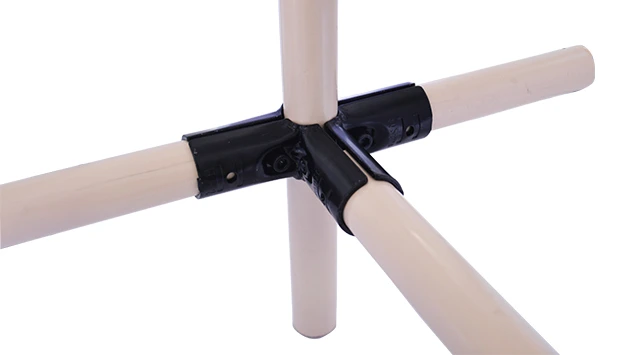
Four Way Straight Lean Pipe Joint
Four way lean pipe joint for 4 pcs 28MM lean pipe connection in straight angle, which used widely in workbench, flow rack, hand trolley frame connection.
The Human-Centric Shift in Manufacturing Workspaces
Walk into any modern manufacturing facility, and you'll notice a quiet revolution happening at the heart of production lines—the workstations. No longer clunky, static setups, today's workspaces are dynamic, adaptable, and designed with one key priority: the people using them. Ergonomics, once a buzzword, is now the backbone of efficient, sustainable production. At the center of this transformation lies a small but mighty component: the lean pipe joint. Specifically, the Four Way Straight Lean Pipe Joint, a unassuming connector that's redefining how we build and adapt workstations to fit human needs, not the other way around.
Ergonomic design isn't just about comfort—it's about reducing strain, preventing injuries, and boosting productivity. For workers spending 8+ hours a day at a workstation, even small inefficiencies can lead to chronic pain, missed shifts, or decreased focus. A poorly positioned shelf might mean constant bending; a fixed-height workbench could force tall workers to hunch or short workers to stretch. These aren't just inconveniences—they're barriers to doing the job well. That's where lean systems, built around flexible components like lean pipes and joints, step in. And among these components, the Four Way Straight Lean Pipe Joint stands out as a unsung hero of adaptability.
What Makes a Lean Workstation "Lean"?
Before diving into the specifics of the Four Way Straight Joint, let's clarify what a "lean workstation" really is. Lean manufacturing, at its core, is about eliminating waste—whether that's time, materials, or unnecessary movement. A lean workstation takes this philosophy and applies it to the physical space where work happens. It's not just a table or a bench; it's a thoughtfully designed ecosystem where tools, materials, and the worker's body move in harmony.
Key features of a lean workstation include modularity (easy to reconfigure), adjustability (fits different tasks and workers), and efficiency (materials and tools are within arm's reach). To achieve this, lean workstations rely on a system of components: lightweight pipes (often aluminum or steel), joints that connect these pipes, work surfaces, roller tracks for material flow, and accessories like casters or shelves. Every part has a purpose, but the joints are the glue that holds it all together—literally and figuratively. They determine how flexible the workstation can be, how quickly it can adapt, and ultimately, how well it supports the human behind the work.
Enter the lean pipe workbench: the most common form of a lean workstation. Typically built from aluminum or steel pipes connected by joints, these workbenches are customizable down to the smallest detail. Need a shelf for tools? Add a pipe and a joint. Want to lower the work surface for a new operator? Adjust the height using adjustable joints. But not all joints are created equal. Some are fixed, limiting flexibility. Others, like the Four Way Straight Lean Pipe Joint, are engineered to maximize adaptability—making them a cornerstone of ergonomic design.

The Four Way Straight Lean Pipe Joint: A Closer Look
At first glance, a Four Way Straight Lean Pipe Joint might seem like a simple piece of hardware: a small, often metal or plastic connector with four openings, designed to join four lean pipes at 90-degree angles. But its simplicity is deceptive. This joint is a masterclass in functional design, solving a critical challenge in workstation ergonomics: how to create multi-directional support without sacrificing stability or adjustability.
Design That Prioritizes Flexibility
Most lean pipe joints are designed for specific angles: 90-degree corners, T-junctions, or straight lines. The Four Way Straight Joint, however, adds a fourth connection point, allowing pipes to extend in four directions—up, down, left, and right—from a single hub. This might sound like a minor detail, but in practice, it's a game-changer. Imagine a workbench where you need to add a vertical shelf above the work surface, a horizontal tool rail to the left, and a lower shelf for materials to the right. With a standard three-way joint, you'd need multiple connectors, potentially creating a cluttered, unstable setup. With a Four Way Straight Joint, you can anchor all three additions (plus the main support pipe) to a single, central point. This not only streamlines the structure but also makes it easier to adjust each component independently.
Materials matter too. Many Four Way Straight Joints are made from aluminum or reinforced plastic, chosen for their lightweight strength. Aluminum, in particular, is a favorite in modern lean systems. Unlike heavy steel, aluminum is easy to handle, reducing the effort required to reconfigure the workstation. It's also resistant to corrosion, making it suitable for factory environments where moisture or chemicals might be present. When paired with aluminum profile pipes—another common component in lean workstations—the joint becomes part of a lightweight yet durable system that's easy to adjust without tools (or with minimal tools, like a hex key).
Ergonomic Benefits: It's All in the Adjustability
So, how does a four-directional joint directly support ergonomic design? Let's break it down with a real-world example. Meet Maria, an assembly line worker at a electronics manufacturer. Her task involves assembling small circuit boards, which requires precision and focus. A few months ago, her workstation was a fixed-height bench with a single shelf above, mounted too high for her 5'4" frame. To reach tools, she'd stretch her shoulders, leading to daily neck pain. The materials bin was on the floor, so she'd bend down dozens of times a day, straining her lower back. Productivity was good, but Maria was tired by lunchtime, and her doctor had warned her about repetitive strain injuries.
Then the facility upgraded to lean workstations using Four Way Straight Lean Pipe Joints. Here's what changed: Using the four-way joint, Maria's team reconfigured her workstation in under an hour. They lowered the upper shelf by 6 inches, positioning tools at eye level and arm's reach. They added a second, lower shelf (connected via the same four-way joint) to hold the materials bin, raising it to waist height—no more bending. They even added a small side rail for her frequently used tweezers and screwdrivers, extending from the joint to her dominant hand side. Overnight, Maria's neck pain vanished. She bent less, stretched less, and could focus on the circuit boards instead of her discomfort. Her productivity ticked up, and she reported feeling energized at the end of her shift.
This isn't a one-off story. The Four Way Straight Joint enables these kinds of adjustments because it provides a stable, central anchor for multiple components. Whether it's adjusting shelf heights, adding tool rails, or repositioning a roller track for material flow, the joint's four connection points mean you can make changes without rebuilding the entire workstation. And because the joint is often tool-adjustable (tightened or loosened with a simple wrench), reconfigurations take minutes, not hours. For facilities with rotating shifts or varying tasks, this flexibility is invaluable—one workstation can serve a tall operator in the morning and a shorter operator in the afternoon, with just a few tweaks.

Beyond the Joint: How Components Work Together for Ergonomics
The Four Way Straight Joint is powerful, but it doesn't work alone. To create a truly ergonomic lean workstation, it needs to collaborate with other components. Let's explore two key partners: aluminum profiles and roller tracks.
Aluminum Profiles: Lightweight Strength for Customization
Aluminum profile pipes are the backbone of many modern lean workstations, and for good reason. Unlike traditional steel pipes, aluminum profiles are lightweight (making them easy to adjust), rigid (supporting heavy tools and materials), and often feature T-slots—grooves along the length that allow accessories like shelves or tool holders to be attached without drilling. When paired with a Four Way Straight Joint, aluminum profiles become even more versatile. The joint's secure grip on the profile ensures that shelves or rails stay in place, even when loaded, while the T-slots let operators add or remove accessories quickly.
For example, a workstation using aluminum profiles and Four Way Straight Joints might include a tool rail with hanging bins for screws and washers. The rail is connected to the main frame via the four-way joint, and the bins slide along the T-slot—so Maria (from our earlier example) can position each bin exactly where she needs it, reducing the need to reach across the workbench. This level of customization isn't possible with fixed, non-T-slot pipes, making aluminum profiles a perfect match for the joint's flexibility.
Roller Tracks: Smoothing Material Flow, Reducing Strain
Another critical component in ergonomic workstations is the roller track. These tracks, made from plastic or metal rollers, allow materials to glide smoothly from one point to another—eliminating the need to lift, drag, or push heavy bins. When integrated into a lean workbench using Four Way Straight Joints, roller tracks become a seamless part of the workstation ecosystem.
Imagine a production line where circuit boards are assembled on a lean workbench, then need to move to the next station for testing. Instead of Maria picking up the board and carrying it (risking drops or strain), the workbench could have a roller track mounted along one edge, connected to the frame via a Four Way Straight Joint. The track is positioned at waist height, so she simply slides the board onto it, and gravity does the rest. The joint ensures the track is securely attached and can be angled slightly for optimal flow—no more bending to lift heavy items onto a high shelf or stooping to place them on the floor.
Roller tracks also support "point-of-use" material storage, a key lean principle. By mounting a roller track above or beside the workbench (using the four-way joint to connect it to the main frame), materials can be delivered directly to the workstation, and finished products can be moved out—all without the operator taking a step. This reduces unnecessary movement, a major source of fatigue in manufacturing.
Comparing Lean Pipe Joints: Why Four Way Straight Stands Out
Not all lean pipe joints offer the same level of flexibility. To understand why the Four Way Straight Joint is so valuable for ergonomics, let's compare it to other common joint types. The table below breaks down key features, from flexibility to ergonomic benefits, to help illustrate its unique advantages.
| Joint Type | Design Purpose | Flexibility Level | Ergonomic Benefit | Best Use Case |
|---|---|---|---|---|
| Four Way Straight Lean Pipe Joint | Connect four pipes in straight, perpendicular directions (up, down, left, right) | High: Supports multi-directional adjustments; ideal for adding shelves, rails, or tracks from a single point | Enables precise positioning of tools/materials at multiple heights/directions, reducing reaching/bending | Complex workstations with multiple storage/tool zones (e.g., assembly lines with varied tasks) |
| Three Way Lean Pipe Joint | Connect three pipes (e.g., T-junction or corner with one additional direction) | Moderate: Limited to three directions; requires multiple joints for complex setups | Good for basic adjustments but may create cluttered, less stable structures with multiple joints | Simple workbenches with one or two additional components (e.g., a single shelf above) |
| 90° Crossing Lean Pipe Joint | Connect two pipes crossing at 90° (e.g., vertical and horizontal pipes intersecting) | Low: Fixed angle; no multi-directional support | Minimal: Best for static structures where no adjustments are needed | Fixed frames or supports where flexibility isn't required (e.g., permanent shelving units) |
| Straight Lean Pipe Joint | Extend a single pipe in a straight line (no branching) | Very Low: No lateral or vertical support; only extends length | None: Designed for length, not ergonomic positioning | Long, straight structures like conveyor rails or beam extensions |
The table highlights a clear pattern: the more directions a joint can support, the more adaptable the workstation. The Four Way Straight Joint's ability to connect four pipes from a single point reduces the need for multiple joints, which not only simplifies the structure but also makes adjustments faster and more precise. For ergonomics, this means workers can tailor their workspace to their body—whether that's raising a shelf by an inch, adding a tool rail to the left, or lowering a roller track to waist height—without compromising stability.
Real-World Impact: How the Four Way Joint Transforms Workspaces
To put this into perspective, let's look at a case study from a mid-sized automotive parts manufacturer. The facility had been using traditional, fixed workbenches for years, and while production targets were met, employee turnover was high, and workers reported frequent back and shoulder pain. A consultant recommended switching to lean workstations built with aluminum profiles, roller tracks, and Four Way Straight Lean Pipe Joints. Here's what happened over six months:
- Reduced Injuries: Workers reported 40% fewer cases of back pain, and the number of strain-related absences dropped by 35%. Adjusting shelf heights and adding roller tracks eliminated constant bending and lifting.
- Faster Task Completion: With tools and materials positioned exactly where needed (thanks to the four-way joints' multi-directional support), average assembly time per unit decreased by 12%. Workers no longer wasted time reaching or searching for items.
- Improved Morale: In exit interviews, employees cited the "comfortable, customizable workspaces" as a key reason for staying. New hires reported feeling more supported and productive within their first week.
- Easy Reconfiguration: When the company introduced a new product line with larger parts, the workstations were reconfigured in hours (not days) by adjusting the four-way joints to add wider shelves and taller supports. Downtime was minimal, saving the company an estimated $10,000 in lost production.
This isn't an isolated success story. Across industries—from electronics to food packaging—facilities using Four Way Straight Joints and other flexible components are seeing similar results. The common thread? By prioritizing the worker's physical needs through adjustable, modular design, these workstations create a win-win: happier employees and healthier bottom lines.
Choosing the Right Components: Tips for Ergonomic Workstation Design
If you're considering building or upgrading to lean workstations, the Four Way Straight Lean Pipe Joint should be high on your list of components—but it's not the only factor to consider. Here are a few tips to ensure your workstation design prioritizes ergonomics:
Start with the Worker, Not the Parts
Before selecting joints or pipes, observe the people using the workstation. What tasks do they perform? How tall are they? What movements cause strain? For example, a worker who assembles small parts might need a lower work surface and magnifying lights, while someone handling large boxes might need a higher surface and heavy-duty roller tracks. The Four Way Joint can support both scenarios, but only if you design with the specific user in mind.
Invest in Quality Materials
Aluminum profiles and durable joints might cost slightly more upfront, but they pay off in the long run. Cheap, flimsy joints can loosen over time, leading to wobbly shelves or unstable work surfaces—both safety hazards. Look for joints with secure locking mechanisms (like set screws or friction fit) and corrosion-resistant materials, especially if the workstation is in a damp or dusty environment.
Don't Overlook Small Adjustments
Ergonomics is in the details. A Four Way Joint can add a shelf, but where exactly should that shelf be? The "golden zone" for tools and materials is between shoulder and knee height—items here require the least effort to reach. Use the joint to position frequently used items within this zone, and reserve lower or higher spaces for less often used supplies. Roller tracks should be angled slightly (1-3 degrees) to allow materials to glide smoothly without sliding too fast. These small tweaks make a big difference in daily comfort.
Train Teams to Adjust Their Workspaces
Even the most flexible workstation is useless if workers don't know how to adjust it. Train your team on how to loosen/tighten joints, reposition shelves, or add accessories. Encourage them to experiment—after all, no one knows their body better than they do. Consider creating a "workstation customization guide" with simple steps and diagrams, empowering employees to make adjustments on the fly.
The Future of Ergonomics: Where Lean Systems Are Headed
As manufacturing continues to evolve—with automation, AI, and changing workforce demographics—ergonomic design will only grow in importance. The next generation of lean workstations will likely integrate smart technology (e.g., sensors that alert workers to poor posture) and even more advanced materials (like carbon fiber pipes for ultra-lightweight setups). But at the core, the principles will remain the same: flexibility, adjustability, and a focus on the human element.
The Four Way Straight Lean Pipe Joint, in many ways, is a preview of this future. It's a simple component that solves a complex problem: how to build workspaces that adapt to people, not the other way around. In doing so, it's not just improving production lines—it's redefining what it means to work comfortably, safely, and sustainably.
So, the next time you walk into a manufacturing facility, take a closer look at the workstations. Chances are, you'll spot a Four Way Straight Joint holding it all together—quietly supporting the hands that build, assemble, and create. And in that quiet support lies a powerful truth: when we design for people, we design for success.