- Company Articles
- Products and Technology
- Product knowledge
- Lightweight Advantage: 3060 National Standard Profile A for Mobile Workstations

Lightweight Advantage: 3060 National Standard Profile A for Mobile Workstations
Related Product
3060 National Standard Profile A
Workbench, production line, logistic rack, warehouse rack Industry: Manufacturer workshop, Automobile, Electronic, Assembling, logistic
Imagine stepping onto a busy production floor—machines hum, workers move with purpose, and every second counts. In the middle of this organized chaos, you notice something: a team of two struggling to push a heavy workstation across the floor. It's slow, it's awkward, and by the time they get it into place, they're sweating through their uniforms. Meanwhile, on the other side of the factory, another worker glides a sleek, lightweight workstation into position with one hand, locks it in place, and gets right back to work. The difference? The second workstation is built with 3060 National Standard Profile A —a material that's redefining what mobile workstations can be.
For decades, manufacturers and warehouse managers have faced a frustrating trade-off: strength vs. mobility. Workstations needed to be tough enough to hold tools, parts, and equipment, but that often meant they were heavy, clunky, and a hassle to reposition. Downtime spent moving workstations, worker fatigue from manual handling, and limited flexibility in floor layouts—these were just part of the daily grind. But in recent years, a quiet revolution has been unfolding in industrial design, and it starts with a simple aluminum profile: the 3060 National Standard Profile A. In this article, we'll dive into why this unassuming piece of metal is becoming the backbone of modern mobile workstations, how its lightweight design solves age-old problems, and why it's more than just a material upgrade—it's a game-changer for lean, efficient operations.
What Even Is 3060 National Standard Profile A?
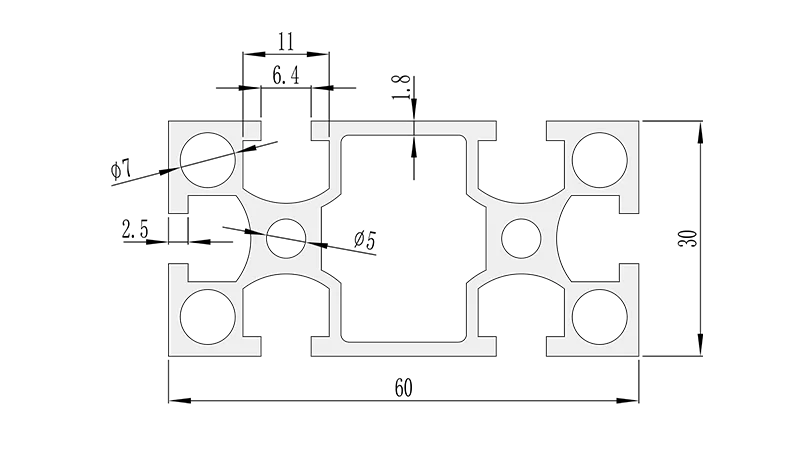
Let's start with the basics. If you're not familiar with industrial aluminum profiles, they're essentially extruded aluminum bars with a specific cross-sectional shape, designed to be strong, modular, and easy to assemble. The "3060" in the name refers to its dimensions: 30 millimeters in width and 60 millimeters in height. The "National Standard" tag means it meets strict quality and dimensional standards set by industry regulators, ensuring consistency whether you buy it from one supplier or another. And "Profile A" denotes its specific cross-sectional design—think of it as the "model" of the profile, with unique T-slots, wall thickness, and structural reinforcements that set it apart from other 3060 variants.
But why does any of this matter? Let's break it down. Unlike generic aluminum pipes or steel bars, 3060 National Standard Profile A is engineered for functionality . Its T-slots—those grooved channels running along its length—are the secret sauce. They let you attach aluminum profile accessories like brackets, shelves, tool holders, and even caster wheels without welding or drilling. Just slide a bolt into the slot, tighten a nut, and you're done. It's like building with industrial Legos, but for grown-ups who need their creations to withstand the rigors of a factory floor.
| Profile Type | Dimensions (WxH, mm) | Weight per Meter (kg) | Max Load Capacity (kg) | Ideal Application |
|---|---|---|---|---|
| 2020 National Standard Profile | 20x20 | 0.8 | 50-80 | Light-duty shelving, small tool racks |
| 3060 National Standard Profile A | 30x60 | 1.5 | 150-200 | Mobile workstations, material handling carts |
| 4040 National Standard Profile | 40x40 | 2.2 | 250-300 | Heavy-duty assembly lines, fixed workbenches |
The table above puts things in perspective. At just 1.5 kg per meter, 3060 Profile A is significantly lighter than the 4040 profile (2.2 kg/m) but still packs a punch with a max load capacity of 150-200 kg—more than enough for most workstation needs, like holding power tools, bins of parts, or even a small assembly setup. Compare that to the tiny 2020 profile, which can barely handle 80 kg, and it's clear why 3060 Profile A hits the sweet spot for mobility and strength.
The Lightweight Revolution: Why "Less" Becomes "More"
Let's talk about the elephant in the room (or the workstation on the floor): weight. For years, "heavy" was equated with "tough." Steel workstations were the gold standard because they could take a beating—but they came with a cost. A typical steel workstation might weigh 150-200 kg empty. Add tools, parts, and a worker leaning on it, and you're looking at 250+ kg. Moving that? You'd need two people, maybe a forklift, and a lot of time. And if you needed to reconfigure the floor layout for a new product run? Forget it—you'd be rearranging workstations once a quarter, not once a week.
Enter 3060 National Standard Profile A. At 1.5 kg per meter, a standard mobile workstation frame (say, 2 meters long on each side, with vertical supports) might weigh just 30-40 kg. Add a worktop, aluminum profile accessories , and even a few caster wheels , and the total weight might hit 60-80 kg. That's light enough for one person to move—no straining, no waiting for help, no forklift required. Suddenly, reconfiguring the production floor isn't a weekend project; it's a 10-minute task between shifts.
But lightweight doesn't just mean easier movement. It means less wear and tear on your facility. Steel workstations scratch floors, dent walls, and put stress on concrete slabs. 3060 Profile A? Its smooth aluminum surface and lighter weight are gentler on floors, reducing repair costs. And for workers, the benefits are personal. Lower physical strain means fewer injuries, less fatigue, and higher morale. A study by the National Institute for Occupational Safety and Health (NIOSH) found that reducing manual handling loads by just 20% can cut workplace injuries by up to 35%. Imagine what a 50% reduction (from 200 kg to 80 kg) could do for your team's well-being.
Debunking the "Lightweight = Weak" Myth
Skeptics might raise an eyebrow: "If it's that light, is it strong enough?" It's a fair question. Let's put it to the test. Aluminum has a reputation for being "softer" than steel, but 3060 Profile A isn't made from your average soda can aluminum. It's crafted from 6063-T5 aluminum alloy—a heat-treated material known for its excellent strength-to-weight ratio. T5 heat treatment involves cooling the extrusion quickly and then artificially aging it, which strengthens the aluminum without making it brittle.
In real-world terms, this means a 3060 Profile A workstation can easily support a 50 kg tool chest, a 30 kg bin of components, and a worker leaning on the edge—all without bending or warping. I visited a electronics manufacturer in Ohio last year that switched to 3060 Profile A workstations, and their production manager, Sarah, told me: "We were worried they'd flex under heavy tools, but after six months, not a single frame has warped. The old steel ones? We had to replace two a year because they'd bend when we moved them. These aluminum ones? They just glide, and they stay straight."
Another test: impact resistance. I've seen workers accidentally knock a 3060 Profile A workstation with a pallet jack (don't tell OSHA). The result? A small scratch, but the frame held. Steel might not scratch as easily, but it dents—permanently. Aluminum's malleability actually works in its favor here: minor impacts cause surface damage, not structural failure.
Aluminum Profile Accessories: The Unsung Heroes
A profile is only as good as the accessories that bring it to life, and 3060 National Standard Profile A has a whole ecosystem of aluminum profile accessories designed to make your workstation smarter, more functional, and uniquely yours. Let's walk through the essentials.
First, connectors. The T-slots in 3060 Profile A work with a variety of connectors: 90° angle brackets for corners, straight connectors for extending lengths, and even 135° brackets for odd angles. These aren't flimsy plastic pieces—they're die-cast aluminum or steel, designed to lock the profile in place and distribute weight evenly. I once watched a technician assemble a workstation frame using just these connectors and an Allen wrench; it took him 20 minutes, start to finish. No welding, no cutting, no mess.
Then there are the worktop supports. Whether you want a wooden, metal, or phenolic resin top, there are brackets that slide into the T-slots and hold the worktop securely. Some even have height-adjustable features, so you can raise or lower the workstation by a few inches to fit different workers—no more one-size-fits-all discomfort.
Tool holders are another game-changer. Need a place to hang screwdrivers, wrenches, or power cords? There are T-slot-compatible tool hooks, pegboards, and even magnetic strips that attach directly to the profile. A mechanic at a car parts plant I visited had customized his 3060 workstation with a tool holder that kept his most-used tools within arm's reach. "I used to waste 5 minutes a day digging through a toolbox," he said. "Now, everything's right there. That adds up to 25 minutes a week—almost two hours a month of extra work time."
And let's not forget caster wheels . The mobility of 3060 Profile A workstations hinges on these small but critical components. You can choose from swivel casters for 360° movement, brake casters to lock the workstation in place, or heavy-duty casters for rough floors. The best part? Attaching them is a breeze: most caster mounts are designed to slide into the T-slots, so you can swap out casters if your needs change (e.g., switching from hard-floor casters to carpet-friendly ones).
Lean System Compatibility: Mobile Workstations That Think Like You Do
In today's manufacturing world, "lean" isn't just a buzzword—it's a way of life. Lean systems focus on eliminating waste, streamlining processes, and maximizing value. And 3060 National Standard Profile A? It's a lean manager's dream come true.
Let's start with waste reduction. Traditional steel workstations are often custom-built, which means if you need to change their layout, you either live with inefficiency or throw them away and start over. 3060 Profile A, with its modular design, lets you repurpose components. Need a longer workstation? Add more profile sections. Need to remove a shelf? Just unscrew the brackets. No waste, no extra cost—just adaptability.
Then there's "motion waste"—the time and energy workers spend moving around. A lightweight, mobile workstation can be positioned right next to the assembly line, reducing the steps a worker takes to grab parts or tools. At a medical device factory in Texas, they used to have workers walk 15 feet to a fixed tool cart every time they needed a specific drill bit. After switching to mobile 3060 Profile A workstations, they moved the tools to the workers. The result? A 12% increase in assembly speed, just from cutting down on walking.
Space optimization is another lean win. In a busy factory, floor space is gold. 3060 Profile A workstations are sleek and compact, with a small footprint. When not in use, they can be nested together or rolled into a corner, freeing up space for other tasks. A warehouse manager I spoke to called it "space on demand." "During peak season, we need 10 workstations spread out," he said. "Off-season, we stack them in a corner and use the space for storage. With steel workstations, we'd have to rent extra space or leave them cluttering the floor year-round."
Real-World Impact: Stories from the Factory Floor
Numbers and specs are great, but nothing tells the story like real people. Let's look at two case studies of businesses that switched to 3060 National Standard Profile A mobile workstations and never looked back.
Case Study 1: Small Electronics Manufacturer
A 50-person electronics plant in Oregon was struggling with bottlenecks in their circuit board assembly line. Their old steel workstations were heavy and fixed, so each worker was stuck in one spot, passing boards down the line. If a machine broke down, the whole line stopped while they reconfigured. They switched to 3060 Profile A workstations with
caster wheels
and modular tool holders. Now, if a machine is down, they can move two workstations together to create a temporary assembly station, keeping production going. Worker turnover also dropped—employees cited "less physical strain" as a key reason for staying. In the first year, they saw a 15% increase in output and a 20% decrease in workplace injuries.
Case Study 2: Automotive Parts Warehouse
A warehouse storing automotive parts needed a way to move small parts bins to different picking stations quickly. Their old wooden carts were heavy and prone to breaking. They replaced them with 3060 Profile A material carts (similar to Material Rack B, but mobile) with roller tracks for easy bin sliding. The carts weighed 70% less than the wooden ones, so pickers could move them with one hand. Picking speed increased by 25%, and cart maintenance costs dropped by 80% (no more rotting wood or loose wheels).
Installation, Maintenance, and Longevity
You might be thinking, "This all sounds great, but is it hard to install? Will it last?" Let's address both.
Installation is surprisingly simple. Most 3060 Profile A systems come with pre-cut lengths (or you can cut them yourself with a hacksaw or miter saw), and the aluminum profile accessories are designed for DIY assembly. You don't need special training—just a few basic tools: an Allen wrench, a tape measure, and maybe a level. Many suppliers even offer online tutorials or assembly guides. A small business owner I know assembled 10 workstations with his two sons over a weekend—no prior experience required.
Maintenance is equally easy. Aluminum is naturally resistant to rust and corrosion, so even in damp or dusty environments, it holds up. A quick wipe with a damp cloth every few weeks is usually enough to keep it clean. The T-slots can collect dust, but a small brush or compressed air will clear them out. For caster wheels , just check the bearings occasionally and add a drop of oil if they start squeaking. Compared to steel, which needs regular painting to prevent rust, 3060 Profile A is practically maintenance-free.
As for longevity, aluminum profiles can last 10-15 years with proper care—longer than most steel workstations, which often rust or bend beyond repair in 5-7 years. And when it does reach the end of its life, aluminum is 100% recyclable, so you're not contributing to landfill waste. It's a sustainable choice that aligns with modern corporate responsibility goals.
The Future of Mobile Workstations
As manufacturing and warehousing continue to evolve—with trends like automation, flexible production, and on-demand manufacturing—mobile workstations will only grow in importance. And 3060 National Standard Profile A is poised to lead the way.
One emerging trend is integrating smart technology. The T-slots in 3060 Profile A are perfect for mounting IoT sensors—temperature monitors, weight sensors, even RFID readers to track tools. Imagine a workstation that alerts you when parts are running low, or a cart that logs its location in the warehouse via GPS. With 3060 Profile A, these aren't just ideas—they're already being tested in forward-thinking facilities.
Sustainability is another driver. As companies aim to reduce their carbon footprints, the recyclability and energy efficiency of aluminum (it takes 95% less energy to recycle aluminum than to produce it from raw ore) make 3060 Profile A an eco-friendly choice. Governments are even offering tax incentives for businesses that switch to sustainable materials, making the investment even more appealing.
Is 3060 National Standard Profile A Right for You?
At the end of the day, the best way to know if 3060 Profile A is right for your mobile workstations is to ask yourself a few questions: Do you need workstations that can be moved by one person? Do you value flexibility (e.g., reconfiguring layouts, adding/removing components)? Is worker comfort and safety a priority? If you answered "yes" to any of these, it's worth considering.
It's not a one-size-fits-all solution, of course. If you're building a workstation that needs to hold 500 kg of equipment, you might need a heavier profile like 4080. But for most applications—assembly workstations, material carts, tool trolleys, or small parts storage—3060 National Standard Profile A hits the mark. It's lightweight without being weak, flexible without being flimsy, and affordable without cutting corners.
In a world where efficiency, adaptability, and worker well-being are more important than ever, 3060 National Standard Profile A isn't just a material—it's a tool for building better workspaces, better processes, and better businesses. So the next time you see a worker struggling with a heavy workstation, remember: there's a lighter, smarter way. And it starts with a simple aluminum profile.