- Company Articles
- Products and Technology
- Product knowledge
- Load Capacity Guide: T Slot Aluminum Pipe with Board Holder for Heavy-Duty Use

Load Capacity Guide: T Slot Aluminum Pipe with Board Holder for Heavy-Duty Use
Related Product
T Slot Aluminum Pipe with Board Holder
T slot Aluminum pipe with board holder,the pipe one side connected by a joint, the other side with a slot which can hold a tray or a aluminum pannel
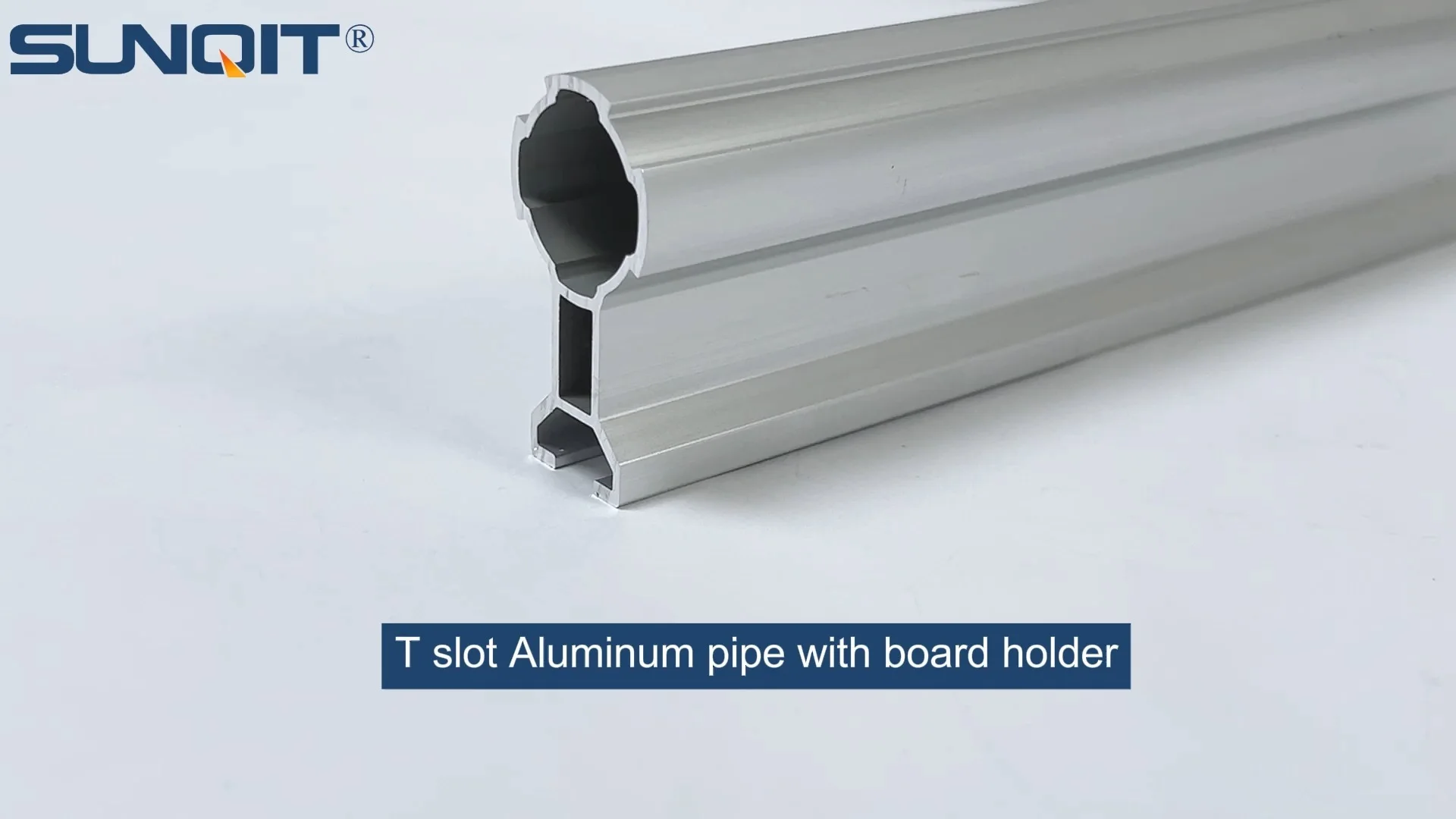
In the world of manufacturing, warehousing, and workshop design, the backbone of efficiency often lies in the tools and structures we rely on daily. Among these, the t slot aluminum pipe with board holder stands out as a quiet workhorse—unassuming, yet critical to keeping operations running smoothly. Whether you're building a sturdy workbench for assembly lines, a material rack for heavy components, or integrating a lean system to streamline workflows, understanding the load capacity of these aluminum structures isn't just a technical detail—it's the difference between a setup that lasts for years and one that falters under pressure. This guide dives deep into what makes t slot aluminum pipes and their board holders tick, how to calculate their load limits, and why choosing the right components—from aluminum profile accessories to adjustable leveling feet—can transform your workspace into a hub of reliability and safety.
1. What Are T Slot Aluminum Pipes and Board Holders, Anyway?
Let's start with the basics. T slot aluminum pipes—often called aluminum extrusion profiles—are precisely engineered tubes with a "T" shaped groove running along their length. This groove isn't just a design quirk; it's a versatile feature that lets you attach accessories like brackets, connectors, and yes, board holders, without welding or drilling. Think of it as a modular building system: you can customize lengths, angles, and configurations on the fly, making it ideal for everything from simple workbenches to complex production lines.
The board holder, specifically, is the component that bridges the gap between the aluminum pipe and your work surface—whether that's a wooden tabletop, a metal sheet, or a plastic board. It clamps securely into the T slot, providing a stable base to support the weight of tools, materials, or equipment placed on top. Unlike rigid, one-size-fits-all alternatives, these holders are adjustable, so you can tweak their position to distribute weight evenly or accommodate different board sizes. Pair this with aluminum profile accessories like gussets, corner codes, or end caps, and you've got a system that's as flexible as it is strong.
Why aluminum, though? For starters, it's lightweight—far easier to handle than steel, especially when building or reconfiguring structures. But don't let its lightness fool you: aluminum alloys like 6061 and 6063 (common in extrusion profiles) offer impressive strength-to-weight ratios, resisting bending and warping even under heavy loads. They're also corrosion-resistant, which is a boon in humid workshops or outdoor settings, and their smooth, anodized finish adds a professional touch while preventing scratches. When you combine these traits with the modularity of T slots, it's no wonder t slot aluminum pipes have become a go-to for lean system setups and custom workbench builds.
2. Why Load Capacity Matters More Than You Think
Imagine a scenario: A small electronics manufacturer invests in a new workbench built with t slot aluminum pipes. They skimp on researching load capacity, assuming "aluminum is strong enough," and place a 200kg testing machine on top. A week later, the bench starts to sag. The machine tilts, damaging a batch of circuit boards. Production halts. The team has to disassemble the bench, replace bent pipes, and restart—all while losing time and money. This isn't just a hypothetical; it's a cautionary tale about underestimating load capacity.
Load capacity refers to the maximum weight a structure can safely support without deforming, breaking, or becoming unstable. For t slot aluminum pipes with board holders, it's determined by a mix of factors: the pipe's dimensions, material strength, how the board holder is attached, and even the spacing between supports. Ignore this, and you risk not just equipment damage, but worker safety. A collapsed workbench or material rack could lead to injuries, lawsuits, or worse.
But it's not just about avoiding disasters. Proper load capacity planning also boosts efficiency. A workbench that's rated for 300kg but only holds 100kg is underutilized, wasting space and resources. Conversely, overloading a setup leads to frequent repairs, downtime, and the need to replace components prematurely. In lean system environments, where every second counts, this inefficiency can ripple through the entire production line, slowing output and increasing costs. Simply put, knowing your load capacity ensures you get the most out of your t slot aluminum investment—safety, longevity, and productivity all in one.

3. Breaking Down Load Capacity: Static vs. Dynamic, and What They Mean for You
When shopping for t slot aluminum pipes, you'll often see two load ratings: static and dynamic. Understanding the difference is key to choosing the right setup.
Static load capacity is the weight a structure can support when the load is stationary—think a workbench holding tools that rarely move, or a material rack storing boxes that sit for days. This is the most common rating you'll need, as most workshop setups involve static loads. For example, a 40x40mm t slot aluminum pipe with a 2mm wall thickness might have a static load capacity of 500kg per linear meter when supported at both ends. That means if your workbench is 1.5 meters long, the total static load it can handle (evenly distributed) would be around 333kg (since the weight is spread over 1.5m).
Dynamic load capacity , on the other hand, applies when the load is moving—like a conveyor belt transporting parts, or a trolley rolling over aluminum guide rails. Dynamic loads exert more stress because of momentum; a 100kg box sliding onto a rack isn't the same as placing it gently. For t slot aluminum systems, dynamic load ratings are usually lower than static ones. A pipe that handles 500kg static might only support 300kg dynamically, so if your application involves movement, you'll need to factor this in.
| T Slot Aluminum Pipe Size (mm) | Wall Thickness (mm) | Material Grade | Static Load Capacity (kg/m)* | Dynamic Load Capacity (kg/m)* | Ideal Use Case |
|---|---|---|---|---|---|
| 20x20 | 1.5 | 6063-T5 | 150-200 | 80-120 | Light workbenches, shelving for small parts |
| 30x30 | 2.0 | 6063-T5 | 300-350 | 180-220 | Medium-duty workbenches, tool racks |
| 40x40 | 2.0 | 6061-T6 | 450-500 | 280-320 | Heavy workbenches, material racks, lean system stations |
| 40x80 | 2.5 | 6061-T6 | 700-800 | 450-500 | Industrial assembly lines, large equipment platforms |
*Load capacities are approximate and based on evenly distributed weight with supports at both ends. Actual values may vary by manufacturer and installation quality.
Another term to watch for is deflection —how much the pipe bends under load. Even if a pipe doesn't break, excessive deflection (say, more than 1/300th of the pipe length) can make the setup unstable. For example, a 1.8m pipe that bends 6mm under load is within safe limits, but 12mm of bend might cause tools to slide or materials to shift. Always check manufacturer specs for deflection limits, especially for precision work like electronics assembly or lab setups.

4. The Hidden Factors That Affect Load Capacity
You might think, "I'll just buy the thickest t slot aluminum pipe available, and load capacity won't be an issue." While pipe size matters, it's only one piece of the puzzle. Let's unpack the hidden factors that can make or break your setup's ability to handle heavy loads.
4.1 Pipe Dimensions: It's Not Just About Thickness
Yes, a 40x40mm pipe with a 2.5mm wall will support more weight than a 20x20mm pipe with 1.5mm walls. But within the same size category, design plays a role. Look for pipes with reinforced internal ribs —these add rigidity without adding much weight. For example, a 40x40mm pipe with a "double T" slot design (two parallel T slots) is stiffer than a basic square pipe of the same size. Also, consider the pipe's length: longer spans mean more deflection. A 40x40mm pipe might handle 500kg over 1m, but over 2m, that drops to 250kg. Always factor in span length when calculating total load.
4.2 Board Holders: The Unsung Heroes of Weight Distribution
Even the strongest pipe won't help if the board holder fails. Board holders—also called "tabletop brackets"—attach the work surface (wood, metal, or plastic) to the t slot aluminum frame. Their design determines how evenly weight is spread across the pipes. Cheap plastic holders might crack under heavy loads, while metal holders with multiple T slot attachments distribute weight better. Look for holders with gusseted bases (triangular reinforcements) and large contact areas with the board—these reduce stress on both the holder and the pipe. For example, a steel board holder with two T slot bolts per side will secure the board more firmly than a plastic one with a single bolt, preventing the board from shifting and overloading one section of the pipe.
4.3 Aluminum Profile Accessories: Small Parts, Big Impact
Aluminum profile accessories like corner codes, gussets, and connectors might seem minor, but they're critical for load capacity. A workbench frame made with 40x40mm pipes but connected with flimsy plastic corners will wobble under load, even if the pipes themselves are strong. Instead, opt for metal corner brackets (preferably aluminum or steel) with bolts that tighten into the T slots. Gussets—triangular plates that reinforce joints—add rigidity, especially at 90-degree angles. For example, adding a gusset to the corner of a workbench leg and frame can increase load capacity by 20-30%. Don't skimp here: cheap accessories turn a robust system into a weak link.
4.4 Aluminum Pipe Adjustable Leveling Feet: Stability Starts at the Ground
Ever tried balancing a heavy box on a wobbly table? The same principle applies to t slot aluminum setups. Uneven floors cause stress to concentrate on certain pipes, reducing overall load capacity. That's where aluminum pipe adjustable leveling feet come in. These small, threaded feet screw into the bottom of the pipes, letting you tweak each leg's height to level the structure. But not all leveling feet are created equal. Look for feet with large, non-slip bases (to prevent sinking into concrete) and high weight ratings (at least as much as the pipe's load capacity). For example, if your workbench is rated for 500kg, each leveling foot should support at least 125kg (since there are four legs). Cheap plastic feet might crack, while metal ones with rubber pads will keep the setup stable and distribute weight evenly.
4.5 Installation: Torque, Spacing, and Common Mistakes
Even the best components fail with poor installation. When attaching board holders or accessories to t slot aluminum pipes, use the right torque for the bolts. Too loose, and the holder shifts; too tight, and you strip the T slot or crack the pipe. Most manufacturers recommend 2-3 Nm of torque for M5 bolts (common in T slots). Also, space supports evenly: for a 2m workbench, adding a middle support (so three supports total, spaced 1m apart) doubles the load capacity compared to just two supports at the ends. And avoid over-tightening leveling feet—snug is good, but cranking them down can bend the pipe or damage the floor.
5. Choosing the Right T Slot Aluminum Pipe and Board Holder for Your Needs
Now that you know what affects load capacity, how do you pick the right setup? It starts with answering one question: What will you actually put on it? List every item that will sit on the workbench or rack—tools, materials, equipment—and calculate their total weight. Add 20% to that number for a safety buffer (because loads often increase over time, or someone might place something heavier than expected). Then, use that total to guide your choices.
For example, if you need a workbench to hold a 250kg milling machine, your total load (with buffer) is 300kg. If the bench is 1.5m long, you'll need pipes rated for at least 200kg/m (300kg / 1.5m). Looking back at our earlier table, a 30x30mm pipe with 2.0mm wall (300-350kg/m static) would work, but a 40x40mm pipe (450-500kg/m) gives extra peace of mind. Pair that with steel board holders, metal corner brackets, and aluminum pipe adjustable leveling feet rated for 100kg each, and you've got a setup that's built to last.
Don't forget to consider future needs. A workshop that starts with small parts might expand to heavier equipment later. Investing in a slightly over-rated system now (e.g., 40x40mm pipes instead of 30x30mm) saves you from rebuilding later. And if you're unsure, ask the supplier for load capacity charts—reputable t slot aluminum suppliers will have detailed specs for their products, including how span length and accessories affect ratings.
6. Real-World Applications: How Load Capacity Shapes Lean Systems and Workbenches
To see load capacity in action, let's look at two real-world examples—one in automotive manufacturing, and another in a warehouse lean system.
6.1 Automotive Assembly Workbench
A mid-sized auto parts manufacturer needed a workbench for assembling engine components. Each assembly station holds a 150kg engine block, plus tools (50kg) and parts bins (30kg), totaling 230kg per station. They chose 40x40mm t slot aluminum pipes (6061-T6, 2.0mm wall) with a static load capacity of 450kg/m. The workbench is 1.2m long, so the total load per meter is 230kg / 1.2m ≈ 192kg/m—well under the pipe's rating. They added steel board holders with gusseted bases, aluminum profile accessories like corner gussets, and aluminum pipe adjustable leveling feet (150kg rating each). The result? A stable, wobble-free workbench that's supported thousands of engine assemblies over three years with zero failures.
6.2 Warehouse Material Rack for Heavy Parts
A logistics company needed a material rack for storing metal castings (20kg each, 10 per shelf). With three shelves, total load per rack is 20kg x 10 x 3 = 600kg. They went with 40x80mm aluminum extrusion profiles (2.5mm wall, 700-800kg/m static) for the vertical supports and 40x40mm pipes for the shelves. The shelves are 1.8m long, with supports every 0.6m (three supports per shelf), distributing the load to 600kg / 3 shelves = 200kg per shelf, or ~111kg/m per shelf—well within the 40x40mm pipe's capacity. They used roller track accessories (from their aluminum profile accessories kit) to slide castings in and out easily, and the entire rack is secured with metal connectors and leveling feet. Even with daily use, the rack shows no signs of deflection, proving that proper load capacity planning pays off.
7. Maintenance: Keeping Your T Slot Aluminum System Strong for Years
Load capacity isn't a "set it and forget it" feature. Over time, bolts loosen, aluminum profiles can corrode (in harsh environments), and leveling feet wear down. Regular maintenance ensures your system stays safe and efficient.
Weekly checks: Tighten any loose board holder bolts or leveling feet. Look for signs of deflection (sagging shelves or workbenches). If a pipe bends more than 1/300th of its length (e.g., 6mm for a 1.8m pipe), it's time to reinforce or replace it.
Monthly checks: Inspect aluminum profile accessories for cracks or corrosion. Clean T slots with a soft brush to remove dust and debris, which can jam accessories. Lubricate roller tracks (if used) with a dry silicone spray to keep movement smooth.
Quarterly checks: Verify leveling feet are still even. Use a spirit level to ensure the workbench or rack hasn't tilted over time. replace any worn feet (e.g., cracked rubber pads) or damaged board holders immediately—don't wait for a failure.
8. Conclusion: Load Capacity as the Foundation of a Strong Workspace
At the end of the day, t slot aluminum pipes with board holders are more than just building materials—they're the foundation of a workspace that's safe, efficient, and adaptable. By understanding load capacity, choosing the right components (from t slot aluminum pipes and aluminum profile accessories to sturdy board holders and aluminum pipe adjustable leveling feet), and maintaining your setup, you're not just investing in a workbench or rack—you're investing in the reliability of your entire operation.
Whether you're building a single workbench or overhauling a lean system, remember: load capacity isn't an afterthought. It's the first step in creating a workspace that works for you, not against you. So take the time to calculate, choose wisely, and build with confidence—your team, your equipment, and your bottom line will thank you.