- Company Articles
- Products and Technology
- Product knowledge
- Load Capacity of 2.0mm Stainless Steel Pipe: What You Need to Calculate

Load Capacity of 2.0mm Stainless Steel Pipe: What You Need to Calculate
Related Product
2.0mm Stainless Steel Pipe
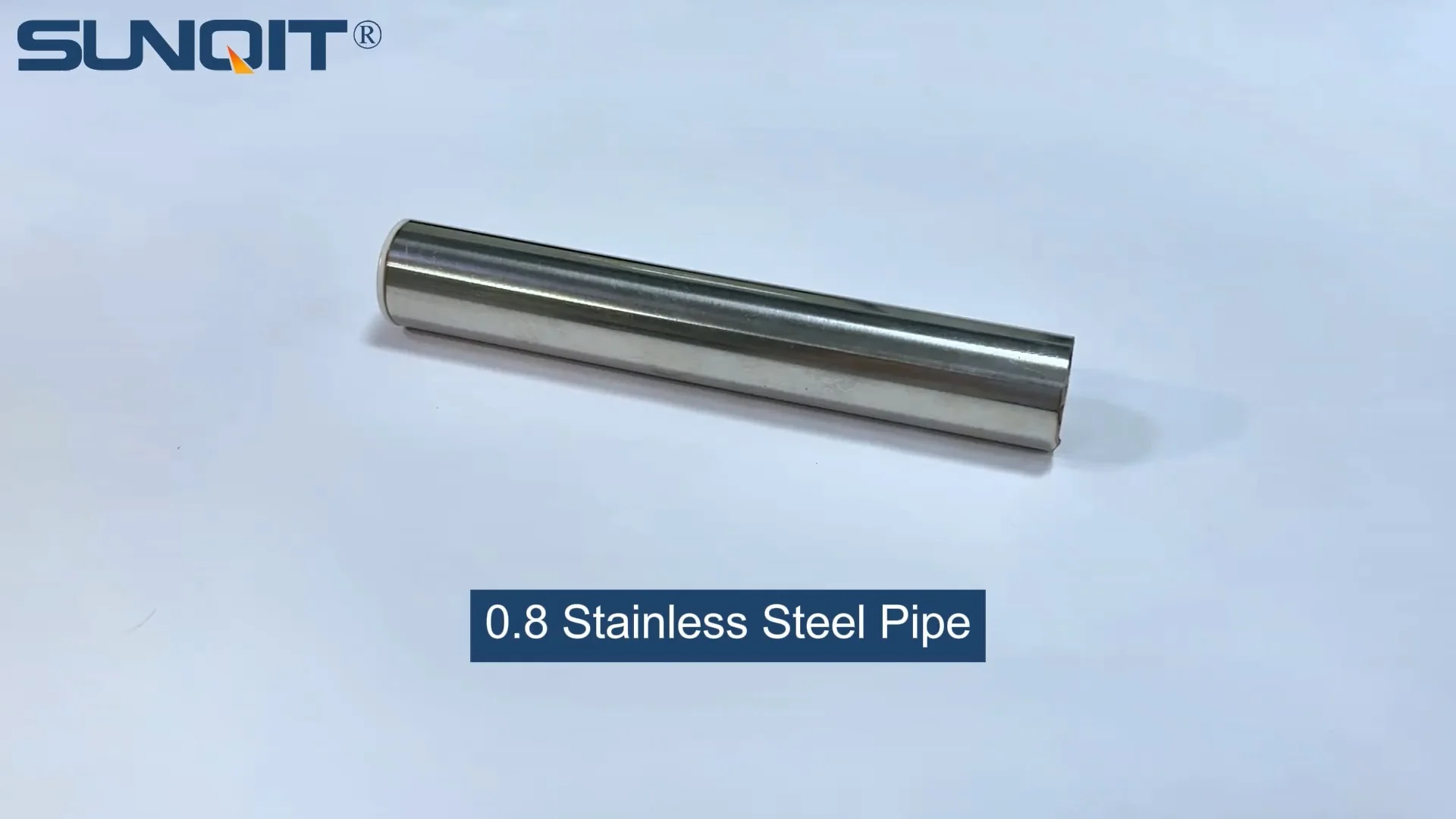
Stainless steel pipe, lean pipe, diameter is 28mm, material is SS201 or SS304, SS201 is normally used in the market. It knows a KARAKURI, KAIZEN material for industrial plant to improve efficiency, save labor cost, standard management.
Walk into any busy manufacturing plant, and you'll likely spot rows of workbenches, material racks, and assembly lines humming with activity. Behind that seamless workflow is a silent hero: the humble stainless steel pipe. But not all pipes are created equal. If you've ever wondered why some workbenches sag under toolboxes while others stand firm for years, the answer often lies in one critical detail: load capacity. And when it comes to durability and strength, the 2.0mm stainless steel pipe stands out in the stainless steel pipe series—but only if you calculate its load capacity correctly.
Let's start with a scenario many workshop managers know too well. A team needs a new workbench for assembling delicate electronics. They order a frame made of stainless steel pipe, assuming "stainless steel" equals "strong enough." But within weeks, the bench starts to bow in the middle, tools slide off, and productivity takes a hit. The culprit? No one stopped to calculate if the 2.0mm stainless steel pipe they chose could actually handle the daily load of 50kg toolboxes, 20kg circuit boards, and the occasional technician leaning on it. That's where understanding load capacity isn't just engineering jargon—it's the difference between a smooth operation and costly downtime.
What Even Is "Load Capacity," Anyway?
Before we dive into calculations, let's demystify the term. Load capacity is simply the maximum weight a structure—like a pipe, beam, or workbench—can safely support without bending, breaking, or deforming permanently. Think of it as the pipe's "strength limit." Exceed that limit, and you're looking at warped frames, unstable work surfaces, or worse, safety hazards.
For 2.0mm stainless steel pipe, this number isn't arbitrary. It's shaped by the pipe's material, dimensions, how it's supported, and even the environment it's in. And while stainless steel is known for being tough, the 2.0mm thickness is a sweet spot for many applications: thick enough to be sturdy, but lightweight enough to keep structures like workbenches or material racks from being overly bulky. That's why it's a staple in the stainless steel pipe series for lean manufacturing setups.
Why 2.0mm Stainless Steel Pipe? A Quick Look at the Stainless Steel Pipe Series
Stainless steel pipes come in various thicknesses—0.8mm, 1.0mm, 1.2mm, 1.5mm, 2.0mm, and beyond. Each has its place. Thinner pipes (like 0.8mm or 1.0mm) work for lightweight racks or temporary structures, while thicker ones (3.0mm+) handle heavy machinery. But 2.0mm? It's the workhorse of the bunch. Here's why:
- Balance of strength and weight: 2.0mm walls provide enough rigidity to support moderate loads without making the pipe too heavy to install or move. This is key for modular setups, where you might need to reconfigure a workbench or trolley later.
- Corrosion resistance: Stainless steel's chromium layer fights rust, but thickness matters. A 2.0mm pipe holds up better in humid workshops or environments with oils and chemicals than thinner options, which can scratch or corrode faster.
- Cost-effectiveness: Thicker pipes cost more, but 2.0mm hits the mark for most small-to-medium industrial needs. You're not overpaying for unnecessary thickness, but you're also not skimping on durability.
To put this in perspective, let's compare it to other options in the stainless steel pipe series. A 1.2mm pipe might save you a few dollars upfront, but it'll sag under 30kg of tools. A 3.0mm pipe could handle 100kg easily, but if you're building a mobile trolley, that extra weight makes it hard to push around. 2.0mm? It's the Goldilocks of pipes—just right for most everyday industrial tasks.

The Big Factors That Shape Load Capacity
Calculating load capacity isn't as simple as looking up a single number online. It's a puzzle with several pieces. Let's break down the main factors that determine how much weight your 2.0mm stainless steel pipe can handle.
1. Material Grade: Not All Stainless Steel Is Created Equal
Stainless steel comes in grades, and each grade has different strength properties. The two most common for industrial pipes are 304 and 316. 304 is the standard—it's strong, affordable, and resists corrosion in dry or mildly humid environments. 316 adds molybdenum, making it better for wet or salty conditions (think coastal factories or food processing plants). But here's the kicker: 316 is slightly stronger than 304. So a 2.0mm 316 stainless steel pipe will have a higher load capacity than a 2.0mm 304 pipe of the same diameter.
How much of a difference? Let's say you have a 25mm diameter 2.0mm pipe. A 304 grade might handle 80kg over a 1m span, while 316 could handle 85kg. Not massive, but enough to matter if your load is right on the edge. Always check the grade with your lean pipe supplier—they should have specs on the material's tensile strength (how much it can stretch before breaking) and yield strength (how much it can bend and still spring back).
2. Pipe Dimensions: Diameter + Thickness = Strength
We already know the thickness is 2.0mm, but diameter matters just as much. A 20mm diameter 2.0mm pipe vs. a 30mm diameter 2.0mm pipe? The 30mm one will support more weight. Why? Because the larger diameter increases the pipe's "moment of inertia"—a fancy term for how resistant it is to bending. Think of it like a ruler: a wider ruler (larger diameter) bends less than a narrow one when you push down on the ends.
Most 2.0mm stainless steel pipes in industrial use have diameters between 20mm and 50mm. For example, a 25mm diameter pipe is common for workbench frames, while 40mm might be used for heavier material racks. The key takeaway? Thickness alone isn't enough—you need to pair 2.0mm with the right diameter for your load.
3. Support: How You Mount It Makes or Breaks It
Imagine holding a ruler by one end and pushing down on the other—it bends like a noodle. Now hold it at both ends and push the middle—it barely moves. The same logic applies to pipes. How you support your 2.0mm stainless steel pipe drastically affects its load capacity. The main support scenarios are:
- Fixed at both ends (like a workbench leg between two shelves): This is the strongest setup. The pipe can handle more weight because the load is distributed between two solid supports.
- Fixed at one end, free at the other (like a cantilever rack): The weakest setup. All the weight is concentrated at the unsupported end, so load capacity drops significantly.
- Supported at intervals (like a conveyor with rollers every 50cm): More supports mean less bending. Adding a support in the middle of a 2m span can nearly double the load capacity.
For example, a 25mm diameter 2.0mm 304 stainless steel pipe fixed at both ends over a 1m span might handle 100kg. If you change that to a cantilever (fixed at one end, 1m span), it might only handle 30kg. That's a huge difference! Always sketch out your support points before calculating.
4. Span Length: The Longer the Pipe, the Less It Can Hold
Span length is the distance between two supports. A pipe spanning 50cm between two shelves will hold more weight than the same pipe spanning 2m. Why? Because bending increases with the square of the span length. In non-math terms: double the span, and the bending (and thus, the load it can handle) drops by four times. Let's use numbers to make it real:
Take a 30mm diameter 2.0mm 304 stainless steel pipe, fixed at both ends. Over a 50cm span, it might hold 200kg. Over 1m? 50kg. Over 2m? 12.5kg. Yikes! That's why long spans need either thicker pipes, larger diameters, or more supports. If you're building a workbench that's 2m long, you can't just use two 2.0mm pipes as the main beams—you'll need to add a middle support, or switch to a larger diameter.
5. Load Type: Static vs. Dynamic
Is the weight sitting still (static load) or moving (dynamic load)? A static load is a toolbox sitting on a workbench all day. A dynamic load is a technician placing a 20kg box on the bench (which adds extra force as it's lowered) or a trolley rolling over a pipe frame. Dynamic loads are harder on pipes because they create sudden stress—think of dropping a book on a table vs. placing it gently. The table (or pipe) feels more force when dropped.
To account for this, engineers use a "safety factor." For static loads, a safety factor of 1.5 is common (meaning the pipe's calculated load capacity should be 1.5x the actual load). For dynamic loads, it jumps to 2.0 or even 2.5. So if your workbench needs to hold 50kg of static tools, you need a pipe that can handle 75kg (50kg x 1.5). If you're rolling 50kg trolleys over a pipe frame (dynamic), aim for 100kg (50kg x 2.0). Better safe than sorry!

Let's Do the Math: Calculating Load Capacity Step-by-Step
Okay, enough theory—let's calculate the load capacity of a 2.0mm stainless steel pipe. We'll use a common scenario: building a workbench with a 25mm diameter 2.0mm 304 stainless steel pipe, fixed at both ends, spanning 1m, supporting a static load. Here's how to do it:
Step 1: Find the Pipe's Moment of Inertia (I)
Moment of inertia (I) measures the pipe's resistance to bending. For a hollow pipe (which stainless steel pipes are), the formula is:
I = (π/64) x (D⁴ – d⁴)
Where:
- π = 3.14
- D = outer diameter (mm)
- d = inner diameter (mm) = D – (2 x thickness). Since thickness is 2.0mm, d = D – 4.0mm.
For our 25mm diameter pipe: D = 25mm, d = 25 – 4 = 21mm.
Plugging in: I = (3.14/64) x (25⁴ – 21⁴) = (0.049) x (390,625 – 194,481) = 0.049 x 196,144 ≈ 9,611 mm⁴.
Step 2: Determine the Modulus of Elasticity (E)
E is a measure of how "stiff" the material is. For 304 stainless steel, E is about 193 GPa (gigapascals), which is 193,000 MPa (megapascals). We'll need to convert this to N/mm² (newtons per square millimeter) since our I is in mm⁴. 1 MPa = 1 N/mm², so E = 193,000 N/mm².
Step 3: Calculate Maximum Deflection (δ)
Deflection is how much the pipe bends under load. For most industrial applications, we limit deflection to 1/200 of the span length (to prevent tools sliding or permanent bending). For a 1m (1000mm) span, that's δ = 1000mm / 200 = 5mm. So the pipe can bend up to 5mm, but no more.
Step 4: Use the Bending Formula to Find Load Capacity (W)
For a pipe fixed at both ends with a uniform load (like a workbench surface), the formula for maximum deflection is:
δ = (5 x W x L³) / (384 x E x I)
We need to solve for W (the total load in newtons, where 1kg = 9.81N). Rearranging the formula:
W = (δ x 384 x E x I) / (5 x L³)
Plugging in our numbers:
- δ = 5mm
- E = 193,000 N/mm²
- I = 9,611 mm⁴
- L = span length = 1000mm
W = (5 x 384 x 193,000 x 9,611) / (5 x (1000)³)
Simplify numerator: 5 cancels out, so (384 x 193,000 x 9,611) ≈ 384 x 1.85 x 10⁹ ≈ 7.1 x 10¹¹
Denominator: 1000³ = 1 x 10⁹
W ≈ 7.1 x 10¹¹ / 1 x 10⁹ = 710 N. Convert to kg: 710 N / 9.81 ≈ 72kg.
So our 25mm diameter 2.0mm 304 stainless steel pipe, fixed at both ends over 1m, can safely hold ~72kg with a maximum deflection of 5mm. Add the safety factor for static loads (1.5), and the recommended working load is 72kg / 1.5 ≈ 48kg. That's right—you should only put 48kg on it to be safe!
Need a Cheat Sheet? Use This Table for Common Scenarios
Not everyone has time to crunch numbers with π and exponents. That's why we've put together a quick-reference table for 2.0mm stainless steel pipes (304 grade) in common diameters and spans. Remember, these are estimates—always confirm with your lean pipe supplier for exact specs!
| Pipe Diameter (mm) | Span Length (m) | Support Type | Max Load Capacity (kg, 304 Grade) | Common Application |
|---|---|---|---|---|
| 20mm | 0.5m | Fixed at both ends | 65kg | Small tool rack |
| 20mm | 1.0m | Fixed at both ends | 16kg | Lightweight shelf divider |
| 25mm | 0.5m | Fixed at both ends | 140kg | Workbench frame (short span) |
| 25mm | 1.0m | Fixed at both ends | 35kg | Workbench crossbeam |
| 30mm | 1.0m | Fixed at both ends | 72kg | Heavy-duty workbench top frame |
| 30mm | 2.0m | Supported at 0.5m intervals (3 supports total) | 55kg | Material rack beam |
Real-World Example: Building a Workbench with 2.0mm Stainless Steel Pipe
Let's put this all together with a practical project: building a 2m long workbench for an electronics assembly line. The workbench needs to support:
- Two 40kg toolboxes (total 80kg)
- Daily assembly materials (30kg)
- A technician occasionally leaning on the edge (70kg, dynamic load)
Total static load: 80kg + 30kg = 110kg. Dynamic load (the lean) adds 70kg, so we need to account for both. Let's design the frame:
Step 1: Choose the pipe diameter. From the table, a 30mm diameter 2.0mm pipe over 1m spans (fixed at both ends) holds 72kg. But our workbench is 2m long. If we use two 30mm pipes as the main beams (left and right), and add a middle support (so each beam spans 1m instead of 2m), each beam will handle 72kg. Two beams? 72kg x 2 = 144kg. That's more than our 110kg static load.
Step 2: Check dynamic load. The technician leaning (70kg) is a dynamic load, so we need to use a safety factor of 2.0. Our total dynamic load is 70kg, so the beams need to handle 70kg x 2 = 140kg. Our two beams can handle 144kg, which is just enough.
Step 3: Add crossbars for stability. Even with main beams, crossbars (using 20mm 2.0mm pipes) every 50cm will prevent the top from sagging between the main beams. From the table, 20mm pipes over 0.5m spans handle 65kg each—more than enough to support the 30kg materials spread out.
Result? A sturdy workbench that stays flat, tools don't slide, and the team can focus on building instead of fixing wobbly surfaces. And because we used 2.0mm stainless steel pipe, it's resistant to the cleaning chemicals used daily in the factory—no rust, no replacement needed for years.
5 Mistakes to Avoid (So You Don't Waste Time or Money)
Even with calculations, it's easy to slip up. Here are the most common errors we see when people work with 2.0mm stainless steel pipe:
1. Ignoring the Environment
Stainless steel resists corrosion, but saltwater, acids, or high humidity can weaken it over time. If your workbench is near a coastal area or a chemical plant, a 2.0mm 304 pipe might corrode faster, reducing its load capacity. Spend the extra on 316 grade or ask your lean pipe supplier about protective coatings.
2. Overlooking Joints and Connectors
Pipes are only as strong as their connections. A 2.0mm pipe with a flimsy plastic joint will fail before the pipe itself. Use metal joints rated for your load, and tighten them properly. Your lean pipe supplier should have joint specs—for example, a 30mm pipe joint might only handle 50kg, even if the pipe can handle 72kg.
3. Forgetting Dynamic Loads
We talked about this earlier, but it's worth repeating: dropping a box on the workbench or leaning on it adds extra force. Always multiply dynamic loads by 2.0 (or ask your supplier for their recommended safety factor).
4. Using the Wrong Span Calculation
If your pipe is supported by another structure (like a shelf bracket that's 10cm wide), the actual span is the distance between the inner edges of the supports, not the outer edges. A 1m bracket spacing with 10cm brackets means the span is 80cm, not 1m. That small mistake can make your load capacity calculation off by 30%.
5. Assuming "Stainless Steel" = "Indestructible"
Stainless steel is tough, but it's not magic. A 2.0mm pipe will bend if you hit it with a forklift or overload it consistently. Train your team to respect the load limits—post them on the workbench if needed!
When to Call in the Pros (Your Lean Pipe Supplier)
Let's be real: not everyone has the time or desire to calculate moment of inertia or modulus of elasticity. That's where your lean pipe supplier comes in. A good supplier won't just sell you pipes—they'll help you engineer the right solution. Here's what to ask them:
- "Can you provide load test reports for your 2.0mm stainless steel pipe?" Reputable suppliers test their products and have data on how much weight different configurations can handle.
- "What grade of stainless steel do you use for these pipes?" Make sure it's 304 or 316, depending on your environment.
- "Do you have design examples for workbenches or racks using 2.0mm pipe?" They might have templates that save you time.
- "What's the best joint type for my load?" They can recommend metal vs. plastic joints based on weight.
A supplier who can't answer these questions? Run. You need a partner who understands both the product and your application.
Final Thoughts: It's All About the "Why"
Calculating the load capacity of 2.0mm stainless steel pipe might seem like extra work, but it's really about protecting your team, your productivity, and your bottom line. A workbench that sags isn't just annoying—it's a sign that corners were cut, and corners cut in manufacturing often lead to bigger problems down the line.
So the next time you're ordering pipes for a project, take 10 minutes to sketch the supports, check the diameter, and confirm the grade. Use the table we provided, or shoot your lean pipe supplier an email with your load and span. Your future self (and your team) will thank you when the workbench stays solid, the tools stay put, and the assembly line keeps humming.
After all, in lean manufacturing, "lean" doesn't mean cutting corners on strength. It means building smart—with the right materials, the right calculations, and the confidence that your 2.0mm stainless steel pipe can handle whatever the day throws at it.