- Company Articles
- Products and Technology
- Product knowledge
- Load Capacity of 4040E EU Standard Aluminum Profile: Safe Weight Limits for Industrial Use

Load Capacity of 4040E EU Standard Aluminum Profile: Safe Weight Limits for Industrial Use
Related Product
4040E EU Standard Aluminum Profile
4040E is a 4.00x4.00 CM fractional 40 series square extrusion T-slot profile with two side open T-slots, two side with closed face, each side with 4.00cm face. The profile has align-a-grooves to assist in aligning connecting profiles.
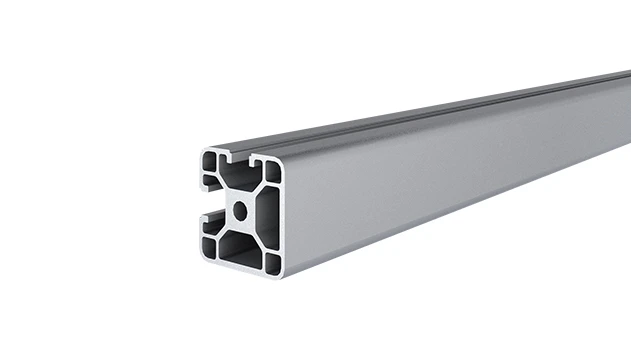
Walk into any modern manufacturing facility, warehouse, or assembly plant, and you'll likely spot a familiar sight: sturdy, silver-gray structures holding up workbenches, guiding conveyor belts, or organizing tools. These unsung heroes of industrial efficiency are aluminum profiles—and among them, the 4040E EU standard aluminum profile stands out as a workhorse. But here's the question that keeps facility managers and engineers up at night: How much weight can this profile actually handle? It's not just about numbers on a spec sheet; it's about safety, productivity, and avoiding costly downtime. Let's dive into the world of 4040E aluminum profiles, break down their load capacity, and explore how to use them safely in real-world industrial settings.
What Is the 4040E EU Standard Aluminum Profile, Anyway?
Before we talk about weight limits, let's make sure we're all on the same page about what a 4040E aluminum profile is. Aluminum profiles—often called aluminum extrusion profiles —are created by pushing heated aluminum alloy through a die to form consistent, custom cross-sections. The "4040" in 4040E refers to its dimensions: approximately 40mm in width and 40mm in height, making it a square or near-square profile. The "E" denotes a specific European standard, meaning it adheres to strict manufacturing tolerances for dimensions, material quality, and performance set by EU regulations.
Why does this matter? In industrial settings, consistency is key. When you order a 4040E profile, you know exactly what you're getting—no surprises in thickness, straightness, or alloy composition. This predictability is critical when designing structures that need to support heavy loads day in and day out. Unlike generic aluminum tubes, which might vary in quality, EU-standard profiles are engineered for reliability, making them a go-to choice for everything from assembly line workbenches to automated conveyor systems.
But the profile itself is just one piece of the puzzle. To build functional structures, you'll need aluminum profile accessories —things like connectors, brackets, end caps, and hinges. These accessories lock the profiles together, distribute weight, and ensure the entire system stays rigid under load. Think of the profile as the bones of your structure, and the accessories as the joints and ligaments holding it all together. A strong bone is useless if the joints are weak, right?
The Basics of Load Capacity: What Determines How Much a 4040E Profile Can Hold?
Load capacity isn't a one-size-fits-all number. A 4040E profile might safely hold 200kg in one setup but fail under 50kg in another. Why? It depends on several key factors, each of which plays a role in how the profile bends, twists, or deforms under pressure. Let's break them down:
1. Material Thickness and Alloy Type
Not all 4040E profiles are created equal. The most common alloys used are 6063 and 6061, both known for their strength and corrosion resistance. 6063 is often used for general-purpose applications, while 6061 (with higher silicon and magnesium content) offers better tensile strength—important for heavy loads. Then there's wall thickness: a profile with a 2.0mm wall will handle more weight than one with a 1.5mm wall, even if they're the same size and alloy. Most 4040E profiles on the market have walls between 1.2mm and 3.0mm, with 2.0mm being a popular middle ground for balance between strength and weight.
2. Span Length (Distance Between Supports)
Imagine holding a ruler at both ends: it's stiff and can support a small weight in the middle. Now hold it by one end only, and it bends dramatically—even with no weight. The same principle applies to aluminum profiles. The "span length" is the distance between two supports (like brackets or posts), and it's the single biggest factor in load capacity. The longer the span, the less weight the profile can handle without excessive bending (deflection). For example, a 4040E profile with a 500mm span might hold 150kg, but stretch that span to 1500mm, and the capacity could drop to 30kg or less.
3. Support Configuration
How many supports do you have? A profile supported at both ends (two supports) will carry more weight than one supported at only one end (cantilevered). Add a third support in the middle, and capacity jumps even higher. Engineers call this "static indeterminacy"—more supports mean weight is distributed across more points, reducing stress on any single section of the profile.
4. Load Type: Static vs. Dynamic
Is the weight sitting still (static load) or moving (dynamic load)? A box sitting on a shelf is static; parts sliding down a roller track or a robot arm moving over a workbench create dynamic loads. Dynamic loads are harder on structures because they add momentum and vibration. A profile that handles 100kg static might only safely handle 70kg dynamic, as the extra force from movement can cause fatigue over time.
5. Connection Quality
Even the strongest profile will fail if its connections are weak. Loose bolts, misaligned brackets, or using the wrong aluminum profile accessories can turn a stable structure into a safety hazard. For example, using a plastic connector meant for light-duty shelving on a heavy workbench could lead to the joint snapping under load. Always match accessories to the profile's intended use—manufacturers usually provide guidelines for which connectors work best with 4040E profiles.

Safe Weight Limits: Real-World Data for 4040E Profiles
Now that we understand the factors, let's get to the numbers. Below is a data table showing typical load capacities for 4040E aluminum profiles under different conditions. Note that these are general guidelines—always check with your profile manufacturer for exact specs, as alloy, thickness, and manufacturing processes can vary.
| Span Length (mm) | Alloy & Wall Thickness | Support Configuration | Static Load Capacity (kg) | Dynamic Load Capacity (kg) | Max Deflection (mm)* |
|---|---|---|---|---|---|
| 500 | 6063, 2.0mm | Two supports (ends) | 180–220 | 120–150 | 1.5–2.0 |
| 500 | 6061, 2.0mm | Two supports (ends) | 220–250 | 150–180 | 1.0–1.5 |
| 1000 | 6063, 2.0mm | Two supports (ends) | 60–80 | 40–55 | 3.0–4.0 |
| 1000 | 6063, 2.0mm | Three supports (ends + middle) | 140–170 | 95–120 | 1.5–2.0 |
| 1500 | 6063, 3.0mm | Three supports (ends + middle) | 90–110 | 60–75 | 2.5–3.5 |
| 2000 | 6061, 3.0mm | Four supports (evenly spaced) | 70–90 | 45–60 | 3.0–4.5 |
*Max deflection is the maximum amount the profile will bend under load. For most industrial applications, keep deflection under 1/200 of the span length (e.g., 5mm for a 1000mm span) to avoid structural stress or equipment damage.
Let's put these numbers in context. A 500mm span with two supports (6063 alloy, 2.0mm wall) can hold 180–220kg statically—enough for a heavy tool chest, a stack of metal parts, or even a small assembly robot. But if you need to span 1000mm with only two supports, that capacity drops to 60–80kg. That's still useful for lighter items, like bins of screws or plastic components, but not for heavy machinery.
Notice how adding supports makes a big difference. At 1000mm, switching from two supports to three (adding a middle support) more than doubles the static load capacity, from 60–80kg to 140–170kg. That's why many industrial workbenches use multiple supports—they maximize strength without needing thicker, heavier profiles.
Also, dynamic loads are consistently lower than static loads. If you're designing a workbench where parts are frequently moved or dropped, factor in that 30–40% reduction. A workbench with a 1000mm span and three supports (6063, 2.0mm) can handle 140kg static, but if workers are regularly placing 100kg parts on it, you're pushing the dynamic limit (95–120kg). To be safe, aim for dynamic loads that are 20–30% below the static capacity—this gives a buffer for unexpected impacts or wear over time.
Practical Applications: Where 4040E Profiles Shine
Understanding load capacity is one thing; applying it to real-world setups is another. Let's look at three common industrial applications where 4040E profiles are used, and how to ensure they're loaded safely.
1. Workbenches: The Backbone of Assembly Lines
A workbench is often the center of an assembly line, holding tools, parts, and sometimes heavy equipment like soldering stations or testing machines. When building a workbench with 4040E profiles, start by determining the span between the legs (supports). Most workbenches are 1200–1800mm long, so let's say 1500mm. Using the table above, a 1500mm span with 6063, 2.0mm walls, and three supports (legs at 0mm, 750mm, 1500mm) would have a static capacity of around 140–170kg. But a typical workbench top (wood, metal, or plastic) adds 10–20kg, so the remaining capacity is 120–150kg for tools and parts.
Pro tip: If workers will stand on the bench (e.g., to reach high shelves), add extra supports. A 100kg person standing in the middle of a 1500mm span would push the dynamic load to around 100kg, which is within the 120–150kg buffer if the static capacity is 140kg. But if two people stand there, you're looking at 200kg—way over the limit. In that case, use 6061 alloy (higher strength) or add a fourth support at 500mm and 1000mm to boost capacity.
2. Material Racks: Storing Heavy Inventory
Material racks—like the "material rack b (3 row and 3 floor)" mentioned in some supplier lists—use horizontal 4040E profiles to hold bins, boxes, or pallets. For a rack with 1000mm horizontal spans between vertical posts, using 6063, 2.0mm profiles with two supports (ends) gives a static capacity of 60–80kg per shelf. If you need to store heavier items (e.g., metal components), switch to 6061 alloy, which bumps capacity to 80–100kg per shelf, or add a middle support to hit 140–170kg.
Another consideration: vertical load. The horizontal profiles rest on vertical 4040E posts, which must support the total weight of all shelves above. A 3-floor rack with 80kg per shelf (3 shelves) plus 10kg per shelf for the shelf itself equals 270kg per vertical post. 4040E vertical posts can handle this easily—vertical load capacity is much higher than horizontal, as compression is easier to resist than bending. But ensure the posts are anchored to the floor with heavy-duty brackets to prevent tipping.
3. Lean Systems: Streamlining Workflows
In lean system setups—where efficiency and waste reduction are key—4040E profiles are used for everything from flow racks to conveyor supports. Flow racks, which use gravity to move parts from the back to the front, rely on sloped 4040E profiles with roller tracks. The slope adds a dynamic element (parts sliding), so dynamic load capacity is critical. For a 1000mm sloped span with two supports, a 6063, 2.0mm profile can handle 40–55kg dynamic. If you're moving small parts (e.g., electronics components), this is more than enough. For heavier parts (e.g., automotive brackets), use 6061 or add supports to keep loads under 55kg per linear meter.
Conveyor supports are another lean system application. Conveyors vibrate as they run, creating dynamic loads, so supports should be spaced no more than 500mm apart for 4040E profiles. This keeps spans short, ensuring the profile can handle the conveyor's weight plus the product being transported without excessive deflection.
Calculating Load for Your Specific Setup: A Step-by-Step Guide
Not all setups fit neatly into the table above. Maybe you have a custom workbench with uneven spans, or a rack with angled supports. Here's how to calculate load capacity for your unique scenario:
Step 1: Gather Profile Specs
Find your 4040E profile's datasheet from the manufacturer. Look for: alloy type (6063 vs. 6061), wall thickness (mm), and moment of inertia (I)—a measure of the profile's resistance to bending (higher = stiffer). You'll also need the modulus of elasticity (E) for the alloy (typically 69 GPa for 6063, 70 GPa for 6061).
Step 2: Define Your Span and Supports
Measure the span length (L) between supports in meters. Note the number of supports and their positions (e.g., two supports at ends, three supports at 0, L/2, L).
Step 3: Choose a Deflection Limit
Most industrial standards recommend a maximum deflection (δ) of L/200 to L/300. For example, a 1000mm span (1m) would have a deflection limit of 5mm (1000/200) to 3.3mm (1000/300). Excessive deflection can damage equipment or cause parts to slide incorrectly.
Step 4: Use the Bending Formula
For a simply supported beam (two supports at ends) with a uniform load, the formula is: δ = (5 * w * L⁴) / (384 * E * I), where w is the load per meter (kg/m). Rearranging to solve for w: w = (δ * 384 * E * I) / (5 * L⁴). Convert w to total load by multiplying by L (span length in meters).
Example: 1000mm (1m) span, δ = 5mm (0.005m), E = 69 GPa (69,000 MPa), I for 4040E 2.0mm wall ≈ 8.5 cm⁴ (85000 mm⁴). Plugging in: w = (0.005m * 384 * 69,000 MPa * 85000 mm⁴) / (5 * (1m)⁴). After unit conversion, this gives w ≈ 75 kg/m, so total load = 75 kg/m * 1m = 75kg—close to the 60–80kg range in our table! This confirms the table is a good starting point.
Step 5: Add a Safety Factor
Always multiply the calculated load by 0.7–0.8 to account for dynamic loads, material variations, and wear. In the example above, 75kg * 0.8 = 60kg—your safe dynamic load. This matches the table's 40–55kg range (since our example uses a higher deflection limit of 5mm).
Common Mistakes to Avoid When Using 4040E Profiles
Even with the best intentions, it's easy to miscalculate or overlook something. Here are five common mistakes and how to avoid them:
1. Overlooking Dynamic Loads
Many people only consider static load when designing, forgetting that movement adds stress. If your structure will have moving parts, always use dynamic load capacity. A quick rule of thumb: multiply static capacity by 0.6–0.7 to get a safe dynamic limit.
2. Using the Wrong Accessories
Cheap plastic connectors or mismatched brackets are a recipe for failure. Aluminum profile accessories are designed to work with specific profile sizes and loads. For 4040E, use heavy-duty metal connectors (like "internal rotatary aluminum joint" or "90° aluminum profile connector") rated for at least the profile's load capacity. Avoid mixing brands—accessories from different manufacturers may have slightly different tolerances.
3. Ignoring Corrosion or Temperature
Aluminum resists corrosion, but in humid or chemical-heavy environments (e.g., food processing, automotive painting), it can still degrade over time. Anodized or powder-coated 4040E profiles offer extra protection. Similarly, extreme temperatures (below -20°C or above 60°C) can weaken aluminum—check the manufacturer's specs for temperature limits.
4. Poor Installation
Loose bolts, misaligned supports, or uneven floors can cause uneven load distribution. Tighten all connections to the manufacturer's torque specs, use a level to ensure supports are vertical/horizontal, and shim under legs if the floor is uneven. A 1° tilt in a support can increase deflection by 10–15%.
5. Overestimating "Safety" with Thicker Walls
It's tempting to buy the thickest wall profile available (e.g., 3.0mm instead of 2.0mm) to "be safe," but this adds unnecessary weight and cost. Thicker profiles are heavier, harder to transport, and require stronger supports. Use the calculations above to find the minimum wall thickness needed for your load—you'll save money and make assembly easier.
Choosing the Right 4040E Profile and Accessories for Your Needs
With so many options, how do you pick the right 4040E profile and accessories? Start by answering these questions:
- What's the maximum load per structure? Use the table or bending formula to determine required capacity.
- Will loads be static or dynamic? Dynamic loads need higher-strength alloys or more supports.
- What's the span length? Longer spans need thicker walls, stronger alloys, or more supports.
- What's the environment like? Corrosive or high-temperature environments need anodized/powder-coated profiles.
- Do you need adjustability? If you might reconfigure the structure later, choose aluminum profile accessories with quick-release bolts or rotatable joints (like "internal rotatary aluminum joint").
When in doubt, consult your supplier. Reputable aluminum profile suppliers have engineers who can help you design a system that meets your load requirements while staying within budget. They can also provide test data for their specific profiles, which is more accurate than generic tables.
Conclusion: Safety, Efficiency, and the Power of 4040E Profiles
The 4040E EU standard aluminum profile is more than just a piece of metal—it's a building block for safe, efficient industrial spaces. By understanding its load capacity, considering factors like span length, support configuration, and load type, and choosing the right aluminum profile accessories , you can design structures that handle heavy loads without compromising on safety or productivity.
Whether you're building a workbench, a material rack, or a lean system workflow, remember: the numbers matter, but so does common sense. Always err on the side of caution, test prototypes if possible, and never assume a profile can handle more than its rated capacity. With the right approach, 4040E profiles will keep your operations running smoothly, your workers safe, and your bottom line healthy.