- Company Articles
- Products and Technology
- Product knowledge
- M10*56 Rubber Leveling Feet for 3C Product Assembly Workstations

M10*56 Rubber Leveling Feet for 3C Product Assembly Workstations
Related Product
M10*56 Rubber Leveling Feet
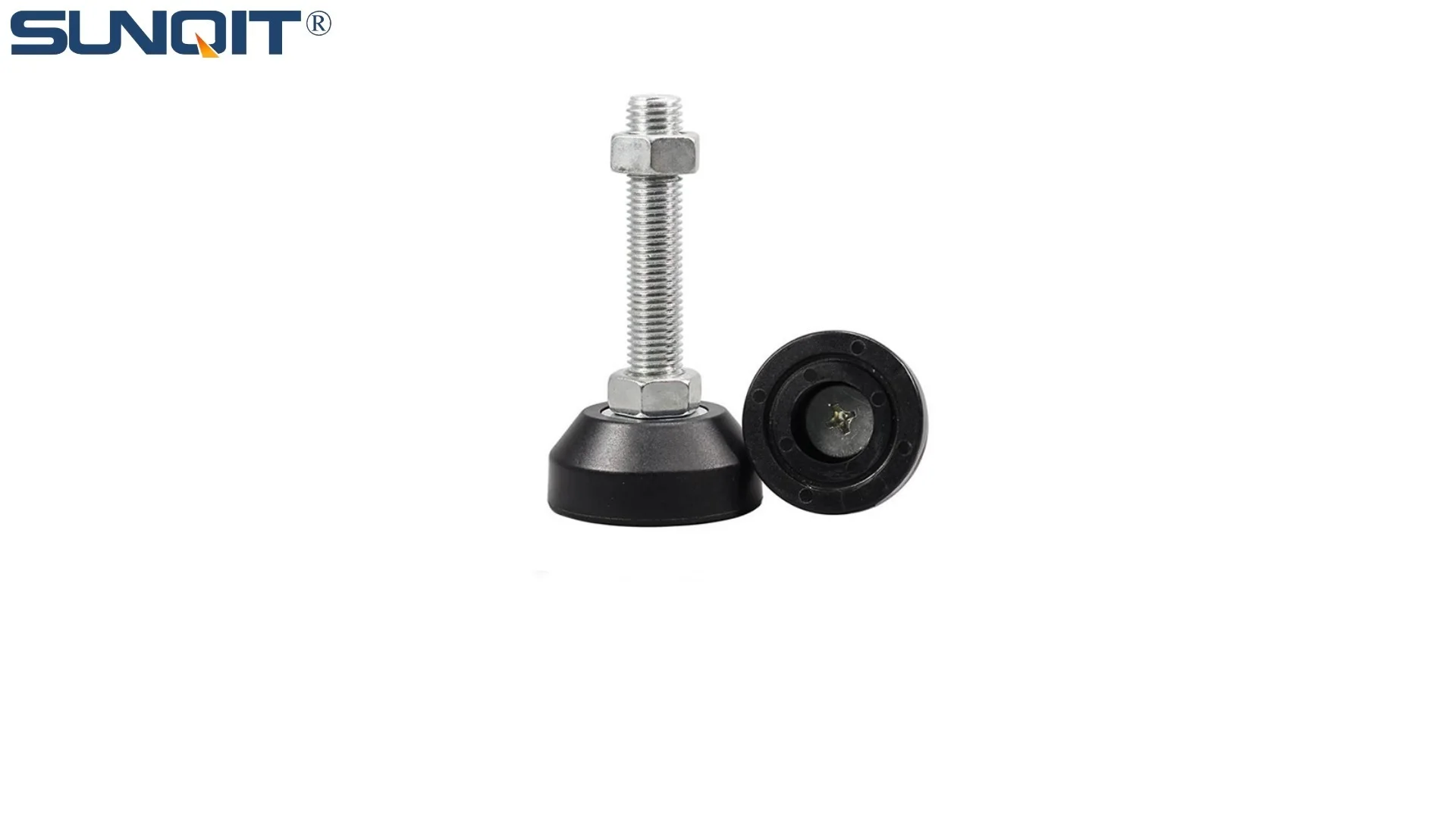
Adjustable leveling feet are designed to keep machines level when placed on uneven or sloped ground. Otherwise known as adjustable equipment feet, they are available to order in a wide variety of size and load capacity combinations.
Walk into any 3C manufacturing facility—where smartphones, laptops, smartwatches, and other electronic gadgets come to life—and you'll see a symphony of precision. Workers hunched over workbenches, carefully placing microchips smaller than a grain of rice onto circuit boards; robotic arms gliding smoothly to solder connections with pinpoint accuracy; quality inspectors squinting through magnifying glasses to check for the tiniest defects. In this world of micrometers and milligrams, every detail matters. But there's one component so, so easy to overlook, that even seasoned production managers might not give it a second thought—until it fails. That component? The humble leveling foot. Specifically, the M10*56 Rubber Leveling Feet that keep those critical workbenches steady, ensuring that every solder, every placement, and every inspection is done on a surface you can trust.
In this article, we're going to shine a light on these unsung heroes. We'll explore why stability is non-negotiable in 3C assembly, dive into what makes the M10*56 Rubber Leveling Feet stand out from the crowd, and explain how they integrate seamlessly with workbenches, lean pipe systems, and aluminum profiles to create the reliable foundation modern factories depend on. Whether you're a production manager looking to optimize your assembly line, a procurement specialist sourcing components, or just someone curious about the nuts and bolts (literally) of electronics manufacturing, this is the guide you didn't know you needed.
Why Stability Matters More Than You Think in 3C Assembly
Let's start with the basics: Why does a wobbly workbench matter? In 3C production, "close enough" isn't close enough. A smartphone's camera module, for example, needs to align with the device's housing within 0.1mm to avoid blurry photos or misaligned lenses. A laptop's keyboard requires each keycap to sit perfectly flush, with uniform spacing, to feel "right" when typed on. Even a tiny vibration or shift in the workbench can throw off these delicate tasks, leading to rework, wasted materials, and delayed shipments.
Consider soldering, a common task in circuit board assembly. A soldering iron tip heated to 350°C needs to touch the exact spot where a component lead meets the circuit trace. If the workbench shifts by just 0.5mm mid-solder, the result could be a cold joint (weak and unreliable) or a bridge (two traces accidentally connected, causing a short circuit). Both scenarios mean the board is defective and needs to be reworked—a costly and time-consuming process in high-volume production.
Then there's the human factor. Workers spending 8–10 hours a day at a wobbly workbench aren't just less productive—they're more likely to develop fatigue or even repetitive strain injuries. Constantly compensating for a surface that rocks back and forth tenses muscles, strains eyes, and increases mental fatigue. Over time, this leads to higher error rates and lower employee morale. In an industry where labor costs and retention are already top concerns, stability isn't just about product quality—it's about people, too.
Floor conditions in factories don't help. Concrete floors, even when newly poured, are rarely perfectly level. Years of heavy machinery rolling over them, (forklifts) dropping loads, and the natural settling of buildings can create small dips, bumps, and slopes that go unnoticed until you place a sensitive workbench on top. Add to that the modular nature of modern production lines—where workbenches are often moved or reconfigured to adapt to new product models—and you've got a recipe for instability. That's where adjustable leveling feet step in, and not just any adjustable leveling feet—the M10*56 Rubber Leveling Feet are designed to tackle these challenges head-on.
Meet the M10*56 Rubber Leveling Feet: Designed for Precision, Built for Durability
At first glance, the M10*56 Rubber Leveling Foot looks simple: a metal stem with threads, a rubber base, and a nut to lock it in place. But simplicity is by design. Let's break down its components and why each matters:
The Stem: M10*56 Threads for Versatility The "M10*56" in the name refers to the thread size and length. "M10" means the thread diameter is 10mm—a common size for medium-duty applications, perfect for workbenches that need to support tools, parts bins, and workers leaning on them. "56mm" is the length of the threaded portion, giving you up to 56mm of adjustability. That might not sound like much, but in a factory with a 2mm dip in the floor, those 56mm mean the difference between a level workbench and a tilted one. The stem itself is typically made from high-grade carbon steel, zinc-plated to resist corrosion—important in factories where humidity or cleaning chemicals can take a toll on metal components.
The Rubber Base: Grip, Vibration Dampening, and Floor Protection The base is where the magic happens. Made from durable, oil-resistant rubber (often nitrile or EPDM), it serves three critical functions: grip, vibration absorption, and floor protection. The rubber's high coefficient of friction ensures the workbench won't slide, even when a worker pushes against it or a heavy component is placed on one side. It also acts as a shock absorber, dampening vibrations from nearby machinery or foot traffic that could otherwise travel up through the workbench legs and disrupt delicate tasks. Finally, the rubber prevents scratches and dents on factory floors—a small detail that adds up when you're replacing damaged concrete or dealing with safety audits.
The Lock Nut: Keeping Adjustments Secure Ever adjusted a leveling foot, only to have it loosen over time as the workbench vibrates? The M10*56 includes a lock nut (sometimes called a jam nut) that, when tightened against the workbench leg, prevents the stem from turning. This "double-nut" design ensures your carefully set level stays put, even through shifts of constant use. It's a small feature, but it eliminates the need for frequent readjustments—saving time and frustration for workers and maintenance teams.
Put it all together, and you've got a leveling foot that's built to last. Most M10*56 Rubber Leveling Feet can support 300–500kg per foot, depending on the design—more than enough for a typical 3C workbench loaded with tools, a laptop, and a bin of components. And because they're adjustable, they adapt to any floor condition, any workbench design, and any production line reconfiguration.

From Lean Pipe Workbenches to Aluminum Profiles: How M10*56 Feet Fit Into Modern Assembly Systems
3C factories don't use one-size-fits-all workbenches. Today's assembly lines demand flexibility, which is why lean pipe systems and aluminum profiles have become industry standards. Let's look at how M10*56 Rubber Leveling Feet integrate with these setups to create stable, adaptable workspaces.
Lean Pipe Workbenches: Flexibility Meets Stability Lean pipe workbenches (often called "kitchen tube" workbenches) are a staple of lean manufacturing. Made from coated steel pipes (lean pipes) and plastic or metal joints, they're lightweight, easy to assemble, and highly customizable—you can add shelves, tool hooks, or lighting in minutes. But their modularity can make stability a challenge. The pipes and joints are strong, but they're only as stable as the feet they stand on. That's where M10*56 leveling feet shine. Most lean pipe workbench legs have pre-drilled holes or threaded inserts that accept M10 stems, making installation a breeze: just screw the foot into the leg, adjust to level, and lock the nut. The result? A workbench that's both flexible (you can reconfigure the top without worrying about the base) and rock-solid.
Imagine a lean pipe workbench used for smartphone motherboard assembly. It has a (ESD) top to protect sensitive components, a shelf for tools, and a bin for screws. Without stable leveling feet, the shelf might tilt, causing tools to slide off; the ESD top might wobble, making it hard to align components. With M10*56 feet, the entire setup stays level, whether you're adding a new shelf or moving the bench to a different part of the line.
Aluminum Profile Workbenches: Strength, Lightweight, and Precision For heavier-duty applications or where a sleeker, more durable setup is needed, aluminum profile workbenches are the go-to. Made from extruded aluminum profiles (think T-slot aluminum), they're strong yet lightweight, resistant to corrosion, and infinitely customizable—thanks to the T-slots that let you attach accessories anywhere along the length. Aluminum profiles are often used in cleanrooms or high-precision areas, where dust and durability matter most.
M10*56 Rubber Leveling Feet pair perfectly with aluminum profiles. The profiles' hollow legs can be fitted with threaded inserts (either pressed in or welded) that match the M10 stem, ensuring a secure connection. Because aluminum is lighter than steel, the leveling feet don't have to support as much weight, but they still need to provide grip and stability—something the rubber base excels at. For example, an aluminum profile workbench used for laptop display assembly might need to support a robotic arm that moves along the bench. Any instability could throw off the arm's calibration, leading to misaligned screens. The M10*56 feet keep the bench steady, so the arm can do its job with precision.

M10*56 vs. Other Adjustable Leveling Feet: What Makes It the Right Choice?
Not all adjustable leveling feet are created equal. Let's compare the M10*56 Rubber Leveling Foot to two common alternatives: plastic adjustable feet and metal-only leveling feet. The table below breaks down their key differences:
| Feature | M10*56 Rubber Leveling Feet | Plastic Adjustable Feet | Metal-Only Leveling Feet |
|---|---|---|---|
| Material | Zinc-plated steel stem, rubber base | Plastic stem and base (often polypropylene) | Steel or stainless steel stem and base |
| Load Capacity (per foot) | 300–500kg | 100–150kg (prone to bending under heavy loads) | 500–1000kg (higher capacity, but less forgiving) |
| Anti-Slip Performance | Excellent (rubber grip prevents sliding) | Poor to fair (smooth plastic slides on concrete) | Poor (metal on concrete has low friction) |
| Vibration Dampening | Good (rubber absorbs shocks and vibrations) | Fair (plastic has some flexibility but less than rubber) | Poor (metal transmits vibrations directly) |
| Floor Protection | Excellent (rubber prevents scratches/dents) | Good (plastic is soft, but may mark floors over time) | Poor (metal can scratch or indent concrete) |
| Adjustment Range | Up to 56mm (M10*56 stem) | Typically 20–40mm (shorter stems) | 50–100mm (longer stems, but bulkier) |
| Best For | Medium-duty workbenches, precision assembly, lean pipe/aluminum profile setups | Light-duty shelving, non-critical workstations | Heavy machinery, static installations (no need for precision) |
As the table shows, plastic feet are lightweight and cheap, but they lack the strength and grip needed for 3C assembly. Metal-only feet can handle heavy loads, but they're slippery, transmit vibrations, and damage floors—making them overkill for most workbenches. The M10*56 Rubber Leveling Feet strike the perfect balance: enough load capacity for workbenches, excellent grip and vibration dampening for precision tasks, and floor protection that keeps maintenance teams happy.
Another key advantage? Cost-effectiveness. While they're not the cheapest option upfront, their durability means they need to be replaced less often than plastic feet. And because they reduce rework and improve efficiency, they pay for themselves in reduced defects and higher productivity. It's a classic case of "buy once, cry once" vs. "buy cheap, replace often."

Installation and Maintenance: Getting the Most Out of Your M10*56 Leveling Feet
Installing M10*56 Rubber Leveling Feet is straightforward, but a few best practices will ensure they perform at their best:
1. Prep the Workbench Legs Before installation, clean the threaded holes or inserts in the workbench legs. Dust, debris, or old paint can jam the threads, making adjustment difficult. A quick wipe with a cloth or a blast of compressed air is usually enough.
2. Hand-Tighten First Screw the leveling foot into the leg by hand until the rubber base touches the floor. This ensures the threads engage properly and prevents cross-threading (which can strip the threads and ruin the leg).
3. Level the Workbench Use a spirit level (bubble level) on the workbench top. Start with one foot, adjust it up or down until the bubble is centered, then move to the opposite corner. Repeat for the remaining legs. For larger workbenches, check both lengthwise and widthwise to ensure no "rocking" (where the bench tilts back and forth between two legs).
4. Lock the Nut Once level, tighten the lock nut against the workbench leg using two wrenches (one to hold the stem, one to turn the nut). This prevents the foot from loosening over time due to vibration.
5. Inspect Regularly Add leveling feet to your regular maintenance checklist. Every month or so, check that the lock nuts are tight and the rubber bases aren't cracked or worn. If the rubber starts to harden or lose grip, replace the foot—don't wait for it to fail.
Pro tip: For workbenches that are moved frequently (common in agile 3C production lines), mark the stem with a permanent marker after leveling. This gives you a visual reference if you need to reset the level quickly after moving the bench.
Real-World Impact: How M10*56 Feet Improve 3C Production Lines
Don't just take our word for it—let's look at a real example. A mid-sized 3C manufacturer in Shenzhen, China, was struggling with high defect rates in their smartphone camera module assembly line. The issue? Their lean pipe workbenches were wobbling, causing workers to misalign the camera lenses with the sensor modules. Defect rates hovered around 8%, leading to thousands of dollars in rework and wasted components.
After consulting with a lean manufacturing expert, they switched from generic plastic leveling feet to M10*56 Rubber Leveling Feet. Within two weeks, defect rates dropped to 3%. Workers reported less eye strain and fatigue, and the maintenance team noted fewer requests to re-level workbenches. Six months later, the manufacturer estimated they'd saved over $50,000 in rework costs alone—not counting the boost in worker morale and productivity.
Another example: a laptop assembly plant in Vietnam was using metal-only leveling feet on their aluminum profile workbenches. The hard metal bases were scratching the factory's epoxy floors, leading to expensive repairs. Switching to M10*56 Rubber Leveling Feet eliminated floor damage, reduced vibration-related errors in keyboard assembly, and even cut down on noise (the rubber dampened the sound of tools being placed on the bench). The plant manager called it "the simplest change we've made with the biggest impact."
Looking Ahead: The Future of Leveling Feet in 3C Manufacturing
As 3C manufacturing evolves—with more automation, smaller components, and stricter quality standards—the demand for stable workbenches will only grow. What does the future hold for leveling feet like the M10*56? We see a few trends:
Integrated Sensors Imagine leveling feet with built-in tilt sensors that send alerts to a factory's IoT system when a workbench starts to wobble. This could enable predictive maintenance, where feet are adjusted or replaced before defects occur.
Smart Adjustment For fully automated lines, motorized leveling feet that adjust themselves based on sensor data could eliminate the need for manual leveling. A robotic arm could even perform the adjustment, freeing up workers for more skilled tasks.
Eco-Friendly Materials As sustainability becomes a priority, we may see leveling feet made from recycled rubber or biodegradable materials, without sacrificing performance.
But even with these advancements, the core principles of the M10*56 Rubber Leveling Foot—strength, adjustability, grip, and simplicity—will remain foundational. Sometimes, the best solutions are the ones that do one job exceptionally well, and do it reliably.
Conclusion: Small Parts, Big Impact
In the fast-paced world of 3C manufacturing, it's easy to get swept up in the latest technologies: AI-powered inspection systems, high-speed robots, cutting-edge materials. But as we've explored, the most critical innovations aren't always the flashiest. The M10*56 Rubber Leveling Feet may be small, but their impact is huge—stabilizing workbenches, reducing defects, protecting workers, and keeping production lines running smoothly.
So the next time you pick up your smartphone or laptop, take a moment to appreciate the precision that went into making it. And remember: behind that precision is a workbench, and under that workbench? A set of M10*56 Rubber Leveling Feet, quietly doing their job—because in 3C assembly, stability isn't just a feature. It's the foundation of everything.