- Company Articles
- Products and Technology
- Product knowledge
- M10*56 Rubber Leveling Feet: Understanding Thread Size & Length Details

M10*56 Rubber Leveling Feet: Understanding Thread Size & Length Details
Related Product
M10*56 Rubber Leveling Feet
Adjustable leveling feet are designed to keep machines level when placed on uneven or sloped ground. Otherwise known as adjustable equipment feet, they are available to order in a wide variety of size and load capacity combinations.
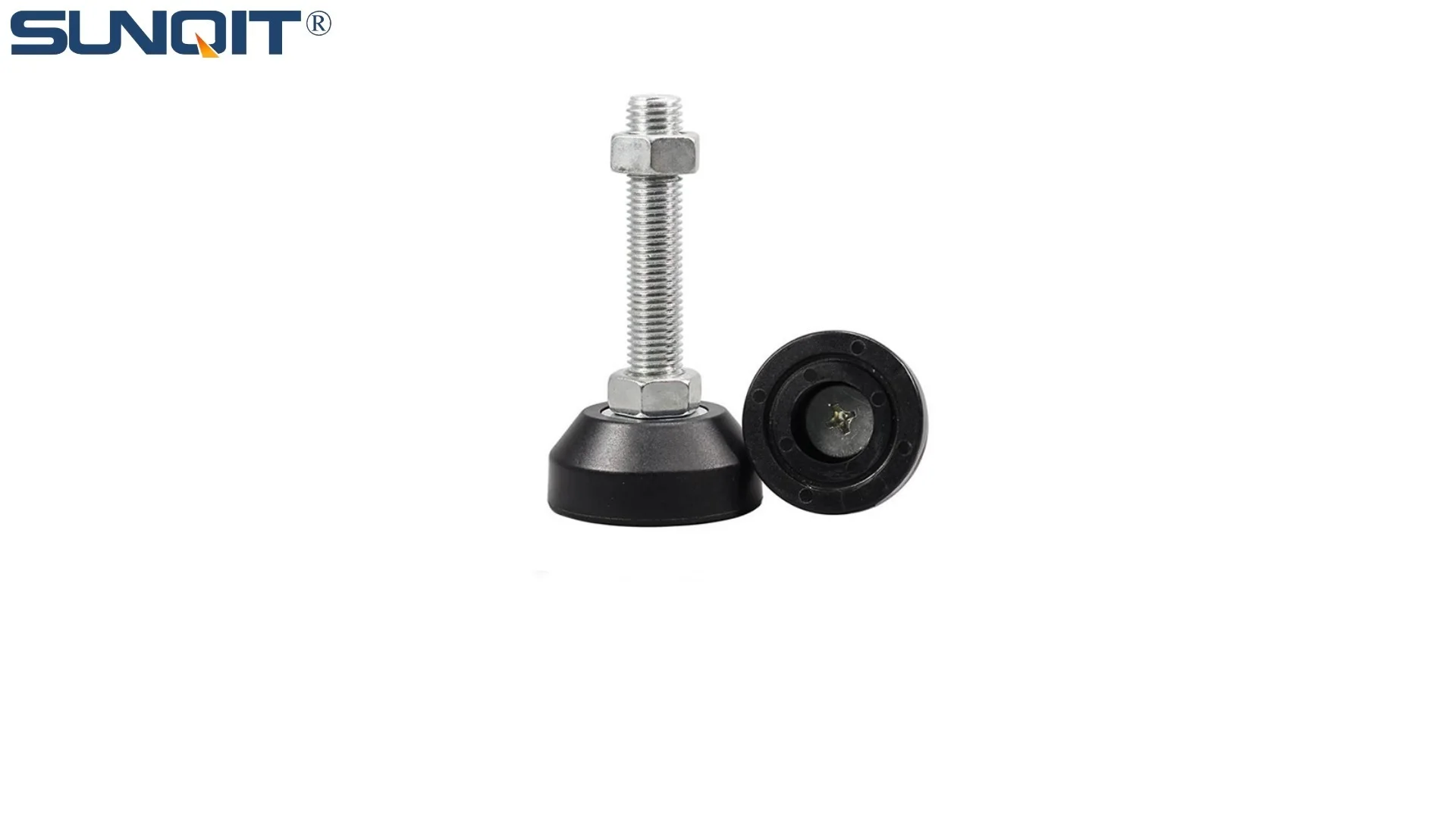
Let's be real—when you're setting up a workspace, the little parts often get overlooked. But if you've ever dealt with a wobbly workbench, a turnover trolley that drifts to one side, or a material rack that just won't stay level, you know exactly how crucial those "little parts" can be. Today, we're shining a spotlight on one of those unsung heroes: the M10*56 rubber leveling foot. It might sound like just another piece of hardware, but get this—its thread size and length could be the difference between a smooth, efficient workflow and a day full of frustrating adjustments. Let's break it down, step by step, in a way that actually makes sense (no engineering degree required).
First Things First: What Even Are M10*56 Rubber Leveling Feet?
Before we dive into the specs, let's make sure we're all on the same page. Imagine you're building a lean pipe workbench for your workshop. You've got the pipes, the joints, the tabletop—everything seems solid. But when you stand back, the whole thing rocks like a seesaw. Annoying, right? That's where leveling feet come in. Rubber leveling feet are those small, often cylindrical components that screw into the bottom of equipment, furniture, or structures to stabilize them. They're like the "feet" of your workspace gear, and the M10*56 is a specific type designed for medium-duty jobs.
The "rubber" part is key here. Unlike metal feet, rubber ones grip floors better, absorb vibrations (hello, quieter workshops!), and won't scratch up your concrete or tile. The "M10*56" part? That's the technical stuff—the thread size and length. Think of it as the foot's "ID card": it tells you exactly how it fits, what it can support, and where it belongs. Let's unpack that ID card now.
Decoding the Thread Size: What Does "M10" Really Mean?
Let's start with the "M10" in M10*56. You've probably seen labels like M8, M12, or M16 on bolts and screws before—this is just the metric system's way of describing thread size. The "M" stands for "metric," and the number that follows (in this case, 10) is the diameter of the thread, measured in millimeters. So, an M10 thread has a diameter of 10mm across the widest part of the threads.
Now, why does 10mm matter? Let's say you're attaching leveling feet to a turnover trolley and rack. If the trolley's legs have pre-drilled holes for M8 threads (that's 8mm diameter), and you try to screw an M10 foot into them, you're going to have a bad time. The thread won't fit—either it'll get stuck halfway, strip the hole, or just spin uselessly. On the flip side, if you use an M8 foot in an M10 hole, it'll be loose, and your trolley will wobble more than a shopping cart with a wonky wheel. So, M10 isn't just a random number—it's a precise measurement that ensures a snug, secure fit in compatible equipment.
You might be wondering, "Is there more to the thread than just diameter?" Great question! Threads also have "pitch," which is the distance between each thread (think of it as the "spacing" between the ridges). For most M10 rubber leveling feet, the pitch is 1.5mm (that's the standard for coarse threads, which are stronger and easier to screw in by hand). Some might have finer pitches (like 1.25mm), but for our purposes—stabilizing workbenches and trolleys—coarse threads are the way to go. They're less likely to loosen over time, even with regular vibrations from tools or movement.

Breaking Down the Length: Why 56mm Matters
Now, let's talk about the "56" in M10*56. This is the length of the threaded part of the leveling foot, measured in millimeters—from the base of the rubber pad (the part that touches the floor) to the very tip of the thread. At first glance, 56mm might seem arbitrary, but trust me, it's anything but. Let's put it in context: if the thread is too short, you might not be able to screw it far enough into the equipment leg to get a stable fit. If it's too long, it could poke through the top of the leg, scratch the inside of your workbench, or even damage whatever you're storing on it. 56mm hits that sweet spot for most medium-duty applications.
Let's take a material rack as an example. Suppose you're setting up a material rack B (you know, the 3-row, 3-floor kind) to store heavy toolboxes and parts bins. Each leg of that rack needs a leveling foot that can reach deep enough into the leg to support the weight without bending or stripping. 56mm gives you enough thread to screw the foot in securely—usually 20-30mm of thread engagement is enough for stability, and 56mm leaves plenty of room to adjust the height (more on that later). Plus, if your floor is uneven (and let's be honest, most workshop floors are), that extra length lets you extend the foot farther to compensate for dips or bumps.
| Specification | Details | Why It Matters |
|---|---|---|
| Thread Size (M10) | 10mm diameter, 1.5mm pitch (standard coarse thread) | Ensures compatibility with most workbench, trolley, and rack legs; strong enough to support medium loads. |
| Thread Length (56mm) | From rubber pad base to thread tip | Provides enough adjustability for uneven floors; ensures secure engagement with equipment legs. |
| Rubber Pad Diameter | Typically 30-40mm (varies by brand) | Wider pad = better weight distribution, less floor damage, and improved grip. |
| Load Capacity | Around 200-300kg per foot (depending on material quality) | Supports heavy workbenches, loaded trolleys, and material racks without sinking or cracking. |

Why These Specifications (M10*56) Are So Popular
You might be thinking, "There are hundreds of leveling foot sizes out there—why is M10*56 everywhere?" The answer is simple: it's versatile. Let's break down the most common places you'll find these feet, and why they're the go-to choice for each.
1. Lean Pipe Workbenches
If you've ever used a lean pipe workbench, you know they're all about flexibility. They're easy to assemble, reconfigure, and adapt to different tasks—whether you're assembling electronics, packing orders, or repairing tools. But all that flexibility goes out the window if the workbench itself isn't stable. M10*56 rubber leveling feet are perfect here because lean pipe legs (usually 28mm or 30mm in diameter) have enough space inside to accommodate the M10 thread. The 56mm length lets you tweak the height of each corner to keep the tabletop perfectly level, even if your floor has seen better days. No more chasing rolling screws or watching parts slide off the edge—just a solid, steady surface to work on.
2. Turnover Trolleys & Racks
Turnover trolleys are workhorses in warehouses and workshops—they cart everything from raw materials to finished products, often over rough concrete or uneven asphalt. If a trolley wobbles, you risk spilling contents, damaging goods, or even tripping. M10*56 feet solve this by gripping the floor (thanks to the rubber pad) and staying firmly screwed into the trolley legs (thanks to that M10 thread). And when you pair them with a turnover trolley and rack combo? The 56mm length ensures that even when the rack is loaded with heavy boxes, the feet don't compress too much or sink into the floor. It's like giving your trolley a pair of sturdy, adjustable shoes.
3. Adjustable Leveling Feet for General Use
Okay, this one's a bit meta, but M10*56 feet are often labeled as "adjustable leveling feet" for a reason. The thread design makes them easy to twist by hand (no power tools needed) to raise or lower the equipment. Let's say your workbench is 1cm lower on the left side—just grab the rubber pad, twist it clockwise, and extend the thread until the tabletop is level. That adjustability is a game-changer for anyone who's ever had to shim a leg with a stack of washers or a scrap of wood (we've all been there). With M10*56 feet, it's a quick, clean fix.

Materials Matter: What's Inside an M10*56 Rubber Leveling Foot?
Now that we understand the "what" and "why" of the specs, let's talk about the "how"—as in, how these little feet are built to last. Most M10*56 rubber leveling feet have two main parts: the threaded rod (usually steel) and the rubber pad. Let's break down each component.
The Threaded Rod: Steel is the go-to here because it's strong, durable, and resistant to bending. Most rods are zinc-plated, which adds a layer of corrosion resistance (important if your workshop is humid or you're dealing with liquids). You might see some stainless steel versions too, which are better for food processing or medical settings where cleanliness is key, but for general use, zinc-plated steel works great and costs less.
The Rubber Pad: Not all rubber is created equal! The best pads are made from nitrile rubber or EPDM, which are oil-resistant, temperature-resistant, and have good grip. Cheaper feet might use recycled rubber, which can crack over time or lose grip when exposed to oil or chemicals (common in workshops). The pad is usually bonded to the steel rod with adhesive or molded directly around it—either way, you want a tight bond to prevent the pad from spinning or falling off after heavy use.
Pro tip: If you're shopping for M10*56 feet, squeeze the rubber pad. It should feel firm but not rock-hard—too hard, and it won't absorb vibrations; too soft, and it'll compress under heavy weight. A good pad will bounce back slowly when you press it, like a firm sponge.
Installation 101: How to Actually Use These Feet (No Fuss)
Installing M10*56 rubber leveling feet is pretty straightforward, but there are a few tricks to make sure they work like they should. Let's walk through the steps, whether you're attaching them to a new workbench or replacing old, worn-out feet.
- Check the mounting holes first. Before you start, make sure the legs of your equipment have M10 threaded holes. If they're unthreaded (just smooth holes), you'll need to tap them with an M10 tap (a tool that cuts threads into metal). If the holes are already threaded but dirty or rusty, clean them out with a wire brush or compressed air—gunk in the threads can make it hard to screw the foot in evenly.
- Screw them in by hand first. This might sound obvious, but it's easy to grab a wrench and start cranking. Resist the urge! Hand-screwing lets you feel if the thread is catching properly. If it's hard to turn, stop—you might be cross-threading (which strips the threads). Back it out, realign, and try again. Once it's hand-tight, you can use a wrench to give it a quarter-turn more—just don't overdo it (you don't want to crack the leg or strip the thread).
- Level as you go. Don't wait until all four feet are installed to check the level—do it one corner at a time. Place a spirit level on the workbench or trolley surface, and adjust each foot by twisting it (clockwise to lower, counterclockwise to raise) until the bubble is centered. This might take a few tries, especially if your floor is really uneven, but trust me, it's worth it.
- Test the stability. Once everything's level, give the equipment a gentle shake. It should feel solid—no wobbling, no creaking, no feet spinning. If it still moves, check if the threads are fully engaged (you might need to screw the foot in a bit more) or if the rubber pad is slipping (try cleaning the floor with a degreaser if it's oily).
Common Mistakes to Avoid (Because We've All Made Them)
Even with the best intentions, it's easy to mess up when installing leveling feet. Here are the top mistakes I've seen (and made myself!)—and how to steer clear of them.
- Using the wrong thread size. This is the biggest one! If your equipment has M8 holes and you try to force an M10 foot, you'll strip the threads. If it has M12 holes and you use M10, the foot will be loose and won't support the weight. Always check the hole size before buying—measure the diameter with a caliper, or ask the manufacturer of your workbench/trolley what thread size they recommend.
- Ignoring thread length. I once installed 30mm-long feet on a workbench with thick steel legs—turns out, the legs were 40mm deep, so the threads barely engaged. The workbench wobbled so bad, I had to replace them with 56mm feet. Moral of the story: Measure how deep the leg holes are, and choose a thread length that's at least 5mm longer than the hole depth (so you have room to adjust).
- Over-tightening. It's tempting to crank the feet as tight as possible, but too much torque can strip the threads or crack plastic legs (yes, some lightweight workbenches have plastic legs). Hand-tight plus a quarter-turn with a wrench is plenty—remember, the rubber pad will compress slightly under weight, so you don't need to wrench it like a bolt on a car engine.
- Forgetting about load capacity. M10*56 feet can usually handle 200-300kg per foot, but that adds up. If you have a 4-legged workbench, that's 800-1200kg total. But if you're stacking 500kg of tools on one corner? The foot under that corner might compress or fail. Distribute weight evenly, and if you're unsure, check the manufacturer's load rating (it's usually printed on the packaging or website).
Choosing a Supplier: Why It Pays to Pick the Right One
Okay, so you're sold on M10*56 rubber leveling feet—now where do you buy them? Not all suppliers are created equal, and a cheap, low-quality foot can cost you more in the long run (think: frequent replacements, damaged equipment, or even workplace accidents). Here's what to look for when shopping around.
Consistent specs. A reliable supplier will list the exact thread size (M10), length (56mm), pitch (1.5mm), and load capacity. If a listing just says "rubber leveling feet" without details, run—those are probably generic, off-brand parts with inconsistent sizing (one might be 54mm, another 58mm, which is a disaster for leveling).
Material quality. Ask about the rubber type (nitrile? EPDM?) and steel plating (zinc? stainless?). Reputable suppliers will be happy to share this info—if they dodge the question, move on. You can also check reviews: look for comments like "sturdy rubber" or "threads fit perfectly" vs. "rubber cracked after a month" or "threads were too loose."
Customer support. Let's say you order M10*56 feet and realize your workbench legs have M8 holes (oops). A good supplier will let you return or exchange them without hassle. Avoid suppliers with strict "no returns" policies—they're usually selling low-quality goods and don't want to deal with complaints.
Bonus: If you're buying other workshop gear (like lean pipe joints, flow racks, or conveyor parts), see if your supplier carries M10*56 feet too. Buying from the same place can save you shipping costs, and you'll know the parts are compatible (no more guessing if the feet will fit your lean pipe workbench legs).
Wrapping It Up: Small Part, Big Impact
At the end of the day, M10*56 rubber leveling feet might not be the most exciting part of your workshop, but they're one of the most essential. They turn wobbly workbenches into steady workstations, rickety trolleys into reliable transporters, and uneven material racks into organized storage solutions. By understanding the thread size (M10) and length (56mm), you can choose the right feet for your needs, install them properly, and avoid the headaches of cheap, ill-fitting hardware.
So, the next time you're setting up a workspace, take a minute to appreciate the little things—like a well-designed leveling foot. Your back (and your productivity) will thank you.