- Company Articles
- Products and Technology
- Product knowledge
- Manufacturing Process of 3030 National Standard Profile A: Extrusion to Finished Product

Manufacturing Process of 3030 National Standard Profile A: Extrusion to Finished Product
Related Product
3030 National Standard Profile A
Workbench, production line, logistic rack, warehouse rack Industry: Manufacturer workshop, Automobile, Electronic, Assembling, logistic
Introduction: The Unsung Hero of Modern Manufacturing
Walk into any factory, workshop, or logistics center, and you'll likely spot it—quietly holding up workbenches, guiding conveyor belts, or forming the backbone of storage racks. It's the aluminum extrusion profile, a material so integral to industrial operations that it's easy to take its existence for granted. But behind every sleek, sturdy length of aluminum profile lies a journey of precision, craftsmanship, and technological innovation. Today, we're pulling back the curtain on one of the most widely used profiles in the industry: the 3030 National Standard Profile A. From raw aluminum ingots to the finished product sitting on a warehouse shelf, let's explore the steps that turn simple metal into a cornerstone of modern manufacturing.
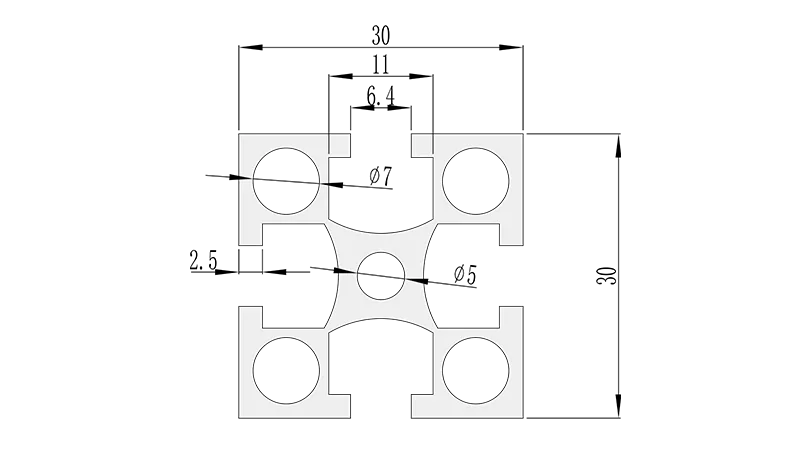
Why focus on the 3030 National Standard Profile A? Because it's the Swiss Army knife of aluminum profiles. Measuring 30mm by 30mm, its square cross-section and standardized T-slot design make it compatible with a vast array of aluminum profile accessories—connectors, brackets, panels, and more. Whether you're building a modular workbench for an electronics assembly line or a lightweight material rack for a distribution center, this profile delivers the strength, versatility, and cost-effectiveness that manufacturers rely on. But before it can do any of that, it has to go through a rigorous manufacturing process that balances art and science.
Step 1: Raw Material Preparation – The Foundation of Quality
Every great product starts with great materials, and aluminum profiles are no exception. The journey of the 3030 National Standard Profile A begins in a warehouse filled with aluminum ingots—silvery, brick-like blocks that look unassuming but hold the key to the profile's performance. These ingots aren't just pure aluminum, though; they're carefully formulated alloys, typically 6063 or 6061, chosen for their ideal balance of strength, ductility, and corrosion resistance. Why alloys? Pure aluminum is soft and malleable, which sounds good for shaping, but it lacks the structural integrity needed for industrial use. By adding small amounts of magnesium (for strength) and silicon (for improved extrusion), manufacturers create an alloy that can be shaped into complex profiles while retaining the durability required for heavy-duty applications.
Before melting, each ingot undergoes a strict inspection. Workers check for surface defects, weight consistency, and alloy composition using handheld spectrometers to ensure it meets national standards. Imagine a chef rejecting a batch of ingredients because they don't meet the recipe—this is the manufacturing equivalent. A single impure ingot could compromise an entire production run, leading to weak spots or uneven extrusion. So, every ingot is logged, tested, and approved before moving to the next stage. It's a tedious step, but one that ensures the 3030 profile will perform as expected, whether it's supporting a 200kg workbench or guiding delicate electronic components down a conveyor line.
Fun Fact: The "3030" in the profile's name refers to its cross-sectional dimensions: 30mm in width and 30mm in height. National standard profiles like this one are designed to meet uniform specifications across manufacturers, so a 3030 Profile A from one supplier will fit seamlessly with aluminum profile accessories from another—a game-changer for businesses that need to customize their setups without worrying about compatibility issues.
Step 2: Melting and Casting – Turning Solids into Slurry
Once the ingots pass inspection, they're loaded into a melting furnace—a massive, cylindrical vessel lined with refractory bricks to withstand extreme heat. The furnace heats the ingots to around 700–750°C (1292–1382°F), a temperature high enough to turn solid aluminum into a silvery, viscous liquid. But melting isn't just about applying heat; it's about precision. Too hot, and the alloy can burn off critical elements like magnesium; too cold, and the metal won't flow properly. Furnace operators monitor the temperature around the clock, using thermocouples and infrared sensors to keep it within a tight 5°C range. It's a bit like baking a cake—get the temperature wrong, and the whole thing falls apart.
As the ingots melt, the molten aluminum is treated to remove impurities. First, a flux—a granular material—is added to the surface. The flux melts and forms a protective layer, trapping dirt, oxides, and other contaminants that rise to the top. These impurities are then skimmed off, leaving behind a cleaner melt. Next, degassing is done to remove hydrogen bubbles, which can cause porosity (tiny holes) in the final profile. A rotary degassing unit—think of a giant whisk—spins in the molten metal, injecting nitrogen or argon gas. The gas bubbles attract hydrogen, carrying it to the surface where it escapes. Without this step, the 3030 profile might end up with weak spots that could crack under stress, making it unsafe for heavy use.
From the furnace, the purified molten aluminum is poured into a casting machine, where it's formed into billets—long, cylindrical logs that will later be extruded into profiles. The most common method here is direct chill (DC) casting. In DC casting, molten aluminum is poured into a water-cooled mold, which solidifies the outer layer of the billet while the inner core remains liquid. As the billet slowly descends from the mold, water jets spray its surface, cooling it from the outside in. This controlled cooling process ensures the billet has a uniform grain structure, which is crucial for successful extrusion. For the 3030 profile, billets are typically 90–120mm in diameter and 6–8 meters long—long enough to produce multiple profile lengths in a single extrusion run.
Step 3: Homogenization – The "Relaxation" Phase for Metal
After casting, the billets look solid, but they're far from ready for extrusion. Inside each billet, the alloying elements (magnesium, silicon) haven't mixed evenly. Instead, they've formed small, uneven clusters called "segregations," which can cause weak points during extrusion. Imagine trying to stretch a rubber band with a knot in it—the knot would snap first. Homogenization solves this problem by heat-treating the billets to redistribute these elements evenly.
The billets are loaded into a homogenization furnace, where they're heated to 500–550°C (932–1022°F) and held there for 4–6 hours. This slow heating allows the segregated elements to dissolve into the aluminum matrix, creating a uniform microstructure. The process is similar to aging a fine wine—time and temperature transform something good into something great. After homogenization, the billets are cooled slowly, either in the furnace or a separate cooling chamber, to prevent thermal shock. The result? A billet that's more ductile, easier to extrude, and less likely to develop cracks or defects during shaping.
Homogenization is also where the 3030 profile's mechanical properties start to take shape. By controlling the cooling rate, manufacturers can influence the profile's hardness and tensile strength. For example, a slower cool might produce a slightly softer billet, which is better for complex extrusions with tight tolerances—exactly what's needed for the 3030's precise T-slot design. It's a subtle step, but one that separates a mediocre profile from one that meets the strict standards of industrial use.
Step 4: Extrusion – Shaping the Profile (The Heart of the Process)
Now comes the most dramatic step in the journey: extrusion. If the previous steps were about preparation, extrusion is where the 3030 National Standard Profile A truly comes to life. Picture a giant pasta maker, but instead of dough, it's pushing 6-meter-long aluminum billets through a steel die at thousands of tons of pressure. That's the extrusion press in action—a machine so powerful it can shape solid metal into intricate profiles with pinpoint accuracy.
The process starts with billet preheating. The homogenized billets are loaded into a log heater, where they're warmed to 480–520°C (896–968°F)—not hot enough to melt, but soft enough to flow. A too-cold billet would crack under pressure; too hot, and it would stick to the die. Next, the billet is transferred to the extrusion press, where a lubricant (usually graphite or a special oil) is applied to its surface to reduce friction. The press then uses a hydraulic ram to push the billet into a container, compressing it until it flows through the die—a custom-made steel tool with a 30mm x 30mm opening and the T-slot grooves that define the profile.
The Die: A Masterpiece of Engineering
The die is the unsung hero of extrusion. Machined from high-strength H13 tool steel, it's designed with precision down to the micrometer. The die for the 3030 Profile A features not just the outer 30x30mm shape, but also the internal T-slot—a narrow groove running along the length of the profile that allows aluminum profile accessories to slide into place. Creating this die is a craft in itself: CNC machines carve the shape, and heat treatment hardens the steel to withstand the extreme pressure of extrusion. A single die can produce thousands of profiles, but over time, wear and tear take their toll. Die makers inspect each die after every run, polishing away tiny imperfections to ensure the profiles stay within tolerance.
As the billet is pressed through the die, the aluminum emerges as a long, continuous length of 3030 profile. Workers guide the emerging profile onto a runout table, where it's pulled by a traction machine to maintain tension and straightness. The speed of extrusion depends on the profile's complexity—for the 3030, it's typically around 3–5 meters per minute. Too fast, and the profile might warp; too slow, and production efficiency suffers. It's a delicate balance, monitored in real time by operators watching gauges and cameras to ensure the profile's dimensions stay true.
| Extrusion Step | Key Parameter | Purpose |
|---|---|---|
| Billet Preheating | 480–520°C | Softens aluminum for flow without melting |
| Extrusion Pressure | 1000–2000 tons | Forces billet through die to shape profile |
| Extrusion Speed | 3–5 m/min | Ensures dimensional stability and surface quality |
| Die Material | H13 Tool Steel | Withstands high pressure and heat without deforming |
Step 5: Heat Treatment – Strengthening the Profile
Fresh from extrusion, the 3030 profile is soft—too soft for industrial use. To give it the strength needed to support heavy loads, it undergoes heat treatment, a two-step process called solution annealing and aging.
First, solution annealing: the extruded profiles are loaded into a furnace and heated to 520–540°C (968–1004°F) for 30–60 minutes. This dissolves any remaining alloy clusters into the aluminum matrix, similar to homogenization but on a smaller scale. Then, the profiles are quenched—rapidly cooled in water or air—to "freeze" the dissolved elements in place. Quenching is critical: if cooled too slowly, the elements would re-cluster, undoing the annealing step. The result is a profile that's supersaturated with alloying elements, making it hard but brittle—like a glass that's been cooled too quickly.
The second step, aging, fixes this brittleness. The quenched profiles are placed in an aging oven at 120–180°C (248–356°F) for 4–8 hours. During aging, the supersaturated elements slowly form tiny, evenly distributed particles called "precipitates." These particles act like microscopic anchors, strengthening the aluminum matrix without making it brittle. It's the same process that gives aluminum alloys their famous "age-hardening" property—over time (or with heat), they get stronger. After aging, the 3030 profile has a tensile strength of around 180–220 MPa, more than enough to support the demands of a busy factory floor.
Step 6: Surface Treatment – Beauty Meets Durability
At this point, the 3030 profile is strong and dimensionally accurate, but its surface is dull and prone to corrosion. Surface treatment solves both problems, transforming the raw aluminum into a sleek, protected finish that can withstand years of use. The most common treatments for industrial profiles are anodizing and powder coating, each with its own benefits.
Anodizing: Nature's Protection, Enhanced
Anodizing is an electrochemical process that grows a layer of aluminum oxide on the profile's surface. The profiles are submerged in an acid electrolyte bath (usually sulfuric acid) and connected to an electric current. As the current flows, oxygen ions react with the aluminum, forming a hard, porous oxide layer that's integrated with the metal itself—unlike paint, which sits on top. This layer is naturally resistant to corrosion and wear, and it can be dyed in a range of colors (silver, black, blue) to match factory aesthetics.
The thickness of the anodized layer depends on the application. For indoor use, a 5–10μm layer is sufficient; for outdoor or high-wear environments, it might be 15–20μm. After anodizing, the profiles are sealed in hot water to close the pores, making the surface non-porous and even more durable. The result? A profile that resists scratches, fingerprints, and rust—perfect for workbenches and material racks that see daily use.
Powder Coating: Color and Toughness in One
For customers who want bold colors or extra durability, powder coating is the go-to option. Powder coating involves applying a dry powder (typically polyester) to the profile's surface using an electrostatic gun. The powder sticks to the aluminum like a magnet, thanks to an electric charge. The profiles are then baked in an oven at 180–200°C (356–392°F), melting the powder into a smooth, hard film. Unlike liquid paint, powder coating has no solvents, so it's more environmentally friendly and produces a thicker, more uniform finish.
Powder-coated 3030 profiles are popular in industries where color coding matters—for example, using red profiles for safety zones or blue for assembly areas. The finish is also highly resistant to chipping and fading, making it ideal for profiles used in high-traffic areas like loading docks or retail displays.
Step 7: Precision Cutting – Tailoring to Length
After surface treatment, the profiles are still in long, continuous lengths—sometimes up to 6 meters. To make them usable for customers, they need to be cut to specific lengths. This is where precision cutting comes in, a step that demands accuracy down to the millimeter.
Most manufacturers use circular saws or band saws equipped with carbide-tipped blades for clean, burr-free cuts. The profiles are clamped into a fixture to prevent movement, and a laser positioning system ensures the cut is exactly where it needs to be. For high-volume orders, automated cutting lines can handle dozens of profiles per minute, sorting them into bins by length. For custom orders, operators might use manual saws, double-checking measurements with digital calipers to ensure compliance with customer specs.
After cutting, the profiles undergo deburring—a process where a rotating brush or abrasive pad smooths the cut edges. Sharp burrs aren't just a safety hazard; they can also damage aluminum profile accessories like end caps or connectors. A quick pass with a deburring tool ensures the profile is safe to handle and easy to assemble.
Step 8: Quality Inspection – The Final Checkpoint
Before the 3030 National Standard Profile A is packed and shipped, it must pass a battery of quality checks. This isn't just a quick glance—manufacturers use a combination of manual inspections and advanced technology to ensure every profile meets national standards.
Dimensional Checks
First, dimensional accuracy. Operators use digital calipers and micrometers to measure the profile's width, height, wall thickness, and T-slot dimensions. For the 3030 Profile A, the tolerance for width and height is typically ±0.3mm—about the thickness of three sheets of paper. To check straightness, profiles are laid on a flat surface, and a laser straightness meter measures any deviation. A profile that's even slightly bent could cause problems during assembly, so any out-of-tolerance pieces are rejected or sent for correction.
Mechanical Testing
Random samples from each production run undergo mechanical testing. A tensile test machine pulls a sample until it breaks, measuring its tensile strength, yield strength, and elongation. For the 3030 profile, the tensile strength should be at least 180 MPa—strong enough to support a small car (though we don't recommend testing that!). Hardness tests (using a Brinell or Rockwell tester) ensure the heat treatment was effective, and corrosion tests (salt spray exposure) verify the surface treatment's durability.
Visual Inspection
Finally, every profile is visually inspected for surface defects: scratches, dents, uneven coating, or discoloration. Anodized profiles are checked for consistency in color and gloss, while powder-coated profiles are examined for pinholes or orange peel texture. It's a tedious process, but one that ensures customers receive a product they can trust.
Step 9: Aluminum Profile Accessories – Completing the System
A profile alone is just a length of metal. It's the aluminum profile accessories that turn it into a functional system. After passing inspection, the 3030 profiles are often paired with accessories like end caps (to cover sharp ends), connectors (to join profiles at angles), and brackets (to mount shelves or panels). These accessories are designed to snap or slide into the profile's T-slot, making assembly quick and tool-free.
For example, a 3030 Profile A used in a workbench might be paired with gusset plates (to reinforce corners), adjustable feet (to level the bench), and a plywood or aluminum top. In a conveyor system, it could use roller track connectors to guide products, or caster wheels to make the whole setup mobile. The beauty of the T-slot design is its flexibility—customers can mix and match accessories to create custom solutions without welding or drilling. It's this versatility that makes the 3030 Profile A a favorite among manufacturers who need to adapt their workspaces quickly.
Conclusion: From Ingot to Innovation
The journey of the 3030 National Standard Profile A is a testament to the marriage of science and skill. From the careful selection of raw materials to the precision of extrusion, from the heat treatment that strengthens the metal to the final inspection that ensures quality, every step plays a role in creating a product that's both ordinary and extraordinary. It's ordinary in that it's used in countless factories and workshops around the world, but extraordinary in the engineering and craftsmanship that go into making it reliable, versatile, and affordable.
Next time you see a workbench, a conveyor, or a storage rack, take a closer look. Chances are, it's built with an aluminum extrusion profile like the 3030. And now, you'll know the story behind it: the ingots melted to perfection, the billets homogenized for uniformity, the die that shapes the metal with pinpoint accuracy, and the workers who ensure every profile meets the highest standards. It's a story of manufacturing at its finest—turning raw materials into tools that build the world around us.
So, the next time you're tasked with setting up a new production line or organizing a warehouse, remember the 3030 National Standard Profile A. It's more than just a piece of aluminum; it's a product of decades of innovation, a symbol of industrial progress, and a reminder that even the most components have a fascinating journey behind them.