- Company Articles
- Products and Technology
- Product knowledge
- Manufacturing Process of Three Way Aluminum Pipe Joints: From Raw Material to Product

Manufacturing Process of Three Way Aluminum Pipe Joints: From Raw Material to Product
Related Product
Three Way Aluminum Pipe Joint
Aluminum 3 way pipe joint for 28mm aluminum pipe connection in 3 direction.
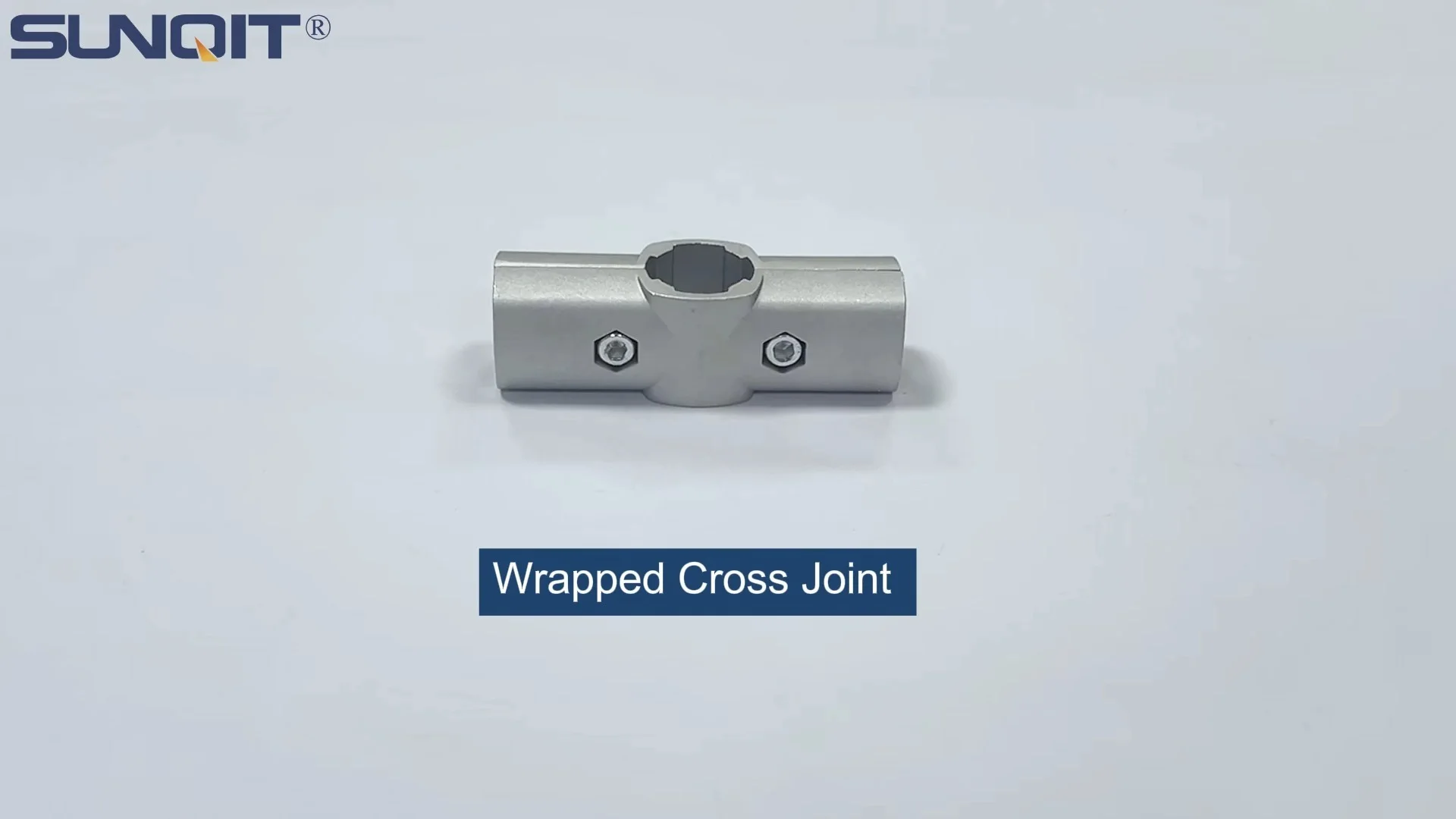
In the bustling world of modern manufacturing, where efficiency and adaptability reign supreme, there's a quiet hero holding everything together: the three way aluminum pipe joint. These unassuming connectors are the backbone of lean systems, the unsung architects of flexible workbenches, and the silent enablers of seamless flow racks in factories and warehouses worldwide. Unlike clunky steel fasteners or brittle plastic connectors of the past, today's three way aluminum pipe joints blend strength, lightweight design, and corrosion resistance—qualities that make them indispensable in industries ranging from automotive assembly to electronics production. But how do these small yet critical components go from raw aluminum to the finished product that keeps assembly lines moving? Let's pull back the curtain and follow their journey, step by step.
1. Raw Material Selection: The Foundation of Quality
Every great product starts with great materials, and three way aluminum pipe joints are no exception. Walk into the material warehouse of a top-tier manufacturer, and you'll find stacks of aluminum ingots—shiny, silvery bars that hold the promise of durability and precision. But not just any aluminum will do. The team here knows that the right alloy is the first line of defense against wear, stress, and corrosion, especially in high-demand environments like factories where joints are constantly adjusted, loaded, and exposed to oils or coolants.
Most three way aluminum pipe joints are crafted from 6061 or 6063 aluminum alloys, chosen for their unbeatable balance of strength, machinability, and cost-effectiveness. "6061 is like the workhorse of alloys," explains Maria, a metallurgist with 15 years in the industry. "It has good tensile strength—around 310 MPa—and it's easy to weld and machine, which is crucial when we need to drill precise holes or thread the joints for a tight fit with aluminum pipe." 6063, on the other hand, is prized for its excellent extrudability, making it ideal for shaping complex geometries like the three-pronged design of these joints. "We test every batch of ingots for purity," Maria adds, holding up a small sample. "Even tiny impurities can weaken the alloy, so we use spectrometers to check for elements like iron or copper. If it's not 99.7% pure aluminum, it doesn't make the cut."
To give you a clearer picture of why these alloys matter, here's a breakdown of their key properties and applications:
| Alloy Type | Key Alloying Elements | Tensile Strength (MPa) | Primary Advantage | Typical Use Case |
|---|---|---|---|---|
| 6061-T6 | Magnesium (1.0%), Silicon (0.6%) | 310 | High strength, weldable | Heavy-duty joints for load-bearing racks |
| 6063-T5 | Magnesium (0.7%), Silicon (0.4%) | 205 | Superior extrudability, smooth finish | Lightweight joints for workbenches, flow racks |
Once the ingots pass inspection, they're cut into smaller billets—cylindrical chunks about the size of a coffee can—that will later be heated and shaped. It's a meticulous process, but as Maria puts it: "You can't build a strong joint on weak material. This step isn't just about checking boxes; it's about respecting the people who will rely on these joints every day."
2. Extrusion: Shaping the Future, One Die at a Time
Head to the production floor, and the air hums with energy. Massive machines tower overhead, their pistons glinting in the factory lights. This is the extrusion area, where raw aluminum billets are transformed into the rough shape of three way joints. Extrusion is often called the "sculpting" step of manufacturing, and for good reason: it's here that the metal is forced into a mold (called a die) to take on its iconic three-pronged form.
The process starts with heating the billets to around 480°C—hot enough to make the aluminum malleable but not molten. "Think of it like warming chocolate: too cold, and it cracks; too hot, and it loses its shape," says Juan, an extrusion operator with a knack for explaining complex processes simply. "We use induction heaters to get the temperature just right—within ±5°C. One degree off, and the billet might stick in the die or come out with uneven walls."
Once heated, the billet is loaded into a hydraulic press, where a ram pushes it through a custom-designed die. The die itself is a work of art: a steel block with a three-pronged opening, precision-machined to ensure each arm of the joint has the exact thickness, length, and angle needed to connect aluminum lean pipe seamlessly. "Designing the die takes weeks," Juan notes, pointing to a CAD drawing on his tablet. "We have to account for how aluminum flows under pressure—some areas might expand, others contract. If the die isn't perfect, the joint might have weak spots or not fit the pipe properly."
As the billet exits the die, it emerges as a long, continuous profile—like a three-pronged ribbon of aluminum. This profile is immediately cooled with water sprays to lock in its shape, then cut into individual joint blanks using a high-speed saw. "You can feel the difference when it's done right," Juan says, picking up a warm blank. "Smooth edges, consistent wall thickness—this is where the joint starts to feel like a finished product, not just a hunk of metal."
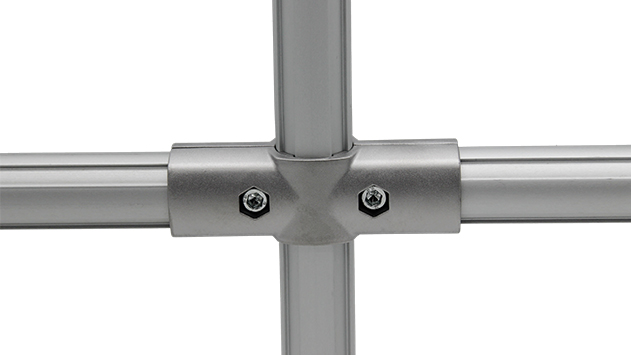
3. Precision Machining: The Art of the Tight Tolerance
Extrusion gives the joint its basic shape, but to turn it into a functional component, it needs precision machining. Walk into the CNC (Computer Numerical Control) workshop, and the vibe shifts from the thunderous energy of extrusion to the quiet focus of high-tech craftsmanship. Rows of CNC mills and lathes hum softly, their cutting tools whirring at thousands of rotations per minute. Here, the joint blanks are transformed from rough shapes into parts that fit together with the kind of precision that makes engineers smile.
"Tolerance is everything here," says Lina, a CNC programmer who oversees the machining process. "A three way joint needs to connect three aluminum pipes perfectly—if the holes are off by even 0.1mm, the pipes won't align, and the whole structure wobbles. That's not just annoying for the user; it can slow down production or even cause safety issues."
The blanks are loaded into fixtures that hold them steady as the machines go to work. First, the ends of each arm are faced (smoothed) to ensure they're flat and perpendicular to the pipe. Then, threads are cut into the inner walls of each arm—usually M10 or M12 threads, depending on the pipe diameter—to allow screws or bolts to secure the joint to the aluminum pipe. "We use tap-and-die tools for threading, but with CNC, we can program the exact depth and pitch," Lina explains. "Older manual methods meant more variability; now, every joint gets the same thread, every time."
Other critical features are added here too: countersinks for screw heads to sit flush, grooves for O-rings (in joints used in damp environments), and chamfers (beveled edges) to prevent cuts when workers assemble the system. After machining, each joint is inspected with calipers and coordinate measuring machines (CMMs) to check dimensions. "We once had a batch where the threads were 0.05mm too shallow," Lina recalls. "We scrapped 200 pieces. It hurt, but we knew sending them out would mean customers struggling to tighten pipes. Quality isn't optional."

4. Surface Treatment: More Than Just a Pretty Finish
By now, the joint is functionally complete—but it's not ready for the spotlight. Aluminum, while naturally corrosion-resistant, can still oxidize over time, especially in humid or chemical-heavy environments. That's where surface treatment comes in: a protective layer that enhances durability, adds color, and gives the joint a professional, finished look.
Most three way joints undergo anodizing—a process that uses electrolysis to create a thick, hard oxide layer on the aluminum's surface. "Anodizing isn't just about making it shiny; it's like giving the joint a suit of armor," says Priya, who runs the surface treatment line. "The oxide layer is porous, so we can also dye it—customers love options like silver, black, or even custom colors for branding."
The anodizing process starts with cleaning: the joints are dipped in a series of tanks to remove oil, grease, and machining residue. "Even a fingerprint can ruin the finish," Priya notes, wearing gloves as she handles a rack of joints. Next, they're submerged in an acid bath and connected to an electric current, which causes the aluminum to react with oxygen and form aluminum oxide. The longer they stay in the bath, the thicker the layer—most joints get a 10-15 micron coating, enough to withstand years of wear.
After anodizing, some joints go through powder coating for extra protection or a matte finish. "Powder coating is like painting with dry paint particles," Priya explains. "We electrostatically charge the powder, spray it on, then bake the joints to melt the powder into a smooth film. It's great for joints used in outdoor or high-moisture areas, like food processing plants."
As the joints emerge from the oven, their surfaces glint uniformly—no smudges, no uneven spots. "This step is where the joint stops being a 'part' and starts being a 'product,'" Priya says, holding up a black anodized joint. "When a worker in a factory picks this up, they might not think about the science behind the finish, but they'll notice that it doesn't rust, that it feels solid. That's the impact we're after."

5. Quality Control: The Last Line of Defense
In a small, well-lit room off the production floor, a team of inspectors sits at tables cluttered with tools: calipers, torque wrenches, magnifying glasses, and even small aluminum pipes. This is the quality control (QC) lab, where every joint is put through its paces before being shipped. "We don't just check for defects—we verify that each joint lives up to the promise of reliability," says Elena, the QC manager, who has a reputation for being both meticulous and fair.
The inspections start with a visual check: Are there scratches in the anodizing? Are the threads clean and free of burrs? Then, dimensional tests: Do the arms measure exactly 50mm long, as specified? Is the angle between each arm precisely 90 degrees? "A joint that's even 1mm too short might not reach the pipe, leading to a loose connection," Elena explains, using a digital caliper to measure an arm. "We log every measurement—if we see a trend, like arms running long, we can adjust the extrusion die before it becomes a problem."
Next comes the fit test: Each joint is screwed onto a length of aluminum pipe using standard bolts. "We simulate real-world use," Elena says, tightening a bolt with a torque wrench. "If the joint wobbles or the bolt strips the threads, it fails. Simple as that." Load testing is another key step: joints are clamped into a machine that pulls on each arm to simulate the weight of a loaded flow rack or workbench. "We test to 120% of the rated load," Elena notes. "If it breaks at 100kg when it's supposed to hold 80kg, it's not leaving here."
Perhaps the most heartening part of QC is the "human test." Elena and her team often pass joints around, feeling for sharp edges, checking how easy they are to grip and adjust. "At the end of the day, these joints are used by people—people who might be assembling products for hours on end," she says. "A joint that's uncomfortable to handle or hard to tighten isn't just a bad product; it's a disservice to the workers. We keep that in mind with every check."
6. Packaging & Distribution: Getting It Right, From Warehouse to Workshop
After passing QC, the joints are ready to make their way into the world. But first, they need to be packaged—securely enough to survive shipping, but also in a way that makes them easy for customers to use. Walk into the packaging area, and you'll see workers placing joints into anti-static bags (to protect against static electricity in electronics factories) or cardboard boxes lined with foam. "We've had customers tell us they hate opening boxes full of loose, scratched joints," says Raj, who manages logistics. "So we pack them in trays with dividers—each joint has its own spot. It takes a little extra time, but it's worth it when a customer says, 'Wow, these arrived in perfect shape.'"
Distribution is all about timing. Most customers are manufacturers or suppliers who need joints "just in time" for their own production lines, so Raj's team works with couriers to ensure on-time delivery. "A delay in joints can mean a delay in their assembly line, which costs them money and stress," Raj says. "We track every shipment—if there's a weather delay or a customs hold, we're on the phone fixing it before the customer even notices."
And when the joints finally arrive at their destination? They might end up in a car factory, holding together a flow rack of engine parts. Or in a warehouse, as part of a lean system for sorting packages. Or in a small workshop, where a craftsman builds custom workbenches. "It's humbling," Raj admits. "We make a small part, but it's part of something bigger. Every joint we ship is a piece of someone else's success story."
Conclusion: More Than Metal—A Commitment to Progress
From raw aluminum ingot to finished product, the journey of a three way aluminum pipe joint is one of precision, care, and respect—for the material, for the process, and for the people who depend on it. It's a story of innovation, too: the shift from heavy steel to lightweight aluminum, from manual machining to CNC precision, from one-size-fits-all to customizable solutions. But perhaps most importantly, it's a story of collaboration—metallurgists, extrusion operators, machinists, inspectors, and logisticians all working together to create something that makes work easier, safer, and more efficient.
So the next time you see a workbench, a flow rack, or a conveyor system in a factory, take a closer look. Chances are, there's a three way aluminum pipe joint holding it all together—quietly, reliably, and with the pride of everyone who helped build it. As Elena, the QC manager, puts it: "We don't just make joints. We make connections—between pipes, between processes, and between people. And that's a job worth doing right."