- Company Articles
- Products and Technology
- Product knowledge
- Material Advantages of 4040C EU Standard Aluminum Profile for Manufacturing Applications

Material Advantages of 4040C EU Standard Aluminum Profile for Manufacturing Applications
Related Product
4040C EU Standard Aluminum Profile
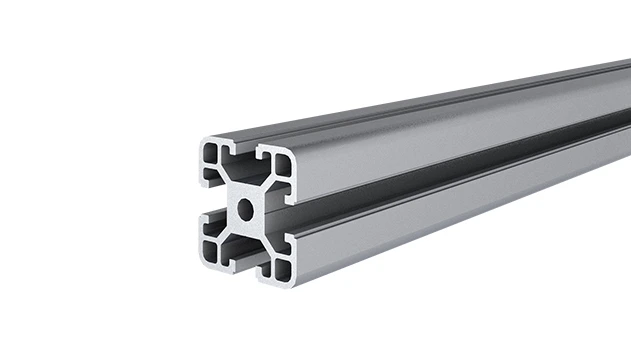
4040C is a 4.00x4.00 CM fractional 40 series square extrusion T-slot profile with four open T-slots, each side with 4.00cm face. The profile has align-a-grooves to assist in aligning connecting profiles.
In the fast-paced world of manufacturing, where efficiency, flexibility, and durability are not just buzzwords but daily requirements, the tools and materials that form the backbone of production lines carry immense weight. Among these, aluminum profiles have emerged as unsung heroes, quietly enabling the adaptability that modern factories demand. Today, we're shining a spotlight on a standout in this category: the 4040C EU Standard Aluminum Profile. More than just a length of metal, this profile is a testament to how thoughtful engineering and material science can transform (workshop) workflows, reduce downtime, and empower teams to build, modify, and grow with confidence. Let's dive into what makes the 4040C a game-changer for manufacturers across industries.
The Foundation: Material Composition That Balances Strength and Practicality
At the heart of the 4040C's appeal lies its material composition. Crafted from 6063-T5 aluminum alloy—a staple in industrial profiles—this choice isn't arbitrary. 6063-T5 is revered for its rare blend of properties: it's lightweight yet surprisingly strong, corrosion-resistant, and malleable enough to be extruded into precise shapes without sacrificing structural integrity. For manufacturers, this translates to a profile that's easy to handle during installation (no need for heavy lifting equipment) but tough enough to withstand the rigors of daily use, from the vibrations of machinery to the occasional bump of a turnover trolley.
What sets the "EU Standard" label apart? It's a promise of consistency. EU standards for aluminum extrusion profiles mandate strict controls over alloy purity, dimensional accuracy, and mechanical performance. For instance, the 4040C's wall thickness, measured at 1.8mm, isn't a random number—it's calibrated to strike the perfect balance between weight and load capacity. This attention to detail means that whether you're sourcing from a supplier in Germany, Poland, or China, the 4040C you receive will meet the same high bar, eliminating the guesswork that often plagues cross-border manufacturing projects.
Structural Integrity: Built to Support Your Ambitions
Let's talk numbers—because in manufacturing, performance isn't subjective. The 4040C's namesake dimensions (40mm x 40mm) make it a versatile workhorse, fitting seamlessly into both compact workstations and larger racking systems. But it's what's inside that counts: the profile's T-slot design, a hallmark of aluminum extrusion profiles, is a masterclass in functionality. These slots, running the length of the profile, aren't just grooves; they're the interface that connects the 4040C to a universe of aluminum profile accessories, from 90° aluminum profile connectors to end caps and rubber strips.
Load capacity is where the 4040C truly shines. Thanks to its optimized wall thickness and alloy composition, it can support up to 300kg per linear meter when properly installed—more than enough for most assembly workbenches, material racks, or even lightweight conveyor systems. Imagine a production line where a 4040C-based workbench holds not just tools but also a 50kg assembly fixture; this profile doesn't flinch. And because the T-slots distribute weight evenly across the structure, there's no risk of weak points developing over time, unlike with welded steel frames that can crack under stress.

Versatility in Action: Accessories That Turn Vision Into Reality
A profile is only as good as the accessories it works with, and the 4040C plays well with others—really well. This is where the "aluminum profile accessories" keyword comes to life, as the 4040C's T-slot design is compatible with a vast ecosystem of connectors, brackets, and fasteners. Let's break down how this versatility transforms manufacturing setups:
- Connectors for Every Angle : Need to build a right-angle frame? The 90° aluminum profile connector locks into the T-slot with a simple bolt, creating a rigid joint without welding. For more complex structures, 45° connectors or 135° brackets let you design slopes, corners, or zig-zag workstations tailored to your space.
- Quick Assembly, Quicker Modifications : Unlike traditional steel frames that require cutting and welding, the 4040C and its accessories snap together in minutes. A team can assemble a basic aluminum tube workbench in under an hour, and if production needs change next month? Disassemble, reconfigure, and reuse—no waste, no downtime.
- Finishing Touches That Matter : From 4040 aluminum profile end caps that protect workers from sharp edges to T-slot rubber seal covers that keep dust out of the slots, these small accessories elevate the 4040C from a functional part to a polished solution. Even something as simple as a nylon handle attached via a bracket turns a static rack into a mobile trolley, all without drilling new holes.
Real Scenario: Building a Lean System Workbench
A electronics manufacturer needed a workbench for their new smartphone assembly line—one that could hold tools, parts bins, and a small testing station, while also being adjustable for workers of different heights. Using 4040C profiles as the frame, they paired it with aluminum honeycomb panels for the work surface (lightweight but sturdy), adjustable leveling feet to compensate for uneven floors, and cable management brackets to keep wires tidy. The result? A custom workbench that took two technicians 90 minutes to build, cost 30% less than a prefabricated steel bench, and can be reconfigured next year when they switch to larger phone models.
Comparing the Contenders: How 4040C Stacks Up Against Other Profiles
To truly appreciate the 4040C, it helps to see how it compares to other popular aluminum profiles. Below is a table breaking down key metrics against the 4040A (a thinner-walled variant) and the 3030 EU Standard (a smaller 30x30mm profile):
| Feature | 4040C EU Standard | 4040A EU Standard | 3030 EU Standard |
|---|---|---|---|
| Dimensions | 40mm x 40mm | 40mm x 40mm | 30mm x 30mm |
| Wall Thickness | 1.8mm | 1.2mm | 1.5mm |
| Max Load Capacity (Linear Meter) | 300kg | 180kg | 200kg |
| Weight (Per Meter) | 1.4kg | 0.9kg | 0.8kg |
| Best For | Heavy-duty workbenches, material racks, conveyor frames | Light shelving, display units, temporary structures | Compact workstations, small trolleys, machine guards |
The 4040C's sweet spot? It offers nearly double the load capacity of the 4040A while remaining lighter than steel alternatives, making it ideal for applications where strength and mobility are both priorities. And compared to the 3030, its larger size means more T-slot space for accessories, allowing for more complex builds without compromising on stability.
Cost-Efficiency: Investing in Long-Term Value
Let's address the elephant in the room: upfront cost. Aluminum profiles, especially EU-standard ones, can cost more than basic steel or plastic alternatives. But manufacturing is about the long game, and the 4040C proves its worth over time. Here's how:
- Durability = Less Replacement : Corrosion-resistant aluminum means the 4040C won't rust in humid environments or degrade when exposed to coolants or cleaning agents. Unlike steel, which might need repainting every few years, the 4040C's anodized finish retains its look and performance for decades.
- Lightweight = Lower Shipping and Installation Costs : A 3-meter length of 4040C weighs just 4.2kg—light enough for one person to carry. This reduces shipping fees and eliminates the need for heavy machinery during installation, cutting labor costs.
- Reusability = Zero Waste : When your production line evolves, the 4040C doesn't end up in a landfill. Disassemble it, repurpose the profiles and accessories, and build something new. Over time, this reuse cycle can slash the total cost of ownership by 40% compared to disposable materials.
Sustainability: Aligning With Modern Manufacturing Values
Today's manufacturers aren't just focused on profits—they're also committed to reducing their environmental footprint, and the 4040C aligns with this mission. Aluminum is 100% recyclable, and recycling it uses just 5% of the energy required to produce new aluminum. EU standards further ensure that the 4040C is produced with minimal waste, from efficient extrusion processes to eco-friendly anodizing treatments that avoid harmful chemicals.
For companies aiming for lean system certification, the 4040C's sustainability credentials are a bonus. By using reusable, recyclable materials, manufacturers can reduce their waste streams and meet ESG (Environmental, Social, Governance) targets without sacrificing performance. It's a win-win: doing right by the planet while building a more resilient production line.
Why the 4040C Stands Out for Manufacturers
At the end of the day, the 4040C EU Standard Aluminum Profile isn't just a piece of metal—it's a partner in manufacturing success. It's the quiet enabler that lets teams adapt to new products, scale operations, and maintain high standards of safety and efficiency. Whether you're building a simple workbench, a complex material rack, or an entire lean production line, the 4040C brings together strength, versatility, and sustainability in a way that few other materials can match.
So, the next time you walk through a factory and see a sturdy workstation, a smooth-flowing conveyor, or a neatly organized material rack, take a closer look—chances are, it's built on the backbone of a profile like the 4040C. And for manufacturers looking to invest in tools that grow with their business, that's not just an advantage—that's a game-changer.