- Company Articles
- Products and Technology
- Product knowledge
- Material Composition of 4040F EU Standard Aluminum Profile: Alloy Type & Mechanical Properties

Material Composition of 4040F EU Standard Aluminum Profile: Alloy Type & Mechanical Properties
Related Product
4040F EU Standard Aluminum Profile
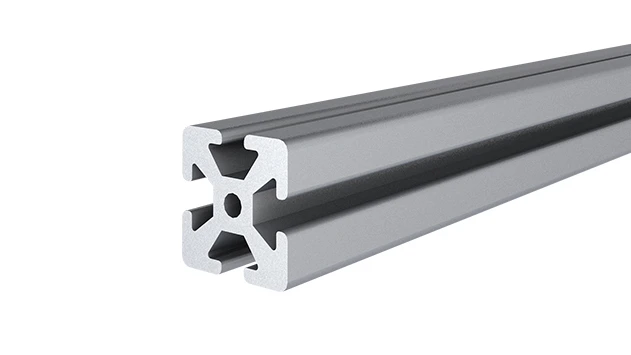
4040F is a 4.00x4.00 CM fractional 40 series square extrusion T-slot profile with four side open T-slots, each side with 4.00cm face. The profile has align-a-grooves to assist in aligning connecting profiles.
Introduction: The Backbone of Modern Manufacturing
Walk into any modern factory, warehouse, or workshop, and you'll likely spot a common unsung hero: the
aluminum profile
. These sleek, versatile structures form the skeleton of workbenches, material racks, conveyors, and lean manufacturing systems, quietly everything from assembly lines to laboratory setups. Among the countless profiles available, the 4040F EU Standard Aluminum Profile stands out as a workhorse—valued for its balanced strength, lightweight design, and adaptability. But what exactly makes this profile so reliable? To answer that, we need to dive into its material composition, alloy type, and the mechanical properties that make it a top choice for engineers, manufacturers, and
lean system supplier
s worldwide.
What is the 4040F EU Standard Aluminum Profile?
Before we unpack its materials, let's clarify what "4040F EU Standard" means. The "4040" refers to the profile's cross-sectional dimensions: approximately 40mm by 40mm, a popular size for medium-duty applications. The "F" denotes a specific design variant—often characterized by its T-slot configuration, which features grooves along its length to accommodate accessories like brackets, connectors, and panels. The "EU Standard" label ensures the profile meets strict European norms for quality, consistency, and performance, giving manufacturers confidence in its reliability across projects.
Unlike generic aluminum extrusions, EU-standard profiles undergo rigorous testing to ensure dimensional accuracy, material purity, and mechanical stability. This is especially critical for industries like automotive, electronics, and pharmaceuticals, where precision and safety are non-negotiable. For a
lean system supplier
, using 4040F profiles means building systems that can withstand daily wear without compromising on flexibility—the cornerstone of lean manufacturing.

Material Composition: The Alloy Behind the Strength
At the heart of the 4040F profile is its aluminum alloy—a carefully crafted blend of aluminum and other elements that determine its performance. Most EU-standard structural profiles, including the 4040F, are made from 6063 aluminum alloy, a heat-treatable alloy renowned for its excellent extrudability, corrosion resistance, and balanced mechanical properties. Let's break down its key components:
Aluminum (97.3-98.3%)
As the base metal, aluminum provides the profile's lightweight nature (about 1/3 the weight of steel) and natural resistance to corrosion. Pure aluminum is too soft for structural use, but when alloyed with other elements, it gains the strength needed for load-bearing applications like workbench es and material racks.Silicon (0.2-0.6%)
Silicon is added to improve the alloy's flow during the extrusion process. When heated, aluminum-silicon alloys become more fluid, allowing them to fill the complex T-slot die of the 4040F profile evenly. This ensures consistent wall thickness and dimensional accuracy—critical for fitting aluminum profile accessories like end caps and connectors.Magnesium (0.45-0.9%)
Magnesium is the primary strengthener in 6063 alloy. When combined with silicon, it forms magnesium silicide (Mg2Si) particles during heat treatment. These tiny particles act as "reinforcements," pinning dislocations in the metal's crystal structure and increasing its strength without sacrificing ductility.Iron (≤0.3%)
Iron is a common impurity in aluminum alloys, but its levels are strictly controlled in 6063. Too much iron can form brittle intermetallic compounds, reducing the alloy's toughness. EU standards limit iron to 0.3% to ensure the 4040F profile remains durable under stress.Other Elements (≤0.15%)
Trace amounts of copper, manganese, zinc, and titanium are often present, each playing a minor role. For example, titanium helps refine the grain structure during casting, improving the alloy's uniformity and strength. This precise composition makes 6063-T5 (the most common temper for 4040F profiles) ideal for structural applications: it's strong enough to support heavy loads, yet malleable enough to be cut, drilled, and assembled with basic tools.Mechanical Properties: How 4040F Stands Up to the Test
A profile's material composition directly influences its mechanical properties—the characteristics that determine how it behaves under stress, load, and environmental conditions. For the 4040F EU Standard Aluminum Profile, these properties are carefully engineered to balance strength, flexibility, and longevity. Let's explore the key metrics:
As the table shows, 4040F isn't the strongest (that title goes to 4040A, made with 6082 alloy), but it offers the best balance of strength, weight, and ductility for medium-duty tasks. This makes it ideal for applications where versatility matters most—like building a
workbench
that needs to support tools, parts, and occasional heavy loads, while remaining easy to reconfigure.
Tensile Strength
Tensile strength measures the maximum stress a material can withstand before breaking under tension. For 4040F profiles in the T5 temper (artificially aged), this typically ranges from 160 to 180 MPa (megapascals). To put that in perspective: a single 4040F beam (1 meter long) can support over 200 kg of weight before failing—more than enough for most workshop tools, electronic components, or small machinery.Yield Strength
Yield strength is the stress at which a material begins to deform permanently (plastic deformation). For 4040F-T5, yield strength is around 110-130 MPa. This means the profile can bend under heavy loads but will return to its original shape once the load is removed—up to that threshold. This "elastic" behavior is crucial for applications like workbench es, where occasional impacts (e.g., dropping a tool) shouldn't leave permanent dents.Elongation
Elongation (% of original length) measures how much the material can stretch before breaking. 4040F-T5 typically has an elongation of 8-10%, indicating moderate ductility. This allows the profile to absorb energy during sudden shocks (like a loaded trolley hitting a rack) without shattering—a safety feature that generic steel profiles often lack.Hardness (Brinell)
Hardness reflects the material's resistance to indentation. The 4040F profile has a Brinell hardness of 45-55 HB, which strikes a balance: hard enough to resist scratches from tools or parts, but not so brittle that it cracks under bending.Modulus of Elasticity
This property (around 69 GPa for aluminum alloys) describes how stiff the material is. While lower than steel (200 GPa), aluminum's lower modulus means 4040F profiles have some "give," reducing stress on connected components like aluminum profile accessories (e.g., 90° connectors). This flexibility is key for modular systems, where components need to move or adjust slightly without failing. To better understand how 4040F compares to other profiles, let's look at a side-by-side comparison:| Mechanical Property | 4040F EU (6063-T5) | 4040A EU (6082-T6) | 3030 EU (6063-T5) |
|---|---|---|---|
| Tensile Strength (MPa) | 160-180 | 250-280 | 150-170 |
| Yield Strength (MPa) | 110-130 | 200-230 | 100-120 |
| Elongation (%) | 8-10 | 6-8 | 8-10 |
| Brinell Hardness (HB) | 45-55 | 70-80 | 40-50 |
| Weight (kg/m) | 1.4-1.6 | 1.8-2.0 | 0.8-1.0 |
Why 4040F Matters for Lean Systems and Beyond
For a
lean system supplier
, the 4040F profile is more than just a building material—it's a tool for creating efficient, adaptable workspaces. Lean manufacturing thrives on minimizing waste and maximizing flexibility, and 4040F delivers on both fronts:
Modularity
The T-slot design of 4040F allows for quick assembly and reconfiguration using aluminum profile accessories like 90° connectors, end caps, and brackets. Need to add a shelf to a workbench ? Simply slide a bracket into the T-slot and tighten a screw. Want to reposition a material rack? Disassemble the frame and rebuild it in minutes. This modularity reduces downtime and allows systems to evolve with changing production needs.Lightweight Efficiency
Weighing just 1.4-1.6 kg per meter, 4040F profiles are easy to handle and install—no heavy machinery required. This lightness also reduces the load on floors and support structures, making it suitable for both ground-level and elevated setups (e.g., mezzanine workstations).Corrosion Resistance
Thanks to its aluminum base and 6063 alloy composition, 4040F resists rust and corrosion, even in humid or dusty factory environments. This longevity reduces replacement costs and ensures systems remain safe and functional for years.Cost-Effectiveness
While premium alloys like 6082 (used in 4040A) offer higher strength, they come at a higher price. 4040F hits the sweet spot: affordable enough for small workshops, yet durable enough for industrial use. For lean system supplier s, this means delivering high-quality solutions without overshooting client budgets.Applications: Where 4040F Shines
The 4040F profile's versatility makes it a staple in countless industries. Here are just a few examples of how it's used:
Workbenches and Assembly Stations
From electronics assembly to mechanical repair, workbench es built with 4040F profiles provide sturdy, customizable surfaces. Add a pegboard for tools, a lamp for lighting, or a shelf for parts—all via T-slot accessories.Material Racks and Storage Systems
EU-standard 4040F racks (like the "Material Rack B (3 row and 3 floor)" from our keyword list) safely store components, raw materials, and finished products. Their modular design allows adjusting shelf heights to fit different item sizes.Conveyor Frames
Lightweight yet strong, 4040F profiles form the frames for roller conveyors and belt conveyors, supporting the movement of parts across assembly lines.Lean Manufacturing Cells
Lean system supplier s use 4040F to build U-shaped workcells, kanban systems, and 5S stations, optimizing workflow and reducing unnecessary movement.Lab and Cleanroom Setups
Its smooth surface and corrosion resistance make 4040F ideal for labs, where cleanliness and chemical resistance are critical.Choosing the Right Supplier: Why EU Standards Matter
Not all 4040F profiles are created equal. While the EU standard sets a baseline, quality can vary between manufacturers. When selecting a supplier, look for certifications like CE marking, which confirms compliance with EU safety and performance standards. A reputable
lean system supplier
will also provide material test reports (MTRs) for their profiles, detailing alloy composition and mechanical properties—proof that the product meets the 4040F specifications.
Avoid generic, uncertified profiles: they may use lower-grade alloys, have inconsistent wall thickness, or fail to meet tensile strength requirements. Over time, this can lead to sagging
workbench
es, unstable racks, or even safety hazards. Investing in EU-standard 4040F profiles is an investment in long-term reliability.
Conclusion: The 4040F Profile—A Foundation for Progress
The 4040F EU Standard Aluminum Profile may not grab headlines, but it's an essential building block of modern manufacturing. Its 6063 alloy composition, balanced mechanical properties, and compatibility with
aluminum profile accessories
make it a favorite among engineers,
lean system supplier
s, and workshop owners alike. Whether you're building a simple
workbench
or a complex lean manufacturing system, 4040F delivers the strength, flexibility, and reliability needed to keep operations running smoothly.
In a world where efficiency and adaptability are key, the 4040F profile isn't just a material—it's a partner in progress.