- Company Articles
- Products and Technology
- Product knowledge
- Material Rack B Design: Maximizing Space with 4040E EU Standard Aluminum Profile

Material Rack B Design: Maximizing Space with 4040E EU Standard Aluminum Profile
Related Product
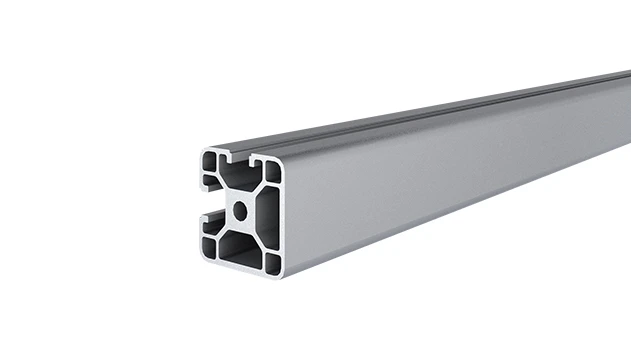
4040E EU Standard Aluminum Profile
4040E is a 4.00x4.00 CM fractional 40 series square extrusion T-slot profile with two side open T-slots, two side with closed face, each side with 4.00cm face. The profile has align-a-grooves to assist in aligning connecting profiles.
Walk into any busy warehouse, manufacturing floor, or distribution center, and you'll notice a common challenge: space. It's the silent puzzle every operations manager wrestles with—how to store more inventory, tools, or materials without expanding the facility. We've all seen the consequences of poor storage: aisles cluttered with boxes, shelves overflowing to the point of instability, and workers spending precious minutes hunting for a single part. But what if there was a storage solution that didn't just hold items, but actively created space? Enter Material Rack B (3 row and 3 floor)—a modular, durable system built around the 4040E EU standard aluminum profile. In this article, we'll dive into how this design transforms cramped spaces into efficient, organized hubs, and why aluminum profile accessories make it a game-changer for lean systems everywhere.
The Hidden Cost of Wasted Space
Before we get into the specifics of Material Rack B, let's talk about why space matters. It's not just about fitting more stuff—it's about time, safety, and bottom-line results. A recent study by the Warehouse Education and Research Council found that workers spend up to 25% of their day traveling to and from storage locations. If your racks are disorganized or inefficiently designed, that number jumps even higher. Imagine a small electronics manufacturer where a technician needs a specific resistor. If that resistor is buried behind three other boxes on a poorly designed shelf, they might spend 15 minutes retrieving it. Multiply that by 10 technicians a day, and you're losing over two hours of productive work—every single day.
Then there's the safety risk. Overloaded wooden shelves warp; flimsy metal racks bend under weight. A single collapsed shelf can damage inventory, injure workers, and halt production. And let's not forget the cost of expansion. Leasing or building additional warehouse space isn't cheap—we're talking tens of thousands of dollars annually. So, the question isn't "Can we afford a better rack?" It's "Can we afford not to?"
Meet Material Rack B: 3 Rows, 3 Floors, Endless Possibilities
Material Rack B (3 row and 3 floor) isn't just another shelf. It's a purpose-built storage system designed with one goal in mind: maximizing vertical and horizontal space without sacrificing accessibility. Let's break down the basics. As the name suggests, it features three rows (side-by-side sections) and three floors (vertical shelves), creating a grid-like structure that turns empty air into usable storage. But what really sets it apart is its foundation: the 4040E EU standard aluminum profile.
You might be wondering, "Why aluminum? Why not steel or wood?" Great question. Let's start with the 4040E profile itself. This isn't just any aluminum—it's an extruded profile, meaning it's shaped under high pressure to create a consistent, durable structure. The "4040" refers to its dimensions: 40mm by 40mm, a sweet spot that balances strength and versatility. The "E" denotes compliance with EU standards, which means rigorous testing for load capacity, corrosion resistance, and safety. So, right out of the gate, you're getting a frame that's built to last, even in tough industrial environments.

Why 4040E Aluminum Profile? The Backbone of Smart Design
Let's talk about the star of the show: the 4040E EU standard aluminum profile. Think of it as the skeleton of Material Rack B—strong, flexible, and ready to adapt. Unlike traditional steel racks, which are heavy and hard to modify, aluminum profiles are lightweight (about 1/3 the weight of steel) but surprisingly strong. A single 4040E profile can support up to 150kg per linear meter, which means even the top shelf of Material Rack B can hold heavy tools or bulk materials without sagging.
But the real magic is in the T-slot design. Run your finger along the edge of a 4040E profile, and you'll notice a continuous slot running the length of the extrusion. This slot is where aluminum profile accessories come into play—connectors, brackets, shelf supports, and end caps all slide into place and lock securely with a simple bolt or lever. No welding, no drilling, no complicated tools. Need to adjust a shelf height? Loosen a couple of connectors, slide the shelf up, and lock it back down. It's that easy. This modularity is key for businesses that grow or change—today's Material Rack B for small parts can become tomorrow's rack for larger components with just a few tweaks.
Corrosion resistance is another win. Unlike steel, which rusts when exposed to moisture or chemicals, aluminum forms a natural oxide layer that protects it. That makes Material Rack B ideal for environments like food processing facilities, auto shops, or even outdoor storage areas. And let's not overlook aesthetics. Aluminum has a clean, modern look that turns a utilitarian rack into something that actually looks good in your workspace. No more ugly, rust-streaked steel—just sleek, professional organization.
Aluminum Profile Accessories: The Building Blocks of Customization
A great frame is nothing without the right accessories, and Material Rack B shines here. Aluminum profile accessories are the unsung heroes that turn a pile of profiles into a fully functional storage system. Let's walk through the key players:
Connectors: The Glue That Holds It All Together
Without connectors, your 4040E profiles are just pieces of metal. But with the right joints—like 90° aluminum crossing joints or parallel aluminum joint A—you can create stable, rigid structures in minutes. These connectors are designed to fit the T-slot perfectly, so you don't have to worry about wobbly shelves. Many are even tool-free; a simple twist of a knob or flip of a lever locks them in place. For Material Rack B's 3-row design, three-way aluminum pipe joints are essential—they connect the vertical posts to the horizontal beams, ensuring the entire rack stays square and sturdy.
Shelf Supports and End Caps: Safety and Functionality
Shelf supports slide into the T-slot and provide a stable base for wooden, metal, or plastic shelves. They're adjustable, so you can set shelf heights to fit everything from small boxes to large equipment. And let's not forget end caps—those small, unassuming pieces that cover the ends of the aluminum profiles. They might seem trivial, but they prevent scratches on inventory, protect workers from sharp edges, and keep dust and debris out of the T-slot. matter, and these accessories prove it.
Leveling Feet: Stability on Uneven Floors
No warehouse floor is perfectly level. That's where aluminum pipe adjustable leveling feet come in. These threaded feet screw into the base of the vertical profiles, letting you tweak the height of each corner until the rack is rock-solid. It's a small feature, but it makes a big difference in preventing wobbling or tipping—especially when the rack is fully loaded.
Material Rack B Design: 3 Rows, 3 Floors, and the Science of Space
Now, let's put it all together: the 4040E profile, aluminum accessories, and the 3-row, 3-floor layout. What makes this design so space-efficient? Let's start with vertical utilization. Most traditional racks waste space above eye level, either because they're not tall enough or because the upper shelves are hard to reach. Material Rack B solves this with three floors, each adjustable to fit different item heights. The bottom floor might hold bulky, heavy items (within easy reach), the middle floor for frequently used parts, and the top floor for seasonal or less-used inventory. By stacking vertically, you're using the airspace that would otherwise go unused.
Then there's the 3-row design. Instead of a single wide shelf that's hard to organize, three narrower rows create distinct zones. You could dedicate one row to incoming materials, one to work-in-progress, and one to finished goods. Or, in a retail backroom, separate rows by product category. This segmentation reduces search time—workers know exactly where to go, and items don't get lost in the shuffle. Plus, narrower rows mean slimmer aisles, which frees up floor space for other equipment like forklifts or pallet jacks.
Let's throw in some numbers to make it concrete. A standard Material Rack B measures 1800mm tall (about 5'11"), 1200mm wide (3'11"), and 450mm deep (1'5"). With three rows and three floors, that's 9 individual shelf sections. Compare that to a traditional steel rack of the same footprint, which might have only 2 rows and 2 floors (4 sections). That's a 125% increase in storage capacity—without expanding the rack's footprint. For a warehouse with 10 such racks, that's the equivalent of adding 5 extra traditional racks' worth of space. It's not magic; it's smart design.
| Feature | Material Rack B (4040E Aluminum) | Traditional Steel Rack |
|---|---|---|
| Storage Sections (Same Footprint) | 9 (3 rows x 3 floors) | 4 (2 rows x 2 floors) |
| Weight (Empty) | ~45kg (easy to move/assemble) | ~120kg (requires heavy machinery) |
| Assembly Time | 1-2 hours (2 people, basic tools) | 4-6 hours (4 people, welding/drilling) |
| Customization | Unlimited (adjust shelves, add accessories) | Limited (fixed shelf heights, hard to modify) |
| Long-Term Cost | Lower (no rust, minimal maintenance) | Higher (rust treatment, replacement parts) |
Lean Systems: Material Rack B as the Foundation of Efficiency
If you're familiar with lean manufacturing or 5S principles (Sort, Set in Order, Shine, Standardize, Sustain), you know that organization is the backbone of efficiency. Lean systems aim to eliminate waste—whether it's time, materials, or motion. Material Rack B fits perfectly into this philosophy. Let's see how:
Sort: With three rows and three floors, it's easy to separate "needed" items from "unneeded." Old inventory can be moved to the top floor, while daily-use items stay at eye level. No more clutter, no more confusion.
Set in Order: Aluminum profile accessories like dividers or label holders let you assign a specific place to every item. A resistor goes in row 1, floor 2; a wrench in row 3, floor 1. Workers don't have to think—they just follow the system.
Shine: Aluminum's smooth surface is easy to clean. Wipe it down with a damp cloth, and it looks brand new. No more scrubbing rust or paint chips off steel racks.
Standardize: Since Material Rack B is modular, every rack in your facility can look and function the same way. New employees can learn the system in minutes, and cross-training becomes a breeze.
Sustain: The durability of aluminum means the rack will still be in great shape years down the line, so your organization system doesn't fall apart after a few months. It's a long-term commitment to efficiency.
I visited a automotive parts supplier last year that had just implemented Material Rack B. Their warehouse manager, Maria, told me, "Before, we had steel racks that were bolted to the floor. If we needed to reconfigure, we had to call in a contractor with a drill. Now, with aluminum profiles, my team can move a shelf in 10 minutes. We just rearranged three racks last week to make space for a new product line—no contractors, no downtime. That's lean."
Real-World Applications: Where Material Rack B Shines
Material Rack B isn't a one-trick pony. It works in almost any industry where storage matters. Let's look at a few examples:
Manufacturing: Keeping Tools and Parts at Hand
In a factory setting, time is money. A CNC machine operator can't afford to walk across the shop for a cutting tool. Material Rack B placed near the production line keeps tools organized and accessible. With 3 rows, you can separate drills, saws, and measuring tools—no more rummaging through a jumbled toolbox.
Retail: Backroom Inventory That's Actually Manageable
Retailers know the chaos of seasonal inventory—holiday decorations in Q4, summer gear in Q2. Material Rack B's 3-floor design lets you rotate stock easily: current season on the bottom, next season on the middle, and off-season on top. Plus, the aluminum frame looks clean, so even the backroom feels organized (no more hiding from store managers!).
Laboratories: Safe, Clean Storage for Sensitive Equipment
Laboratories need storage that's sterile and corrosion-resistant. Aluminum's non-porous surface won't harbor bacteria, and the T-slot design means no crevices for dust to collect. Material Rack B can hold test tubes, chemicals, or lab equipment—all within easy reach, all safely stored.
Maintenance and Longevity: Investing in the Future
One of the biggest concerns with any storage system is, "How long will it last?" With Material Rack B, the answer is: a long time. Aluminum doesn't rust, so even in humid or wet environments, the frame stays strong. The T-slot design means accessories can be replaced individually if they wear out—no need to buy a whole new rack. A quick wipe-down with soap and water is all it takes to keep it looking and functioning like new.
Compare that to steel racks, which often need repainting every few years to prevent rust, or wooden shelves that warp and rot. Over a 10-year period, the maintenance costs of a steel rack can add up to 50% of the initial purchase price. Material Rack B? Maybe a few replacement connectors or end caps—total. It's an investment that pays for itself in durability alone.
Conclusion: Space Isn't the Problem—Design Is
At the end of the day, Material Rack B (3 row and 3 floor) isn't just about storing things. It's about rethinking how we use space. By combining the strength of 4040E EU standard aluminum profile with the flexibility of aluminum profile accessories, it turns wasted air into usable storage, chaos into order, and inefficiency into productivity. Whether you're running a small workshop or a large warehouse, this design proves that you don't need more space—you need smarter space.
So, the next time you look at your cluttered shelves or overcrowded aisles, remember: the solution isn't to expand. It's to upgrade. Material Rack B isn't just a rack—it's a space-creating, time-saving, lean-system-boosting tool that grows with your business. And in today's fast-paced world, that's not just an advantage. It's a necessity.