- Company Articles
- Products and Technology
- Product knowledge
- Material Strength of 4040r EU Standard Aluminum Profile: Alloy Composition Analysis

Material Strength of 4040r EU Standard Aluminum Profile: Alloy Composition Analysis
Related Product
4040R EU Standard Aluminum Profile
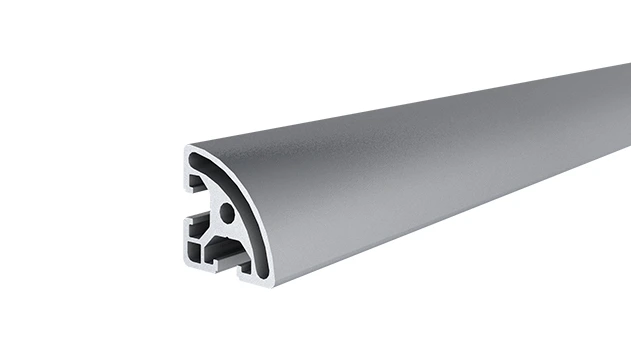
4040R is a 4.00x4.00 CM fractional 40 series square extrusion T-slot profile with two side open T-slots, each side with 4.00cm face,the other side is round face. The profile has align-a-grooves to assist in aligning connecting profiles.
Walk into any modern manufacturing plant, warehouse, or even a tech startup's assembly room, and you'll likely spot a common sight: sleek, silver structures holding everything from heavy machinery to delicate electronic components. These are aluminum profiles—unassuming yet indispensable building blocks that keep industries running smoothly. But not all aluminum profiles are created equal. Today, we're zeroing in on one that's become a favorite in factories and workshops across Europe: the 4040r EU standard aluminum profile . What makes this particular profile stand out? It all starts with what's inside—its alloy composition—and how that translates to the material strength that engineers and operators rely on daily.
1. The Backbone of Modern Manufacturing: Why Aluminum Profiles Matter
Before diving into the specifics of the 4040r, let's take a step back. Why has aluminum become the go-to material for everything from workbenches to conveyor systems? Unlike steel, aluminum is lightweight—about a third the density—making it easy to handle and install without sacrificing strength. It's also naturally resistant to corrosion, thanks to a thin oxide layer that forms on its surface, which means it holds up in damp warehouses or outdoor settings. But perhaps most importantly, aluminum profiles are incredibly versatile. Through extrusion—the process that gives us aluminum extrusion profile products—manufacturers can shape aluminum into complex cross-sections, creating custom solutions for almost any need.
In industries where efficiency and durability are non-negotiable, the right aluminum profile can make or break operations. A flimsy profile might bend under the weight of tools, causing delays and safety risks. A poorly designed one could slow down workflows because it doesn't integrate well with other equipment. That's where standards come in. EU standards, in particular, are known for their strict guidelines, ensuring that profiles like the 4040r meet consistent quality and performance benchmarks. For businesses, this means less guesswork: when you choose a EU-standard profile, you know it's been tested to handle real-world demands.
2. Understanding 4040r EU Standard Aluminum Profile: What Makes It Unique?
The 4040r isn't just a random string of numbers and letters. Let's break it down: "4040" refers to its cross-sectional dimensions—40mm by 40mm—making it a medium-sized profile, perfect for applications that need a balance of strength and flexibility. The "r" often denotes a rounded edge design, which isn't just for aesthetics; rounded edges reduce the risk of injury (no sharp corners to catch clothing or skin) and minimize stress concentrations, which can weaken the profile over time. And "EU standard"? That's your guarantee that every 4040r profile has passed rigorous testing for material composition, mechanical properties, and safety.
But what truly sets the 4040r apart is its focus on practicality. Unlike some specialty profiles designed for niche uses, the 4040r is a workhorse. It's found in assembly lines, where it supports conveyor belts and tool holders. It's in material racks, storing heavy components without warping. It's even in workbenches, where technicians stand for hours, relying on the profile to stay stable under constant use. None of this would be possible without its carefully engineered alloy composition—the secret sauce that gives it the strength to perform day in and day out.

3. Alloy Composition Breakdown: The Elements That Define Strength
At its core, aluminum is a soft metal. Pure aluminum has a tensile strength of around 90 MPa (megapascals)—enough to hold a few kilograms, but nowhere near what's needed for industrial use. To make it strong enough for profiles like the 4040r, manufacturers add other elements, creating an alloy. Think of it like baking a cake: the base is aluminum, but the "ingredients" you mix in (alloying elements) determine the final texture and structure. Let's take a closer look at what goes into the 4040r's alloy and why each element matters.
3.1 Primary Alloying Elements: The Heavy Lifters
Silicon (Si): Silicon is like the "flow agent" in the alloy. During extrusion—the process that shapes aluminum extrusion profile products—aluminum needs to flow smoothly through a die to take on the 40x40mm shape with consistent wall thickness. Silicon lowers the melting point of the alloy and improves its fluidity, ensuring that even complex cross-sections (like the 4040r's rounded edges) come out uniform. But silicon does more than aid manufacturing; it also forms compounds with other elements (like magnesium) that strengthen the alloy. In the 4040r, silicon typically makes up 0.4-0.8% of the composition—just enough to boost fluidity without making the alloy brittle.
Magnesium (Mg): If silicon is the flow agent, magnesium is the "strength booster." When combined with silicon, magnesium forms Mg2Si precipitates—tiny particles that act like reinforcements within the aluminum matrix. These precipitates block the movement of dislocations (defects in the metal's atomic structure), making the alloy harder to deform. For the 4040r, magnesium content usually ranges from 0.4-1.0%. This might sound small, but it's critical: a 1% increase in magnesium can raise tensile strength by 30-40 MPa, turning a flimsy profile into one that can support hundreds of kilograms.
Manganese (Mn): Manganese plays a supporting role, enhancing both strength and corrosion resistance. It reacts with iron (a common impurity in aluminum) to form harmless compounds, preventing the formation of brittle iron-aluminum phases that weaken the alloy. In the 4040r, manganese levels are kept low—typically 0.1-0.5%—but its presence ensures the profile holds up in humid or industrial environments where rust and degradation are constant threats.
3.2 Trace Elements: The Unsung Heroes
While primary elements get most of the attention, trace elements in the 4040r's alloy are just as important. Let's look at a few:
Iron (Fe): Iron is almost always present in aluminum alloys, but too much can be a problem. Excess iron forms large intermetallic compounds (like FeAl3) that act as stress points, making the alloy prone to cracking. EU standards strictly limit iron in the 4040r to 0.7% max, ensuring these compounds stay small and don't compromise strength.
Copper (Cu): Copper adds hardness to aluminum, but it's a double-edged sword. While it boosts strength, it can also reduce corrosion resistance. For the 4040r, which often ends up in damp warehouses or near cleaning chemicals, copper content is kept low (usually under 0.1%) to strike a balance between hardness and durability.
Zinc (Zn): Zinc is sometimes added in small amounts (0.1% max) to enhance the alloy's response to heat treatment, which we'll discuss later. It helps form fine precipitates during aging, further boosting strength without adding significant weight.
3.3 How EU Standards Regulate Composition
What makes the 4040r a "EU standard" profile isn't just marketing—it's a promise of consistency. The European Committee for Standardization (CEN) sets strict limits on alloy composition to ensure profiles perform uniformly across brands. For example, EN 755-2, the standard for wrought aluminum alloys for general engineering purposes, specifies the allowable ranges for each element in the 4040r's alloy (typically 6063, a common extrusion alloy). This means whether you buy a 4040r from a supplier in Germany or Poland, you're getting the same balance of silicon, magnesium, and trace elements—and thus the same strength and reliability.
4. Material Strength Metrics: What the Numbers Really Mean for Your Workspace
Alloy composition is interesting, but what does it mean for someone using the 4040r in a factory? Let's translate chemistry into real-world performance with three key metrics: tensile strength, yield strength, and hardness.
4.1 Tensile Strength: Pulling Power in Daily Use
Tensile strength is the maximum stress a material can withstand before breaking when pulled apart. For the 4040r, this typically ranges from 180-220 MPa. To put that in perspective: a single 4040r profile (with a wall thickness of 1.5mm) can handle a pulling force of around 5,000-6,000 Newtons—enough to lift a small car! In practice, this means if you're using 4040r to build a hanging rack for tools, you won't have to worry about it snapping under the load, even with years of use.
4.2 Yield Strength: When Does Deformation Start?
Tensile strength tells us when a profile breaks, but yield strength is about when it bends . Yield strength is the stress at which the material starts to deform permanently. For the 4040r, this is usually 110-140 MPa. Why does this matter? Imagine a workbench made with 4040r legs. If you place a 200kg machine on it, the legs might flex slightly, but as long as the stress stays below the yield strength, they'll spring back to their original shape. Exceed that, and the legs could warp, making the workbench unstable. Thanks to its magnesium-silicon precipitates, the 4040r has a high enough yield strength to handle typical workshop loads without permanent deformation.
4.3 Hardness: Standing Up to Scratches and Wear
Hardness measures a material's resistance to indentation or scratching—important for profiles that see constant contact, like workbench surfaces or conveyor rails. The 4040r typically has a Brinell hardness of 45-55 HB (Brinell Hardness). For context, this is harder than pure aluminum (which is around 20 HB) but softer than steel (which can be over 100 HB). This balance is ideal: hard enough to resist scratches from tools or parts, but not so hard that it's brittle (which would make it prone to chipping).
5. The Extrusion Process: How Shape Enhances Strength
Alloy composition is the foundation, but the way the 4040r is made—via extrusion—turns that foundation into a strong, usable product. Extrusion is like squeezing toothpaste from a tube: a heated aluminum billet (a solid cylinder) is pushed through a die with a 40x40mm opening, taking on the profile's shape. But this process does more than just shape the metal; it aligns the alloy's grain structure, making the profile stronger in the direction of extrusion.
During extrusion, the 4040r's wall thickness is carefully controlled. Most 4040r profiles have a wall thickness of 1.2-2.0mm, with thicker walls in areas that bear more load (like the corners). This design ensures that the profile can support weight evenly, reducing stress points. After extrusion, the profile undergoes heat treatment—usually T6 tempering. This involves heating the profile to 520°C to dissolve the Mg2Si precipitates, then quenching (rapid cooling) to lock the elements in solution, followed by artificial aging at 175°C to form fine, evenly distributed precipitates. This process is what gives the 4040r its final strength—without it, even the best alloy would fall short.
6. Practical Applications: Where 4040r's Strength Shines
Enough theory—let's talk about how the 4040r performs on the factory floor. Here are a few common uses where its alloy-driven strength makes all the difference:
6.1 Workbenches: The Heart of Assembly Lines
Workbenches are where the magic happens—whether it's assembling circuit boards or repairing machinery. A typical workbench made with 4040r profiles needs to support tools, parts, and sometimes even the operator leaning on it. With its 180-220 MPa tensile strength, a 4040r frame can easily handle 300-400kg of weight without bending. And because the profile is compatible with aluminum profile accessories like clamps and shelves, it's easy to customize the bench to fit specific tasks—no need for welding or drilling, which could weaken the metal.
6.2 Material Racks: Storing Heavy Loads Safely
In warehouses, material racks built with 4040r profiles hold everything from steel components to packed boxes. A three-tier rack might carry 500kg per shelf, and the 4040r's yield strength ensures the uprights don't bow over time. Even better, the profile's corrosion resistance means it won't rust in humid environments, keeping stored goods safe from contamination.
6.3 Conveyor Systems: Keeping Production Moving
Conveyors are the arteries of manufacturing, moving products 24/7. The 4040r is often used as a frame for roller conveyors, where it needs to support the weight of the conveyor itself plus the goods being transported. Its hardness ensures that the rollers don't scratch or dent the profile, even with constant friction. And when paired with aluminum profile end cap accessories, the 4040r's rounded edges prevent snags, keeping the conveyor running smoothly.
7. Comparing 4040r to Other Profiles: Why It Stands Out
To truly appreciate the 4040r's strength, let's compare its alloy composition and key metrics to two other popular EU standard profiles: the 3030 (30x30mm) and 2020 (20x20mm). This table shows how the 4040r's alloy and design make it a top choice for medium-to-heavy-duty applications:
| Profile Type | Alloy (Typical) | Si (%) | Mg (%) | Tensile Strength (MPa) | Yield Strength (MPa) | Common Use Cases |
|---|---|---|---|---|---|---|
| 4040r EU Standard | 6063 T6 | 0.4-0.8 | 0.4-1.0 | 180-220 | 110-140 | Workbenches, material racks, conveyor frames |
| 3030 EU Standard | 6063 T6 | 0.4-0.8 | 0.4-0.8 | 160-200 | 90-120 | Lightweight shelving, machine guards |
| 2020 EU Standard | 6063 T5 | 0.2-0.6 | 0.2-0.6 | 140-180 | 80-110 | Small component holders, display racks |
The 4040r's higher magnesium content (up to 1.0% vs. 0.8% in 3030) and T6 tempering give it a clear edge in tensile and yield strength. This makes it the go-to for applications where load-bearing is critical, while smaller profiles like the 2020 excel in lightweight, low-load scenarios.
8. Beyond Strength: The Role of Accessories in Performance
A strong profile is only as good as the system it's part of. That's where aluminum profile accessories come in. Take aluminum profile end cap products, for example. These simple plastic or metal caps snap onto the ends of the 4040r, covering sharp edges to prevent cuts and keeping dust, debris, and moisture out of the hollow profile. Over time, this protection prevents corrosion from the inside out, extending the profile's lifespan.
Then there are connectors—angles, brackets, and T-joints—that link 4040r profiles together. A poorly designed connector can create weak points, even if the profile itself is strong. EU-standard accessories are engineered to distribute stress evenly across the profile, ensuring that joints don't fail under load. For example, a 90-degree corner bracket for 4040r will have a wide base that contacts the profile's entire surface, spreading the weight of a shelf or workbench across the metal rather than concentrating it on a single point.
Rubber strips, another common accessory, add grip and reduce noise. When used on workbench surfaces, they prevent tools from sliding and absorb vibrations from machinery, which can weaken metal over time. In conveyor systems, rubber strips along the edges of 4040r profiles keep products centered, reducing friction and wear on both the profile and the goods being transported.
9. Conclusion: Why 4040r's Alloy Composition Makes It a Reliable Choice
At the end of the day, the 4040r EU standard aluminum profile isn't just a piece of metal—it's a testament to how careful alloy design, precise manufacturing, and smart engineering come together to solve real-world problems. Its blend of silicon for fluidity, magnesium for strength, and trace elements for balance gives it the tensile and yield strength needed to support heavy loads, while its compliance with EU standards ensures consistency and reliability.
Whether you're building a workbench that needs to last decades, a material rack that holds tons of inventory, or a conveyor system that runs nonstop, the 4040r delivers. And when paired with the right aluminum profile accessories —end caps, connectors, rubber strips—it becomes more than just a profile; it's a complete solution that grows with your business.
So the next time you walk into a factory and see those sleek silver structures, take a closer look. Chances are, you're looking at 4040r profiles—quietly doing their job, day in and day out, thanks to the science of alloy composition. It's not glamorous, but it's the kind of reliability that keeps industries moving forward.