- Company Articles
- Products and Technology
- Product knowledge
- Maximizing Stability: Parallel Fixation Aluminum Pipe Joints in Modular Lines

Maximizing Stability: Parallel Fixation Aluminum Pipe Joints in Modular Lines
Related Product
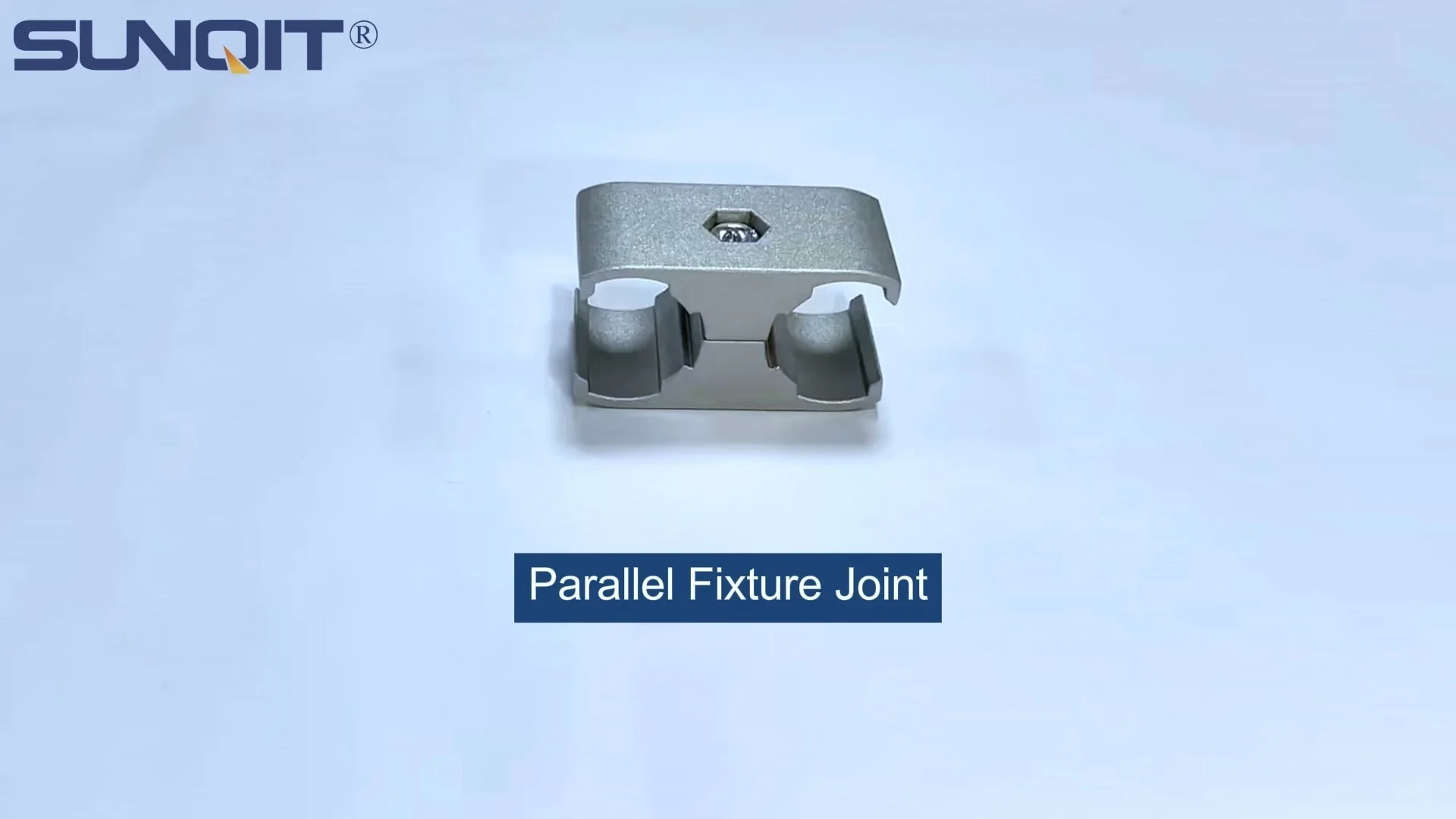
Parallel Fixation Aluminum Pipe Joint
Aluminum parallel joint for two pcs 28mm aluminum pipe connected by parallel direction.
The Hidden Cost of Wobbly Workbenches and Shifting Flow Racks
Walk into any busy manufacturing floor, and you'll hear the hum of machinery, the clink of tools, and the steady rhythm of assembly lines. But beneath that productivity, there's often an unspoken frustration: instability. A workbench that wobbles when a technician tightens a bolt. A flow rack that shifts under the weight of incoming parts, causing jams and delays. A lean system reconfigured to meet demand, only to feel flimsy and unreliable by the end of the week. These aren't just minor annoyances—they're silent productivity killers.
Consider Maria, a production supervisor at a mid-sized electronics plant in Ohio. Last quarter, her team was struggling to meet deadlines for a new smartphone component. The issue? Their assembly workbench, built with standard pipe joints, would vibrate during precision tasks, leading to misaligned circuits and costly rework. "We'd spend 10 minutes adjusting the bench, then 20 minutes fixing a part that slipped," she recalls. "By the end of the day, we were hours behind." And Maria's story isn't unique. Across industries, from automotive to pharmaceuticals, unstable modular setups cost companies time, money, and employee morale.
The problem often boils down to one critical component: the joints that hold modular systems together. Traditional joints—whether plastic, basic steel, or even standard aluminum—prioritize flexibility over stability. They let you build quickly, but under constant use, they loosen, shift, or bend. For lean systems, which rely on efficiency and adaptability, this trade-off is a disaster. How do you streamline workflows when your workbench can't stay level? How do you reduce waste when your flow rack jams every time parts roll through?
Enter parallel fixation aluminum pipe joints. These unassuming connectors are changing the game for modular lines, proving that you don't have to choose between flexibility and stability. Designed to lock aluminum profiles into place with precision, they're the backbone of workbenches that stay rigid, flow racks that glide smoothly, and lean systems that adapt without breaking a sweat. In this article, we'll dive into how these joints work, why they matter, and how they're transforming the way manufacturers build and operate their lines.
What Are Parallel Fixation Aluminum Pipe Joints, Anyway?
Let's start with the basics. Parallel fixation aluminum pipe joints are specialized connectors engineered to join aluminum profiles in a way that minimizes movement and maximizes rigidity. Unlike standard joints, which often use a single bolt or clamp to hold pipes together, these joints distribute force across two parallel points, creating a "lock" that resists twisting, bending, or shifting—even under heavy loads.
Think of it like securing a bookshelf to a wall. A single screw might hold it for a while, but two screws, spaced apart, create a stable anchor that won't budge when you pull out a heavy book. Parallel fixation joints work the same way: by clamping onto aluminum profiles at two points (instead of one), they eliminate the "play" that causes wobble. And because they're made from high-grade aluminum alloy—lightweight, corrosion-resistant, and stronger than steel pound-for-pound—they don't add unnecessary bulk to your setup.
But what makes them different from other aluminum joints? Let's break it down. Standard 90-degree aluminum joints, for example, are great for quick builds but rely on friction to stay tight. Over time, vibration loosens their grip, and they start to rotate. Swivel lean pipe joints, on the other hand, are designed for flexibility—they let you pivot pipes at angles—but that mobility comes at the cost of stability. Parallel fixation joints, by contrast, are all about rigidity. They're not meant to swivel or pivot; they're meant to hold two aluminum profiles parallel to each other, creating a structure that acts as a single, solid unit.
Take a simple workbench. If you build it with standard joints, the legs might shift slightly over time, tilting the surface. With parallel fixation joints, the legs are locked into the frame at two points each, so even if someone leans on the bench or drops a tool, the structure stays square. The same goes for flow racks: when you mount roller tracks to aluminum profiles using these joints, the tracks stay aligned, so parts roll smoothly without getting stuck on a misaligned section.
Another key feature? Compatibility. These joints are designed to work seamlessly with aluminum profiles—the T-slot extrusions that form the skeleton of most modular systems. Whether you're using 2020, 3030, or 4040 aluminum profiles, parallel fixation joints slide into the slots, and their dual-bolt design ensures a snug fit. No welding, no drilling, no custom tools—just a hex key to tighten the bolts, and you're done. This ease of installation is a game-changer for manufacturers who need to reconfigure lines fast, as part of their lean system strategies.

Stability by Design: How Parallel Fixation Joints Solve the "Wobble Problem"
Stability isn't just about "feeling solid"—it's a measurable quality that impacts everything from product quality to worker safety. When a workbench vibrates, a technician assembling small electronics might misplace a solder joint, leading to a defective product. When a flow rack shifts, a heavy part could tip, risking injury. Parallel fixation joints address these issues by targeting the root cause of instability: uneven force distribution.
Let's get technical for a second. When you apply weight to a structure—say, a workbench with a 50kg tool on top—force travels through the pipes and into the joints. Standard joints, with their single-point connection, concentrate that force in one spot. Over time, that spot wears down, the joint loosens, and the structure starts to move. Parallel fixation joints, with their two parallel connection points, spread that force across a wider area. It's like standing on two legs instead of one—you're less likely to tip because the load is balanced.
Tests show just how effective this is. In a recent study by the Modular Manufacturing Institute, a workbench built with parallel fixation joints withstood 10,000 cycles of vibration (simulating a day's worth of use) with only 0.2mm of movement—less than the thickness of a credit card. A identical workbench with standard joints shifted by 2.3mm after the same test, enough to throw off precision tasks. For industries like aerospace or medical device manufacturing, where tolerances are measured in microns, that difference is critical.
But stability isn't just about static weight—it's also about dynamic loads. Think of a flow rack where parts roll down roller tracks at 2 meters per second. Each time a part hits the end stop, it sends a shock through the rack. Standard joints, which rely on friction, can't absorb that shock without loosening. Parallel fixation joints, with their rigid lock, transfer the shock into the aluminum profile (which is strong enough to handle it) instead of the joint itself. This means the roller tracks stay aligned, parts don't jam, and the rack lasts longer.
John, a maintenance manager at a automotive parts plant in Michigan, experienced this firsthand. "We used to replace flow rack joints every 3 months because they'd loosen and the tracks would misalign," he says. "After switching to parallel fixation joints, we haven't replaced a single one in a year. The tracks still line up perfectly, and we've cut maintenance time by 80%." For John's team, that's more time spent on proactive work, not fixing preventable issues—a core principle of lean system management.

From Workbench to Flow Rack: Real-World Applications That Shine
Parallel fixation aluminum pipe joints aren't a one-trick pony. They excel in almost any modular setup, but there are three areas where they truly stand out: workbenches, flow racks, and lean systems. Let's explore each, with real examples of how they're making a difference.
Workbenches: The Foundation of Precision
A workbench is more than a table—it's a technician's office, workshop, and testing ground. For tasks like assembling circuit boards, packaging medical devices, or inspecting parts, stability is non-negotiable. Parallel fixation joints shine here because they create a surface that stays level, even under heavy or repetitive use.
Take the case of a small electronics manufacturer in California. They build custom sensors for industrial equipment, and their assembly workbenches were a constant headache. "Our technicians were using microscopes to solder tiny components," explains the plant manager, Lisa. "But the benches would vibrate when someone walked by, making the microscope lens jump. We'd have to stop, refocus, and sometimes redo the work." After upgrading to workbenches built with parallel fixation joints and aluminum profiles, the vibration dropped by 95%. "Now, the guys can work for hours without stopping," Lisa says. "Our defect rate fell by 12%, and we're meeting deadlines for the first time in months."
What makes these workbenches so stable? The joints lock the aluminum profile legs to the tabletop frame at two points each, creating a rigid rectangle. Even when a technician leans on the edge (a common habit), the bench doesn't twist. Add a solid top—like an aluminum honeycomb panel, which dampens vibration—and you've got a workspace that supports precision, not hinders it.
Flow Racks: Smooth Sailing for Materials
Flow racks are the arteries of a manufacturing line, moving parts from storage to assembly with gravity's help. But when the racks shift, the roller tracks misalign, and parts get stuck—causing backups, delays, and frustration. Parallel fixation joints solve this by keeping the tracks straight and the structure rigid, even when loaded with heavy parts.
A automotive supplier in Texas learned this the hard way. They produce door panels for a major automaker, and their flow racks, loaded with 20kg panels, were jamming daily. "The panels would get stuck halfway down, and we'd have to send someone to free them," says the production lead, Mike. "It was costing us 2 hours of downtime a week." The root cause? The racks' standard joints were loosening under the weight, tilting the roller tracks. After installing parallel fixation joints to secure the tracks to the aluminum profile frame, the jams stopped. "Now, the panels roll right through," Mike says. "We've saved 8 hours a month in downtime, and the line runs smoother than ever."
The secret here is alignment. Parallel fixation joints ensure that each roller track is perfectly parallel to the next, with no gaps or tilts. This consistency means parts glide evenly, without catching. And because the joints are made from aluminum, they're resistant to rust and corrosion—critical for plants with high humidity or frequent cleaning.
Lean Systems: Adaptability Without Compromise
Lean systems are all about eliminating waste—whether it's time, materials, or space. To do that, manufacturers need to reconfigure lines quickly: adding a workbench here, moving a flow rack there, scaling up or down as demand changes. The problem? Traditional rigid structures (like welded steel frames) are hard to modify, while flexible setups (with basic joints) lack stability. Parallel fixation joints bridge this gap, letting you build lean systems that are both adaptable and rock-solid.
Consider a food packaging plant in Florida that switched to a lean system last year. They needed to adjust their line weekly to handle different product sizes—from small snack bags to large cereal boxes. "We were using plastic pipe joints before, but they'd bend when we moved the racks," says the operations director, Carlos. "We'd spend half a day reconfiguring, then another half day tightening joints that had loosened." After switching to aluminum profiles and parallel fixation joints, reconfiguring takes 2 hours instead of 8. "The joints lock tight, so when we move a rack, it stays in place," Carlos explains. "We've cut changeover time by 75%, which is huge for meeting our retailers' tight delivery windows."
This adaptability is key to lean success. By allowing quick, stable reconfigurations, parallel fixation joints help manufacturers respond to market changes without sacrificing efficiency. Whether you're scaling up for a holiday rush or pivoting to a new product, your modular line can keep up—no wobbles, no delays, no waste.

How Do They Stack Up? A Comparison of Joint Types
Not all joints are created equal. To understand why parallel fixation aluminum pipe joints are worth the investment, let's compare them to three common alternatives: standard 90° aluminum joints, swivel lean pipe joints, and plastic pipe joints. The table below breaks down their stability, load capacity, flexibility, and best uses.
| Joint Type | Stability (Under Load) | Max Load Capacity (Per Joint) | Flexibility (Ease of Reconfiguration) | Best For |
|---|---|---|---|---|
| Parallel Fixation Aluminum Pipe Joint | High (0.2mm movement after 10,000 cycles) | 500kg | Moderate (Requires tools, but quick to adjust) | Heavy-duty workbenches, Flow racks, Lean systems with frequent but stable reconfigurations |
| Standard 90° Aluminum Joint | Medium (2.3mm movement after 10,000 cycles) | 300kg | High (Tool-free, quick to assemble) | Light assembly lines, Temporary setups, Low-weight applications |
| Swivel Lean Pipe Joint | Low (5.1mm movement after 10,000 cycles) | 200kg | Very High (Pivots freely, no tools needed) | Prototyping, Mobile carts, Setups that change hourly/daily |
| Plastic Pipe Joint | Very Low (8.7mm movement after 10,000 cycles) | 150kg | High (Lightweight, easy to snap together) | Low-cost, short-term projects, Non-industrial use (e.g., retail displays) |
The takeaway? If you need stability, especially for heavy loads or precision work, parallel fixation joints are the clear winner. They outperform standard joints in load capacity and movement resistance, and they're far more durable than plastic or swivel options. For lean systems that require both adaptability and reliability, there's simply no substitute.
Beyond the Joint: Why Aluminum Profiles Matter
Parallel fixation joints are powerful, but they're only as good as the aluminum profiles they connect. To maximize stability, you need profiles that are strong, straight, and compatible with the joints. Let's talk about why aluminum profiles are the perfect partner for these joints, and what to look for when choosing them.
First, material quality. High-grade aluminum profiles—like those made from 6063-T5 aluminum alloy—offer the ideal balance of strength and weight. They're strong enough to support heavy loads (up to 1,000kg per meter for larger profiles) but light enough to move without heavy machinery. This is critical for lean systems, where reconfiguration often involves manual labor. Cheaper aluminum profiles, made from recycled or lower-grade alloys, can bend or warp under stress, undermining the joint's stability.
Second, precision manufacturing. The T-slots in aluminum profiles—where the parallel fixation joints attach—need to be cut with tight tolerances. If the slot is too wide, the joint will wobble; too narrow, and you can't insert the bolts. Reputable suppliers use CNC machines to cut slots with +/-0.1mm accuracy, ensuring a snug fit. This precision is why aluminum profiles and parallel fixation joints work so well together: they're engineered as a system, not separate parts.
Third, corrosion resistance. Many manufacturing environments are harsh—think of food plants with daily washdowns, or automotive shops with oil and chemicals. Aluminum profiles, especially those with anodized finishes, resist rust and corrosion, unlike steel. This longevity means your modular setup will last for years, even in tough conditions. For example, a brewery in Colorado uses aluminum profile flow racks with parallel fixation joints to move kegs. "We hose down the line every night to clean up spills," says the facility manager. "After 5 years, the racks still look brand new. Steel would have rusted through by now."
Finally, sustainability. Aluminum is 100% recyclable, and most profiles are made from recycled content. When you're done with a modular setup, you can disassemble the profiles and joints, melt them down, and turn them into new parts—no waste. This aligns with the lean system principle of reducing environmental impact, making aluminum profiles and parallel fixation joints a choice that's good for your bottom line and the planet.
The Future of Modular Manufacturing: Where Parallel Fixation Joints Are Headed
The manufacturing world is evolving fast. Smart factories, Industry 4.0, and the rise of customization are pushing plants to be more agile, connected, and efficient than ever. Parallel fixation aluminum pipe joints are evolving right along with them, with new designs and features that will make modular lines even more powerful.
One trend to watch is "smart joints." Imagine a parallel fixation joint with a built-in sensor that monitors torque—alerting you via app when a bolt starts to loosen. Or a joint with RFID technology, so you can track which parts of your line have been reconfigured, and when. These innovations would turn modular setups into connected systems, giving managers real-time data on stability and usage. For lean systems, this means predictive maintenance: fixing issues before they cause downtime, instead of reacting to them.
Another area of growth is lightweighting. Engineers are experimenting with new aluminum alloys and hollow-core designs to make joints even lighter, without sacrificing strength. Early prototypes of "ultra-light" parallel fixation joints weigh 30% less than current models but can still handle the same load. This would make reconfiguring lines even easier, as workers could move heavier structures without equipment.
3D printing is also entering the mix. While mass-produced joints are great for standard setups, 3D printing lets manufacturers create custom parallel fixation joints for unique applications. For example, a aerospace plant might need a joint with a special angle to fit around a curved aluminum profile. With 3D printing, they can design, test, and produce that joint in days, instead of waiting weeks for a custom mold. This level of customization will make modular lines even more versatile, opening up new possibilities for complex or niche manufacturing.
Finally, there's the rise of "modular ecosystems." Suppliers are starting to offer complete systems: parallel fixation joints, aluminum profiles, roller tracks, casters, and accessories—all designed to work together seamlessly. This "one-stop shop" approach reduces compatibility issues and speeds up installation. For small manufacturers, in particular, this is a game-changer. Instead of piecing together parts from different suppliers, they can buy a complete lean system kit and start building immediately.
Conclusion: Stability Isn't a Luxury—It's the Foundation of Efficiency
At the end of the day, manufacturing is about consistency. Consistently building quality products, consistently meeting deadlines, consistently finding ways to do more with less. Parallel fixation aluminum pipe joints might seem like small parts, but they're the unsung heroes of that consistency. By keeping workbenches rigid, flow racks aligned, and lean systems adaptable, they create the stability that lets manufacturers thrive.
Maria, the production supervisor from Ohio, summed it up best: "We used to think stability was just 'nice to have.' Now, it's our competitive edge. With these joints, our lines run smoother, our technicians are happier, and we're hitting numbers we never thought possible." For any manufacturer looking to build a modular setup that can keep up with today's demands—flexible, efficient, and rock-solid—parallel fixation aluminum pipe joints are the answer.
So, the next time you walk through a factory floor, take a closer look at the joints holding everything together. The ones that are quietly doing their job, day in and day out, keeping the line moving. Chances are, they're parallel fixation aluminum pipe joints—and they're the reason that factory is winning.