- Company Articles
- Products and Technology
- Product knowledge
- Mechanical Engineering Workshops: Four Way Straight Lean Pipe Joint in Custom Fixture Design

Mechanical Engineering Workshops: Four Way Straight Lean Pipe Joint in Custom Fixture Design
Related Product
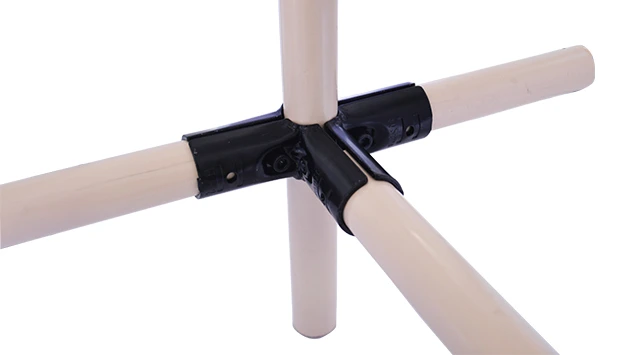
Four Way Straight Lean Pipe Joint
Four way lean pipe joint for 4 pcs 28MM lean pipe connection in straight angle, which used widely in workbench, flow rack, hand trolley frame connection.
Walk into any bustling mechanical engineering workshop, and you'll immediately sense the energy—whirring drills, clinking tools, and the focused hum of teams turning raw materials into precision parts. But behind that energy lies a hidden challenge: the fixtures that hold, organize, and transport these parts. For decades, workshops relied on rigid, welded metal structures or clunky wooden benches—fixtures that worked for one project but became obsolete the moment a new design came through the door. Workers wasted hours adjusting these immovable setups, while managers watched as valuable floor space got eaten up by unused, one-size-fits-nothing tools. It's a scenario that feels all too familiar: the right idea, but the wrong tools to bring it to life.
Enter the era of lean manufacturing—a philosophy built on flexibility, efficiency, and respect for people. At the heart of this revolution is a simple yet powerful tool: the lean pipe system. And within that system, one component stands out as a quiet game-changer: the four way straight lean pipe joint. This unassuming connector isn't just a piece of hardware; it's the key to unlocking a workshop's full potential. In this article, we'll explore how this joint transforms custom fixture design, making workshops more adaptable, productive, and worker-friendly—one modular build at a time.
Lean Systems: More Than a Buzzword—A Workshop's Best Friend
Before diving into the specifics of the four way straight lean pipe joint, let's take a step back and understand why lean systems matter. Lean manufacturing, born from the Toyota Production System, isn't about cutting corners or skimping on quality. It's about eliminating waste —waste of time, space, materials, and even worker frustration. In a mechanical workshop, waste often creeps in through inflexible fixtures. Imagine a team tasked with assembling a new line of small engines. Last month, they built large industrial pumps, so their workbench is set up with heavy-duty clamps and a fixed shelf height. Now, with smaller parts, the clamps are too bulky, and the shelf is too low—workers hunch over, tools get misplaced, and every adjustment takes 20 minutes of wrestling with bolts and wrenches. That's waste. Lean systems attack this problem head-on.
Lean pipe systems, often called "flexible pipe systems," are the physical embodiment of lean principles. They're made up of lightweight, durable pipes (usually steel or aluminum) and a variety of joints that let you build, modify, and rebuild fixtures on the fly. No welding, no specialized tools, no permanent commitments. Need a taller shelf? Swap out a short pipe for a longer one. Want to add a side rail to your workbench? Snap on a joint and connect a new pipe. It's like building with industrial-grade Legos, but with the strength to handle real-world workshop demands.
At the core of these systems is the lean pipe itself—a hollow tube, often coated in plastic or rubber to protect parts and reduce noise. But pipes alone can't create structure. That's where joints come in. And among the many joint types—90-degree elbows, T-joints, swivel connectors—the four way straight lean pipe joint is a standout for its versatility. It's the Swiss Army knife of connectors, allowing you to branch out in four directions from a single point. Think of it as a central hub: up, down, left, right—all from one joint. This might sound simple, but in a workshop where space is tight and projects vary daily, that flexibility is gold.
The Four Way Straight Lean Pipe Joint: Design That Makes Sense
Let's get technical—without getting lost in jargon. What exactly is a four way straight lean pipe joint? Picture a small, cylindrical metal block with four threaded holes, each aligned at 90-degree angles (like the north, south, east, and west directions on a compass). These holes are sized to fit standard lean pipes, and each comes with a setscrew or a locking pin to secure the pipe in place. Some joints are made of zinc-plated steel for strength, others of aluminum for lighter applications—either way, they're built to withstand the daily wear of a workshop, from accidental bumps with a trolley to the weight of heavy toolboxes.
What makes this joint special isn't just its four connection points; it's how those points work together. Unlike a T-joint, which only splits a pipe into three directions, or a corner joint, which forces a 90-degree turn, the four way straight joint lets you build linear structures with built-in adaptability . For example, imagine building a flow rack—a gravity-fed shelf system where parts glide down to the assembly line. With a four way joint, you can run a main horizontal pipe along the wall, then connect vertical pipes at intervals to support the rack's levels. Need an extra shelf halfway? Just add another vertical pipe to the joint. Later, if you need to widen the rack, unscrew the setscrews, slide the joint along the main pipe, and lock it in place. No cutting, no welding, no waiting for a maintenance crew. A single worker can make the change in 10 minutes.
Another key feature is compatibility. The four way straight lean pipe joint works seamlessly with other lean pipe accessories—casters for mobile workbenches, roller tracks for material flow, even tool hooks and bin holders. This modularity means you're never stuck with a "finished" fixture. A workbench today can become a turnover trolley tomorrow, simply by swapping out the feet for casters and adding side rails. It's this "build once, use forever (in different ways)" mentality that aligns perfectly with lean's focus on reusability.

From Idea to Assembly: Real-World Applications of the Four Way Joint
Enough theory—let's look at how the four way straight lean pipe joint solves real problems in workshops. We'll explore three common scenarios where this joint turns frustration into efficiency: custom workbenches, flow racks, and mobile material trolleys.
1. Custom Workbenches: Built for the Way You Work
Workbenches are the heart of any workshop, but standard models are often a compromise. They're either too low, too high, too narrow, or cluttered with fixed shelves that don't fit your tools. With lean pipe and four way joints, you can build a workbench that fits your team like a glove. Let's say your assembly team includes workers of different heights—instead of forcing everyone to adapt to a 36-inch bench, build one with adjustable legs using four way joints. The main frame uses vertical pipes connected to a horizontal base via four way joints; by adding or removing pipe segments, you can raise or lower the bench in 6-inch increments. Add a shelf halfway up using another four way joint, and suddenly you've got a dedicated space for tools, keeping the work surface clear.
But it doesn't stop there. Need a vice on one end? Attach it to a pipe extension using a four way joint. Want to hang power tools overhead? Run a crossbar between two vertical pipes, secured with—you guessed it—four way joints. When the project changes, take it apart and rebuild. A team at a mid-sized automotive parts workshop in Ohio did just that: they used four way joints to build a workbench for assembling brake calipers, then reconfigured the same pipes and joints into a testing station for fuel injectors a month later. The result? They saved $800 on new fixtures and cut setup time for the new project by 75%.
2. Flow Racks: Keeping Parts Moving, Not Waiting
In many workshops, parts spend too much time sitting idle—stacked in bins on the floor, buried under other materials, or requiring workers to walk across the shop to retrieve them. Flow racks solve this by using gravity to feed parts directly to the assembly line, but traditional flow racks are rigid. The four way straight lean pipe joint changes that. Let's say you need a flow rack for small electronic components—resistors, capacitors, diodes. With a four way joint, you can build a rack with three levels: the top for incoming parts, the middle for active assembly, and the bottom for empty bins. Each level uses roller tracks (another lean pipe accessory) to let bins glide smoothly. If a new component arrives that's taller than the others, just adjust the vertical pipes on the four way joints to raise that level—no need to rebuild the entire rack.
A furniture manufacturer in North Carolina used this approach to organize woodworking parts. Their old system had fixed wooden shelves, and workers often had to climb ladders to reach top-level bins. By switching to a lean pipe flow rack with four way joints, they added adjustable levels and angled the roller tracks to make parts easier to reach. The result? A 40% reduction in time spent retrieving parts and zero ladder-related near-misses. As one worker put it: "I used to dread restocking the top shelf. Now, I just adjust the rack to my height and slide the bin right into place. It sounds small, but it makes the whole day less tiring."
3. Mobile Material Trolleys: Taking the "Heavy" Out of Heavy Lifting
Moving materials around a workshop shouldn't be a workout, but with rigid, heavy trolleys, it often is. Lean pipe mobile trolleys, built with four way joints, are lightweight yet sturdy, making them easy to push even when loaded. For example, a maintenance team might need a trolley to carry tools and replacement parts to different machines. With four way joints, they can build a trolley with a lower shelf for bulky parts, an upper shelf for tools, and side rails to keep everything from sliding off. Add casters with brakes, and the trolley stays put when in use but glides smoothly when moving. Later, if they need to carry longer pipes, they can extend the trolley's frame by adding more pipes to the four way joints—no need to buy a new trolley.
A aerospace parts supplier in Washington state took this a step further. They built a series of identical trolleys using four way joints, each with color-coded bins for different part types. When a new order came in for a larger component, they simply combined two trolleys into one longer unit using additional pipes and four way joints. "We used to have five different trolley sizes cluttering the shop," said the operations manager. "Now, we have one base design that we adapt as needed. It's saved us 30 square feet of storage space and eliminated the argument over who gets the 'good' trolley."

Traditional Fixtures vs. Lean Pipe Fixtures: A Side-by-Side Comparison
Still not convinced the four way straight lean pipe joint is worth the switch? Let's compare traditional fixtures (welded steel, wooden benches, fixed racks) with lean pipe fixtures built using four way joints. The difference isn't just in flexibility—it's in cost, time, and worker satisfaction.
| Feature | Traditional Fixtures | Lean Pipe Fixtures with Four Way Joints |
|---|---|---|
| Setup Time | Weeks (waiting for welding, painting, or delivery) | Hours (assembled on-site with basic tools) |
| Adaptability | Fixed (requires cutting/welding to modify) | Highly adaptable (adjustable in minutes with setscrews) |
| Cost Over Time | High (replace entire fixture when needs change) | Low (reuse pipes and joints for new designs) |
| Worker Satisfaction | Low (frustration with mismatched setups) | High (workers can customize their own workspaces) |
| Space Efficiency | Poor (permanent fixtures waste unused space) | Excellent (disassemble or reconfigure to free space) |
The Human Touch: Why Workers Love Lean Pipe Fixtures
At the end of the day, workshops are about people—and the best tools are the ones that make people's jobs easier. The four way straight lean pipe joint does exactly that by putting control back into workers' hands. When a team can design and adjust their own fixtures, they feel valued and empowered. It's not just about efficiency; it's about respect for the expertise of the people on the floor.
Take Maria, a senior assembler at a machinery workshop in Texas. For years, she worked at a fixed-height bench that forced her to bend her wrists awkwardly when using her drill. "I'd go home with a sore arm every night," she recalls. "I mentioned it to my supervisor, but the bench was welded, so there was nothing they could do." Then the workshop switched to lean pipe systems. Maria and her team built their own workbenches, adjusting the height to match each worker's elbow level. "Now my arm doesn't hurt, and I can focus on the work instead of the pain," she says. "It sounds small, but it makes me want to come to work."
Or consider Raj, a new engineer fresh out of college, tasked with setting up a prototype assembly line. With traditional fixtures, he would have needed to submit a request to the maintenance department, wait weeks for approval, and then hope the final product matched his vision. With lean pipe and four way joints, he built the entire line himself in a day, adjusting as he went. "It was like solving a puzzle," he says. "I could test a design, see what worked, and tweak it on the spot. That's how innovation happens—fast, not in slow motion."
Choosing the Right Supplier: What to Look For
Ready to invest in lean pipe systems with four way straight joints? The next step is finding a reliable supplier. Not all lean pipe products are created equal—quality matters, especially in a workshop environment. Here are a few key things to look for:
- Material Quality: Opt for lean pipes made of high-grade steel or aluminum, with a durable plastic coating to resist scratches and corrosion. Joints should be zinc-plated or anodized to prevent rust.
- Compatibility: Ensure the supplier's four way joints work with standard lean pipe sizes (typically 28mm or 30mm diameter) and other accessories like casters, roller tracks, and workbench tops.
- Customer Support: Look for suppliers who offer design assistance or sample kits. A good supplier will help you plan your first fixture, not just sell you parts.
- Lead Times: Since lean systems are about agility, your supplier should have stock on hand for quick delivery. Avoid suppliers with 4-6 week wait times—you need parts when inspiration (or a new project) strikes.
Remember, a lean pipe system is an investment in your workshop's future. Choosing a reputable supplier ensures that your four way joints, pipes, and accessories will last for years, even with heavy use.
The Future of Workshop Design: Lean, Flexible, and People-First
As manufacturing continues to evolve—with shorter product lifecycles, custom orders, and a focus on sustainability—workshops need tools that can keep up. The four way straight lean pipe joint isn't just a solution for today; it's a foundation for tomorrow. Imagine a future where workshops are entirely modular, with fixtures that adapt in real time to 3D-printed designs or AI-optimized assembly lines. With lean pipe systems, that future is already here.
But perhaps the most exciting part is how these systems put people at the center. In a world where automation often dominates the conversation, lean pipe fixtures remind us that the best innovations are the ones that empower workers, not replace them. They turn workshops from places of frustration into spaces of creativity, where teams can build, experiment, and improve—together.
So, the next time you walk into a mechanical engineering workshop, take a closer look at the fixtures. If you see a workbench that looks like it was built by the team using colorful pipes and simple joints, you're looking at the future. And at the heart of that future? The four way straight lean pipe joint—small, mighty, and ready to build a better workshop, one connection at a time.