- Company Articles
- Products and Technology
- Product knowledge
- Mechanical Manufacturing: 4040r EU Standard Aluminum Profile Structural Support

Mechanical Manufacturing: 4040r EU Standard Aluminum Profile Structural Support
Related Product
4040R EU Standard Aluminum Profile
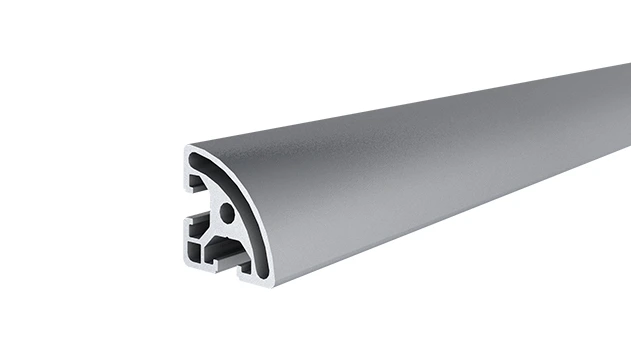
4040R is a 4.00x4.00 CM fractional 40 series square extrusion T-slot profile with two side open T-slots, each side with 4.00cm face,the other side is round face. The profile has align-a-grooves to assist in aligning connecting profiles.
Walk into any modern manufacturing facility, and you'll notice a silent backbone holding everything together: structural support systems. From the workbenches where technicians assemble intricate components to the flow racks that keep materials moving smoothly, these structures are the unsung heroes of efficiency, safety, and adaptability. In an industry where downtime costs money and flexibility is key, the choice of structural support can make or break daily operations. This is where the 4040r EU Standard Aluminum Profile steps in—a solution designed to balance strength, versatility, and practicality in ways that traditional materials simply can't match.
Imagine a production line that needs to reconfigure overnight to accommodate a new product, or a workbench that must support heavy machinery without weighing down the floor. These scenarios demand more than just "sturdy" support; they need systems that are lightweight yet robust, easy to modify, and built to last. The 4040r aluminum profile, with its precision engineering and modular design, has become the go-to choice for manufacturers aiming to stay agile in a fast-paced market. Let's dive into what makes this profile a cornerstone of modern mechanical manufacturing.
What Is the 4040r EU Standard Aluminum Profile?
At its core, the 4040r EU Standard Aluminum Profile is a extrusion-molded aluminum component defined by its dimensions (40mm x 40mm cross-section) and compliance with strict EU manufacturing standards. The "r" in its name often refers to its rounded edges—a subtle but crucial detail that enhances safety by reducing sharp corners, a common hazard in busy workshops. But beyond its shape, this profile represents a philosophy: that structural support should be both functional and flexible.
Aluminum extrusion, the process used to create this profile, involves forcing heated aluminum alloy through a die to form a consistent cross-sectional shape. This method ensures precision, uniformity, and the ability to integrate features like T-slots—longitudinal grooves that run along the profile's length. These T-slots are game-changers, allowing users to attach accessories, brackets, and other components without welding or drilling, making customization as simple as sliding a bolt into place.
Compliance with EU standards (such as EN 755-9, which governs aluminum extrusions for structural applications) isn't just a badge of quality; it's a guarantee of reliability. Manufacturers can trust that the 4040r profile meets rigorous criteria for material strength, dimensional accuracy, and corrosion resistance—critical factors in environments where equipment longevity directly impacts the bottom line.
Core Features: Why 4040r Stands Out in Mechanical Manufacturing
The 4040r profile isn't just another piece of metal. Its design is a result of decades of innovation in material science and manufacturing needs. Let's break down its most impactful features:
Lightweight Yet Incredibly Strong
Aluminum is inherently lighter than steel—about one-third the weight—yet the 4040r profile, thanks to its alloy composition (typically 6063-T5, a heat-treated aluminum-magnesium-silicon alloy), offers impressive tensile strength. This combination is a boon for manufacturing facilities: lighter structures reduce floor load stress, make installation and reconfiguration easier (no need for heavy lifting equipment), and lower shipping costs for pre-assembled components. A 4040r workbench, for example, can support hundreds of kilograms while remaining movable by a small team during line changes.
Modular by Design
The T-slots running along the 4040r's length are its most versatile feature. These slots act as built-in attachment points for a vast array of aluminum profile accessories, from brackets and connectors to panels and shelves. Need to add a tool holder to a workbench? Slide a T-nut into the slot and tighten a bolt. Want to extend a flow rack to accommodate longer materials? Connect two profiles with a 90° aluminum profile connector. This modularity eliminates the need for custom fabrication, cutting lead times from weeks to hours.
Corrosion Resistance for Longevity
Manufacturing environments are tough. Exposure to oils, coolants, humidity, and even chemicals can take a toll on metal structures. The 4040r profile addresses this with its natural aluminum oxide layer, which forms a protective barrier against corrosion. Many variants also come with anodized or powder-coated finishes, further enhancing resistance. Unlike steel, which requires regular painting or galvanizing to prevent rust, the 4040r profile maintains its integrity with minimal maintenance, reducing long-term costs.
Precision Engineering for Seamless Integration
In mechanical manufacturing, precision matters. A misaligned workbench or a wobbly flow rack can lead to errors in assembly, wasted materials, and even safety risks. The 4040r profile is extruded to tight tolerances, ensuring that every piece fits together perfectly. Whether you're building a multi-level material rack or a custom machine guard, the consistency of the 4040r's dimensions means components align without gaps or stress points, creating stable, reliable structures.

Technical Specifications: The Details That Matter
To truly appreciate the 4040r's capabilities, let's look at its technical specifications. The table below outlines key details that make it suitable for structural support in mechanical manufacturing:
| Specification | Details |
|---|---|
| Cross-Sectional Dimensions | 40mm x 40mm (width x height), with rounded edges (radius typically 2-3mm) |
| Wall Thickness | Common options: 1.5mm, 2.0mm, or 3.0mm (varies by load requirement; thicker walls for higher weight capacity) |
| Standard Lengths | 6 meters (common), with custom cuts available (e.g., 1m, 2m, 3m) for specific projects |
| Material | Aluminum alloy 6063-T5 (heat-treated for strength; tensile strength ~215 MPa, yield strength ~180 MPa) |
| Surface Finish | Anodized (natural, black, or silver) for corrosion resistance; powder-coated options for color customization (e.g., blue, gray) |
| T-Slot Configuration | Typically 2-4 T-slots (one per side), with slot width 8mm or 10mm (compatible with standard T-nuts and bolts) |
| Static Load Capacity (per meter) | Up to 500kg (for 3.0mm wall thickness, evenly distributed load); varies by wall thickness and support spacing |
| Compliance | EU EN 755-9 standard (aluminum extrusions for structural applications); RoHS compliant (no hazardous substances) |
These specifications aren't just numbers—they translate to real-world performance. For example, a 4040r profile with a 2.0mm wall thickness can easily support a workbench loaded with tools, parts bins, and a small assembly fixture, while remaining light enough for two workers to reposition. The T-slot configuration ensures compatibility with a wide range of accessories, making it a universal building block for custom structures.
Aluminum Profile Accessories: Turning Profiles into Systems
A profile is only as useful as the accessories that complement it. The 4040r's modularity shines when paired with aluminum profile accessories—components designed to extend its functionality and simplify assembly. Let's explore some essential accessories that transform 4040r profiles into complete structural systems:
90° Aluminum Profile Connectors
These L-shaped brackets are the backbone of corner joints, allowing users to connect two 4040r profiles at a right angle without welding. Made from the same aluminum alloy as the profile, they slide into T-slots and secure with bolts, creating strong, rigid connections. Whether building a workbench frame or a flow rack corner, these connectors ensure stability while keeping assembly reversible—critical for future modifications.
T-Slot Rubber Seal Covers
While T-slots are versatile, they can collect dust, debris, or liquids in busy workshops. T-slot rubber seal covers are flexible strips that snap into the slots, protecting them from contamination and reducing the risk of small parts (like screws or washers) falling into gaps. They also add a finished look to structures, making them suitable for environments where aesthetics matter, such as customer-facing demo areas.
Aluminum Profile End Caps
Cutting profiles to length can leave sharp edges or exposed internal surfaces. End caps—plastic or aluminum covers that snap onto the profile's ends—solve this by adding a smooth, safe finish. They also prevent debris from entering the profile's hollow interior, which is especially useful in cleanrooms or food processing facilities where hygiene is critical.
Gusset Alp 4040
For structures that need extra reinforcement (e.g., heavy-duty workbenches or load-bearing racks), gusset plates like the Gusset Alp 4040 are indispensable. These triangular brackets attach to the inside or outside of corner joints, distributing weight more evenly and increasing the structure's resistance to bending or twisting. In high-vibration environments (such as near machinery), gussets prevent joints from loosening over time, ensuring long-term stability.
Real-World Applications: From Workbenches to Flow Racks
The 4040r profile's versatility makes it suitable for a wide range of structural support needs. Let's explore two common applications where it truly excels: workbenches and flow racks.
Workbenches: The Heart of Assembly Lines
A workbench is more than just a table; it's a technician's command center. It needs to support tools, materials, and sometimes even small machinery, all while remaining comfortable to use for hours. The 4040r profile is ideal for building custom workbenches, thanks to its modularity and load capacity.
Consider a "Workbench E" (single deck, without casters)—a common configuration in electronics assembly. Using 4040r profiles for the frame, manufacturers can adjust the height to match ergonomic standards (typically 750-850mm), add shelves for parts bins via T-slots, and attach tool holders or monitor arms. The lightweight frame makes it easy to position the workbench near assembly lines, while the aluminum's rigidity ensures the surface doesn't flex under the weight of soldering stations or testing equipment. For added functionality, accessories like LED light strips can be mounted via T-slots, illuminating the workspace without cluttering the surface.
Flow Racks: Keeping Materials Moving
In lean manufacturing, minimizing waste—including time spent searching for materials—is paramount. Flow racks (or "Material Rack B," a 3-row, 3-floor design) use gravity to feed materials to the front, ensuring easy access and reducing retrieval time. The 4040r profile forms the rack's frame, while roller tracks (another accessory) are mounted to its T-slots to create the inclined surface for material flow.
A typical flow rack built with 4040r profiles might have adjustable shelves, allowing users to change the angle of the roller tracks to control material speed (steeper for lightweight boxes, gentler for fragile components). The modular design means adding or removing rows is simple—just disconnect the profiles, adjust the frame, and reattach. This flexibility is crucial for adapting to seasonal demand changes or new product lines, where material sizes and volumes can vary dramatically.
Why Choose 4040r Over Traditional Materials?
To understand the 4040r's value, let's compare it to two traditional structural materials: steel and wood.
Steel: Strong but Cumbersome
Steel is undeniably strong, but its weight is a liability. A steel workbench frame might require a forklift to move, making reconfiguration time-consuming and costly. Steel also rusts without regular maintenance, a problem in humid or chemical-exposed environments. The 4040r profile, by contrast, offers 70% of steel's strength at a third of the weight, with no rusting and minimal upkeep.
Wood: Cheap but Short-Lived
Wooden workbenches are inexpensive upfront, but they're prone to warping, splintering, and damage from moisture or chemicals. They also lack modularity—modifying a wooden shelf requires sawing or drilling, which weakens the structure. The 4040r profile, while having a higher initial cost, pays off in longevity (5-10 years vs. 1-2 years for wood) and adaptability, making it a smarter long-term investment.
The Sustainability Edge
In an era of increasing environmental awareness, aluminum's recyclability is another advantage. Unlike steel (which loses quality when recycled) or wood (which is not always sustainably sourced), aluminum can be recycled repeatedly without degradation. Many 4040r profiles are made from recycled aluminum, reducing their carbon footprint—a selling point for manufacturers aiming to meet green production goals.
Case Study: How One Manufacturer Boosted Efficiency with 4040r
Let's look at a real-world example of the 4040r profile in action. XYZ Precision Components, a mid-sized electronics manufacturer, was struggling with outdated steel workbenches and fixed wooden flow racks. Their challenges included:
- Steel workbenches were heavy and hard to reposition, slowing down line changes for new products.
- Wooden flow racks warped in the factory's humid environment, causing materials to jam.
- Custom steel brackets for tools and monitors required welding, leading to long lead times for modifications.
XYZ switched to 4040r aluminum profiles for their workbenches and flow racks. The results were striking:
- Faster line changes: Workbenches, now lightweight, could be reconfigured by a 2-person team in 2 hours instead of 8 hours (previously requiring a forklift and welding).
- Reduced downtime: Flow racks with 4040r frames and plastic roller tracks (another accessory) eliminated jams, cutting material retrieval time by 15%.
- Lower maintenance costs: Anodized aluminum resisted corrosion, and modular accessories meant damaged parts (e.g., a broken roller track) could be replaced in minutes, not days.
Plant Manager Maria Lopez summed it up: "The 4040r profiles didn't just fix our old problems—they let us think differently about how we design our workspace. We can now test new layouts in a week, not a month, and that agility has helped us take on more custom orders."
Conclusion: The Future of Structural Support in Manufacturing
The 4040r EU Standard Aluminum Profile is more than a component; it's a catalyst for innovation in mechanical manufacturing. Its blend of strength, flexibility, and sustainability addresses the industry's most pressing needs: adapting to change, reducing costs, and ensuring safety. As manufacturers continue to embrace lean principles and smart factory technologies, the demand for modular, adaptable structural support will only grow—and the 4040r profile is poised to lead the way.
Whether you're building a simple workbench or a complex material handling system, the 4040r profile offers a level of customization and reliability that traditional materials can't match. It's a reminder that sometimes, the most impactful innovations aren't flashy machines but the quiet structures that hold everything together—making every day on the factory floor a little more efficient, a little safer, and a lot more adaptable.