- Company Articles
- Products and Technology
- Application Cases
- Mechanical Manufacturing Applications: 3060 National Standard Profile A Frames

Mechanical Manufacturing Applications: 3060 National Standard Profile A Frames
Related Product
3060 National Standard Profile A
Workbench, production line, logistic rack, warehouse rack Industry: Manufacturer workshop, Automobile, Electronic, Assembling, logistic
Walk into any bustling mechanical manufacturing facility, and you'll quickly realize that the unsung heroes of productivity aren't just the high-tech machines humming in the background. They're the structures that hold everything together: the workbenches where precision assembly happens, the material racks that keep parts organized, the frames that support conveyor systems, and the trolleys that ferry components from one station to the next. These structures are the backbone of the factory floor, and their design directly impacts efficiency, adaptability, and even employee satisfaction. In recent years, one material has risen to prominence in redefining these critical structures: aluminum profiles. And among the stars of this aluminum revolution stands the 3060 national standard profile a —a versatile, robust, and surprisingly flexible solution that's transforming how manufacturers build, adapt, and thrive.
The Shift to Smarter Structures in Mechanical Manufacturing
Gone are the days when manufacturing facilities relied solely on heavy, welded steel frames. While steel has its merits, it comes with a laundry list of drawbacks: it's cumbersome to transport, difficult to modify once welded, and prone to rust if not properly treated. As factories evolve—adapting to new product lines, tighter spaces, and the need for rapid reconfiguration—rigid steel structures have become a liability. Enter aluminum profiles: lightweight yet surprisingly strong, corrosion-resistant, and designed with modularity in mind. These profiles, often referred to as "industrial aluminum extrusions," are engineered with precision, following national standards to ensure consistency and reliability across applications.
Aluminum's rise in manufacturing isn't just a trend; it's a response to three critical needs: flexibility , durability , and cost-effectiveness . Unlike steel, aluminum profiles can be assembled and disassembled without welding, using simple tools and a range of aluminum profile accessories —think connectors, brackets, and end caps. This modularity means a workbench frame built today can be reconfigured into a material rack next month, or expanded to accommodate a new assembly line next year. Durability? Aluminum's natural resistance to corrosion ensures these structures stand up to the oils, coolants, and humidity of factory environments. And cost-effectiveness? Lower shipping costs (thanks to reduced weight), minimal maintenance, and the ability to repurpose components over time make aluminum profiles a smart long-term investment.
Meet the 3060 National Standard Profile A: A Jack-of-All-Trades
Not all aluminum profiles are created equal. National standards exist to categorize profiles by their dimensions, wall thickness, and load-bearing capabilities, ensuring manufacturers can select the right tool for the job. Among these, the 3060 national standard profile a has emerged as a favorite for medium-duty applications. Let's break down what makes this profile so special.
Dimensions and Design: The Perfect Balance of Size and Strength
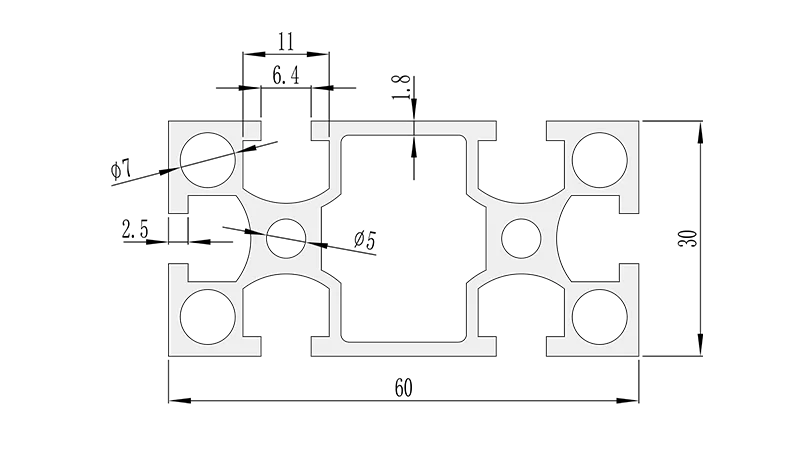
The "3060" in its name refers to its cross-sectional dimensions: 30 millimeters in width and 60 millimeters in height. This rectangular shape isn't arbitrary—it's a deliberate balance between compactness and load capacity. At 30mm wide, the profile fits comfortably in tight spaces, making it ideal for workbenches or material racks in crowded facilities. The 60mm height, however, gives it the structural rigidity needed to support significant weight without bending or warping. Most 3060 national standard profile a options have a wall thickness of 1.5mm to 2.0mm, striking a sweet spot between lightness and durability. But the real genius lies in its T-slot design.
Run your hand along the length of a 3060 profile, and you'll notice grooves—called T-slots—running the entire length of its sides. These slots are the secret to the profile's modularity. They allow for quick attachment of accessories using bolts, nuts, and brackets, eliminating the need for drilling or welding. Imagine building a frame where you can adjust the height of a shelf, add a crossbar, or mount a tool holder in minutes, not hours. That's the power of T-slots, and the 3060 profile a maximizes this with strategically placed slots (typically two per long side and one per short side) to accommodate a wide range of connections.
Load Capacity: More Than Just a Pretty Profile
Don't let its lightweight nature fool you: the 3060 national standard profile a is a workhorse. Depending on the wall thickness and the type of aluminum alloy used (most commonly 6063-T5, known for its excellent strength-to-weight ratio), this profile can support impressive loads. On average, a single 3060 profile a can handle a vertical load of 200–300 kg per linear meter when properly supported, and even more when used in a frame structure with cross-bracing. This makes it ideal for everything from supporting a workbench top loaded with tools and components to forming the vertical posts of a multi-tiered material rack.
To put this in perspective: a typical assembly workbench might require a frame that supports 150 kg of tools, parts, and the occasional operator leaning on it. A 3060 profile a frame, with its 300 kg per meter capacity, provides more than enough margin for safety and longevity. For heavier applications, like supporting a conveyor system or a heavy-duty material rack, the profile can be reinforced with gussets or paired with thicker-walled variants—all while maintaining that critical modularity.
Aluminum Profile Accessories: The Glue That Holds Modularity Together
A profile is only as good as the accessories that bring it to life. The 3060 national standard profile a's versatility shines when paired with the right aluminum profile accessories —small, often overlooked components that turn a stack of extruded aluminum into a functional, adaptable structure. Let's take a closer look at the accessories that make 3060 frames so practical:
- Angle Codes and Connectors: These are the "joints" of the aluminum frame world. For 3060 profiles, 90-degree angle codes (like the "turning angle code 3030" or "3060 aluminum angle yards") attach to T-slots, allowing profiles to be joined at right angles without welding. There are also 45-degree and 135-degree connectors for more complex angles.
- End Caps: Simple but essential, end caps snap onto the ends of profiles to cover sharp edges, prevent dust buildup in T-slots, and give structures a clean, finished look. The "3060 aluminum profile end cap" is designed to fit the profile's dimensions perfectly.
- Gussets: For added strength at joints, gussets (like "gusset alp 3030") are small, triangular plates that reinforce connections, distributing load more evenly across the frame. They're especially useful in high-stress areas, like the corners of a workbench or the base of a material rack.
- Brackets and Mounts: These come in endless varieties, from flat brackets for mounting shelves to L-brackets for attaching tools. Many are designed to slide into T-slots, allowing for quick adjustments—no need to drill new holes if you want to reposition a shelf by an inch or two.
- Panel Holders: For workbenches or enclosures, panel holders attach to T-slots to secure plywood, acrylic, or metal panels, creating surfaces or barriers as needed.
The beauty of these accessories is their universality. Most are designed to work across multiple profile sizes, so a connector that fits a 3060 profile a will often work with a 3030 or 4040 profile, too. This interchangeability reduces inventory costs and makes it easy to mix and match profiles for custom solutions.
3060 National Standard Profile A Frames in Action: Real-World Applications
Enough talk about specs—let's dive into how the 3060 national standard profile a is making a difference on factory floors. From workbenches to material racks, these frames are proving their mettle in diverse applications. Let's explore two common use cases where 3060 frames shine.
Case Study 1: The Adaptable Workbench
The workbench is the command center of any assembly line. It's where operators spend hours piecing together components, testing products, and accessing tools. A poorly designed workbench can lead to fatigue, inefficiency, and even errors. Enter the 3060 profile a workbench frame.
Consider a mid-sized electronics manufacturer that produces both small circuit boards and larger control panels. Their old workbenches were a hodgepodge of wooden tops on steel frames—heavy, immovable, and with fixed shelves that couldn't adapt to the varying heights of components. When they switched to 3060 national standard profile a frames, everything changed. The new frames were assembled using angle codes and gussets, with adjustable height legs (fitted with anti-slip leveling feet from the accessory lineup). The wooden tops were replaced with lightweight aluminum honeycomb panels, and T-slots along the frame allowed for modular tool holders, LED task lights, and even small shelves that could be repositioned in seconds as product lines changed.
One operator, Maria, who assembles both circuit boards and control panels, noted: "Before, I'd have to stretch to reach tools on the fixed shelf, or stack boxes on the floor when parts didn't fit. Now, I can move the shelf up or down depending on what I'm working on. It sounds small, but it's made a huge difference in how tired I am at the end of the day." The flexibility of the 3060 frame also meant the manufacturer could easily add extensions to workbenches during peak production, then disassemble and store the extra sections when demand slowed—no wasted space, no wasted money.
Case Study 2: Material Rack B (3 Row and 3 Floor) – Organized, Accessible, and Built to Last
Material storage is another area where 3060 national standard profile a excels. Take the material rack b (3 row and 3 floor) —a common design for organizing small to medium-sized parts in bins or boxes. Traditional steel versions of this rack are heavy, hard to move, and often rust in humid environments. By using 3060 profiles for the frame, manufacturers can create a rack that's lightweight enough to be repositioned with a pallet jack, yet strong enough to hold hundreds of kilograms of parts.
A automotive parts supplier recently made this switch. Their old steel racks were bolted to the floor, and rearranging them required a crew with power tools and half a day's work. With 3060 profile a frames, they built modular 3-row, 3-floor racks that could be assembled in under an hour using just hex keys and a rubber mallet. Each vertical post was a 3060 profile, reinforced with gussets at the base for stability. Horizontal beams, also 3060 profiles, were connected using angle codes, and the shelves were made of plywood supported by brackets that slid into T-slots—adjustable in 50mm increments to accommodate different bin sizes. The result? A storage system that could be reconfigured overnight to prioritize fast-moving parts, or expanded by adding more sections as inventory grew.
The supplier also noted improved employee morale: "Before, if a part was on the bottom shelf, you'd have to kneel or bend awkwardly to reach it. Now, we can adjust shelf heights to keep frequently used parts at waist level. It's reduced strain injuries and made picking parts faster." Plus, the aluminum frames' corrosion resistance meant the racks looked newer longer, even in the facility's slightly humid basement storage area.
Why 3060 National Standard Profile A Stands Out: A Comparison with Other Profiles
With so many aluminum profiles available—from the tiny 2020 to the beefy 4080—why choose 3060 national standard profile a? The answer lies in its balance of size, strength, and versatility. Let's compare it to two other popular profiles to see where it fits best:
| Profile Type | Dimensions (mm) | Typical Wall Thickness (mm) | Approx. Vertical Load Capacity (kg/m) | Best For | Limitations |
|---|---|---|---|---|---|
| 2020 National Standard Profile | 20x20 | 1.0–1.2 | 80–120 | Light-duty applications: small shelves, machine guards, desktop organizers | Too narrow for larger workbenches; limited load capacity for heavy tools |
| 3060 National Standard Profile A | 30x60 | 1.5–2.0 | 200–300 | Medium-duty applications: workbenches, material racks (3-row/3-floor), conveyor supports, assembly line frames | May be overkill for very lightweight tasks; slightly bulkier than 2020 |
| 4040 National Standard Profile | 40x40 | 2.0–3.0 | 300–450 | Heavy-duty applications: large equipment frames, industrial workstations, robot bases | Heavier and more expensive than 3060; overkill for most medium-duty tasks |
As the table shows, 3060 national standard profile a hits the sweet spot for most mechanical manufacturing applications. It's not the smallest, but it's compact enough for tight spaces. It's not the strongest, but it's more than capable of handling the loads of workbenches, material racks, and assembly frames. And because it's lighter and less expensive than 4040 profiles, it's a cost-effective choice for projects where heavy-duty strength isn't necessary.
The Long-Term Benefits: Beyond the Initial Build
The advantages of 3060 national standard profile a frames extend far beyond their initial assembly. Let's break down the long-term benefits that make them a smart investment for manufacturers:
Adaptability: Grow, Shrink, and Change with Ease
Manufacturing is rarely static. New product lines, process improvements, or facility expansions can turn yesterday's "perfect" layout into today's bottleneck. With 3060 frames, adapting is as simple as unbolting a few connectors, adding or removing profiles, and reattaching the accessories. A workbench can become a testing station; a material rack can become a temporary assembly line side table. This adaptability reduces the need to purchase entirely new structures, saving money and reducing waste.
Durability: Built to Withstand the Factory Grind
Aluminum's natural resistance to corrosion is a game-changer in manufacturing environments. Unlike steel, which requires regular painting or coating to prevent rust, aluminum profiles maintain their integrity even when exposed to oils, coolants, or humidity. The 3060 profile a's anodized finish (a common treatment) adds an extra layer of protection, ensuring the frame looks and performs like new for years—even decades—with minimal maintenance.
Safety: Lightweight, Sharp-Edge-Free, and Stable
Employee safety is a top priority in any factory, and 3060 frames deliver here, too. Their lightweight nature reduces the risk of injury during assembly or reconfiguration—no need for heavy lifting equipment for most tasks. End caps (a standard aluminum profile accessory) eliminate sharp edges, preventing cuts. And the modular design, when properly assembled with the right accessories, creates stable structures that minimize wobbling or tipping, even under load.
Sustainability: Green Manufacturing Starts with Material Choices
Sustainability is no longer a buzzword; it's a business imperative. Aluminum is 100% recyclable, and recycling it requires just 5% of the energy needed to produce new aluminum. When a 3060 frame reaches the end of its useful life (which, with proper care, could be decades), its components can be melted down and repurposed—no waste sent to landfills. Additionally, the ability to reconfigure frames instead of replacing them reduces the overall demand for new materials, further lowering a facility's carbon footprint.
Conclusion: 3060 National Standard Profile A – More Than a Frame, a Catalyst for Manufacturing Excellence
In the fast-paced world of mechanical manufacturing, every detail matters. The structures we build to support our work aren't just inanimate objects—they're partners in productivity, adaptability, and innovation. The 3060 national standard profile a embodies this partnership. It's a profile that doesn't just hold things up; it holds the potential for smarter workflows, happier employees, and a more sustainable future. Whether it's forming the frame of a workbench where precision meets efficiency, or the backbone of a material rack b (3 row and 3 floor) that keeps parts organized and accessible, 3060 profiles are proving that the best manufacturing solutions are those that grow with you.
As manufacturers continue to face pressure to do more with less—less space, less time, less cost—the 3060 national standard profile a stands out as a reminder that the right tools don't just solve problems; they create opportunities. So the next time you walk through a manufacturing facility, take a closer look at the frames holding up the workbenches, the racks storing the parts, and the structures supporting the future of production. Chances are, you'll see aluminum profiles hard at work. And among them, the 3060 profile a will be there—quietly, reliably, and flexibly—shaping the factories of today and tomorrow.