- Company Articles
- Products and Technology
- Product knowledge
- Medical Device Manufacturing: Using Four Way Straight Lean Pipe Joint for Cleanroom Workstations

Medical Device Manufacturing: Using Four Way Straight Lean Pipe Joint for Cleanroom Workstations
Related Product
Four Way Straight Lean Pipe Joint
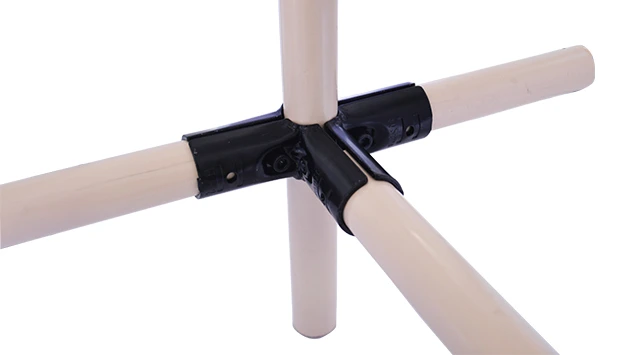
Four way lean pipe joint for 4 pcs 28MM lean pipe connection in straight angle, which used widely in workbench, flow rack, hand trolley frame connection.
In the hushed, sterile corridors of a medical device manufacturing cleanroom, every detail matters. A single particle of dust could compromise a catheter's sterility. A misaligned workstation might throw off the calibration of a surgical instrument. And in an industry where regulations like FDA's 21 CFR Part 820 or ISO 13485 dictate every move, rigidity isn't just inefficient—it's risky. This is where the yet powerful components of lean systems step in, and among them, the four way straight lean pipe joint stands out as a quiet revolution for cleanroom workstations.
The Backbone of Precision: Why Cleanroom Workstations Can't Afford to Be Static
Medical device manufacturing is a dance of precision and adaptability. One week, a facility might be producing small-batch orthopedic implants; the next, scaling up for a new line of diagnostic sensors. Each product has unique requirements: some need ESD-safe surfaces to protect sensitive electronics, others demand height-adjustable workbenches to align with automated assembly tools, and all require surfaces that can withstand rigorous sanitization—bleach, alcohol, and high-pressure washes included.
Traditional workstations, often built from fixed steel or wooden frames, struggle to keep up. Welding or bolting parts together makes reconfiguration a nightmare. Custom-built setups take weeks to modify, leaving teams stuck with clunky, underutilized spaces while production deadlines loom. Worse, hard-to-clean corners or crevices in these rigid structures become breeding grounds for contaminants, turning compliance audits into heart-stopping events.
This is where lean systems shine. Rooted in the principles of eliminating waste and continuous improvement, lean systems prioritize flexibility, modularity, and efficiency—three qualities that are non-negotiable in modern medical manufacturing. And at the heart of these systems, holding it all together, are components like the four way straight lean pipe joint.
Lean Systems in Medical Manufacturing: More Than Just a Buzzword
When we talk about lean systems in medical device production, we're not just referring to "being efficient." We're talking about creating workspaces that adapt to the work, not the other way around. In a cleanroom, this means reducing unnecessary movement (a technician shouldn't have to reach across three feet for a tool), minimizing clutter (excess parts increase contamination risk), and ensuring every square inch of the workstation serves a purpose.
Lean pipe systems—built from lightweight, durable pipes and connectors—embody this philosophy. Unlike traditional metal frames, they're designed to be reconfigured in hours, not weeks. Need to add a shelf for new testing equipment? Swap out a section of pipe. Shift to a smaller product that requires a narrower workstation? Disassemble and rebuild with minimal tools. This flexibility isn't just about saving time; it's about staying compliant. When an auditor asks, "How do you ensure this workstation meets ISO 14644-1 air cleanliness standards?" a modular setup lets you point to easy-to-clean surfaces, no-weld construction (which eliminates bacteria-trapping gaps), and quick adjustments to maintain proper workflow separation.

The Four Way Straight Lean Pipe Joint: Small Part, Big Impact
If lean pipe systems are the "bones" of a flexible cleanroom workstation, then the joints are the "joints" that let those bones move. And among the many connectors available, the four way straight lean pipe joint is a workhorse. At first glance, it's unassuming: a small, often aluminum or stainless steel component with four ports, designed to connect lean pipes in straight lines—forward, backward, left, and right. But its simplicity is its strength.
What Makes It Ideal for Cleanrooms?
1. Tool-Free Assembly, Weld-Free Design : In a cleanroom, welding is a non-starter. Fumes contaminate the air, and the heat can warp sensitive materials. The four way straight lean pipe joint requires no welding—just a simple twist or bolt (depending on the design) to secure pipes in place. This means technicians can assemble or reconfigure workstations without disrupting the cleanroom's sterility, and without waiting for a maintenance crew with power tools.
2. Unmatched Stability Without Compromising Flexibility : Medical devices demand precision, and a wobbly workstation is a recipe for disaster. The four way joint's design distributes weight evenly across connected pipes, creating a stable base for everything from microscopes to automated pick-and-place machines. Yet, unlike fixed brackets, it doesn't lock you into a permanent layout. Loosen a few bolts, and you can repurpose the joint to build a new shelf, a material rack, or even a turnover trolley—all from the same set of components.
3. Material Matters: Stainless Steel and Aluminum for Cleanroom Compatibility : Many four way straight lean pipe joints are made from stainless steel or anodized aluminum. Stainless steel resists corrosion from harsh sanitizers, while aluminum offers a lightweight alternative that's easy to clean and won't rust. Both materials are non-porous, so they don't trap bacteria or particles—a critical feature when every surface is swab-tested during compliance checks.
4. Compatibility with Lean Pipe Accessories : A workstation isn't just pipes and joints. It needs ESD workbench tops, roller tracks for smooth material flow, and casters for mobility (when sterility permits). The four way joint plays well with others: attach a roller track placon mount, and suddenly your workstation becomes a mini-conveyor for moving parts. Add a caster wheel bracket, and you've got a mobile unit that can be wheeled to a sterilization area when needed. This compatibility turns a basic frame into a fully functional, customized workspace.

Building the Perfect Cleanroom Workstation: A Step-by-Step Example
Let's say a medical device manufacturer needs a workstation for assembling pacemaker components—small, delicate parts that require ESD protection, a height-adjustable surface, and a built-in material rack to keep tools within arm's reach. Here's how the four way straight lean pipe joint brings it all together:
Step 1: Start with the Frame : Using aluminum lean pipes (lightweight and ESD-safe) and four way straight lean pipe joints, the team assembles a rectangular base. The four way joints at each corner connect vertical pipes for height, while additional joints along the sides add horizontal supports for the workbench top.
Step 2: Add Stability and Adjustability : Heavy-duty casters with locking brakes (another lean pipe accessory) are attached to the base using caster mounting brackets, letting the workstation move when needed but stay fixed during assembly. Adjustable leveling feet (screwed into the base pipes) ensure the workstation sits perfectly flat, even on slightly uneven cleanroom floors—critical for precision work.
Step 3: Integrate the Workbench Top : An ESD-safe aluminum honeycomb panel is secured to the horizontal supports. The panel is easy to wipe down, resists scratches from tools, and dissipates static electricity to protect the pacemaker's sensitive electronics.
Step 4: Add Material Storage : On one side of the workstation, four way joints connect vertical pipes to build a three-tier material rack. Each tier uses roller track (another lean pipe accessory) to let bins of screws, wires, and components glide smoothly forward as needed, reducing the technician's reach and minimizing movement waste.
The result? A workstation that took less than a day to build, can be reconfigured in hours if the pacemaker design changes, and meets every sanitization and ESD requirement. And at the center of it all? The four way straight lean pipe joint, quietly holding the pieces together while keeping the door open for endless possibilities.
Traditional vs. Lean Pipe Workstations: A Side-by-Side Comparison
| Feature | Traditional Fixed Workstations | Lean Pipe Workstations (with Four Way Straight Joints) |
|---|---|---|
| Reconfiguration Time | Weeks (requires welding, custom fabrication) | Hours (tool-free assembly with joints) |
| Sanitization Ease | Poor (weld seams, crevices trap contaminants) | Excellent (smooth, non-porous surfaces; no hidden gaps) |
| ESD Compatibility | Limited (requires expensive custom coatings) | Built-in (aluminum/stainless steel pipes dissipate static) |
| Cost Over Time | High (frequent replacements for new products) | Low (reusable components; reconfigure instead of replace) |
| Compliance Support | Risky (hard to modify for audit requirements) | Strong (easy to adjust for ISO/FDA standards; documentation-friendly) |
Choosing the Right Lean Pipe Supplier: More Than Just Parts
Not all lean pipe components are created equal—especially in medical manufacturing, where quality can't be compromised. When selecting a lean pipe supplier, look for partners who understand the unique demands of cleanrooms. A reliable supplier won't just sell you a four way straight lean pipe joint; they'll provide material certifications (like ISO 9001 for manufacturing processes), ESD-test reports for conductive components, and even help design your workstation to meet specific regulatory needs.
Ask questions like: "What materials are your joints made from? Do they resist corrosion from medical-grade sanitizers?" or "Can you provide case studies of other medical device clients who've used your four way joints in cleanrooms?" A supplier who's invested in your success will have answers—and maybe even samples—to prove it. After all, in an industry where a single faulty joint could lead to a product recall, cutting corners on components is never worth the risk.
The Future of Cleanroom Manufacturing: Flexibility as a Competitive Edge
As medical device technology advances—think smaller, smarter implants, AI-driven diagnostic tools, and personalized medicine—manufacturing facilities will need to become even more agile. The days of building a workstation for a single product and using it for decades are gone. Today's teams need spaces that can pivot, adapt, and evolve alongside innovation.
In this landscape, the four way straight lean pipe joint isn't just a component; it's a symbol of that agility. It's proof that even the smallest parts can have a big impact on how safely, efficiently, and compliantly we build the tools that save lives. So the next time you walk into a cleanroom and see a workstation that seems to "fit" perfectly—adjustable, clean, and ready for whatever comes next—take a closer look. Chances are, there's a four way straight lean pipe joint holding it all together, quietly empowering the precision that makes medical device manufacturing possible.