- Company Articles
- Products and Technology
- Product knowledge
- Medical Device Manufacturing: Why Swivel Stem Caster Wheels with Brake Are Essential

Medical Device Manufacturing: Why Swivel Stem Caster Wheels with Brake Are Essential
Related Product
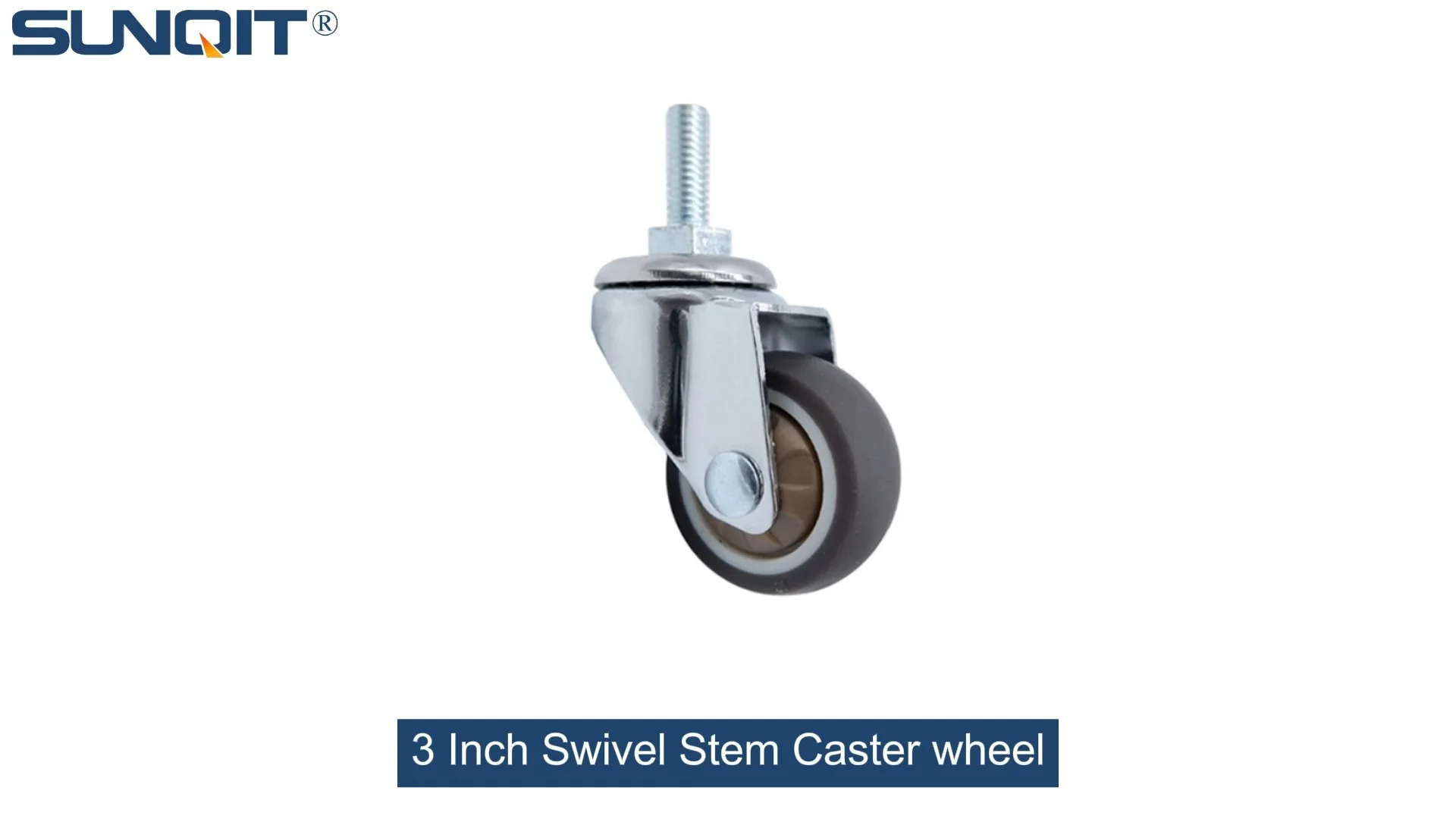
Swivel Stem Caster wheel
360 Degree Swivel Stem Caster. Threaded-post mount design, castors diameter 3 inch.Each swivel caster wheels loading 70KGS. Heavy enough and widely suit for carts, chairs, cabinet, flow rack, workbench, turnover rolley.
Walk into any medical device manufacturing facility, and you'll notice a symphony of precision: technicians hunched over microscopes assembling catheter components, robots placing tiny sensors onto pacemaker PCBs, and workers in white coats carefully transferring trays of sterile parts from one station to the next. In this world, where a fraction of a millimeter can mean the difference between a life-saving device and a costly recall, every detail matters—including the wheels under the workbenches.
That's where swivel stem caster wheels with brake come into play. They're not just "wheels on a cart"—they're silent partners in ensuring safety, precision, and efficiency. Imagine a technician mid-assembly, hands steady as they attach a delicate wire to a surgical tool. If their workstation suddenly rolls an inch to the left, that wire could snap, ruining hours of work and delaying production. Or picture a cleanroom where contamination is enemy number one: an unchecked cart drifting into a sterile zone could compromise an entire batch of implants. These scenarios aren't just hypothetical—they're why medical device manufacturers can't afford to overlook the humble caster wheel.
The Basics: What Are Swivel Stem Caster Wheels with Brake?
Let's start with the basics. A caster wheel is a wheel mounted on a frame, designed to make objects mobile. "Swivel stem" refers to how the wheel attaches and moves: the stem (a metal rod) inserts into a socket, allowing the wheel to rotate 360 degrees. This swivel action makes maneuvering tight corners or aligning workstations a breeze—critical in facilities where space is often at a premium.
The "with brake" part is what elevates these casters from useful to essential. Most models have a foot-operated brake that locks either the wheel (to prevent rolling) or the swivel mechanism (to keep the wheel facing a fixed direction), or both. In medical settings, this dual locking feature is a game-changer. It means a workstation can be easily moved when a process needs reconfiguring, then locked down solid when precision work begins.
But not all casters are created equal. In medical device manufacturing, you'll rarely find cheap, plastic casters from a hardware store. These environments demand casters built to handle heavy loads (think stainless steel workbenches loaded with testing equipment), resist chemicals (from daily sanitization), and operate smoothly without generating dust or debris. That's why suppliers specializing in industrial-grade components—like those offering lean system solutions—often prioritize these casters as part of their core product lines.
Why Medical Device Manufacturing Can't Compromise on Caster Quality
Safety First: Preventing Unintended Movement in Sensitive Processes
Safety in medical manufacturing isn't just about protecting workers—it's about protecting patients. A workstation that rolls unexpectedly during assembly can lead to misaligned parts, which in turn can cause device failures once implanted or used in surgery. For example, consider a team assembling insulin pumps: each component, from the insulin reservoir to the delivery mechanism, must align perfectly. If the workbench shifts mid-assembly, the pump's flow rate could be off by a fraction of a milliliter—enough to endanger a patient's health.
Swivel stem casters with brake eliminate this risk. With a quick tap of the foot, the brake engages, anchoring the workstation to the floor. Technicians can focus on their tasks without worrying about the surface beneath them moving. This peace of mind isn't just about avoiding mistakes; it's about reducing mental fatigue. When workers don't have to subconsciously brace for movement, they can channel more energy into the meticulous work of building life-saving devices.
Precision Handling: Maintaining Alignment in Assembly Workflows
Medical device assembly often involves multi-step workflows where parts move from one station to the next. For example, a pacemaker might start at a component sorting station, move to a PCB soldering station, then to a testing station, and finally to packaging. Each transfer requires alignment: the output of one station must perfectly match the input of the next.
Without reliable casters, this alignment becomes a constant battle. A workstation that drifts out of position might mean parts don't feed correctly into a conveyor, or a testing probe misses its mark. Swivel stem casters solve this by combining mobility with stability. When it's time to reposition a workstation, the swivel feature allows for easy maneuvering around obstacles like machinery or storage racks. Once in place, the brake locks the caster, ensuring the workstation stays exactly where it needs to be—down to the millimeter.
Real Scenario:
A mid-sized medical device company was struggling with inconsistent alignment between their ESD workstation (used for handling circuit boards) and their conveyor system. Parts would often get stuck at the transition point, causing delays. After upgrading to swivel stem casters with dual-locking brakes, they were able to align the workstation with the conveyor once, lock it down, and eliminate the jams entirely. Productivity increased by 15% in that line alone.
Compliance and Cleanliness: Meeting Regulatory Standards
The FDA and other regulatory bodies don't just care about the final product—they care about how it's made. Facilities must adhere to strict guidelines for cleanliness, process control, and traceability. Casters might seem like a small part of this, but they play a big role in compliance.
For starters, cleanrooms and controlled environments require casters that don't shed debris. Low-quality casters with cracked rubber or loose bearings can release particles into the air, which can contaminate sterile parts. Swivel stem casters designed for medical use often feature sealed bearings and non-marking, easy-to-clean materials (like polyurethane) that resist harboring bacteria.
Then there's process control. Regulatory audits often require manufacturers to demonstrate that workflows are consistent and repeatable. If workstations move unpredictably, it's harder to prove that each device was assembled under the same conditions. Lockable casters create a "fixed point" in the workflow, ensuring that every device goes through the same steps in the same environment—critical for passing audits and maintaining certifications.

Integrating with Key Workspace Elements
Workbenches: The Foundation of Efficient Assembly
The workbench is the heart of any assembly operation. It's where technicians spend hours sorting, soldering, and inspecting parts. In medical manufacturing, workbenches are often customized with drawers for tools, shelves for documentation, and ESD mats to protect sensitive electronics. But even the best workbench is only as good as its mobility system.
Swivel stem casters with brake transform static workbenches into dynamic tools. Need to reconfigure the floorplan for a new product launch? Unlock the brakes, roll the workbench to its new spot, and lock it down. Have a temporary surge in production? Add an extra workbench on wheels to the line without disrupting existing workflows. This flexibility is especially valuable in small to mid-sized facilities where space is limited and adaptability is key.
What's more, these casters support the weight of fully loaded workbenches. A typical medical assembly workbench might hold 200+ pounds of equipment: microscopes, testing devices, bins of parts, and laptops for documentation. Cheap casters can sag or fail under this weight, leading to uneven surfaces or wobbly work areas. Industrial-grade swivel stem casters, however, are built to handle heavy loads—some up to 500 pounds per caster—ensuring the workbench remains stable and level, even when fully loaded.
Lean Systems: Streamlining Workflows with Mobile Flexibility
Lean manufacturing principles—focused on eliminating waste and streamlining workflows—are everywhere in medical device production. From 5S (Sort, Set in Order, Shine, Standardize, Sustain) to kanban inventory systems, lean is all about making processes as efficient as possible. Swivel stem casters with brake are a natural fit for lean systems because they enable "flow": the smooth movement of materials and work-in-progress through the production line.
Take, for example, a kanban system where parts are delivered to assembly stations "just in time." Instead of workers walking to a central storage area to fetch parts, mobile carts with lockable casters deliver bins directly to the workstation. When the cart arrives, the brakes lock, ensuring it stays put until the bin is empty. Then, it's unlocked, rolled back to storage, and refilled. This cuts down on walking time, reduces wait times, and keeps the production line moving.
Lean also emphasizes "poka-yoke" (mistake-proofing). Lockable casters act as a poka-yoke tool by preventing carts from being accidentally moved during loading or unloading. A worker can't accidentally bump a cart and send it rolling into a machine if the brake is engaged—a simple but effective way to reduce errors and waste.
ESD Workstations: Protecting Sensitive Electronics
Many medical devices, from heart monitors to surgical robots, rely on delicate electronics. These components are highly susceptible to electrostatic discharge (ESD), which can damage circuits or degrade performance over time. ESD workstations are designed to prevent this by grounding workers and equipment, but their effectiveness depends on stability.
An ESD workstation on unstable casters is a hazard. If the workstation rocks or shifts, the ground connection could loosen, exposing components to ESD risk. Swivel stem casters with brake solve this by keeping the workstation firmly planted. The stem design ensures a secure connection to the workstation frame, while the brake prevents movement that could disrupt grounding.
Additionally, many ESD casters are made with conductive materials that dissipate static charges, adding an extra layer of protection. This is critical in environments where even a small static spark could ruin a $10,000 sensor or delay production while components are tested for damage.

Beyond the Wheel: Additional Considerations for Caster Selection
| Consideration | Why It Matters in Medical Manufacturing | Key Feature to Look For |
|---|---|---|
| Load Capacity | Workbenches and carts often carry heavy equipment (microscopes, testing devices) and full bins of parts. | At least 300 lbs per caster; higher for specialized equipment. |
| Floor Protection | Cleanroom and production floors are often coated with epoxy or vinyl, which can scratch or scuff. | Non-marking polyurethane wheels; soft tread to absorb impact. |
| Chemical Resistance | Daily cleaning with disinfectants (alcohol, bleach) can degrade low-quality materials. | Wheels and brakes made from chemical-resistant polymers or stainless steel. |
| Noise Level | Excessive noise can distract technicians and increase stress in precision tasks. | Precision ball bearings; shock-absorbing tread to reduce rolling noise. |
Load Capacity: Supporting Heavy Medical Equipment
When selecting casters, load capacity isn't just a "nice-to-have"—it's a safety requirement. A caster that's underrated for the load it's carrying will wear out quickly, leading to uneven rolling, brake failure, or even collapse. In medical manufacturing, where equipment and parts are often expensive and irreplaceable, this is a risk no facility can take.
To calculate the right load capacity, start by adding up the weight of the workstation or cart, plus the maximum weight of tools, parts, and materials it will carry. Then, divide that total by the number of casters (typically 4 per workstation). For example, a workbench weighing 150 lbs with 300 lbs of equipment needs casters rated for at least (450 lbs / 4 casters) = 112.5 lbs each. It's always smart to add a 20-30% buffer to account for unexpected loads or uneven weight distribution.
Floor Protection: Preserving Cleanroom Surfaces
Cleanroom floors are a significant investment. They're designed to be smooth, non-porous, and easy to sanitize—critical for preventing contamination. But rough or hard caster wheels can scratch these surfaces, creating crevices where bacteria can hide. Over time, this can lead to increased cleaning costs and even failed inspections.
That's why medical facilities should opt for casters with non-marking, soft-tread wheels. Polyurethane is a popular choice: it's durable, resists chemicals, and rolls smoothly without leaving marks. Some casters also feature "floor-friendly" designs, like rounded edges or shock-absorbing tread, to minimize impact on floors. For facilities with especially sensitive floors, there are even casters with rubber treads that mimic the grip of a shoe, reducing slipping and scuffing.

Real-World Impact: How Quality Casters Transform Daily Operations
Let's circle back to the technicians, the people on the front lines of medical device manufacturing. For them, the right casters aren't just about compliance or efficiency—they're about making their jobs easier and safer.
Maria, a senior assembler with 10 years of experience, puts it this way: "I used to work at a facility with old, rusty casters on the workbenches. Every time I leaned on the bench to reach for a tool, it would roll an inch or two. I'd have to stop, realign the parts, and start over. Now, with these new swivel stem casters, I lock the bench once in the morning and forget about it. I can focus on the work, not the workstation."
Then there's Raj, who manages a cleanroom for a surgical instrument manufacturer. "We had a problem with carts drifting into sterile zones during audits. The auditors kept flagging it as a contamination risk. After switching to lockable casters, we haven't had a single citation. The brakes are so easy to use—even the new hires remember to engage them. It's a small change, but it made a huge difference in our audit results."
These stories highlight a simple truth: in medical device manufacturing, success lies in the details. Swivel stem caster wheels with brake may not be the most glamorous part of the process, but they're essential for keeping production on track, ensuring product quality, and protecting both workers and patients.
Conclusion: Investing in the Right Caster—A Small Part with a Big Role
When you're building devices that save lives, you can't cut corners—on materials, on training, or on the wheels under your workbenches. Swivel stem caster wheels with brake are more than just components; they're an investment in safety, precision, and peace of mind. They allow facilities to adapt to changing production needs, maintain compliance with strict regulations, and support the technicians who build the devices that matter most.
So the next time you walk through a medical device manufacturing facility, take a moment to look down. Those small, unassuming wheels under the workbenches? They're not just rolling—they're helping build a healthier future, one locked brake at a time.