- Company Articles
- Products and Technology
- Application Cases
- Medical Device Production Success Story: Aluminum Workbench B Improves Assembly Precision

Medical Device Production Success Story: Aluminum Workbench B Improves Assembly Precision
Related Product
Aluminum Workbench B
Aluminum tube workbench is more flexible and durable, compared with traditional PE/ABS coated steel tube. It is easy to assemble, anti corrosion, rust protection, and recycle use after disassemble.
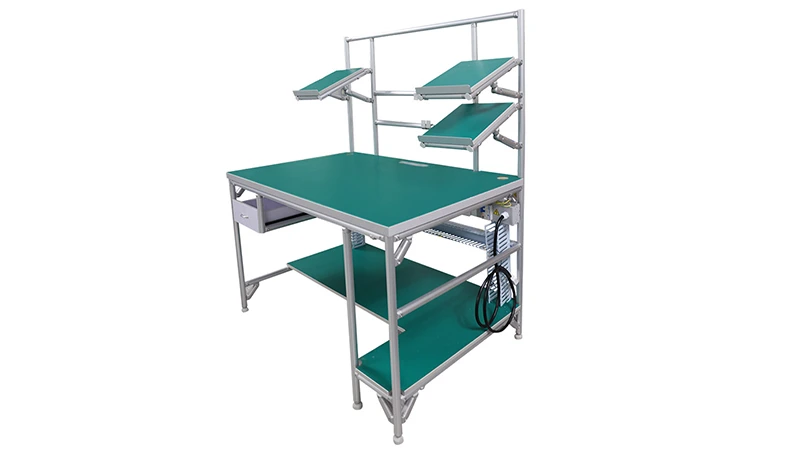
In the world of medical device manufacturing, precision isn't just a goal—it's a lifeline. Every component, from tiny surgical tools to complex diagnostic equipment, demands exact measurements, stable work environments, and zero tolerance for errors. A single misaligned part or static discharge could compromise patient safety, delay critical treatments, or damage a company's reputation. For MedTech Innovations, a mid-sized manufacturer specializing in cardiovascular monitoring devices, this reality hit close to home in early 2024—until a simple yet transformative solution changed everything: the Aluminum Workbench B.
The Breaking Point: When "Good Enough" Wasn't Enough
Sarah Martinez, MedTech's production manager, still remembers the Monday morning meeting that sparked the search for change. The quality control report sat on her desk, its numbers glaring: a 7.2% error rate in the final assembly of their flagship heart rate monitor, up from 3.1% the previous quarter. Rework costs had spiked by $45,000 in three months, and the team was burning out from overtime. "We were band-aiding issues instead of fixing them," Sarah recalls. "Our workstations were a hodgepodge of old wooden benches and metal tables—some wobbled, others had uneven surfaces. Static was a constant problem; we'd lost two batches to ESD damage alone. And getting parts to the line? It felt like a scavenger hunt. Our material handlers were running back and forth between storage and stations because we didn't have a smooth flow rack system. Morale was in the gutter."
The root cause, Sarah realized, was inconsistency. Each workstation had its own quirks: one had a cracked surface that trapped screws, another sat an inch lower than the others, forcing operators to hunch. None were ESD-safe, leaving sensitive circuit boards vulnerable to static. And without efficient roller track or flow rack, materials arrived in fits and starts, disrupting the rhythm of assembly. "We needed a system, not just tools," she told her team. "Something that could grow with us, keep everything standardized, and protect our products from start to finish."
The Discovery: Aluminum Workbench B and the Lean System Shift
Sarah's search led her to a trade show in Chicago, where she stumbled upon a booth showcasing aluminum lean pipe solutions. "I was skeptical at first," she admits. "We'd tried 'improvements' before—fancy software, new tools—but nothing stuck. Then I saw the Aluminum Workbench B. It was sleek, sturdy, and modular. The rep explained that it was part of a full lean system: workbenches, flow racks, roller tracks, all designed to work together. What sold me? The ESD protection. These workstations weren't just tables; they were engineered to dissipate static, with grounded surfaces and adjustable heights. And the aluminum frame? Lightweight but tough enough to handle our daily wear and tear. I thought, 'This could be it.'"
She brought samples back to the plant, and the team's reaction was immediate. "Maria, our lead assembler, ran her hand over the surface and said, 'No more hunting for dropped parts in cracks.' Raj, who handles circuit boards, tested the ESD matting and grinned—he'd lost count of how many boards he'd ruined to static. Even the material handlers perked up when they saw the flow rack and roller track demos. 'Imagine,' one joked, 'not sprinting to grab resistors at 3 p.m.'" (Though Sarah quickly added, "Let's not just imagine—let's do it.")

The Implementation: From Chaos to Cohesion
The transition wasn't without growing pains. The team spent a week reconfiguring the production floor, swapping out old workstations for 12 Aluminum Workbench B units. "We had to rearrange the layout to fit the new flow rack and roller track," Sarah explains. "It felt like rearranging a puzzle, but the modularity of the aluminum lean pipe made it easy. We could adjust the height of each bench to match our operators' ergonomics—no more hunched shoulders. We added roller track along the back of each station, so parts glided right to where they were needed, no more running. And the flow rack? It became our 'material supermarket.' Each bin has a label, each shelf is at eye level, and the roller track ensures that the first part in is the first part out—no more expired components."
The ESD workstation upgrade was a game-changer for Raj and his team. "Before, I'd wear three grounding straps and still worry," he says. "Now, the bench itself is grounded. I can place a circuit board down and focus on soldering, not static. It's like having a safety net. I haven't had a single ESD failure since we switched."

The Results: Precision, Productivity, and Pride
Six months later, the metrics speak for themselves. Sarah's latest quality report tells the story:
| Metric | Before (Q1 2024) | After (Q3 2024) | Improvement |
|---|---|---|---|
| Error Rate | 7.2% | 1.8% | -75% |
| Assembly Time per Unit | 22 minutes | 15 minutes | -32% |
| Rework Cost | $45,000/quarter | $9,000/quarter | -80% |
| Team Satisfaction Score | 62/100 | 89/100 | +44% |
But the numbers only tell part of the story. "Walk through the floor now," Sarah says, "and it's like night and day. The workstations are uniform—no more 'my bench vs. your bench.' The roller track hums softly as parts glide to stations. Operators aren't just faster; they're happier. Maria told me last week, 'I don't leave work with a headache anymore.' And the best part? We're shipping more units, with fewer errors, and our customers have noticed. Last month, a client rep visited and said, 'Your line looks like it's running on autopilot.' I smiled and thought, 'It's not autopilot—it's Aluminum Workbench B and a lean system that finally works.'"
The Future: More Than a Workbench, a Foundation
MedTech Innovations has since expanded its aluminum lean system, adding more flow racks and customizing workstations with tool holders and overhead shelves—all compatible with the original Aluminum Workbench B. "We're not just keeping up now; we're growing," Sarah says. "We're launching a new pacemaker component line next quarter, and we'll be using the same lean system. The modularity means we can add stations or reconfigure the line in a day, not a week. And the ESD protection? It's non-negotiable for medical devices. We're not just meeting standards—we're setting them."
For Sarah, the lesson is clear: success in manufacturing isn't about grand gestures. It's about the tools that make the daily grind smoother, safer, and more precise. "The Aluminum Workbench B didn't just fix our error rate," she says. "It gave our team confidence. They know we're invested in their success, and that makes all the difference. When you walk into our plant now, you don't just see workstations—you see a team that's proud of what they build. And that, more than any metric, is the real win."