- Company Articles
- Products and Technology
- Product knowledge
- Modular Conveyor Systems with 4080B EU Standard Aluminum Profile: Adaptability to Production Changes

Modular Conveyor Systems with 4080B EU Standard Aluminum Profile: Adaptability to Production Changes
Related Product
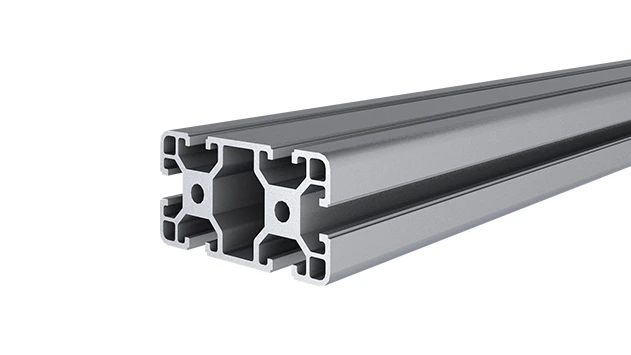
4080B EU Standard Aluminum Profile
4080B is a 4.00x8.00 CM fractional 40 series square extrusion T-slot profile with two side open T-slots, each side with 4.00cm face, two side with 8.00cm face. The profile has align-a-grooves to assist in aligning connecting profiles.
The Hidden Cost of Rigid Production Lines
Every production manager has faced it: that moment when a new product design, a sudden spike in demand, or a shift in workflow renders part of your assembly line obsolete. You stand there, staring at a conveyor belt bolted to the floor, a workbench welded into place, or a material rack that can't be reconfigured without calling in a welder or spending days on renovations. These rigid systems aren't just inconvenient—they're costly. Downtime, labor for modifications, and the missed opportunity to pivot quickly can eat into profit margins faster than you'd think.
This is where modularity steps in as more than just a buzzword. Imagine a production line that bends, not breaks, when change comes. A system where conveyor tracks can be extended or re-routed in hours, not weeks. Where workbenches and material racks evolve with your needs, using components that click together like building blocks. At the heart of this flexibility lies a key player: the 4080B EU standard aluminum profile . Paired with the right accessories and a focus on lean system principles, it's transforming how manufacturers adapt to the unpredictable rhythms of modern production.
Why 4080B Aluminum Profile? The Backbone of Modularity
Aluminum profiles have long been a staple in industrial settings, but the 4080B EU standard stands out for a reason. Let's break it down: "4080" refers to its dimensions—40mm in width and 80mm in height—striking a perfect balance between strength and versatility. "EU standard" ensures compatibility with a vast ecosystem of accessories, from brackets to connectors, meaning you're never locked into a single supplier. But what truly makes it special is its T-slot design: those continuous grooves running along its length allow for quick, tool-free attachment of components, turning static structures into dynamic, reconfigurable systems.
Unlike traditional steel or welded frameworks, aluminum profiles are lightweight enough to be moved by a small team but robust enough to handle heavy loads—think 200kg+ per meter for the 4080B. They resist corrosion, require minimal maintenance, and their clean, sleek finish fits seamlessly into modern, organized workspaces. When paired with modular conveyor components like roller track and aluminum profile accessories, they become the foundation of a production line that grows with your business.

From Static to Dynamic: How Modular Conveyors Transform Workflow
Conveyors are the arteries of any production line, moving materials, components, and finished products where they need to go. But traditional conveyors—whether belt-driven, chain-driven, or gravity-fed—often suffer from a fatal flaw: they're fixed. If you need to add a side branch for a new inspection station, or reangle the line to accommodate a new machine, you're looking at significant downtime and expense.
Modular conveyors built with 4080B aluminum profiles and roller track change the game. Here's how it works: the 4080B profiles serve as the frame, providing a stable base that can be extended using simple connectors. The roller track—whether steel, aluminum, or plastic—snaps into place using specialized brackets, allowing you to create straight runs, curves, inclines, or declines as needed. Need to add a 90-degree turn? Swap out a straight roller track section for a curved one. Want to raise the conveyor height to align with a new workbench? Adjust the aluminum profile legs using height-adjustable feet. It's like building with adult-sized Legos, but for industrial strength.
Take a typical electronics assembly plant, for example. When a new smartphone model requires a longer testing phase, they can extend their modular conveyor by adding two more 4080B profile sections and a few meters of roller track—all in under a day. No welding, no drilling, no disruption to other parts of the line. That's the power of adaptability.
Beyond Conveyors: Building a Lean Ecosystem
A truly lean production system isn't just about conveyors—it's about every element working in harmony to eliminate waste, reduce movement, and optimize flow. The 4080B aluminum profile doesn't stop at conveyor frames; it's the building block for a full suite of lean tools:
- Workbenches: Using 4080B profiles as legs and frames, you can build workbenches with adjustable heights, integrated tool rails, and even ESD (electrostatic discharge) surfaces for sensitive electronics. Add a workbench E (single deck-without caster) for a stationary setup, or attach casters for mobility—no need to buy a whole new bench when needs change.
- Material Racks: A material rack B (3 row and 3 floor) built with 4080B profiles can be reconfigured to hold taller boxes, more bins, or even specialized components by simply adjusting the shelf heights using T-slot brackets. No more one-size-fits-all storage that leaves half the space unused.
- Turnover Trolleys: Lightweight yet sturdy, trolleys built with aluminum profiles and swivel casters make moving materials between stations effortless. When a new product requires larger bins, swap out the shelves or add side rails in minutes.
The magic lies in the ecosystem of aluminum profile accessories that accompany the 4080B. From corner brackets and hinges to pipe clamps and panel mounts, these small components turn basic profiles into custom solutions. Need to attach a monitor arm to a workbench? There's a bracket for that. Want to add a tool holder to a conveyor frame? A T-slot nut and bolt will do the job in seconds. This level of customization ensures that every piece of your production line is purpose-built for your workflow—not the other way around.
Real-World Impact: How One Manufacturer Cut Downtime by 60%
Let's ground this in reality with a story from a mid-sized automotive parts manufacturer we worked with last year. Their challenge? They produced 12 different part variations, each requiring a slightly different assembly sequence. Their old setup relied on fixed conveyor belts and welded material racks, meaning switching between part runs took 8 hours of downtime—time they couldn't afford with tight delivery deadlines.
We helped them transition to a modular system centered on 4080B aluminum profiles. Here's what changed: Their main conveyor line was rebuilt using 4080B frames and interchangeable roller track sections. Material racks were replaced with adjustable units that could be reconfigured in 30 minutes flat. Workbenches were upgraded to height-adjustable models with ESD surfaces, reducing operator fatigue and errors. The result? Changeover time dropped from 8 hours to just 3 hours. Over six months, they saved 120+ hours of downtime, increased output by 15%, and even reduced ergonomic injuries due to better workstation design.
This isn't an isolated case. Manufacturers across industries—from electronics to pharmaceuticals—are reporting similar wins. The common thread? They stopped seeing their production line as a fixed asset and started treating it as a flexible, evolving system. And at the center of that evolution is the 4080B aluminum profile, quietly enabling the kind of adaptability that turns market volatility into a competitive advantage.
Choosing the Right Partner: Beyond Parts, Toward Partnership
Investing in modularity isn't just about buying aluminum profiles and roller track—it's about finding a supplier who understands your workflow and can guide you toward the right components. A good lean system supplier won't just sell you parts; they'll ask questions: What are your biggest pain points with current systems? How often do your production needs change? What's your ideal changeover time? They'll then help you design a system that grows with you, recommending compatible components (like ESD workbenches for electronics or heavy-duty roller track for automotive parts) and even providing on-site support for initial setup.
Look for suppliers who offer a full range of accessories, from the basics (casters, brackets) to specialized parts (ESD-safe rollers, corrosion-resistant joints). Compatibility is key—you don't want to get stuck with a profile that only works with one brand's connectors. The 4080B EU standard's universality helps here, but it's still worth verifying that your supplier carries a broad selection of aluminum profile accessories to avoid last-minute delays.
Traditional vs. Modular: The Numbers Speak for Themselves
| Metric | Traditional Rigid Systems | Modular Systems (4080B Aluminum Profile) |
|---|---|---|
| Changeover Time | 3–5 days (requires welding/construction) | 2–8 hours (tool-free reconfiguration) |
| Initial Investment | Lower upfront (but higher long-term costs) | Higher upfront (but 30–50% lower total cost over 5 years) |
| Scalability | Limited (requires full replacement for expansion) | Unlimited (add sections/components as needed) |
| Downtime for Repairs | High (parts often custom/welded) | Low (standardized parts, easy to swap) |
| Ergonomic Adaptability | None (fixed heights/positions) | High (adjustable workbenches, variable heights) |
The Future of Production: Lean, Modular, and Ready for Whatever Comes Next
The only constant in manufacturing is change. Consumer demands shift, technologies evolve, and global events (think supply chain disruptions or pandemics) force us to rethink how we produce and deliver goods. In this environment, rigidity is a liability. Modularity isn't just a solution—it's a survival strategy.
The 4080B EU standard aluminum profile, paired with roller track, aluminum profile accessories, and a commitment to lean system principles, offers more than just flexibility. It offers peace of mind. The peace of mind that comes from knowing your production line can keep up with your ambition. That you won't be left behind when the next opportunity or challenge arrives. That every dollar you invest in your infrastructure is an investment in adaptability—not obsolescence.
So, the next time you look at your production line, ask yourself: Is this system working for me, or am I working around it? If the answer is the latter, it might be time to explore the world of modularity. Your future self—faced with the next big change—will thank you.