- Company Articles
- Products and Technology
- Product knowledge
- Modular Design with 3030 National Standard Profile A: Reconfigurable Workspaces

Modular Design with 3030 National Standard Profile A: Reconfigurable Workspaces
Related Product
3030 National Standard Profile A
Workbench, production line, logistic rack, warehouse rack Industry: Manufacturer workshop, Automobile, Electronic, Assembling, logistic
In today's fast-paced world, where industries evolve overnight and workspace needs shift with every new project, the demand for flexibility has never been higher. Whether you're running a bustling manufacturing plant, a dynamic research lab, or a creative office, the ability to adapt your environment quickly can mean the difference between stagnation and innovation. Traditional fixed furniture and rigid structures? They belong to a bygone era. Enter modular design—a philosophy centered on adaptability, efficiency, and sustainability—and at its heart lies a quiet hero: the 3030 National Standard Profile A . This unassuming aluminum extrusion is redefining how we build, modify, and repurpose workspaces, making "one-size-fits-all" a relic of the past.
What Is 3030 National Standard Profile A?
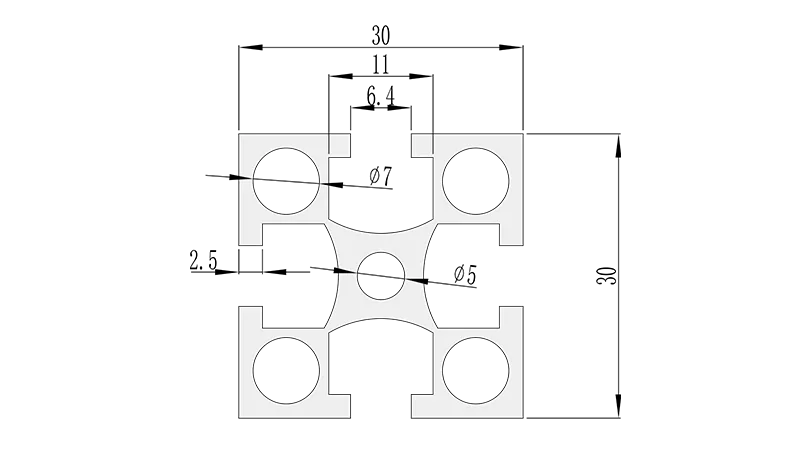
Before diving into its transformative potential, let's get to know the star of the show. The 3030 National Standard Profile A is an aluminum extrusion profile defined by its precise 30mm x 30mm cross-section, adhering to strict national manufacturing standards. Crafted from high-grade 6063-T5 aluminum alloy, it balances strength, lightweight design, and corrosion resistance—qualities that make it ideal for heavy-duty industrial use while remaining easy to handle and reconfigure. Its surface, often anodized or powder-coated, adds durability and a clean, professional finish, suitable for everything from factory floors to sleek office environments.
What truly sets this profile apart is its T-slot design . Running along all four sides, these slots are not just grooves; they're the gateway to infinite customization. Imagine a grid of tiny channels that let you attach, detach, and reposition components with minimal effort. Need a shelf? Slide a bracket into the T-slot. Want to add a tool holder? Secure it with a T-bolt and nut. This simplicity eliminates the need for welding or permanent fasteners, turning assembly into a process as straightforward as building with blocks—only these blocks can support hundreds of pounds and withstand the rigors of daily use.
The Magic of Modular Design: Flexibility, Scalability, Sustainability
Modular design isn't just about "building blocks"—it's a mindset. It prioritizes three core values: flexibility (adapt to changing needs), scalability (grow or shrink without starting over), and sustainability (reduce waste by reusing components). The 3030 National Standard Profile A embodies all three, making it a cornerstone of modern workspace design.
Flexibility: Workspaces That Keep Up with You
Consider a small electronics manufacturing workshop. One month, they're assembling smartphones; the next, they pivot to wearables. Fixed workbenches and rigid material racks would require a complete overhaul—costly, time-consuming, and wasteful. With 3030 profiles, the same base structure can be reimagined. Remove a section here, add a shelf there, swap out a conveyor track—all in a matter of hours. A workbench used for soldering today becomes a testing station tomorrow, simply by reconfiguring its accessories.
Scalability: Grow Without Limits
Startups know this pain: as the team expands, so does the need for workspace. With traditional furniture, scaling means buying new desks, shelves, and storage units—each purchase adding to costs and clutter. 3030 profiles eliminate this. Need a longer workbench? Add another section of profile. Outgrowing your material rack? Stack on more levels using compatible brackets. It's growth without the guilt of excess—each new component integrates seamlessly with the old, creating a cohesive system that evolves with your business.
Sustainability: Reduce, Reuse, Reconfigure
In an era of increasing environmental awareness, waste reduction is non-negotiable. Traditional fixed structures often end up in landfills when they're no longer needed. 3030 profiles, however, are built to be reused. A material rack from a closed project can be disassembled and repurposed into a shipping station. Old workbench components can be stripped down and rebuilt into a new assembly line. Even the aluminum itself is 100% recyclable, ensuring that if a profile does reach the end of its life, it doesn't become waste—it becomes raw material for something new.
The Unsung Heroes: Aluminum Profile Accessories
A profile is only as good as the components that bring it to life. This is where aluminum profile accessories shine. These small, often overlooked parts—connectors, brackets, end caps, and fasteners—are the glue that holds the modular dream together. Let's take a closer look at the ones that make the 3030 National Standard Profile A so versatile.
Connectors: The "Joint" Force
Connectors are the translators of the modular world, letting profiles communicate and form stable structures. For 3030 profiles, the 90° aluminum profile connector is a workhorse. Sleek and compact, it joins two profiles at a right angle, perfect for building frames, shelves, or workbench legs. Then there's the three-way aluminum pipe joint , which splits a single profile into three directions—ideal for creating multi-tiered racks or corner structures. Even better, many connectors require nothing more than a hex key to tighten, making assembly a one-person job.
Brackets and Supports: Reinforcement Where It Counts
For heavier loads or added stability, brackets like the gusset alp 3030 are indispensable. These triangular plates attach to the corners of 3030 profiles, distributing weight evenly and preventing wobbling—critical for workbenches holding heavy machinery or material racks stacked with inventory. The parallel fixation aluminum pipe joint is another gem, letting you mount two profiles side by side to create a stronger, wider surface without sacrificing T-slot access.
End Caps and Finishing Touches
It's the little things that make a space feel polished. 3030 aluminum profile end caps snap into the ends of profiles, covering sharp edges and giving a clean, finished look—important in environments where safety (think: bustling factories) or aesthetics (like modern offices) matter. Even simple accessories like plastic pipe sleeves or covers add protection, preventing scratches and extending the profile's lifespan.
| Accessory Type | Function | Common Use Case |
|---|---|---|
| 90° Aluminum Profile Connector | Joins two profiles at a right angle | Workbench frames, shelf corners |
| Gusset Alp 3030 | Reinforces corners, distributes weight | Heavy-duty material racks, machine bases |
| 3030 Aluminum Profile End Cap | Covers sharp edges, improves aesthetics | Exposed profile ends in offices or labs |
| Parallel Fixation Aluminum Pipe Joint | Mounts two profiles side by side | Wider workbench surfaces, double-deep shelves |
From Concept to Creation: Building Workspaces with 3030 Profiles
Let's put theory into practice. One of the most common applications of 3030 National Standard Profile A is the humble workbench —but "humble" is hardly the word. These aren't your grandfather's wooden benches; they're customizable hubs that adapt to the task at hand. Let's walk through building a basic workbench and see how modularity takes center stage.
Step 1: The Frame—Strong, Light, and Ready to Adapt
Start with four 3030 profile legs, cut to your desired height (standard workbench height is 36 inches, but adjust for ergonomics). Connect them with horizontal profiles using 90° connectors to form a rectangle—this is your base. For extra stability, add diagonal braces using three-way joints, or reinforce with gusset brackets if you anticipate heavy loads. Already, this frame is stronger than most pre-made workbenches, yet weighs a fraction of the steel alternatives, making it easy to move (with casters, of course—more on that later).
Step 2: The Top—A Canvas for Customization
The workbench top is where the T-slot magic truly shines. Use a plywood, MDF, or aluminum honeycomb panel (for lightweight strength) cut to size. Mount it to the frame using T-slot bolts, which slide into the profiles and tighten with a nut—no drilling required. Now, the fun begins: add a shelf below using angle brackets, attach a tool rail along the back with T-slot fasteners, or even mount a small vice using a compatible bracket. Need to rearrange? Loosen the bolts, slide the components, and retighten. It's that simple.
Step 3: Ergonomics and Stability with Adjustable Leveling Feet
No workspace is perfect—floors are uneven, surfaces slope, and stability is non-negotiable. This is where adjustable leveling feet come in. Screw these into the bottom of the workbench legs, and you can tweak each foot's height to compensate for dips or bumps. Models like the suction cup anti-slip foot adjuster take it further, gripping the floor to prevent sliding—essential for workbenches with moving parts or in high-traffic areas. Heavy-duty options like the heavy duty split foot seat distribute weight over a larger area, protecting delicate floors (think: polished concrete in modern offices) while keeping the bench rock-steady.
Step 4: Mobility (When You Need It)
Sometimes, even a stationary workbench needs to move. Add caster wheels (another accessory!) to the legs, and suddenly your bench becomes a mobile workstation. Lock the casters when in use for stability, unlock to roll it to a new location—perfect for cleaning, reorganizing, or collaborating with a teammate across the room. Many casters are designed to fit directly into the T-slots of 3030 profiles, so you don't need to modify the frame.
Lean Systems: Efficiency Meets Modularity
In manufacturing, lean system principles—eliminating waste, streamlining workflow, and optimizing processes—are the gold standard. The 3030 National Standard Profile A aligns perfectly with this ethos, enabling businesses to build systems that adapt to lean goals without overcomplicating things.
Material Racks: From Clutter to Order
Traditional material storage often means fixed shelves that either waste space (too tall, too deep) or cram items together (hard to access). With 3030 profiles, you can build material rack B (3 row and 3 floor) —a custom solution where each shelf height, width, and depth is tailored to your inventory. Need to store small components? Add dividers using T-slot brackets. Stock larger items? Remove a shelf to create more vertical space. Even better, as your inventory changes, the rack changes with it—no more buying new racks or leaving empty space.
Flow Racks and Conveyors: Keeping Production Moving
Lean manufacturing thrives on smooth material flow. 3030 profiles make building custom flow racks or roller tracks a breeze. Mount swivel roller balls 1 inch into the T-slots of a sloped profile, and you've got a gravity-fed flow rack that moves parts from the back to the front, reducing picking time. For longer distances, build a simple conveyor using aluminum guide rails and roller tracks—all attachable via T-slots, and adjustable to match production speed or product size.
Visual Management: A Place for Everything
Lean systems emphasize visual cues—color-coding, labels, and clear organization. 3030 profiles play along here too. Use colored end caps or powder-coated profiles to denote zones (e.g., red for hazardous materials, green for finished goods). Attach magnetic label holders to T-slots for easy updates as processes change. Even tool placement becomes visual: mount tools directly to the profile using custom brackets, so everything has a "home," reducing time spent searching for equipment.
Real-World Impact: How a Small Manufacturer Transformed with 3030 Profiles
To see the 3030 National Standard Profile A in action, let's visit Precision Parts Co., a family-owned manufacturer of automotive components. A few years ago, their production floor was a maze of fixed steel workbenches, mismatched material racks, and static conveyor belts. Retooling for a new product took weeks, and employee complaints about ergonomics (too low benches, hard-to-reach tools) were common. Their solution? A complete overhaul using 3030 profiles and modular accessories.
First, they replaced all workbenches with custom 3030-based models. Each bench's height was adjustable via leveling feet, and employees could add/remove shelves or tool holders based on their tasks. "I used to strain my back reaching for wrenches," says Maria, a senior assembler. "Now I just slide the tool rail closer—no more pain."
Next, they built modular material racks using 3030 profiles and aluminum accessories. "We used to have three separate racks for different parts," explains Juan, the production manager. "Now we have one rack that we reconfigure weekly. If we're making Widget X, we set it up for small bins; if it's Widget Y, we expand the shelves for larger boxes. Setup time went from 2 days to 2 hours."
Finally, they integrated lean principles with a custom flow rack system. Using 3030 profiles, swivel roller balls, and aluminum guide rails, they created a gravity-fed line that moved parts directly to the assembly station. "Waste from walking to fetch parts dropped by 40%," Juan reports. "And when we got a rush order for a new component, we modified the flow rack in an afternoon—no need to shut down production."
The results? Productivity up 25%, employee satisfaction scores improved, and retooling costs cut by 60%. "We didn't just buy workbenches," Juan says. "We invested in a system that grows with us."
The Future of Workspaces: Where 3030 Profiles Are Headed
As workspaces continue to evolve—driven by automation, remote collaboration, and sustainability—the 3030 National Standard Profile A is poised to play an even bigger role. Here's what we can expect:
Integration with Smart Technology
Imagine workbenches with built-in sensors that monitor tool usage or track inventory levels, all powered by components mounted in T-slots. 3030 profiles can already accommodate cable management systems (using T-slot covers to hide wires), and as IoT devices shrink, we'll see more smart accessories—like LED lights that adjust based on occupancy or temperature sensors that trigger fans—all attached via modular brackets.
Sustainability as a Core Feature
With stricter environmental regulations and consumer demand for eco-friendly practices, manufacturers are prioritizing recyclable materials and circular design. 3030 profiles, made from 100% recyclable aluminum, are already ahead of the curve. We'll see more accessories made from recycled plastics or biodegradable composites, and modular systems designed for easy disassembly and reuse—further reducing waste.
Customization for Niche Industries
From medical labs requiring sterile, ESD-safe workspaces to creative studios needing flexible art stations, niche industries are demanding tailored solutions. 3030 profiles, with their endless accessory combinations, are perfect for this. We'll see specialized accessories like ESD-safe brackets, chemical-resistant end caps, or sound-dampening panels—all designed to snap into T-slots and transform a basic profile into a industry-specific tool.
More Than a Profile—A Partner in Progress
The 3030 National Standard Profile A is more than just aluminum and T-slots. It's a catalyst for change, empowering businesses to build workspaces that are as dynamic as the people who use them. Whether you're a small startup scaling rapidly, a manufacturer adapting to new products, or a lab chasing the next breakthrough, this profile and its accompanying accessories—aluminum profile connectors, adjustable leveling feet, modular workbenches—offer a level of flexibility, efficiency, and sustainability that traditional structures can't match.
In a world where the only constant is change, the ability to adapt isn't a luxury—it's a necessity. The 3030 National Standard Profile A doesn't just meet that need; it redefines what's possible. So, the next time you look at your workspace, ask: Is it holding you back, or growing with you? With modular design and the 3030 profile, the answer can be the latter—today, tomorrow, and for years to come.