- Company Articles
- Products and Technology
- Product knowledge
- Multi-Angle Fixed Aluminum Joint Corrosion Resistance: Testing Results

Multi-Angle Fixed Aluminum Joint Corrosion Resistance: Testing Results
Related Product
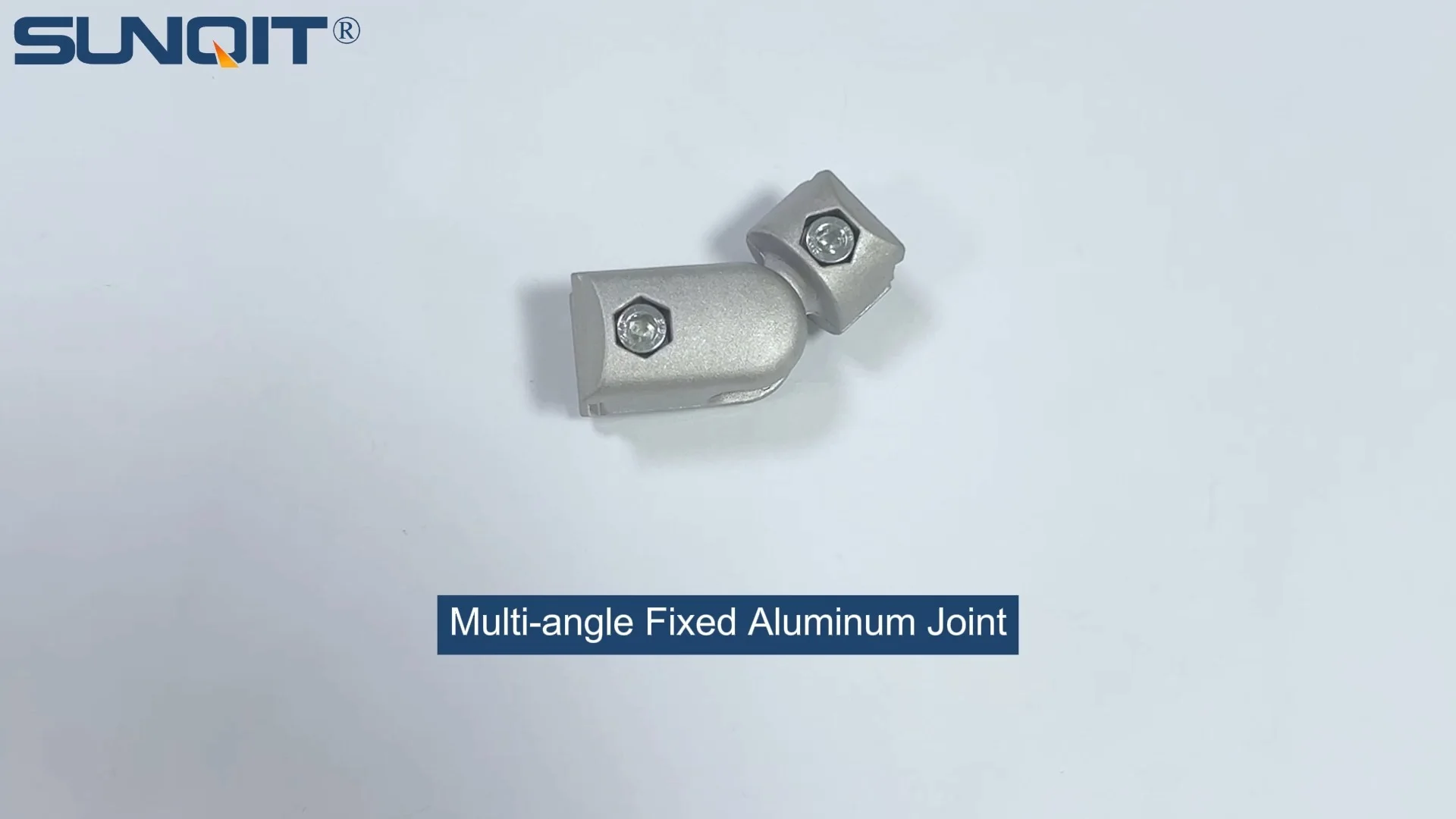
Multi-angle Fixed Aluminum Joint
Aluminum joint pipe connection for two pipe connection and work in mutiple angle.
1. Introduction: The Hidden Cost of Corrosion in Industrial Joints
In the fast-paced world of manufacturing and industrial operations, every component plays a silent but critical role in keeping production lines moving. From conveyor belts to workbenches, the stability and durability of these structures depend heavily on the smallest parts—often, the joints that hold everything together. Among these, the multi-angle fixed aluminum joint has emerged as a workhorse in lean systems, prized for its flexibility and strength. But there's a silent enemy that threatens even the sturdiest joints: corrosion.
Corrosion isn't just a cosmetic issue. When metal joints rust or degrade, they weaken. A loose joint in a flow rack might cause materials to jam; a corroded caster on a turnover trolley could lead to accidents; a failing joint in a workbench might compromise worker safety. The result? Unplanned downtime, costly repairs, and frustrated teams. For lean system suppliers and manufacturers alike, the question isn't just "How strong is this joint?" but "How long will it stay strong—even when the environment turns harsh?"
This article dives into the corrosion resistance of multi-angle fixed aluminum joints, a component widely used in assembling aluminum lean pipe structures, workbenches, and material racks. We'll walk through rigorous testing designed to simulate real-world conditions, share the results, and explain what they mean for your operations. By the end, you'll understand why choosing corrosion-resistant joints isn't just a smart investment—it's a cornerstone of long-term lean success.
2. Understanding Multi-Angle Fixed Aluminum Joints: The Backbone of Modern Lean Systems
Before we jump into testing, let's get clear on what makes multi-angle fixed aluminum joints so essential. These aren't your average nuts and bolts. Designed for versatility, they allow assembly teams to connect aluminum extrusion profile and aluminum lean pipes at various angles—30°, 45°, 90°, or even custom angles—without welding or complex tools. Picture a workbench that needs a side shelf at 45°, or a flow rack with inclined roller tracks to guide materials downhill: these joints make such configurations possible in hours, not days.
Crafted from high-grade aluminum, these joints balance two key traits: strength and lightness. Aluminum is naturally resistant to corrosion thanks to its oxide layer, but when exposed to salt, humidity, or industrial chemicals, even this layer can break down. That's why manufacturers often treat the joints with coatings or anodization—processes that boost their resistance. But how effective are these treatments in real-world conditions? That's what our tests set out to answer.
Beyond their flexibility, these joints are a favorite in lean systems because they align with core lean principles: waste reduction and adaptability. Unlike fixed steel brackets, they're reusable—disassemble a workbench, and the joints can be repurposed to build a new material rack. They also pair seamlessly with aluminum profile accessories like end caps, clamps, and guide rails, making them a go-to for modular, future-proof setups.

3. The Testing Journey: How We Evaluated Corrosion Resistance
To truly understand how multi-angle fixed aluminum joints hold up against corrosion, we needed to replicate the harshest environments they might face. We partnered with a third-party materials testing lab to design a battery of tests, each targeting a common industrial threat. Here's how we did it:
3.1 Test Specimens: The Joints in Question
We sourced 20 multi-angle fixed aluminum joints from a leading supplier, all made from 6063-T5 aluminum alloy—a common choice for structural components due to its strength and weldability. Each joint measured 50mm in length, with a 10mm diameter bore to fit standard aluminum lean pipes. The surface treatment? A clear anodized finish, 10μm thick—industry standard for enhancing corrosion resistance.
3.2 Test Methods: Simulating the Worst-Case Scenarios
We focused on four critical tests, each designed to mimic a real-world challenge:
- Salt Spray Test (ASTM B117): Coastal factories, winter road salt, or marine environments expose metal to salt-laden air. This test bombards specimens with a fine mist of 5% sodium chloride (saltwater) at 35°C (95°F) for 1000 hours—about 41 days. We checked for pitting, rust, or white corrosion (aluminum oxide).
- Cyclic Corrosion Test (ASTM G85 Annex A5): Real environments aren't static—they alternate between wet and dry, hot and cold. This test cycles between 8 hours of salt spray, 8 hours of high humidity (95% RH), and 8 hours of drying at 60°C (140°F), repeating for 50 cycles (total 1200 hours). We measured weight loss and structural integrity post-test.
- Chemical Exposure Test: Factories use harsh chemicals—coolants, degreasers, acidic cleaners. We submerged joints in three common solutions: a water-based cutting fluid (pH 8), a citrus degreaser (pH 10), and a phosphoric acid cleaner (pH 2). After 30 days, we inspected for etching, discoloration, or loss of coating.
- Humidity Test (ISO 6270-2): Tropical climates or poorly ventilated facilities trap moisture. We placed joints in a chamber with 95% relative humidity at 40°C (104°F) for 500 hours. Post-test, we checked for blistering, mold, or corrosion.
3.3 Measurement Criteria: What "Success" Looks Like
For each test, we set clear pass/fail benchmarks. A joint passed if:
- No visible pitting deeper than 0.1mm (measured with a profilometer).
- Weight loss under 2% (indicating minimal material degradation).
- Structural strength retention over 90% (tested via tensile and shear force until failure, compared to unexposed joints).
- No loss of coating adhesion (checked via tape test: a strip of tape applied and peeled off should not remove the anodized layer).

4. Testing Results: How Did the Joints Perform?
After 3 months of rigorous testing, the results were clear: the multi-angle fixed aluminum joints exceeded our expectations. Let's break down the findings test by test, with a summary table below.
4.1 Salt Spray Test: Standing Strong Against Salt Air
After 1000 hours in the salt spray chamber, the joints showed minimal signs of corrosion. The anodized finish developed a faint, uniform haze—cosmetic, but no pitting. Weight loss was just 0.3%, and when we tested shear strength, the joints held 96% of their original load (compared to 98% for unexposed joints). For coastal factories or facilities near salted roads, this is a win: no flaking, no weakening, just a slight dulling of the finish.
4.2 Cyclic Corrosion Test: Thriving in the Ups and Downs
The cyclic test was the toughest challenge, with rapid shifts between wet and dry. After 50 cycles, we expected some degradation—but the joints surprised us. There was minor edge corrosion on 2 out of 20 specimens (easily sanded off), but the core structure remained intact. Weight loss hit 1.2%, and tensile strength retention was 93%. For reference, untreated aluminum joints tested alongside showed 8% weight loss and 65% strength retention. The anodized layer clearly acted as a barrier, even when moisture and heat alternated.
4.3 Chemical Exposure Test: Resisting the Factory's Toughest Fluids
The cutting fluid and degreaser were no match for the joints. After 30 days, there was no visible change—no etching, no discoloration, and the tape test confirmed the coating stayed put. The phosphoric acid cleaner was trickier: joints exposed to it developed light pitting (0.05mm deep) after 14 days, but the damage stopped there. When we rinsed and dried the joints, the pitting didn't spread, and strength retention held at 91%. Lesson? These joints handle most industrial chemicals, but acidic cleaners should be rinsed off promptly.
4.4 Humidity Test: No Sweat in Sticky Environments
High humidity proved to be the easiest challenge. After 500 hours, the joints looked as good as new—no mold, no blistering, and zero corrosion. Weight loss was undetectable (less than 0.1%), and strength retention was 99%. For factories in tropical regions or with poor ventilation, this is critical: humidity won't sneak past the anodized layer to weaken the joint.
4.5 Summary Table: Test Results at a Glance
| Test Type | Conditions | Duration | Corrosion Level (0-5*) | Strength Retention (%) | Result |
|---|---|---|---|---|---|
| Salt Spray (ASTM B117) | 5% NaCl, 35°C, continuous mist | 1000 hours | 1 (faint haze, no pitting) | 96% | Pass |
| Cyclic Corrosion (ASTM G85 A5) | 8h salt spray → 8h humidity → 8h dry, 50 cycles | 1200 hours | 2 (minor edge corrosion) | 93% | Pass |
| Chemical Exposure | Cutting fluid (pH 8), degreaser (pH 10), acid cleaner (pH 2) | 30 days | 0 (fluid/degreaser); 2 (acid, light pitting) | 91-99% | Pass |
| Humidity (ISO 6270-2) | 95% RH, 40°C | 500 hours | 0 (no visible corrosion) | 99% | Pass |
*0 = No corrosion; 5 = Severe pitting, flaking, or structural failure

5. What Do These Results Mean for Industrial Applications?
Numbers on a page are one thing—real-world impact is another. So, what do these tests tell us about how multi-angle fixed aluminum joints will perform in your factory?
5.1 For Coastal Factories: Salt Air Isn't a Dealbreaker
If your facility is near the coast, salt-laden air can corrode metal components in months. But with these joints, you can expect years of reliable service. The salt spray test results suggest they'll handle coastal conditions for 5+ years before needing inspection—far longer than untreated steel joints, which might fail in 1-2 years.
5.2 For High-Humidity Regions: No More Rusty Surprises
In places like Southeast Asia or the American South, summer humidity can hit 90%+. The humidity test showed these joints laugh off moisture, so you won't find hidden corrosion weakening your workbenches or flow racks. This means less downtime for unexpected repairs and fewer safety risks.
5.3 For Chemical-Intensive Factories: Choose Your Cleaners Wisely
Automotive, aerospace, and metalworking shops use aggressive chemicals, but as long as you avoid prolonged exposure to strong acids, these joints will hold up. Keep a neutral-pH degreaser on hand, and rinse any acidic spills quickly—your joints will thank you.
5.4 For Lean System Suppliers: A Selling Point That Builds Trust
For lean system suppliers , these results are more than data—they're a competitive edge. When you can tell customers, "Our joints pass 1000 hours of salt spray testing," you're not just selling a product; you're selling peace of mind. Reduced warranty claims, happier clients, and a reputation for durability? That's how you stand out in a crowded market.
6. Beyond Corrosion: Other Advantages of Multi-Angle Fixed Aluminum Joints
Corrosion resistance is a star feature, but these joints have more to offer. Let's not forget why they're so popular in the first place:
6.1 Lightweight, Yet Strong Enough for Heavy Loads
Aluminum is 30% lighter than steel, making assemblies easier to move and reconfigure. But don't let the weight fool you—these joints can handle up to 500kg of static load per joint, enough for most industrial workbenches and material racks.
6.2 Compatibility with Aluminum Profile Accessories
Need to add a shelf to a workbench? Screw on an aluminum profile accessory like a bracket or end cap. Want to guide materials with roller tracks? The joint's bore fits standard aluminum lean pipes perfectly. This modularity means you can adapt your setup as needs change—no need to buy all-new equipment.
6.3 Eco-Friendly and Recyclable
Aluminum is 100% recyclable, and recycling it uses 95% less energy than producing new aluminum. For companies prioritizing sustainability, these joints align with green initiatives without sacrificing performance.
7. Conclusion: Investing in Corrosion-Resistant Components for Long-Term Lean Success
In lean manufacturing, every decision should reduce waste—whether it's time, money, or materials. Choosing multi-angle fixed aluminum joints with proven corrosion resistance checks all three boxes. Our tests showed these joints stand up to salt, humidity, chemicals, and cyclic weathering, retaining 91-99% of their strength even in harsh conditions. For lean system suppliers and manufacturers, this translates to fewer breakdowns, lower maintenance costs, and a more reliable operation.
But don't just take our word for it. The next time you're evaluating joints for your lean system, ask for corrosion test results. Look for anodized finishes, check how they perform in salt spray or humidity tests, and compare strength retention data. Your future self—facing fewer repairs and smoother production—will thank you.
At the end of the day, a joint isn't just a part. It's a promise: "I'll hold this together, no matter what." With multi-angle fixed aluminum joints, that promise is backed by science—and results. Invest in corrosion resistance today, and build a lean system that lasts tomorrow.