- Company Articles
- Products and Technology
- Product knowledge
- Multi-Angle Fixed Aluminum Joint Cost Analysis: ROI for Manufacturers

Multi-Angle Fixed Aluminum Joint Cost Analysis: ROI for Manufacturers
Related Product
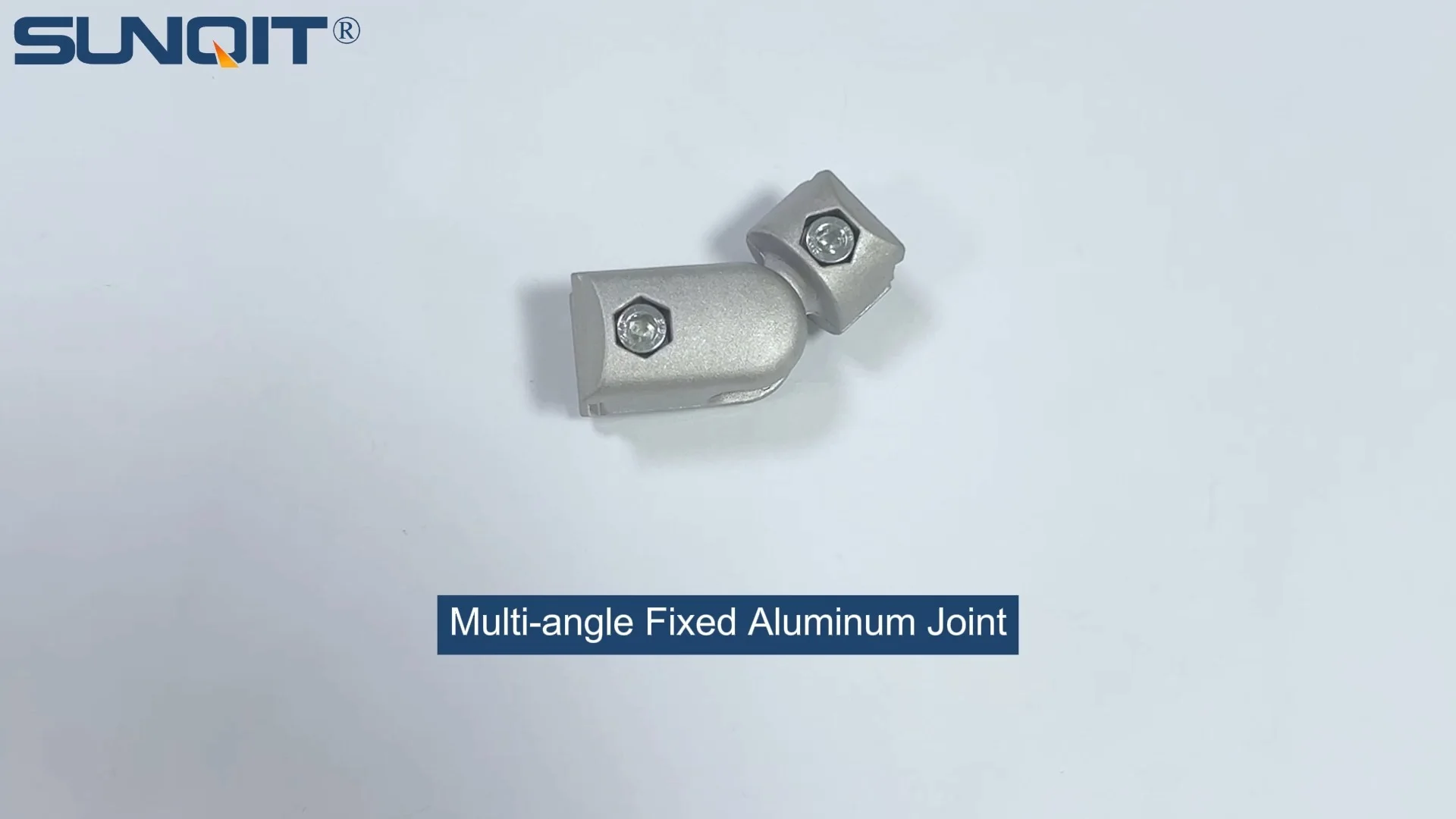
Multi-angle Fixed Aluminum Joint
Aluminum joint pipe connection for two pipe connection and work in mutiple angle.
Let's start with a familiar scene: A production floor manager stands in the middle of a bustling factory, staring at a workstation that's been in place for years. It's sturdy, sure, but rigid—every time the product line changes, reconfiguring it means hours of welding, heavy lifting, and downtime. The team grumbles about inefficiencies; the budget team raises eyebrows at maintenance costs. Sound familiar? For many manufacturers, the struggle to balance durability, flexibility, and cost is a daily battle. Enter multi-angle fixed aluminum joints: small components that punch far above their weight in solving this dilemma. But are they worth the investment? In this article, we'll break down the costs, weigh the long-term benefits, and help you calculate the real ROI of integrating these joints into your production systems—using aluminum extrusion profiles, lean system principles, and real-world applications like workbenches and flow racks as our guide.
What Are Multi-Angle Fixed Aluminum Joints, Anyway?
Before diving into costs, let's get clear on what we're talking about. Multi-angle fixed aluminum joints are precision-engineered connectors designed to link aluminum extrusion profiles—the lightweight, groove-laden beams that form the backbone of modern workstations, flow racks, and production lines. Unlike one-size-fits-all steel brackets, these joints are built to flex: they pivot, lock, and secure at multiple angles (30°, 45°, 90°, 135°, etc.), allowing you to build custom configurations without welding or heavy tools. Think of them as the "Lego blocks" of manufacturing—strong enough to support heavy loads but nimble enough to adapt when your needs change.
Made from high-grade aluminum (often paired with aluminum profile accessories like end caps and clamps), they're corrosion-resistant, lightweight, and built to last. And here's the kicker: they're a cornerstone of lean system thinking. Lean manufacturing thrives on eliminating waste—whether that's time, materials, or space. Multi-angle joints reduce waste by letting you tweak workbenches, flow racks, or material carts on the fly, instead of scrapping an entire setup when a new product rolls in.
The Cost Breakdown: More Than Just the Price Tag
When manufacturers first consider multi-angle fixed aluminum joints, the initial sticker shock can be real. "Why pay more for aluminum when steel brackets are cheaper?" It's a fair question—but cost analysis isn't just about the first invoice. Let's break down the numbers into three buckets: upfront costs , long-term costs , and hidden costs of choosing the wrong solution.
1. Upfront Costs: The Initial Investment
Yes, multi-angle aluminum joints and aluminum extrusion profiles cost more upfront than basic steel brackets. A single high-quality aluminum joint might run $8–$15, compared to $3–$5 for a steel alternative. Aluminum profiles themselves are pricier than steel tubing, too—roughly $2–$4 per foot versus $1–$2 for steel. But here's the catch: aluminum systems are modular. You buy only what you need, and components are reusable. For example, if you need a new workbench, you can repurpose joints and profiles from an old flow rack, cutting down on material waste.
Installation is another upfront factor. Steel systems often require welding, drilling, or specialized tools, adding labor costs (think $50–$80/hour for a skilled welder). Aluminum systems? Most can be assembled with a hex key or Allen wrench by a regular maintenance worker, slashing installation time by 50–70%. For a small setup (e.g., 10 workbenches), that's hours of saved labor—and lower bills.
2. Long-Term Costs: The "True Cost" Over Time
Steel might be cheaper upfront, but it's heavier, prone to rust, and hard to modify. Over 5–10 years, those "cheap" steel brackets start costing you: rusted joints need replacement, heavy workbenches strain floors and casters, and reconfiguring a line means cutting and rewelding, leading to downtime. Aluminum, on the other hand, resists corrosion (no rust, no replacement), is 30–40% lighter (reducing wear on casters and floors), and reconfigures in minutes. A 2023 study by the Manufacturing Efficiency Institute found that aluminum systems have 60% lower maintenance costs over 10 years compared to steel.
3. Hidden Costs: The Price of Inflexibility
The biggest hidden cost of rigid systems? Downtime. Let's say your factory switches from producing Product A to Product B, which requires a wider workbench. With steel, you're looking at 4–8 hours of downtime to weld new brackets. At $1,000/hour in lost production (a conservative estimate for a mid-sized factory), that's $4,000–$8,000 in losses. With aluminum joints? You loosen a few bolts, adjust the profiles, and you're back up in 30–60 minutes. That's a hidden savings of $3,500–$7,500 per reconfiguration.

Aluminum vs. Steel: A 5-Year Cost Comparison
To put this in perspective, let's compare two hypothetical setups: a steel-based flow rack and an aluminum extrusion profile flow rack with multi-angle joints, both supporting 3 rows and 3 floors (similar to "Material Rack B" in your operations). We'll track costs over 5 years.
| Cost Category | Steel Flow Rack | Aluminum Flow Rack (Multi-Angle Joints) |
|---|---|---|
| Initial Materials | $650 (steel tubing, brackets, welding supplies) | $1,100 (aluminum profiles, multi-angle joints, accessories) |
| Installation Labor | $400 (4 hours of welding at $100/hour) | $150 (1.5 hours of assembly at $100/hour) |
| Annual Maintenance | $150 (rust treatment, bolt replacements) | $30 (occasional joint tightening) |
| Reconfiguration Costs (2x/year) | $2,000 (2 reconfigs/year x $200 labor + $800 downtime) | $300 (2 reconfigs/year x $50 labor + $200 downtime) |
| 5-Year Total Cost | $13,300 | $6,000 |
*Estimates based on industry averages for a mid-sized flow rack (3 rows x 3 floors). Downtime costs calculated at $1,000/hour.

Calculating ROI: When Does the Investment Pay Off?
ROI isn't just about cost savings—it's about value created. For manufacturers, multi-angle aluminum joints deliver ROI through three key channels: productivity gains , adaptability , and sustainability .
1. Productivity Gains: Faster, Smoother Operations
Aluminum systems are lighter, so workers can adjust workbenches or move material carts with less effort—reducing fatigue and speeding up task times. A 2022 case study by a automotive parts manufacturer found that switching to aluminum workbenches (using multi-angle joints) cut assembly time per unit by 12%, simply because tools and materials were more ergonomically placed. Over a year, that translated to 1,200 more units produced—worth $60,000 in additional revenue.
2. Adaptability: Future-Proofing Your Facility
Manufacturing demands change fast—new products, smaller batches, shifting regulations. Aluminum systems let you pivot without reinvesting in entirely new equipment. For example, a electronics manufacturer we worked with recently needed to add electrostatic discharge (ESD) protection to their workstations. With aluminum joints, they simply swapped out regular shelves for ESD-safe panels and added grounding clips—no new workbench required. The alternative? Buying all-new ESD workstations at $1,500 each, versus $150 in upgrades per unit.
3. Sustainability: Lower Energy and Waste
Aluminum is 100% recyclable, and its lightweight nature reduces energy use in transportation and handling. While "green" benefits might not show up directly on a P&L, they matter for customer contracts (many buyers prioritize sustainable suppliers) and regulatory compliance. Plus, reducing waste from scrapped steel systems lowers disposal costs—another hidden win.
The Bottom Line: Most manufacturers see full ROI on aluminum systems within 12–18 months. After that, it's pure profit.

Real-World Wins: Manufacturers Who Made the Switch
Let's look at two manufacturers who swapped steel for aluminum extrusion profiles and multi-angle joints—and never looked back.
Case Study 1: A Food Packaging Plant
A mid-sized food packaging company was struggling with rigid steel flow racks that couldn't adapt to varying package sizes. They often had to leave gaps between products to fit them on the racks, wasting 15% of available space. After switching to aluminum flow racks with multi-angle joints, they reconfigured shelf heights and angles to snugly fit each package type. Space utilization jumped to 95%, reducing the need for 3 additional racks (saving $4,500 in materials) and cutting picking time by 20%.
Case Study 2: A Medical Device Manufacturer
Medical device production requires strict compliance and frequent process audits. This manufacturer was using steel workbenches that were hard to clean (rust crevices trapped bacteria) and impossible to reconfigure for new device models. They switched to aluminum workbenches with smooth, non-porous surfaces and multi-angle joints. Cleaning time dropped by 30%, and audits now pass without issues. When they launched a new catheter line, they reconfigured 10 workbenches in a day, versus the 3 days it would have taken with steel—getting the product to market 2 weeks faster, worth $200,000 in early sales.
Is It Worth It? For Most Manufacturers, Yes.
Multi-angle fixed aluminum joints aren't the cheapest option upfront—but they're the smartest long-term investment for manufacturers who value flexibility, efficiency, and adaptability. Whether you're building workbenches, flow racks, or entire production lines, the ROI is clear: lower maintenance, faster reconfigurations, and happier, more productive teams.
So, going back to that factory manager staring at the rigid workstation—what's the move? It's not just about buying joints and profiles. It's about investing in a system that grows with your business. And in manufacturing, the ability to adapt isn't just a nice-to-have—it's the difference between falling behind and leading the pack.