- Company Articles
- Products and Technology
- Application Cases
- Multi-Angle Fixed Aluminum Joint in Automotive Manufacturing: Case Studies

Multi-Angle Fixed Aluminum Joint in Automotive Manufacturing: Case Studies
Related Product
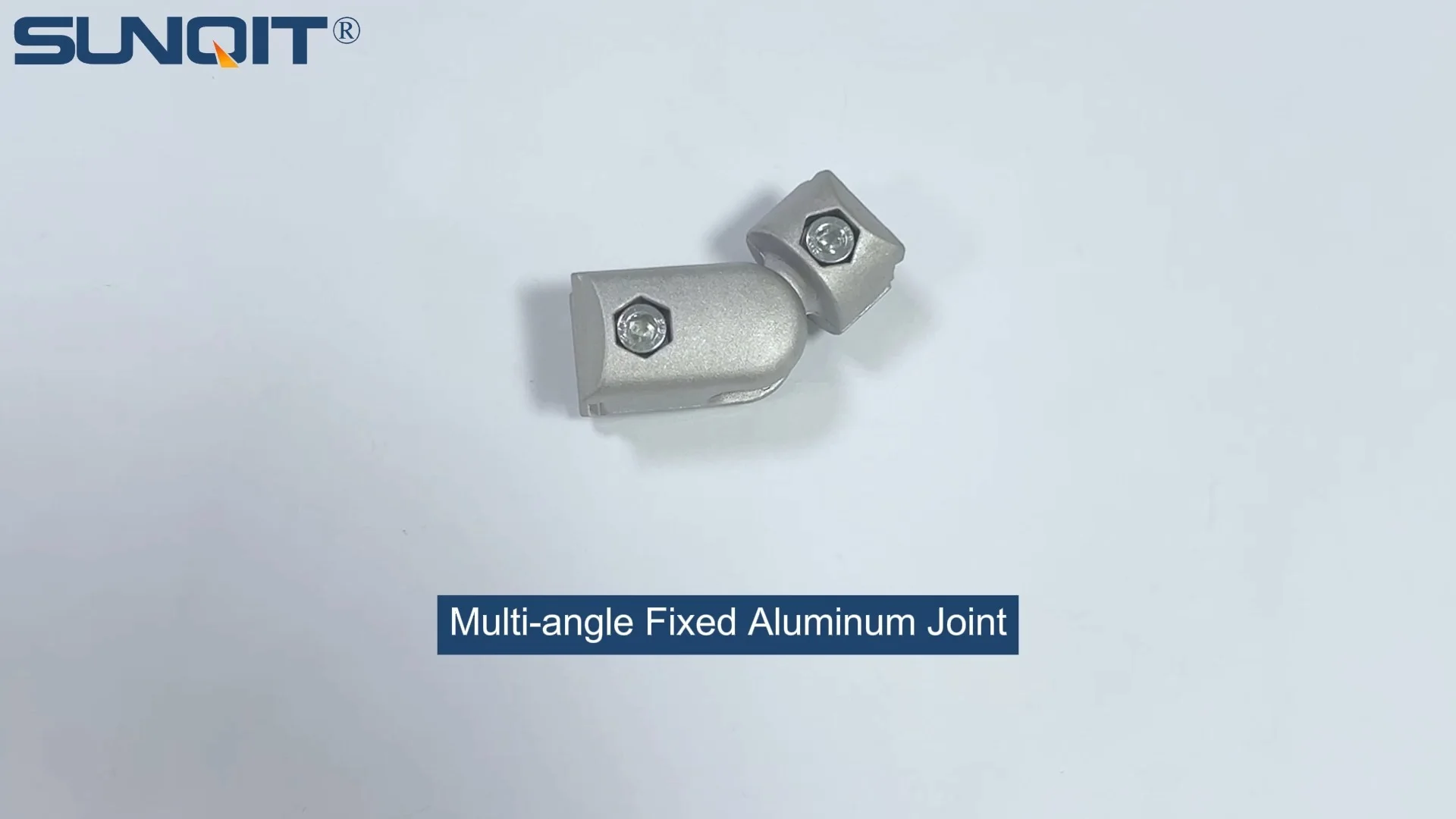
Multi-angle Fixed Aluminum Joint
Aluminum joint pipe connection for two pipe connection and work in mutiple angle.
The automotive industry is in the midst of a transformation. From the rise of electric vehicles (EVs) to the push for smarter, more flexible manufacturing, factories worldwide are grappling with a common challenge: how to build production systems that can keep pace with rapid change. Traditional manufacturing setups—often built with welded steel frames, rigid conveyors, and static workbenches—were designed for long production runs of a single model. Today, with shorter product lifecycles, frequent design updates, and the need to switch between models (or even between ICE and EV production), rigidity has become a liability.
Enter the multi-angle fixed aluminum joint: a humble yet revolutionary component that's quietly reshaping how automotive plants design, build, and adapt their assembly lines. In this article, we'll explore what makes this joint so valuable, dive into real-world case studies from automotive manufacturers, and uncover how it's driving efficiency, flexibility, and cost savings across the industry. Whether you're a production manager, a plant engineer, or simply curious about the future of manufacturing, these stories offer a glimpse into the tools powering the next generation of automotive production.
What Is a Multi-Angle Fixed Aluminum Joint?
Before we jump into the case studies, let's take a moment to understand the star of the show: the multi-angle fixed aluminum joint. At its core, this component is a connector designed to join aluminum profiles—hollow, T-slot extrusions commonly used in industrial framing—at various angles. Unlike traditional welded steel joints, which are permanent and require specialized labor to modify, multi-angle fixed aluminum joints are engineered for flexibility and ease of use.
Here's what sets them apart:
- Versatile Angles: As the name suggests, these joints can lock aluminum profiles together at multiple angles—30°, 45°, 90°, 135°, and even custom angles—without the need for cutting or welding. This means a single joint can adapt to different structural needs, from the straight edges of a workbench to the sloped sides of a material rack.
- Tool-Free (or Minimal-Tool) Assembly: Most multi-angle joints use simple bolts or set screws to secure profiles, making assembly and disassembly quick. A basic hex key is often all that's needed, eliminating the need for welders or heavy machinery.
- Durability Meets Lightweight: Aluminum is naturally resistant to corrosion, a critical feature in automotive plants where oils, coolants, and cleaning agents are common. Despite being lighter than steel, aluminum profiles reinforced with these joints offer impressive strength—enough to support heavy components like engine blocks or battery packs.
- Compatibility with Lean Principles: In lean manufacturing, waste reduction and continuous improvement are king. Multi-angle joints align perfectly with this mindset by enabling "just-in-time" reconfigurations. If a production line needs to be rearranged for a new model, teams can disassemble and rebuild frames in hours, not days.
Now, let's see how these features translate to real results on the factory floor.
Case Study 1: Streamlining Component Assembly at a Tier 1 Supplier
The Challenge: Rigid Workbenches Slowing Down Brake Component Production
Our first case study takes us to a tier 1 automotive supplier specializing in brake calipers and master cylinders. With clients including major OEMs like Ford and Volkswagen, the plant produces over 500,000 components annually. Until recently, their assembly lines relied on welded steel workbenches—sturdy, but static. The problem? Brake component designs change frequently to meet evolving safety standards (e.g., lighter materials, integrated sensors for ADAS), and each new design required a new workbench.
"We were spending $15,000 to $20,000 per new workbench, and lead times were 6–8 weeks," recalls Maria Gonzalez, the plant's production engineering manager. "By the time the new benches arrived, the design might have changed again, leaving us with obsolete equipment. It was a cycle of waste."
Compounding the issue was ergonomics. Workers on the line varied in height, but the fixed workbenches couldn't be adjusted, leading to increased fatigue and a higher risk of repetitive strain injuries. Gonzalez's team needed a solution that could adapt to new component sizes and keep workers comfortable—without breaking the bank.
The Solution: Modular Workbenches with Multi-Angle Joints and Aluminum Profiles
In 2023, the supplier partnered with a lean system integrator to overhaul their assembly workstations. The centerpiece of the redesign? Workbenches built using aluminum profiles and multi-angle fixed aluminum joints. Here's how they worked:
1. Adjustable Height and Angle: The workbench frames were constructed with 40mm x 40mm aluminum profiles, connected at 90° angles using multi-angle joints. By adding telescoping legs (another aluminum profile accessory), the height could be adjusted from 750mm to 950mm—accommodating workers of all statures. For tasks requiring a sloped surface (e.g., assembling small brake line fittings), 45° joints tilted the worktop, reducing eye and neck strain.
2. Quick Swap-Outs for New Components: When a new brake caliper design was introduced, instead of building a new bench, engineers simply reconfigured the existing one. Using 30° and 135° joints, they added side rails to hold new tooling, or adjusted the depth of the bench to fit larger components. "What used to take 8 weeks now takes 8 hours," Gonzalez notes. "We even keep spare aluminum profiles and joints on hand, so we can prototype new setups during night shifts without disrupting production."
3. Integrated Tool Storage: T-slot aluminum profiles allowed the team to add pegboards, tool hooks, and small parts bins directly to the workbench frame—all secured with compatible accessories. No more drilling holes in steel benches or using adhesive hooks that fell off.
The Results: 30% Faster Reconfigurations and 25% Cost Savings
After 12 months of using the modular workbenches, the results spoke for themselves:
- Reduced Lead Times: Reconfiguring a workbench for a new component dropped from 6–8 weeks to 1–2 days. This allowed the supplier to meet tight OEM deadlines for prototype parts, a competitive edge in a crowded market.
- Lower Costs: The initial investment in aluminum profiles and multi-angle joints paid off within 6 months. Instead of spending $20,000 on a new steel bench, reconfiguring an existing aluminum bench cost just $1,500 in materials (mostly extra profiles and joints). Over a year, the plant saved $120,000 on workbench costs alone.
- Happier Workers: Ergonomic adjustments led to a 40% reduction in reported neck and back pain, and a 15% improvement in assembly accuracy (fewer misaligned fittings). "Our operators love that they can tweak the bench to fit their needs," Gonzalez says. "It's a small change, but it makes them feel valued—and that translates to better work."

Case Study 2: Enhancing Battery Pack Conveyors for EV Production
If there's one area where automotive manufacturing is changing faster than any other, it's electric vehicle (EV) production. Battery packs—the heart of an EV—are large, heavy (often 400kg+), and prone to frequent design updates as automakers chase longer range and faster charging. For one European EV manufacturer, this posed a unique challenge: their battery pack assembly line relied on fixed steel conveyors that couldn't keep up with evolving pack sizes.
The Challenge: Rigid Conveyors Stalling Battery Pack Flow
The plant, which produces battery packs for luxury EVs, had a conveyor system that transported packs from cell assembly to module integration, and finally to final testing. The conveyors were built with welded steel frames and fixed roller tracks, set at a 1.5° incline to use gravity for movement. But when the automaker introduced a new battery pack design with a 10% larger footprint, the conveyors became a bottleneck:
- The wider packs couldn't fit through the steel side rails, causing jams.
- The fixed incline was too steep for the heavier new packs, leading to damaged cells.
- Welding new steel rails to widen the conveyors would require shutting down the line for 3 days—a costly delay in a plant running 24/7.
The Solution: Adjustable Conveyor Frames with Multi-Angle Joints
The plant's engineering team turned to aluminum profiles and multi-angle fixed aluminum joints to rebuild the conveyor frames. Here's how they addressed the issues:
1. Wider, Adjustable Rails: The original steel rails were replaced with aluminum guide rails, mounted to frames built with 80mm x 40mm aluminum profiles. Multi-angle joints allowed the rails to be spaced 150mm wider—enough for the new battery packs—by simply loosening bolts, rotating the joints, and re-tightening. No welding, no cutting.
2. Variable Incline Angles: By using 30° and 45° multi-angle joints, the team adjusted the conveyor incline from 1.5° to 0.8°—gentler, but still enough to move the heavier packs without damaging cells. The joints locked securely, ensuring the incline didn't shift under load.
3. Modular Support Legs: To maintain stability with the wider, heavier loads, the conveyor support legs were reinforced with diagonal bracing—connected using 45° multi-angle joints. This distributed weight evenly across the floor, preventing sagging.
The best part? The entire (reconfiguration) was done in 16 hours during a scheduled maintenance window. "We split the line into sections," explains Jürgen Schmidt, the plant's maintenance supervisor. "One team disassembled the old steel rails, another built the new aluminum frames with multi-angle joints, and we tested the flow by morning. The line was back up by the next shift."
The Results: Zero Downtime, Improved Safety, and Future-Proofing
After the upgrade, the benefits were immediate:
- No Production Loss: The 16-hour avoided a 3-day shutdown, saving an estimated €2.4 million in lost output.
- Zero Jams or Damage: The wider rails and gentler incline eliminated pack jams and cell damage, reducing scrap rates by 18%.
- Future-Proofed for More Changes: Six months later, when the automaker introduced a third battery pack size (smaller than the original but with a taller profile), the team used the same multi-angle joints to raise the rails by 100mm—again, in just 4 hours.

Case Study 3: Lean System Integration in a Final Assembly Plant
Our third case study comes from a North American automotive OEM with a final assembly plant producing both ICE and EV models on the same line—a practice known as "mixed-model production." While mixed-model lines boost efficiency, they demand extreme flexibility: one hour, workers might be assembling a compact SUV; the next, a pickup truck with a longer wheelbase. This variability strained the plant's traditional lean system, which relied on fixed material racks and static workstations that couldn't adapt to different part sizes.
The Challenge: Static Material Racks Disrupting Lean Flow
In lean manufacturing, "5S" (Sort, Set in Order, Shine, Standardize, Sustain) is a cornerstone principle, emphasizing organization and visual management. At this plant, material racks along the assembly line were supposed to hold parts (e.g., door panels, dashboards) in a "first-in, first-out" (FIFO) flow. But with mixed-model production, the racks became disorganized:
- SUV door panels are taller than pickup door panels, so they hung over the rack edges, blocking access.
- EV battery cables (thicker and heavier than ICE wiring harnesses) needed deeper shelves to prevent falling.
- Workers wasted 15 minutes per shift searching for parts that had been misplaced due to poor rack design.
The Solution: Adaptable Material Racks with Multi-Angle Joints
The plant's lean coordinator, Mike Chen, proposed replacing the fixed steel racks with modular racks built using aluminum profiles and multi-angle fixed aluminum joints. The goal: create racks that could adjust to part sizes in minutes, not days.
Here's how they designed them:
1. Adjustable Shelf Heights and Angles: Each rack frame was built with vertical aluminum profiles connected by horizontal shelves. Multi-angle joints allowed shelves to be set at 0° (flat) for EV cables, 15° (sloped) for pickup door panels (to prevent sliding), or 30° (steeper slope) for smaller parts like dashboard clips. Shelf height could be adjusted in 50mm increments by moving the joints up or down the vertical profiles.
2. Removable Side Rails: For taller SUV parts, side rails (connected with 90° joints) could be quickly removed or repositioned to 45° angles, creating extra clearance. "Workers can make these changes themselves with a hex key," Chen notes. "They don't need to wait for maintenance—empowering them to solve problems on the spot."
3. Color-Coded for Model Types: To reinforce 5S, the team used colored aluminum profile accessories (yellow for SUV parts, blue for pickups, green for EVs) and labeled shelves with model-specific part numbers. The T-slot profiles made it easy to clip on magnetic labels that could be swapped when models changed.
The Results: 15% Less Waste and a 10% Boost in Productivity
After 6 months of using the adaptable racks, the plant saw significant improvements in lean metrics:
- Reduced Search Time: Workers now spend less than 2 minutes per shift looking for parts, down from 15 minutes. This added up to 1,200+ extra productive hours per month across the plant.
- Improved 5S Compliance: Audits showed a 40% increase in "Set in Order" scores, as parts stayed organized even during model changes.
- Lower Part Damage: Sloped shelves and adjustable rails reduced part scrap by 12%, saving $80,000 annually in replacement costs.

Beyond the Assembly Line: Why Multi-Angle Joints Matter for the Future of Automotive
The case studies above highlight the immediate benefits of multi-angle fixed aluminum joints: faster reconfigurations, lower costs, and happier workers. But their impact goes deeper, addressing two critical trends shaping automotive manufacturing:
1. The Shift to EVs and Electrification
EV production is inherently more variable than ICE production. Battery chemistry, pack size, and electric motor designs evolve rapidly as automakers compete for range and efficiency. Multi-angle joints allow plants to pivot quickly—whether it's adjusting a workbench for a new battery module or reconfiguring a conveyor for a different motor housing. As one plant manager put it: "In EVs, the only constant is change. With aluminum joints, we're not just keeping up—we're ahead."
2. The Rise of Customization
Today's consumers want vehicles tailored to their needs: a truck with a built-in tool chest, an SUV with a premium sound system, or an EV with a custom battery range. This means assembly lines must handle "lot size 1" production—building one unique vehicle at a time. Rigid steel setups can't handle this, but modular systems with multi-angle joints can. Imagine a workbench that adjusts from building a base-model door to a luxury trim door in 10 minutes, or a material rack that switches from holding cloth seats to leather seats with a few turns of a bolt.
| Traditional Steel Welded Joints | Multi-Angle Fixed Aluminum Joints |
|---|---|
| Permanent; requires welding to modify | Reconfigurable in hours; no welding |
| Heavy (hard to move or adjust) | Lightweight (easier to handle and transport) |
| Prone to rust in harsh environments | Corrosion-resistant aluminum |
| High labor and tooling costs | Low labor costs (basic tools only) |
| Long lead times for changes | Rapid changes (hours/days vs. weeks) |
Conclusion: The Joint That's Building the Future
In the fast-paced world of automotive manufacturing, flexibility isn't just a nice-to-have—it's a survival skill. The multi-angle fixed aluminum joint may not grab headlines like AI-powered robots or 3D-printed parts, but it's the unsung hero enabling plants to adapt, innovate, and thrive. From brake component workbenches to EV battery conveyors, it's proving that sometimes the smallest components make the biggest difference.
As Maria Gonzalez, the tier 1 supplier's production manager, puts it: "We used to see our assembly line as a fixed asset. Now, thanks to these joints, we see it as a canvas—one we can repaint whenever the market demands. And in automotive, that's priceless."
So the next time you walk through an automotive plant, take a closer look at the workbenches, the conveyors, the material racks. Chances are, you'll spot the telltale glint of aluminum profiles and the subtle angles of multi-angle joints—quietly hard at work, building the cars of tomorrow, today.