- Company Articles
- Products and Technology
- Product knowledge
- Multi-Angle Fixed Aluminum Joint in Home Appliance Production: Efficiency Boost

Multi-Angle Fixed Aluminum Joint in Home Appliance Production: Efficiency Boost
Related Product
Multi-angle Fixed Aluminum Joint
Aluminum joint pipe connection for two pipe connection and work in mutiple angle.
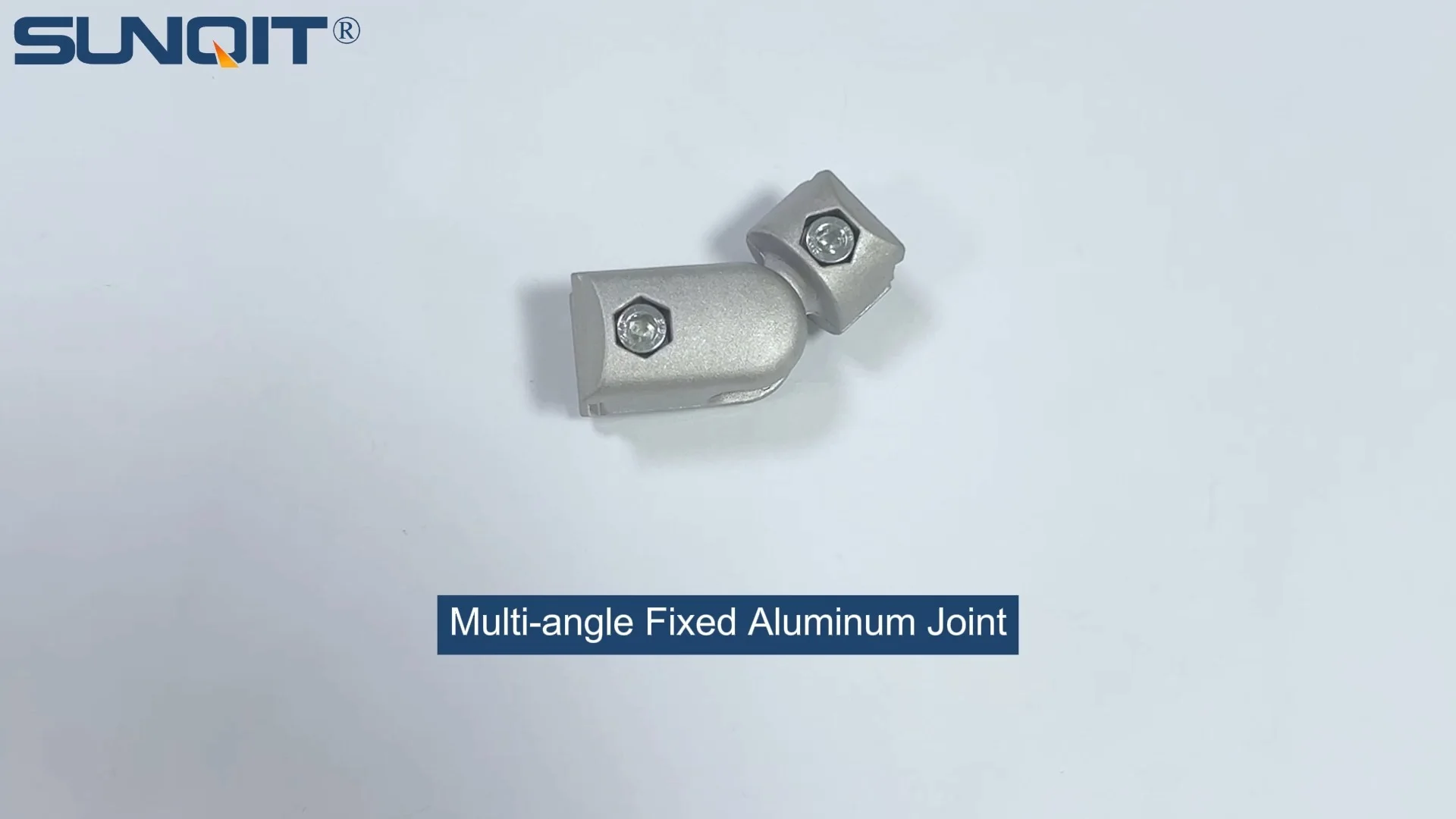
How a small component is transforming assembly lines, one connection at a time
The Heartbeat of Home Appliance Production Lines
Walk into any home appliance factory, and you'll feel it immediately—the rhythm. The hum of machinery, the clink of parts being assembled, the steady movement of conveyor belts carrying half-built refrigerators, washing machines, or ovens. It's a symphony of precision, but like any symphony, even the smallest off-note can throw everything off. For years, one of the most persistent "off-notes" in these production lines has been rigidity. Assembly stations bolted to the floor, workbenches fixed at awkward heights, roller tracks that can't adjust to new part sizes—these inflexible setups don't just slow things down; they wear on the people behind the work.
Imagine a line worker named Carlos, who's spent the past five years assembling control panels for dishwashers. His workbench is too low, forcing him to hunch over 8 hours a day. The roller track feeding parts to his station is at a slight incline that makes small components slide too fast, leading to fumbles and occasional scrapes. "I've asked for adjustments," he'd say during team meetings, "but the setup's 'permanent.'" His frustration isn't just personal—it trickles down to the products. When workers are strained, errors happen. When errors happen, production stalls. And when production stalls, everyone feels the pressure: managers, quality control, even the customers waiting for their new appliances.
But what if that rigidity didn't have to be permanent? What if the very bones of these production lines— the structures that hold workbenches, support roller tracks, and connect aluminum profiles—could bend, twist, and adapt to the people using them? Enter the multi-angle fixed aluminum joint: a small, unassuming component that's quietly revolutionizing how home appliance factories operate. It's not just a piece of metal; it's a bridge between efficiency and humanity, turning rigid lines into flexible ecosystems where both machines and people thrive.
The Unsung Hero: What is a Multi-Angle Fixed Aluminum Joint?
At first glance, the multi-angle fixed aluminum joint might seem unremarkable. It's a compact, lightweight piece, often no larger than a fist, with a sleek silver finish and a series of grooves and holes designed to lock onto aluminum profiles. But its simplicity is deceptive. This joint is engineered to do something traditional steel or plastic joints can't: connect aluminum profiles at virtually any angle—30°, 45°, 90°, even 135°—while maintaining a rock-solid hold. It's the difference between a rigid puzzle piece that only fits one way and a Swiss Army knife of connections, adaptable to whatever the production line throws at it.
Made from high-grade aluminum, it's both strong and surprisingly light. Unlike heavy steel joints that require two people to lift and bolt into place, this aluminum version can be carried in one hand, making installation a one-person job. Its durability is another standout feature. Aluminum resists corrosion, even in factories where moisture or cleaning chemicals are present, and the joint's internal locking mechanism—often a combination of bolts and friction-fit grooves—ensures it won't loosen over time, even under the vibration of heavy machinery.
But the real magic is in the "multi-angle" part. Traditional joints might let you connect two profiles at 90° or straight line, but that's it. If a production line needs a workbench with a sloped top to prevent parts from sliding off, or a roller track that curves gently to feed parts into a new assembly station, those old joints can't keep up. The multi-angle fixed aluminum joint, though? It laughs at those challenges. With a few adjustments to its locking bolts, it can pivot to almost any angle, turning standard aluminum profiles into custom structures that fit the task, not the other way around.

How It Works: Fitting into the Production Puzzle
To understand the multi-angle fixed aluminum joint's impact, you need to see it in action—how it fits into the larger ecosystem of factory components. Let's start with aluminum profiles, the "building blocks" of modern production lines. These extruded aluminum beams, with their T-slot grooves, are lightweight yet strong, perfect for constructing everything from workbenches to material racks. But profiles alone are just pieces of metal; they need joints to become useful structures. That's where our hero comes in.
Picture a team tasked with building a new assembly station for smart oven control panels. The design calls for a workbench that's 42 inches high (to reduce worker), a roller track angled at 15° to feed circuit boards smoothly, and a small shelf above the bench for tools. With traditional joints, this would mean ordering custom-cut steel brackets for the angle, welding parts together, and hoping the measurements are perfect. If the team later decides the roller track needs to be steeper (say, 20°) to handle thicker circuit boards? They'd have to start over.
With the multi-angle fixed aluminum joint, it's a different story. The team starts by cutting standard aluminum profiles to length. For the workbench legs, they use 40x40mm aluminum profiles, connecting them to the tabletop frame with 90° joints. For the roller track, they attach two profiles at a 15° angle using the multi-angle joint—no custom brackets needed. The shelf above? A few more profiles, connected with 90° and 45° joints to create a sturdy overhang. And if they need to adjust the roller track later? Loosen the joint's bolts, pivot to 20°, retighten, and done. The whole setup takes hours instead of days, and it's infinitely tweakable.
This flexibility extends to compatibility with other components, too. The joint works seamlessly with roller track accessories—like plastic guide rails that keep parts from slipping off—and even integrates with ESD (electrostatic discharge) workbenches, critical for assembling sensitive electronics. Its T-slot design matches standard aluminum profile accessories, so factories don't have to invest in new tools or parts; they can use what they already have, reducing waste and cost.

The Lean System Connection: Streamlining Workflows
Lean manufacturing isn't just a buzzword in factories—it's a philosophy. At its core, it's about eliminating waste: waste of time, waste of materials, waste of effort. For years, rigid production setups have been a major source of that waste. A workbench that's too tall for 5'2" workers but too short for 6'1" ones? That's waste of effort (and ergonomic strain). A roller track that can't be repositioned when a new product line launches? That's waste of time (waiting for new tracks to be built) and money (buying duplicates). The multi-angle fixed aluminum joint, however, is a lean system's best friend.
Take a typical lean goal: "continuous flow." In assembly lines, this means parts should move smoothly from one station to the next, with no bottlenecks. If a washing machine drum, for example, gets stuck on a roller track because the track's angle is wrong, that's a flow interruption. With the multi-angle joint, the track can be adjusted on the spot to keep things moving. No more stopping production to call maintenance; the line workers themselves can make the tweak. That's "continuous flow" in action.
Another lean principle is "respect for people," and here the joint shines brightest. When workstations are built around the people using them—not the other way around—workers are more engaged, less fatigued, and more productive. Consider a team assembling refrigerator doors. Before the multi-angle joint, their workbench had a fixed shelf at chest height, forcing them to reach up repeatedly to grab hinges. Now, using the joint, they've angled the shelf downward by 10°, bringing the hinges to eye level. "It sounds small," says team lead Maria, "but my shoulder pain is gone. I can focus on the work, not the ache."
Even "just-in-time" production, where parts arrive exactly when needed, benefits. Factories often reconfigure lines seasonally to meet demand—more ovens in summer, more heaters in winter. With traditional setups, reconfiguring takes weeks. With aluminum profiles and multi-angle joints, it takes days. A factory making 1,000 washing machines a day can switch to 1,500 during peak season by quickly adding extra workbenches and adjusting roller tracks—all using the same joints and profiles. No waste, no delays, just adaptability.

Real Impact: Stories from the Factory Floor
Let's zoom in on a real-world example: a mid-sized appliance factory in Ohio that manufactures front-loading washing machines. In 2023, the plant was struggling with two issues: high turnover among line workers (largely due to ergonomic complaints) and slow production times on their new "EcoWash" model, which had larger, heavier drum assemblies. The EcoWash's drum weighed 12 pounds more than the previous model, and the existing roller track—fixed at a 5° incline—couldn't handle the extra weight, causing jams. Meanwhile, workers on the drum assembly station were reporting wrist and back pain from the workbench's fixed height.
The plant manager, Lisa, had heard about aluminum profile systems and decided to test them, with the multi-angle fixed aluminum joint as the centerpiece. The team replaced the drum assembly workbench with one built from 40x80mm aluminum profiles and multi-angle joints. Workers could now adjust the bench height from 36" to 44" using the joints, and the roller track feeding drums to the station was reangled to 10°—enough to move the heavier drums without jams. They even added a small, pivoting shelf (using 45° joints) for tools, so workers didn't have to reach across the bench.
The results were striking. Within a month, turnover on the EcoWash line dropped by 40%. "I used to go home with a headache every day from hunching," says Maria, one of the drum assemblers. "Now the bench fits me, the tools are right there, and the drums glide in smoothly. I actually look forward to coming to work." Production speed improved, too: the line went from assembling 80 EcoWash units per shift to 100—a 25% increase. And when the plant launched a smaller "Compact EcoWash" six months later, they reconfigured the same workbench and roller track in a day, using the multi-angle joints to adjust heights and angles, instead of building a new station from scratch.
"It's not just about the machines—it's about the people. When you give them tools that adapt to
their
needs, they don't just work harder; they work smarter. The multi-angle joint didn't just fix our production line—it fixed how our team felt about their work." — Lisa, Plant Manager
Comparing Traditional vs. Multi-Angle: A Clear Advantage
Still skeptical? Let's break down how the multi-angle fixed aluminum joint stacks up against traditional steel or plastic joints. The table below compares key features that matter most to factories: flexibility, durability, installation time, and long-term cost-efficiency.
| Feature | Traditional Steel/Plastic Joints | Multi-Angle Fixed Aluminum Joint |
|---|---|---|
| Flexibility | Limited to 90° or straight angles; no on-site adjustments | Adjustable to 30°, 45°, 90°, 135°, etc.; reconfigurable in minutes |
| Durability | Steel rusts; plastic cracks under heavy loads; bolts loosen over time | Aluminum resists corrosion; friction-lock design prevents loosening; withstands vibration |
| Installation Time | Requires welding or custom brackets; 4–6 hours for a simple workbench | Bolt-on assembly; no welding; 1–2 hours for the same workbench |
| Cost-Efficiency | Low upfront cost, but high long-term costs (replacements, custom parts, downtime) | Slightly higher upfront cost, but 50%+ savings on reconfigurations and maintenance |
| Worker Impact | Rigid setups cause strain; limited adaptability to worker height/needs | Ergonomic adjustments reduce fatigue; higher job satisfaction |
The data speaks for itself. Traditional joints might save a few dollars on day one, but they cost far more in the long run—in lost time, worker turnover, and missed opportunities to adapt. The multi-angle fixed aluminum joint, by contrast, is an investment that pays dividends every day.
Beyond the Line: Future of Home Appliance Production
Home appliance factories are evolving. Consumer demand for "smart" appliances—think Wi-Fi-enabled refrigerators or AI-powered washing machines—is driving the need for more frequent product updates. A factory that could stick to one model for five years now needs to switch between variants (smaller, larger, with different features) multiple times a year. Rigid production lines can't keep up with that pace.
The multi-angle fixed aluminum joint isn't just solving today's problems; it's preparing factories for tomorrow. As more plants adopt "modular manufacturing"—where stations can be quickly rearranged like Lego blocks—these joints will be the "studs and tubes" holding everything together. Imagine a future where a single factory line can produce a basic oven in the morning, a smart oven with a touchscreen in the afternoon, and a compact oven for apartments by evening—all by reconfiguring workbenches, roller tracks, and material racks using multi-angle joints.
There's also a sustainability angle. Aluminum is 100% recyclable, and since the joint allows factories to reuse profiles and components instead of scrapping them when lines change, it reduces waste. A study by the Aluminum Association found that using reusable aluminum structures in manufacturing can cut a factory's carbon footprint by up to 15%—a significant step toward greener production.
And let's not forget the human element. As factories adopt more automation, the role of workers is shifting from repetitive tasks to problem-solving, maintenance, and quality control. These workers deserve tools that empower them, not constrain them. The multi-angle fixed aluminum joint does exactly that: it puts control back in their hands, letting them shape their workspaces to fit their skills and needs. In doing so, it's not just boosting efficiency—it's redefining what it means to work in a modern factory.
Conclusion: Small Component, Big Change
The multi-angle fixed aluminum joint is easy to overlook. It's small, it's simple, and it doesn't have flashy features like robots or AI. But in the world of home appliance production, where every second and every ergonomic detail counts, it's a game-changer. It's turning rigid, frustrating assembly lines into flexible, human-centered workspaces where efficiency and well-being go hand in hand.
Carlos, Maria, and Lisa's stories aren't anomalies. They're glimpses of a future where factories aren't just places that make things—they're places that support the people making things. A future where a small joint, connecting aluminum profiles at just the right angle, is the difference between a stressed team and a thriving one, between a delayed order and a satisfied customer.
So the next time you unbox a new refrigerator or start a load of laundry in your washing machine, take a moment to appreciate the unseen heroes behind it. Not just the workers, but the components that make their work possible. The multi-angle fixed aluminum joint might not have a label or a user manual, but its impact is written all over the products we rely on—and the lives of the people who build them.