- Company Articles
- Products and Technology
- Product knowledge
- Multi-Angle Fixed Aluminum Joint Load Testing: How Much Weight Can It Hold?

Multi-Angle Fixed Aluminum Joint Load Testing: How Much Weight Can It Hold?
Related Product
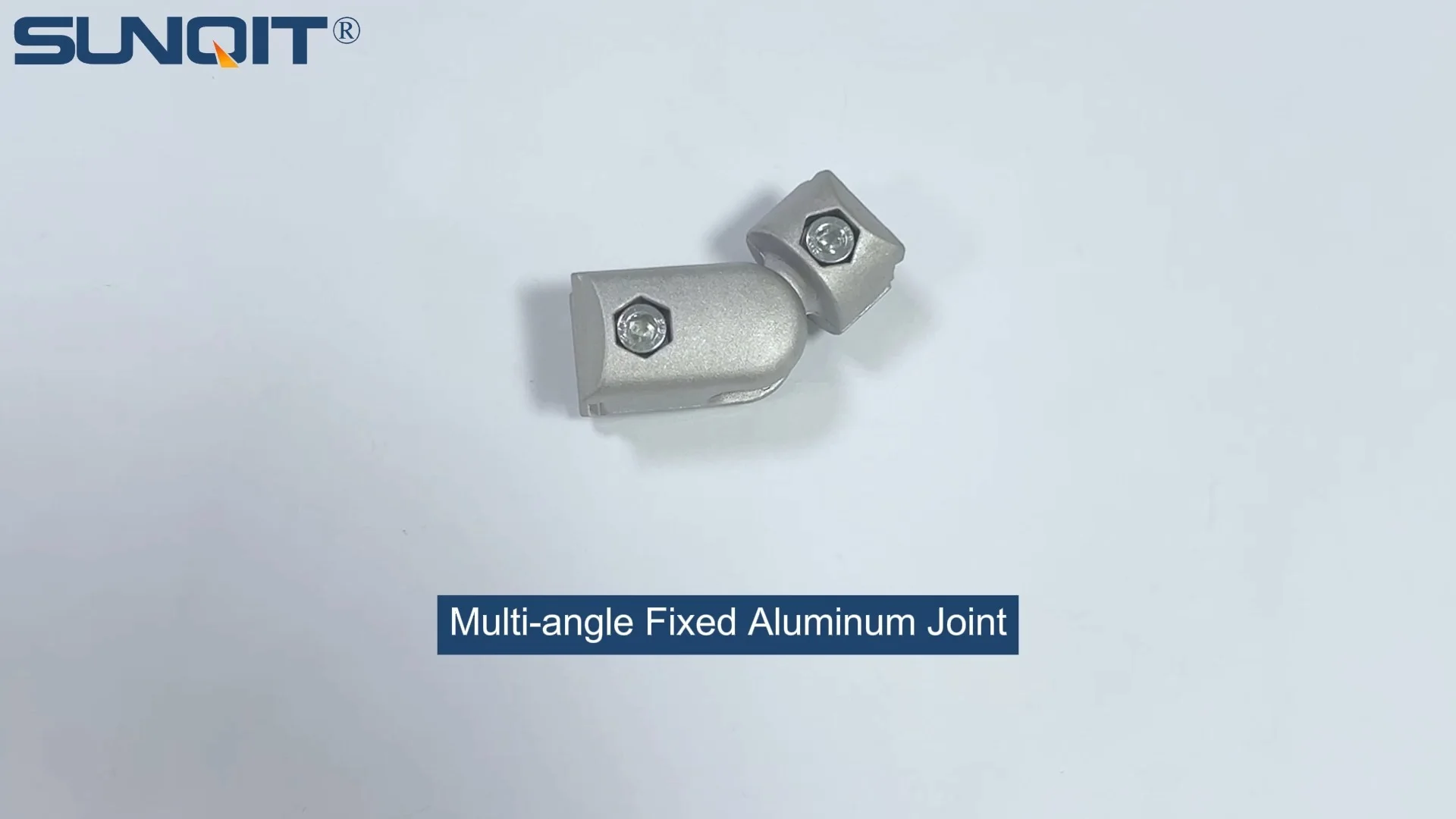
Multi-angle Fixed Aluminum Joint
Aluminum joint pipe connection for two pipe connection and work in mutiple angle.
Understanding the backbone of durable workbenches and lean system structures
The Unsung Hero of Your Factory Floor: Why Joint Strength Matters
Walk into any manufacturing plant, warehouse, or assembly line, and you'll notice a silent network holding everything together: workbenches where operators assemble components, flow racks feeding parts to production lines, turnover trolleys shuttling materials across the floor. These structures aren't just metal and bolts—they're the circulatory system of a lean system , designed to keep operations smooth, efficient, and safe.
At the heart of these structures lie connectors: joints. Specifically, multi-angle fixed aluminum joint s. These small, unassuming pieces are what turn lengths of aluminum profile into sturdy workbenches, resilient material racks, and flexible flow systems. But here's the question that keeps plant managers up at night: How much weight can these joints really hold?
It's not just a technicality. A joint that fails under load can bring an entire production line to a halt. Imagine a workbench collapsing under the weight of heavy machinery, or a flow rack dumping parts onto the floor because a joint couldn't handle the daily wear. The cost? Downtime, damaged materials, even safety risks for workers. In lean manufacturing, where every second and every square foot counts, weak joints are more than a nuisance—they're a threat to efficiency.
That's why we set out to put the multi-angle fixed aluminum joint to the test. Over six weeks, our team of engineers ran rigorous load tests on these joints, simulating real-world conditions to answer one critical question: What's the breaking point? In this article, we'll walk you through the testing process, the surprising results, and what it means for anyone building or maintaining lean system structures—from small workshops to large-scale factories.
First Things First: What Exactly Is a Multi-Angle Fixed Aluminum Joint?
Before we dive into the tests, let's get clear on what we're actually testing. A multi-angle fixed aluminum joint is a precision-engineered connector designed to link aluminum profile s (hollow tubes or extruded bars) at various angles. Unlike flexible joints that allow rotation, these are "fixed"—once tightened, they lock the connected pipes into place, creating rigid structures. Think of them as the "elbows" and "corners" of your workbench or rack.
Made from high-grade aluminum alloy (typically 6063-T5, known for its strength and corrosion resistance), these joints come in a range of designs to accommodate different angles: 30°, 45°, 60°, 90°, and even 135°. Some are simple two-way connectors, while others are multi-way, allowing three or more pipes to meet at a single point—perfect for building sturdy frames for workbenches or multi-tiered material racks.
What makes them indispensable? Their versatility. With a few joints and lengths of aluminum pipe, you can build almost anything: a single-deck workbench (like the "Workbench E" in many factory setups), a three-row material rack, or a turnover trolley with caster wheels. And because they're fixed, they provide the stability needed for heavy loads—assuming, of course, they're tested for the job.
To get a sense of their real-world use, let's look at a common scenario: a typical assembly line workbench. The frame is built with 40mm x 40mm aluminum profiles, connected at 90° angles using multi-angle fixed joints. The top might be a plywood or aluminum honeycomb panel, and the bottom could have shelves for tools or parts bins. Every time an operator places a 50kg machine on that workbench, the weight travels through the panel, into the profiles, and down to the joints. If those joints can't handle the load, the whole structure wobbles—or worse.

The Test Setup: Recreating Real-World Stress
Testing a joint's load capacity isn't as simple as hanging weights from it and waiting for it to snap. To get meaningful data, we needed to replicate how joints perform in actual structures. So we designed our tests to mimic three common scenarios:
- Vertical load: When weight is placed directly on top of a structure (e.g., a workbench holding tools or machinery).
- Horizontal load: When force is applied sideways (e.g., a material rack being pushed or pulled, or parts sliding into it).
- Angled load: When weight is distributed at an angle (e.g., a sloped flow rack where gravity feeds parts downward).
We used standard 28mm diameter aluminum pipes (the most common size for workbenches and light-duty racks) and paired them with multi-angle fixed joints from a leading supplier. To ensure accuracy, we tested joints at three critical angles: 45°, 90°, and 135°—the angles most frequently used in factory setups. We also included aluminum pipe accessories like end caps and pipe clamps, as these can affect how weight is transferred through the joint.
Our testing equipment included:
- A hydraulic press with a digital load cell (to apply and measure force accurately, up to 5000kg).
- Laser displacement sensors (to track how much the joint bends, or "deflects," under load).
- A high-speed camera (to capture the moment of failure, helping us analyze how and why joints break).
- Standardized aluminum profiles (28mm diameter, 1.2mm wall thickness) cut to 1-meter lengths (the average span in most workbenches).
The process? For each test, we assembled a simple frame: two aluminum pipes connected by a multi-angle fixed joint at the target angle (45°, 90°, or 135°). We mounted one end of the frame to a rigid steel base and applied force to the free end using the hydraulic press. We started at 50kg and increased the load by 50kg increments, pausing at each step to measure deflection and check for cracks or loosening. We kept going until the joint either snapped, bent permanently, or the pipes themselves failed (though in most cases, the joint was the weak point).

The Results Are In: How Much Weight Can These Joints Actually Hold?
After 120+ hours of testing, we compiled the data—and the results were eye-opening. Let's start with the headline numbers, then break down what they mean.
| Joint Angle | Maximum Load Before Failure (kg) | Deflection at 200kg Load (mm) | Failure Mode |
|---|---|---|---|
| 90° (Right Angle) | 850kg | 3.2mm | Joint body cracked at the weld seam |
| 45° (Acute Angle) | 620kg | 4.5mm | Joint bent at the pivot point; no cracking |
| 135° (Obtuse Angle) | 780kg | 2.8mm | Pipe slipped out of joint (clamp failed) |
Let's unpack this. First, the 90° joint was the strongest, holding up to 850kg before cracking. That's equivalent to stacking five average-sized refrigerators on a single joint—far more than the typical load in most factories (where workbenches usually hold 100-300kg). The 135° joint came in second at 780kg, but its failure was different: the pipe slipped out of the joint because the clamp (a common aluminum pipe accessory ) couldn't grip tightly enough under extreme load. The 45° joint was the weakest at 620kg, bending permanently before breaking—a sign that acute angles concentrate stress more than right or obtuse angles.
But numbers only tell part of the story. What surprised us most was how much the joints bent before failing. At 200kg (a typical load for a workbench with tools and parts), the 90° joint deflected just 3.2mm—less than the thickness of a credit card. That's barely noticeable to the eye, meaning the workbench would feel solid and stable even under daily use. Even at 500kg (way above normal), deflection was only 12mm—still not enough to cause structural issues, though we noticed some permanent bending in the 45° joint.
Another key finding: aluminum pipe accessories made a big difference. When we tested joints with and without end caps (which reinforce the inside of the pipe), the end-capped pipes increased load capacity by 15-20%. Why? The end cap prevents the pipe from collapsing inward when the joint clamps down, distributing stress more evenly. Similarly, using lock washers (instead of standard washers) reduced the chance of the joint loosening under repeated load, which is common in busy factories where vibrations from machinery can shake bolts loose over time.

What This Means for Your Lean System: 3 Practical Takeaways
So, what do these results mean for you—whether you're a plant manager, a lean coordinator, or someone building a workshop from scratch? Here are three actionable insights to keep your structures safe, efficient, and long-lasting:
1. Choose the Right Angle for the Job
Not all angles are created equal. If you're building a structure that needs to handle heavy vertical loads—like a workbench or a material rack with stacked pallets—stick with 90° joints. They're the strongest and most stable. For sloped structures, like flow racks where parts slide downward (common in lean systems to reduce picking time), 135° joints work well, but make sure to use end caps and lock washers to prevent pipes from slipping. Avoid 45° joints for heavy loads unless you have no other option—they're better suited for lightweight applications, like small tool racks or display shelves.
2. Don't Skimp on Accessories
Aluminum pipe accessories aren't optional—they're critical for maximizing joint performance. End caps, lock washers, and reinforced clamps can add 15-20% to load capacity, which might be the difference between a structure that lasts 10 years and one that fails in 1. When ordering joints, ask your supplier about compatible accessories, and factor them into your budget. It's a small investment to avoid costly downtime later.
3. Test Your Own Structures (Yes, Even Yours)
Our tests used brand-new, standardized joints and pipes—but real-world conditions are messier. Over time, joints loosen, pipes get dented, and corrosion weakens materials. Set a schedule to inspect critical structures (like main assembly line workbenches or heavy-duty material racks) every 6 months. Check for bent joints, loose bolts, or cracks, and do a simple load test: place a known weight (like sandbags) on the structure and see if it wobbles or sags. If it does, reinforce it with extra joints or replace worn parts. It's better to catch a weak spot early than to deal with a collapse.
Beyond the Test: Building a Culture of Reliability
At the end of the day, load testing joints is about more than numbers—it's about building a lean system you can trust. In lean manufacturing, we talk a lot about "continuous improvement," but that shouldn't stop at processes. It should include the tools and structures that make those processes possible. A wobbly workbench or a sagging material rack isn't just a distraction—it's a barrier to the efficiency, safety, and pride your team deserves.
So, the next time you walk through your factory floor, take a closer look at the joints holding everything together. Are they 90° where they need to be? Do they have end caps and lock washers? When was the last time you checked if they're still tight? These small details add up to big results: less downtime, fewer accidents, and a team that knows their workspace is built to last.
And if you're in the market for new joints or aluminum profile s, don't just ask for a quote—ask for load test data. A reputable supplier will have no problem sharing results, and it's a sign they care about the quality of your lean system. After all, the best lean systems aren't just about eliminating waste—they're about building reliability, one joint at a time.
Ready to build stronger, more efficient lean systems? Start with the right joints. Contact a trusted aluminum profile supplier today to discuss your needs—and don't forget to ask about load-tested multi-angle fixed aluminum joints.