- Company Articles
- Products and Technology
- Product knowledge
- Multi-Angle Fixed Aluminum Joint Specifications: Sizing & Load Capacity

Multi-Angle Fixed Aluminum Joint Specifications: Sizing & Load Capacity
Related Product
Multi-angle Fixed Aluminum Joint
Aluminum joint pipe connection for two pipe connection and work in mutiple angle.
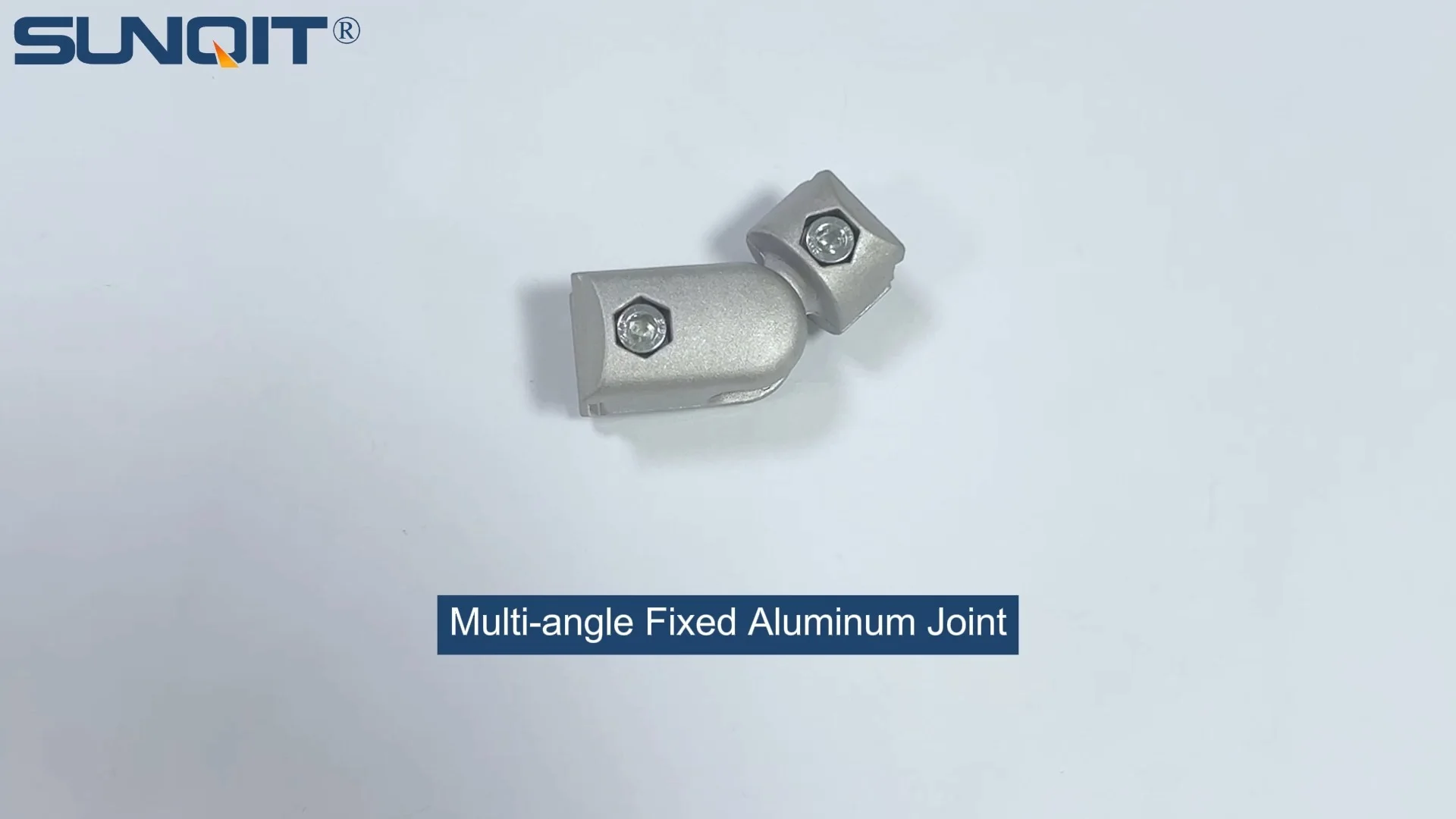
In the world of manufacturing and warehouse management, the difference between a smooth, efficient workflow and a frustrating, error-prone one often comes down to the smallest components. We talk a lot about big-picture concepts like "lean system" optimization and workflow design, but the truth is, those systems rely on heroes: the building blocks that hold everything together. Today, we're shining a spotlight on one such hero: the multi-angle fixed aluminum joint. These unassuming connectors are the backbone of durable, flexible workspaces, linking aluminum profiles into everything from sturdy workbenches to intricate material racks. Whether you're setting up a new production line or upgrading an existing facility, understanding their specifications—especially sizing and load capacity—can mean the difference between a workspace that grows with your needs and one that hits a wall (or worse, collapses).
What Are Multi-Angle Fixed Aluminum Joints?
Let's start with the basics. Multi-angle fixed aluminum joints are specialized connectors designed to join aluminum pipes, tubes, or profiles at various angles—think 30°, 45°, 90°, 135°, and sometimes even custom angles—while keeping those angles locked in place. Unlike swivel or adjustable joints, these are "fixed," meaning once you set the angle during assembly, it won't shift or rotate under load. That rigidity is what makes them indispensable for structures that need to stay stable, like workbenches where precision matters or material racks holding heavy inventory.
Most are made from high-grade aluminum alloys, typically 6061-T6 or 6063-T5. Why aluminum? It's lightweight, which keeps entire structures from becoming cumbersome, but it's also surprisingly strong—especially when alloyed with magnesium and silicon, as these grades are. Plus, aluminum naturally resists corrosion, a must in factories where humidity, oils, or chemicals might otherwise eat away at metal components. Many joints also undergo anodizing, a process that adds a protective oxide layer, boosting durability and giving them that sleek, uniform finish you'll recognize in professional workspaces.
The "multi-angle" magic lies in their design. A single joint might have two, three, or even four connection points, each engineered to lock into an aluminum profile at a specific angle. For example, a 90° joint is perfect for corner connections in a square workbench, while a 45° joint could help build a diagonal brace for extra stability. Some advanced models even let you adjust the angle slightly during installation (within a fixed range, like 30° to 60°) before tightening, giving you flexibility without sacrificing security.
Sizing: Getting the Fit Right
Size matters—especially when it comes to joints. A joint that's too small for your aluminum profile will fail under stress; one that's too large adds unnecessary weight and cost. To choose the right size, you'll need to consider three key factors: the diameter of your aluminum pipe or profile, the thread size (if threaded), and the overall dimensions of the joint itself.
Matching Joints to Aluminum Profiles
Aluminum profiles come in standard sizes, often referred to by their cross-sectional dimensions (e.g., 2020, 3030, 4040, 4080), where the numbers represent width and height in millimeters. For example, a 3030 profile is 30mm x 30mm, while a 4080 is 40mm x 80mm. Multi-angle fixed joints are designed to pair with these profiles, so the first rule is simple: check the joint's compatibility with your profile size.
Take basic aluminum tubes, like the "basic aluminum tube" common in lean systems. These tubes typically have outer diameters (OD) of 28mm, 30mm, or 40mm. A joint meant for a 28mm tube won't grip a 40mm tube properly, leading to wobbly connections. Similarly, T-slot aluminum pipes have grooves along their length for attaching accessories, and joints for these need to align with those slots to ensure a tight fit. Always check the manufacturer's specs for "compatible profile size"—it's usually listed as a range (e.g., "fits 2020-4040 profiles") or a specific dimension.
Thread Size and Connection Type
Many joints connect to profiles using threads, either on the joint itself or via bolts that pass through the profile and into the joint. Common thread sizes include M5, M6, M8, and M10 (metric) or 1/4"-20, 5/16"-18 (imperial), depending on the joint's load rating. A larger thread size generally means a stronger connection—an M10 bolt can handle more torque and pull-out force than an M5. For example, a joint used in a heavy-duty material rack might use M8 threads, while one in a lightweight workbench shelf could get by with M6.
Not all joints are threaded, though. Some use friction fit (pressing into the profile) or set screws that bite into the aluminum to hold the joint in place. These are popular for quick assembly, but they rely on the joint's inner diameter matching the profile's outer diameter exactly. A 28mm tube with a friction-fit joint that's even 0.5mm too loose will never feel secure.
Overall Dimensions: Length, Width, and Protrusion
Even if the joint fits the profile, you need to consider its overall size. How long is the joint? Will it stick out too far and interfere with other components, like roller tracks or shelving? For example, a joint with a 50mm long connection arm might work great for a standalone rack but could block a roller track guide rail if mounted too close. Similarly, the joint's width (or "wingspan") affects how much space it takes up—critical in tight workspaces where every inch counts.
Pro tip: Always mock up a small section of your structure with the actual joints and profiles before full assembly. It's easier to catch sizing issues (like a joint that's too long) with a prototype than after you've drilled 50 holes.

Load Capacity: How Much Weight Can They Really Handle?
Sizing is about fit; load capacity is about safety. There's no point in a perfectly fitting joint if it bends or breaks when you load it up. Load capacity refers to the maximum weight a joint can support without failing—either by bending, shearing (snapping), or pulling free from the profile. But here's the catch: it's not a one-size-fits-all number. A joint rated for 200kg might only handle 100kg in real-world use, depending on how it's installed and what it's holding.
Static vs. Dynamic Load: What's the Difference?
First, you need to know the difference between static and dynamic load. Static load is the weight applied when everything is stationary—think of a stack of boxes sitting on a shelf. Dynamic load is weight in motion: boxes being placed on the shelf, tools being slammed down on a workbench, or materials sliding along a roller track. Dynamic loads are harder on joints because they add impact and vibration, which can weaken connections over time.
Manufacturers usually list both ratings, and the dynamic load is almost always lower than the static one. For example, a joint might have a static load capacity of 300kg but a dynamic load of 150kg. If your application involves frequent movement (like a turnover trolley or a conveyor system), always go by the dynamic rating. Err on the side of caution—overestimating static load is a common mistake that leads to accidents.
Factors That Affect Load Capacity
So, what determines how much a joint can handle? Let's break it down:
- Material Quality: Not all aluminum is created equal. A joint made from 6061-T6 aluminum (high strength, good corrosion resistance) will outperform one from a cheaper alloy with more impurities. Ask suppliers for material certificates—reputable ones will happily share alloy composition and tensile strength data.
- Joint Design: A joint with a thicker wall, reinforced connection points, or gussets (small triangular supports) will distribute load better than a flimsy, thin-walled design. Look for ribs or webbing on the joint's body—these are signs of intentional engineering for strength.
- Number of Connection Points: A joint connecting two profiles (a "two-way" joint) has fewer stress points than a four-way joint linking four profiles. More connections mean more load sharing, but also more potential for uneven stress distribution. For example, a three-way joint holding a shelf above a workbench will have to bear the shelf's weight plus any downward force from above—make sure all three arms are rated for the combined load.
- Angle of Connection: Joints at 90° angles generally handle more load than those at extreme angles like 30° or 135°. Why? At 90°, the load is distributed straight down the length of the profile; at 30°, some of that load becomes shear force (trying to slide the joint off the profile). If you need a steep angle, check if the manufacturer has angle-specific load ratings.
- Installation Quality: Even the best joint will fail if installed poorly. Overtightening bolts can strip threads; undertightening leads to movement and wear. Using the wrong size bolts (too short, too weak) or skipping washers (which distribute load) also cuts capacity. Always follow the manufacturer's torque specs—most recommend 8-12 Nm for M8 bolts in aluminum profiles.
| Joint Size (Thread/Matching Profile) | Compatible Aluminum Profile | Max Static Load (kg) | Max Dynamic Load (kg) | Typical Application |
|---|---|---|---|---|
| M5 / 2020 Profile | 2020 EU Standard Aluminum Profile | 80 | 40 | Light-duty workbench shelves, small tool racks |
| M8 / 3030 Profile | 3030 EU Standard Aluminum Profile | 200 | 100 | Medium workbenches, Material Rack B (3 row and 3 floor) |
| M10 / 4040 Profile | 4040 EU Standard Aluminum Profile | 350 | 175 | Heavy-duty assembly lines, industrial material racks |
| M12 / 4080 Profile | 4080 EU Standard Aluminum Profile | 500 | 250 | Conveyor supports, large storage systems |
The table above gives a general idea of load capacities for common joint sizes, but always verify with your supplier. Remember, these numbers assume ideal conditions: proper installation, compatible profiles, and no extreme angles. If your setup pushes any of these limits, factor in a safety margin—engineers often use 50% of the rated load for critical applications.

Real-World Applications: From Workbenches to Material Racks
Enough theory—let's talk about how these joints work in the wild. Multi-angle fixed aluminum joints are versatile, but they really shine in a few key applications. Let's walk through two common scenarios where sizing and load capacity make all the difference.
Case Study 1: Building a Heavy-Duty Workbench
A mid-sized electronics manufacturer needed a new workbench for assembling circuit boards. The bench had to hold a soldering station (15kg), a parts bin organizer (25kg), and tools (10kg), plus withstand daily use—techs leaning on it, components being set down quickly, and occasional impacts from dropped tools. They chose an aluminum workbench frame using 4040 profiles and multi-angle fixed joints.
First, they calculated total dynamic load: around 50kg static (15+25+10) plus impact from tools, so they estimated 75kg dynamic. Looking at the table, an M10 joint for 4040 profiles has a dynamic rating of 175kg—plenty of buffer. They opted for 90° joints at the corners and 45° diagonal braces for stability. During assembly, they torqued bolts to 10 Nm (per the joint specs) and added gusset plates at stress points. Six months later, the bench still feels rock-solid, with no signs of joint deformation or loosening.
Case Study 2: Material Rack B (3 Row and 3 Floor)
A warehouse supplying automotive parts needed to organize small components—think nuts, bolts, and washers—into a compact, accessible storage system. They chose Material Rack B (3 row and 3 floor), a modular design that uses aluminum profiles and multi-angle joints to create three vertical rows, each with three shelves. Each shelf needed to hold up to 80kg of parts boxes, and the rack had to fit in a tight corner, requiring some 135° joints for the back corners.
The project manager initially considered M8 joints for 3030 profiles, which have a static load of 200kg—more than enough for 80kg per shelf. But the 135° angle meant load distribution would be less optimal, so they upgraded to M10 joints on 4040 profiles, even though it added slight cost. The result? A rack that not only holds the weight but also stays stable when workers pull boxes out quickly. The 135° joints, with their reinforced design, haven't budged, and the shelves remain level—no sagging, no swaying.

Choosing the Right Joint for Your Project
Now that you understand sizing and load capacity, how do you pick the right joint for your specific needs? Start with these steps:
1. Define Your Load Requirements
List everything the structure will hold, including dynamic forces. For a workbench, include tools, materials, and user weight (if someone might stand on it). For a rack, calculate per-shelf weight and multiply by the number of shelves. Add 50% for safety—better to overestimate than under.
2. Match Joint Size to Profile
If you're already using aluminum profiles (like 3030 or 4040), check their specs to find compatible joint sizes. If starting from scratch, let load capacity guide profile choice: heavier loads need larger profiles, which need larger joints.
3. Consider Angles and Layout
Will you need 90° corners, 45° braces, or odd angles like 60°? Not all multi-angle joints offer every angle—some are limited to 90° and 45°. Draw a rough sketch of your structure to note angle points, then check joint specs for angle compatibility.
4. Don't Skimp on Quality
It's tempting to save money with cheaper joints, but low-quality aluminum or poor machining can lead to weak points. Look for suppliers who test their joints to industry standards (like ISO 9001) and provide load test reports. Remember: a joint that costs $2 more upfront might save you $200 in repairs or downtime later.
5. Think About Aluminum Pipe Accessories
Joints don't work alone—they rely on aluminum pipe accessories to perform at their best. T-slot rubber seal covers protect joint threads from dust and corrosion, while end caps prevent sharp edges that could damage materials or injure workers. Even small things like lock washers or thread-locking adhesive can improve joint longevity by preventing bolts from loosening under vibration.
Maintenance: Keeping Joints Strong for the Long Haul
Your work isn't done once the structure is built. Multi-angle fixed joints need regular care to maintain their load capacity and stability:
- Inspect Quarterly: Check for signs of wear—cracks in the joint body, stripped threads, or gaps between the joint and profile. Tighten any loose bolts (but don't overtighten).
- Clean Regularly: Wipe joints with a damp cloth to remove dust, oil, or chemicals. For heavy grime, use mild soap and water—avoid harsh solvents that can damage anodized finishes.
- Lubricate Threads: If you need to disassemble and reassemble joints (for reconfiguring the structure), apply a thin layer of anti-seize lubricant to threads to prevent galling (aluminum sticking to aluminum).
- replace When Needed: If a joint shows signs of deformation (bending, cracking) or can't hold torque anymore, replace it immediately. Don't try to "fix" it with extra bolts or welding—this compromises safety.
The Future of Multi-Angle Fixed Aluminum Joints
As manufacturing and warehousing evolve, so do the tools that build them. We're already seeing trends in joint design that focus on even better strength-to-weight ratios, with manufacturers experimenting with hollow-core designs to reduce weight without sacrificing load capacity. Some are also integrating smart features, like RFID tags embedded in joints, making it easier to track inventory of components for quick replacements.
Another trend is modularity. More joints now come with interchangeable inserts, letting you switch between profile sizes or angles without buying entirely new joints. This flexibility is a boon for small businesses that need to adapt quickly to changing production needs.
Conclusion: Small Joints, Big Impact
Multi-angle fixed aluminum joints might not get the same attention as high-tech machinery or fancy software, but they're the unsung heroes of efficient, durable workspaces. By understanding their sizing, load capacity, and how they interact with aluminum profiles and accessories, you can build structures that not only meet today's needs but also adapt to tomorrow's challenges. Whether you're assembling a simple workbench or a complex Material Rack B (3 row and 3 floor), remember: the right joint isn't just a connector—it's the foundation of a workspace that works as hard as you do.
So, the next time you're planning a workspace upgrade, take a moment to appreciate these small but mighty components. Your back (and your bottom line) will thank you.