- Company Articles
- Products and Technology
- Product knowledge
- Multi-Angle Fixed Aluminum Joint vs. Regular Aluminum Joint: Key Differences

Multi-Angle Fixed Aluminum Joint vs. Regular Aluminum Joint: Key Differences
Related Product
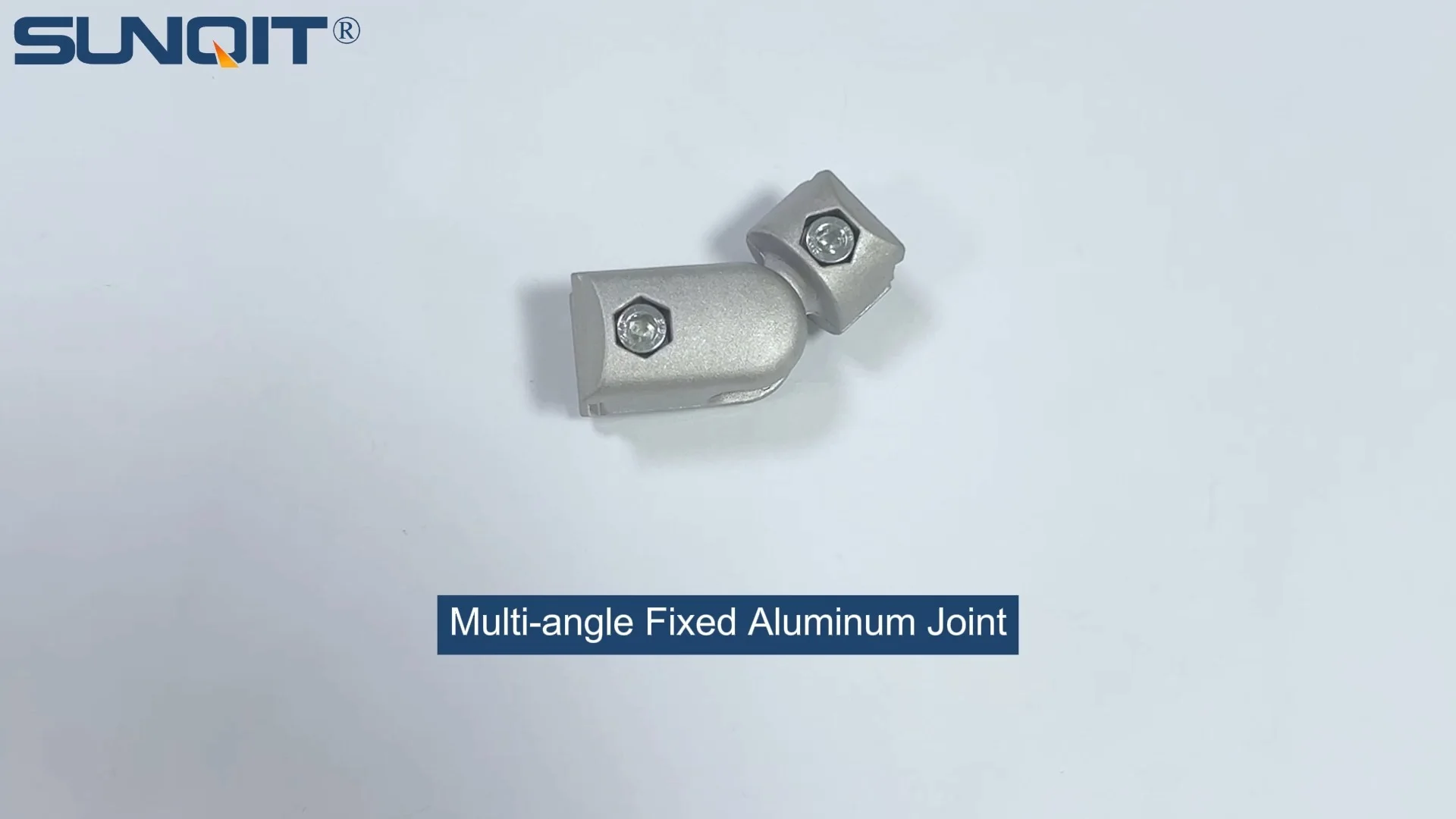
Multi-angle Fixed Aluminum Joint
Aluminum joint pipe connection for two pipe connection and work in mutiple angle.
Walk into any modern manufacturing facility, electronics assembly plant, or warehouse, and you'll quickly realize that the backbone of daily operations lies not just in the machinery or the workforce—but in the structures that organize workspaces, streamline material flow, and keep processes running like clockwork. From workbenches where technicians assemble delicate components to material racks that hold inventory, and conveyor systems that move products seamlessly, these structures depend on one critical element: the joints that hold them together. In the world of aluminum framing, two types of joints stand out for their ubiquity and impact: the multi-angle fixed aluminum joint and the regular aluminum joint. While they may seem similar at first glance, their differences can drastically affect everything from workflow efficiency to long-term adaptability. Let's dive into what sets these two apart, and why choosing the right one matters for your specific needs.
Understanding the Basics: What Are Aluminum Joints, Anyway?
Before we compare the two joint types, let's ground ourselves in the fundamentals. Aluminum joints are the connectors that link aluminum pipes, profiles, or tubes together, forming the skeleton of structures like workbenches, material racks, conveyor systems, and more. They're the unsung heroes of lean manufacturing—quietly ensuring that every part of your operation stays stable, aligned, and efficient. Without reliable joints, even the sturdiest aluminum lean pipe or aluminum profile would be little more than a collection of disconnected pieces.
In the world of industrial and manufacturing setups, joints come in countless shapes and sizes, each designed for specific tasks. Some prioritize flexibility, allowing structures to be reconfigured on the fly. Others focus on rigidity, ensuring that heavy loads stay secure. Some are built for speed, making assembly quick and tool-free, while others emphasize precision, guaranteeing that angles and alignments stay consistent over time. Today, we're zooming in on two of the most common types: the multi-angle fixed aluminum joint and the regular aluminum joint. Let's start by breaking down what each one is, how it works, and where it shines.
Multi-Angle Fixed Aluminum Joint: The Flexible Workhorse
Imagine a joint that doesn't just connect two pieces of aluminum—but lets you connect them at almost any angle you need. That's the promise of the multi-angle fixed aluminum joint. As the name suggests, this type of joint is engineered to accommodate multiple angles (think 30°, 45°, 90°, 135°, and everything in between) while maintaining a secure, fixed connection once installed. It's like having a Swiss Army knife in your structural toolkit: versatile, precise, and ready to adapt to whatever layout your workflow demands.
Design and Construction
Multi-angle fixed aluminum joints are typically made from high-grade aluminum alloys (often 6063-T5, known for its strength and corrosion resistance) and feature a modular design with internal mechanisms that allow for angle adjustment. Unlike some joints that lock into a single position during manufacturing, these joints have adjustable components—like rotating collars or sliding brackets—that let you set your desired angle before tightening them down. Once secured (usually with bolts or set screws), they "lock" into place, creating a rigid connection that can withstand vibration, heavy loads, and the wear and tear of daily use.
What really sets them apart is their precision. Many multi-angle joints come with built-in angle markers or detents at common intervals (e.g., every 15°), ensuring that your structure is aligned exactly how you need it. This level of accuracy is a game-changer for custom setups, where even a small misalignment can throw off an entire assembly line or material flow.
Key Features
- Multi-angle adjustability: Connects pipes/profiles at 30°, 45°, 90°, 135°, or custom angles.
- Fixed once installed: No unintended movement after tightening, ensuring stability.
- High load capacity: Engineered to support heavy weights (often up to 500kg or more, depending on size).
- Corrosion resistance: Aluminum alloy construction stands up to moisture, chemicals, and industrial environments.
- Compatibility with aluminum profile accessories: Works seamlessly with end caps, clamps, and other aluminum pipe accessories for a polished finish.

Regular Aluminum Joint: The Reliable Standard
If the multi-angle fixed joint is the Swiss Army knife, the regular aluminum joint is the trusty wrench—simple, reliable, and designed for the jobs you do day in and day out. Regular aluminum joints (sometimes called "standard" or "fixed-angle" joints) are the most common type of connector in industrial setups. They're engineered to connect aluminum pipes or profiles at specific, pre-determined angles—most often 90° (right angles) or 180° (straight lines)—and they do this job exceptionally well.
Design and Construction
Regular aluminum joints are typically simpler in design than their multi-angle counterparts. They're often cast or machined into a fixed shape—for example, a "T" shape for connecting three pipes at 90°, or an "L" shape for two pipes at a right angle. This fixed design means there's no adjustability: if you need a 90° angle, you buy a 90° joint; if you need a straight line, you buy a straight joint. This simplicity makes them easy to manufacture, which often translates to lower costs.
Like multi-angle joints, regular joints are usually made from aluminum alloys, though some lower-cost options may use plastic or steel. They're secured with bolts, screws, or press-fit connections, and while they lack adjustability, they make up for it in reliability. A well-made regular joint will hold its angle indefinitely, even under heavy loads, because there are no moving parts to wear out or loosen over time.
Key Features
- Fixed angles: Designed for specific angles (most commonly 90° and 180°).
- Simplicity: No adjustable parts, making installation quick and straightforward.
- Cost-effective: Lower manufacturing complexity often means lower upfront costs.
- Durability: Fixed design reduces wear on moving parts, extending lifespan.
- Widely available: Standard sizes and angles mean they're easy to source from most aluminum pipe suppliers.

Head-to-Head: Key Differences Between Multi-Angle Fixed and Regular Joints
Now that we understand how each joint works, let's put them side by side. The table below summarizes their most important differences, from design to applications.
| Feature | Multi-Angle Fixed Aluminum Joint | Regular Aluminum Joint |
|---|---|---|
| Angle Flexibility | Adjustable (30°, 45°, 90°, 135°, etc.) | Fixed (usually 90° or 180°) |
| Design Complexity | Higher (modular, adjustable components) | Lower (fixed, simple shape) |
| Load Capacity | High (up to 500kg+ with heavy-duty models) | High (similar to multi-angle for same size/material) |
| Installation Time | Longer (requires angle adjustment and precise tightening) | Shorter (fixed angle, no adjustment needed) |
| Upfront Cost | Higher (due to design complexity) | Lower (simpler manufacturing) |
| Best For | Custom setups, adaptable workflows, unique layouts | Standard setups, fixed workflows, repetitive tasks |
| Maintenance Needs | Slightly higher (adjustable parts may need occasional tightening) | Lower (no moving parts to wear) |
| Aluminum Profile Compatibility | Wide (works with most aluminum profiles and pipes) | Limited (often designed for specific profile sizes) |

Real-World Applications: When to Choose Which?
At the end of the day, the "better" joint depends on your specific needs. Let's look at some common scenarios where one type outperforms the other.
Multi-Angle Fixed Joints: Ideal for Customization and Change
If your workflow changes regularly—say, you're a contract manufacturer that switches between different product lines, or a warehouse that needs to reconfigure storage for seasonal items—multi-angle fixed joints are your best bet. Here are a few examples where they shine:
- Custom workbenches: Imagine building an aluminum workbench A for an electronics assembly line that needs to angle slightly to reduce operator strain. With a multi-angle joint, you can set the tabletop at a 15° incline, ensuring workers stay comfortable during long shifts.
- Material racks with unique layouts: Material rack B (3 rows and 3 floors) might need to be adjusted to fit oddly shaped components. Multi-angle joints let you angle shelves to prevent items from sliding or to maximize vertical space.
- Lean manufacturing cells: Lean systems thrive on adaptability. Multi-angle joints make it easy to reconfigure production lines, add new stations, or adjust conveyor angles to optimize flow—all without replacing entire structures.
Regular Joints: Perfect for Stable, Repetitive Workflows
If your setup rarely changes—like a dedicated assembly line for a single product, or a static storage rack that holds the same items year-round—regular aluminum joints are the practical choice. They're reliable, cost-effective, and get the job done without unnecessary frills. Examples include:
- Flow racks: Flow racks use gravity to move materials from the back to the front, and they require straight, consistent rails. Regular 90° joints ensure the racks stay square, so products glide smoothly without jamming.
- Basic conveyor systems: Roller track or belt conveyors often run in straight lines or simple 90° turns. Regular straight or L-shaped joints keep the conveyor aligned, reducing maintenance headaches.
- Static shelving: Warehouse racks that hold boxes or pallets in a fixed grid don't need adjustability. Regular joints are strong enough to support heavy loads and simple enough to install quickly.
Installation and Maintenance: What to Expect
Installing and maintaining your joints might not be the most exciting part of setting up your workspace, but it's crucial for ensuring safety and longevity. Let's break down what you'll need for each joint type.
Multi-Angle Fixed Joints: Precision Takes Time
Installing a multi-angle joint requires a bit more patience than a regular joint. Here's a quick step-by-step:
- Align the pipes/profiles at your desired angle using the joint's angle markers.
- Tighten the joint's adjustment screws or bolts to hold the angle temporarily.
- Double-check the alignment with a level or protractor (critical for workflows like conveyor systems, where misalignment can cause jams).
- Fully tighten the securing bolts (use a torque wrench for consistency, if possible) to lock the angle in place.
Maintenance-wise, multi-angle joints may need occasional checks. Over time, vibration from machinery or heavy loads can loosen bolts, so a quarterly tightening session is a good idea. Also, keep an eye on the adjustment mechanisms—if they start to stick, a light coating of lubricant (like silicone spray) can help keep them moving smoothly.
Regular Joints: Quick Setup, Minimal Upkeep
Installing a regular joint is straightforward: slide the pipes into the joint, align them (which is easy since the angle is fixed), and tighten the bolts. No measuring, no adjusting—just secure and go. This speed makes them ideal for large-scale projects, like installing dozens of flow racks in a warehouse.
Maintenance is equally simple. Since there are no moving parts, regular joints rarely need attention beyond an occasional bolt check. If a joint does loosen (which is rare), a quick tighten with a wrench is all it takes. And because they're simple in design, replacing a damaged regular joint is usually cheaper and faster than replacing a multi-angle one.
Cost: Short-Term Savings vs. Long-Term Value
Let's talk about money—because budget is always a factor. Regular aluminum joints are almost always cheaper upfront. Since they're simpler to make, manufacturers can produce them at a lower cost, and that savings gets passed on to you. For example, a standard 90° regular joint might cost $5–$10, while a comparable multi-angle joint could run $15–$30.
But here's the catch: if you need to reconfigure your setup later, multi-angle joints can save you money in the long run. Let's say you build a material rack with regular joints, but six months later, you need to adjust the shelf angles. With regular joints, you'd have to buy new joints, new pipes, and spend hours rebuilding. With multi-angle joints, you just loosen the bolts, adjust the angle, and retighten—no new parts needed. Over time, this adaptability can offset the higher upfront cost.
So, when deciding, ask yourself: How likely is my setup to change in the next year? Two years? Five? If the answer is "very likely," multi-angle joints are worth the investment. If it's "probably never," regular joints will keep more money in your pocket.
Compatibility with Aluminum Profiles and Accessories
Both joint types work with aluminum profiles and pipes, but multi-angle joints often offer broader compatibility. Because they're designed to be adaptable, many multi-angle joints can connect different sizes of aluminum lean pipe or aluminum profile (e.g., 2020, 3030, 4040 profiles) with the right aluminum pipe accessories. This flexibility is a huge plus if you're working with a mix of old and new equipment.
Regular joints, on the other hand, are often designed for specific profile sizes. A 90° joint for a 3030 profile might not fit a 4040 profile, so you'll need to buy different joints for different sizes. This isn't a dealbreaker, but it does mean more planning when ordering parts.
Conclusion: Choosing the Right Joint for Your Workflow
At the end of the day, there's no "better" joint—only the right joint for your needs. Multi-angle fixed aluminum joints offer unmatched flexibility, making them perfect for dynamic, changing environments where customization is key. They're an investment in adaptability, helping you stay agile in a fast-paced market.
Regular aluminum joints, on the other hand, are the reliable workhorses of static setups. They're affordable, easy to install, and require minimal maintenance—ideal for workflows that stay consistent over time.
So, before you order, take a moment to assess your needs: How often does your setup change? Do you need custom angles? What's your budget? Answering these questions will help you choose between the flexibility of multi-angle joints and the simplicity of regular ones. And remember—whether you're building a single aluminum workbench or an entire lean manufacturing system—the joints you choose will be the foundation of your success. Choose wisely.