- Company Articles
- Products and Technology
- Product knowledge
- Multi-Angle Fixed Aluminum Joint vs. Welded Joints: Flexibility Comparison

Multi-Angle Fixed Aluminum Joint vs. Welded Joints: Flexibility Comparison
Related Product
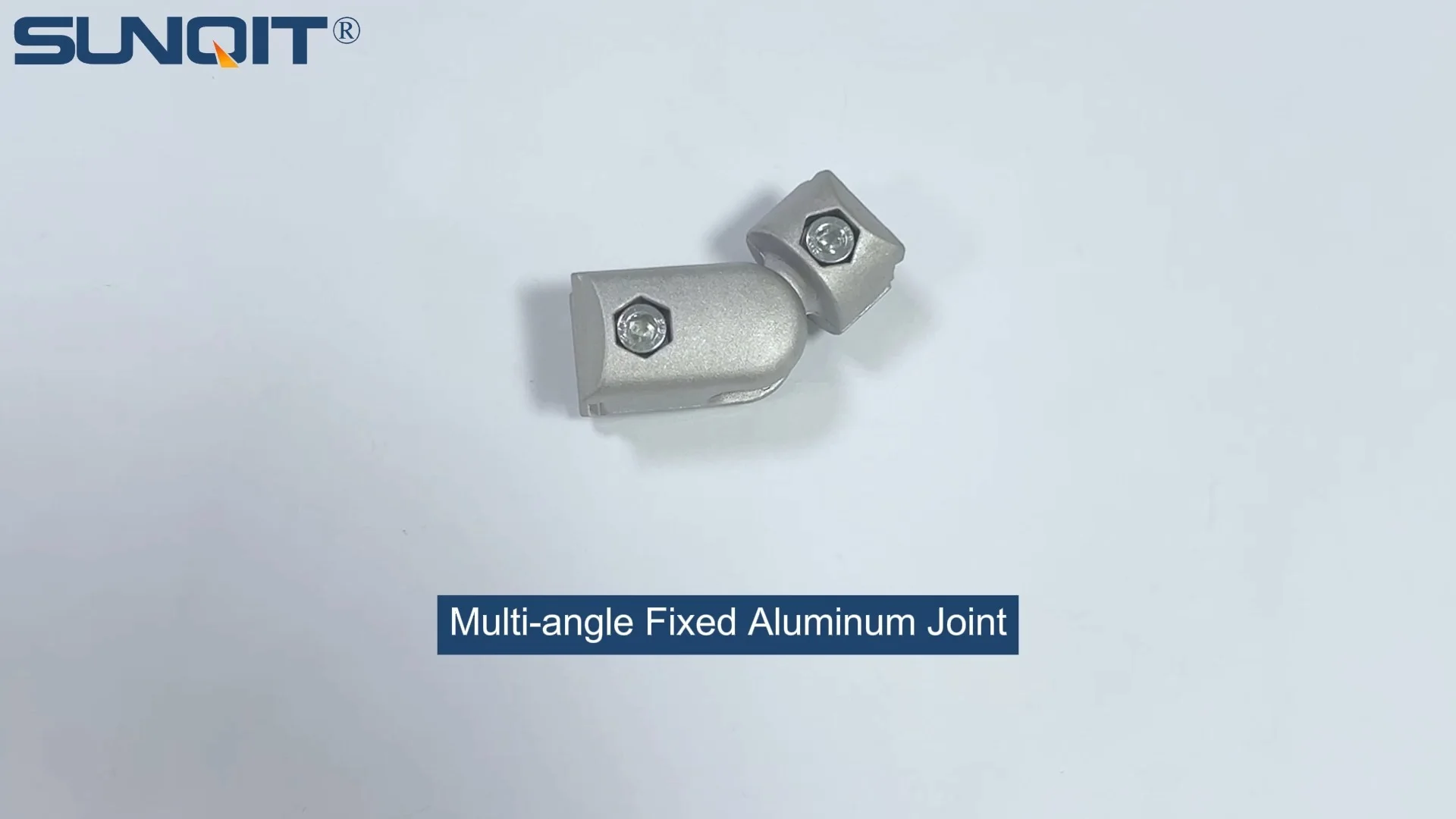
Multi-angle Fixed Aluminum Joint
Aluminum joint pipe connection for two pipe connection and work in mutiple angle.
Walk into any modern factory, warehouse, or workshop these days, and you'll notice a quiet revolution happening on the shop floor. The rigid, bolted-down structures of yesteryear are slowly giving way to something more… adaptable. Production lines that once took weeks to reconfigure now shift shape in a matter of hours. Workbenches that used to be permanent fixtures now adjust to new tasks with a few twists of a wrench. At the heart of this shift? The humble joint—the unsung hero that holds everything together. Today, we're diving deep into two heavyweights in the world of industrial joints: the multi-angle fixed aluminum joint and the traditional welded joint. If you've ever scratched your head wondering why some setups feel stuck in time while others flow like water, this is the conversation you've been waiting for.
What Are Multi-Angle Fixed Aluminum Joints, Anyway?
Let's start with the new kid on the block (though it's not *that* new—just gaining well-deserved attention). Multi-angle fixed aluminum joints are exactly what they sound like: modular connectors designed to link pieces of aluminum extrusion profile (you know, those sleek, grooved metal beams you see in everything from workbenches to conveyor systems) at—you guessed it—multiple angles. Think of them as the industrial equivalent of LEGO blocks, but for grown-ups who need their creations to withstand the daily grind of a factory floor.
Here's the magic: these joints aren't welded, glued, or permanently fused. Instead, they're engineered to clamp, bolt, or snap onto aluminum extrusion profiles, creating a secure connection that's strong enough to hold tools, materials, and even heavy machinery, but flexible enough to take apart and rebuild when your needs change. They come in all shapes and sizes—T-joints, L-joints, cross-joints, and yes, those "multi-angle" ones that let you pivot between 30°, 45°, 90°, or just about any angle in between, depending on the design.
Take, for example, a small electronics manufacturer that produces both smartwatches and wireless headphones. Their assembly lines need to shrink, expand, or reorient every time a new model launches. With multi-angle fixed aluminum joints, they can reconfigure their workbenches (like the aptly named Workbench E, a single-deck setup without casters) or material racks (say, Material Rack B with its 3 rows and 3 floors) by simply loosening a few bolts, adjusting the angles of the joints, and tightening them back up. No sparks, no waiting for welds to cool, no calling in a specialist. Just a team of regular staff and a toolkit.
But what makes these joints tick? It starts with the material: aluminum extrusion profile. Unlike generic metal pipes, aluminum extrusion profiles are precision-engineered with internal channels and external grooves that lock perfectly with joint accessories—think brackets, screws, and clamps. This isn't just about strength; it's about *compatibility*. A multi-angle fixed aluminum joint from one supplier will often work seamlessly with aluminum profile accessories from another, thanks to standardized designs. That means you're not locked into a single brand, and you can mix and match parts to create exactly what you need.
The Old Reliable: Welded Joints Explained
Now, let's talk about the tried-and-true contender: welded joints. For decades, welding has been the gold standard for joining metal. It's simple in concept: heat two pieces of metal until they melt, fuse them together, and let them cool into a single, solid piece. No bolts, no clamps, just raw, molten metal bonding at the molecular level. It's the kind of connection that feels permanent—and for good reason. When done right, a welded joint can withstand immense pressure, vibration, and wear. It's the backbone of bridges, skyscrapers, and heavy machinery that needs to stay put for decades.
In industrial settings, welded joints have long been the go-to for structures that don't need to change. Think of a massive automotive plant's main assembly line, where the conveyor systems and heavy-duty racks stay in the same configuration for years. Welding makes sense here: the upfront cost of hiring skilled welders and the time to set everything up pays off in long-term stability. There's no risk of bolts loosening over time or joints shifting under heavy loads. Once it's welded, it's *there*.
But welded joints come with a catch—several, actually. Let's say that automotive plant suddenly needs to switch from producing sedans to electric SUVs, which are taller and wider. That conveyor system? It's welded into place, so reconfiguring it would mean cutting the old welds (a messy, time-consuming process), repositioning the metal beams, and welding everything back together. That could take days or even weeks, during which production grinds to a halt. And if the welders make a mistake? You're looking at more cutting, more welding, and more delays.
Welded joints also demand specialized labor. You can't just hand a wrench to any employee and say, "Go weld that." It takes years of training to master the art of welding—controlling the heat, ensuring proper penetration, avoiding weak spots that could fail under stress. And that expertise doesn't come cheap. On top of that, welding requires equipment: welders, protective gear, ventilation systems to handle fumes. For small to medium-sized businesses, that's a significant upfront investment, especially if they only need occasional reconfigurations.

Head-to-Head: Multi-Angle Aluminum vs. Welded Joints
Now that we've got the basics down, let's pit these two against each other. We'll break it down by the factors that matter most to anyone running a production line, warehouse, or workshop: flexibility, installation time, cost, durability, and adaptability. Spoiler: It's not a knockout—each has its place—but the winner might surprise you, depending on your needs.
1. Flexibility: The Ability to Pivot (Literally)
Let's start with the star of the show: flexibility. When we talk about flexibility in industrial joints, we're talking about how easily a structure can be adjusted, reconfigured, or repurposed. And here, multi-angle fixed aluminum joints shine brighter than a freshly polished aluminum profile.
Multi-angle joints are built for change. Their design allows for quick adjustments to angles, heights, and layouts. Need to tilt a roller track (like the Plastic Roller Track Guide Rail in yellow or grey) from 10° to 15° to speed up material flow? Loosen the joint, adjust, retighten. Want to add a third level to your Material Rack B? Grab a few extra aluminum extrusion profiles and some multi-angle joints, and you're set. Even better, these joints are reusable. Take apart an old workbench, and you can use the same joints to build a turnover trolley or a new material rack. It's like having a set of building blocks that never runs out.
Welded joints, on the other hand, are about as flexible as a brick wall. Once two pieces of metal are welded together, they're one. You can't adjust the angle without cutting the weld (which weakens the metal) and rewelding, which is time-consuming and risky. Want to move a welded workbench six inches to the left? You might as well build a new one—dismantling and rebuilding a welded structure is often more trouble than it's worth. For static setups that never change, this isn't a problem. But in today's fast-paced manufacturing world, where product cycles get shorter and customer demands shift overnight, rigidity can be a death sentence.
Consider a furniture manufacturer that used to produce only dining tables but now dabbles in home office desks. With welded joints, their production line for tables was fixed—same height, same width, same workflow. When they added desks, they had to build an entirely new line from scratch. With multi-angle aluminum joints, they could have modified the existing line: adjusting workbench heights to accommodate desk assembly, reconfiguring roller tracks to handle different-sized components, and adding new sections as needed. The result? They saved months of setup time and thousands in construction costs.
2. Installation Time: From Days to Hours
Time is money, especially in manufacturing. Let's talk about how long it takes to get a structure up and running with each joint type.
Installing multi-angle fixed aluminum joints is like putting together IKEA furniture—minus the confusing instructions (okay, maybe not *that* easy, but close). Most joints require nothing more than a hex key, a wrench, and a basic understanding of "lefty loosey, righty tighty." Since they're bolt-on or clamp-on, you don't need specialized tools or training. A team of two or three workers can assemble a simple workbench in an hour or two. A more complex setup, like a multi-level material rack with roller tracks and casters (hello, Caster Wheel and Caster Accessories), might take a day, but that's still a fraction of the time it takes to weld.
Welding, by contrast, is a slow process. First, you need to prep the metal—cleaning, aligning, clamping it into place. Then, the welder has to work their magic, section by section, making sure each weld is strong and even. After welding, you wait for the metal to cool, grind down rough edges, and paint or coat the weld to prevent rust. For a single workbench, this could take a full day (or more, if the welder is busy). For a large production line? We're talking weeks. And if there's a mistake—say, the angle is off by a few degrees—you start over. There's no "oops, let's adjust that" with welding.
One manufacturing plant I worked with once switched from welded to aluminum joints for their assembly lines. Their old welded line took three weeks to build. The new aluminum line? Just five days. And when they needed to tweak the layout a month later, they did it over a long weekend. The difference in downtime alone justified the switch.
3. Cost: Short-Term vs. Long-Term Thinking
Cost is always a factor, and here's where things get tricky: multi-angle aluminum joints often have a higher upfront cost than welded joints. Aluminum extrusion profiles and precision-engineered joints aren't cheap—you'll pay more per piece than you would for raw steel and a welder's hourly rate. But looks can be deceiving. When you factor in long-term costs, aluminum joints often come out ahead.
Let's break it down. Welded joints have low upfront material costs (steel is cheap), but high labor costs. Skilled welders charge anywhere from $50 to $150 an hour, and a single project can take dozens of hours. Then there's the cost of equipment: welders, grinders, safety gear, ventilation systems. For small businesses, this is a huge barrier. And if you ever need to reconfigure? You're paying for that labor all over again—cutting, rewelding, repainting. It adds up fast.
Multi-angle aluminum joints have higher upfront material costs, but lower labor costs. Since they're bolt-on, you don't need a welder—just a few workers with basic tools. Installation is faster, so labor hours are minimal. And when you need to reconfigure? You reuse the same joints and profiles. No new materials, no new labor (beyond the time to adjust). Over time, this reuse and adaptability save money. A study by the Manufacturing Technology Insights Group found that companies using modular aluminum systems (with multi-angle joints) saved an average of 30% on reconfiguration costs compared to those using welded steel structures.
Take a startup that builds custom electronics enclosures. In their first year, they used welded joints. They spent $2,000 on steel and $3,000 on a welder to build their initial workbench and material rack. Six months later, they landed a big client and needed to double their production space. They had to hire the welder again, buy more steel, and spend another $4,500. Total cost after a year: $9,500. In their second year, they switched to multi-angle aluminum joints. They spent $5,000 on aluminum extrusion profiles, joints, and tools, but installation took just two workers a day ($400 in labor). When they needed to expand again six months later, they reused 80% of the existing parts, spending only $1,000 on new profiles and $200 in labor. Total cost after a year: $6,600. They saved $2,900 in just 12 months—and the savings grow with each reconfiguration.
4. Durability: Are Aluminum Joints "Weak"?
Critics of aluminum joints often argue that they're not as strong as welded joints. "Bolts loosen over time!" "Aluminum bends!" "Welded steel is indestructible!" There's some truth to this—welded joints are incredibly strong under static loads. But aluminum joints are far more durable than their reputation suggests, especially when paired with high-quality aluminum extrusion profiles.
Aluminum extrusion profiles are made from high-grade aluminum alloys (like 6061-T6) that are strong, lightweight, and resistant to corrosion. When combined with multi-angle joints that use high-tension bolts and locking nuts, they can handle significant loads. Most aluminum joint systems are rated to hold hundreds, if not thousands, of pounds—more than enough for most manufacturing applications (workbenches, material racks, conveyor systems). And modern joint designs include features like internal rotary mechanisms and reinforced brackets that prevent loosening over time. As long as you follow the manufacturer's load guidelines, aluminum joints are plenty durable.
Welded joints are strong, but they have weaknesses too. Welds can develop cracks over time, especially if the structure vibrates or is subjected to stress (like a conveyor system that runs 24/7). These cracks are hard to spot and can lead to catastrophic failure. Welded steel is also prone to rust if not properly painted or coated, which weakens the joint over time. Aluminum, on the other hand, naturally forms a protective oxide layer that resists corrosion—no painting required.
A food packaging plant learned this the hard way. They had a welded steel conveyor system that ran through a humid production area. Within two years, the welds started rusting, and the conveyor began to sag. Repairs cost $10,000, and downtime cost another $5,000. They replaced it with an aluminum extrusion system using multi-angle joints. Five years later, the aluminum system still looks new—no rust, no sagging, no repairs. The initial investment paid for itself in avoided downtime and maintenance.
5. Adaptability to Change: Thriving in a Fast-Paced World
We've touched on this, but it's worth emphasizing: in today's manufacturing landscape, adaptability isn't just nice to have—it's essential. Customer demands change, product lines evolve, new technologies emerge. Your facility needs to keep up, and your joints play a big role in that.
Multi-angle fixed aluminum joints are built for adaptability. They're part of a modular system, which means you can add, remove, or rearrange components with ease. Need to integrate a new robot arm into your assembly line? Add a few aluminum profiles and joints to create a mounting bracket. Want to switch from batch production to continuous flow? Reconfigure your roller tracks (using Roller Track Placon Mounts for rail connections) to guide materials more efficiently. The possibilities are endless.
Welded joints, by their nature, resist change. They're designed for permanence, which is great for structures that need to last 50 years (like bridges), but terrible for factories that need to pivot every 5 years (or 5 months). In the age of Industry 4.0, where smart factories use data to optimize workflows in real time, rigidity is a liability. You can't optimize a workflow if you can't adjust the physical layout to match.
Consider a pharmaceutical company that produces vaccines. During the COVID-19 pandemic, demand skyrocketed, and they needed to triple production capacity overnight. Their existing production lines, built with welded joints, were fixed—they couldn't add more workstations or speed up material flow without building new lines. So they built temporary lines using multi-angle aluminum joints. Within weeks, they had new workbenches, material racks, and conveyor systems up and running. When demand stabilized, they reconfigured those temporary lines into packaging stations for other vaccines. Welded joints would have taken months to build and couldn't be repurposed—aluminum joints let them adapt on the fly.
At a Glance: Multi-Angle Aluminum vs. Welded Joints
| Criteria | Multi-Angle Fixed Aluminum Joints | Welded Joints |
| Flexibility | High: Adjust angles, heights, and layouts with ease; reusable components. | Low: Fixed once welded; adjustments require cutting and rewelding. |
| Installation Time | Fast: Bolt-on assembly with basic tools; hours to days. | Slow: Requires skilled welders and equipment; days to weeks. |
| Cost | Higher upfront material costs, but lower long-term costs due to reuse and low labor. | Lower upfront material costs, but higher labor and reconfiguration costs. |
| Durability | High: Strong aluminum extrusion profiles resist corrosion; bolts and joints hold up under stress. | High: Strong welds, but prone to rust and fatigue cracks over time. |
| Adaptability | Excellent: Modular design allows for quick reconfiguration and integration of new components. | Poor: Permanent structure; reconfiguration requires rebuilding from scratch. |

When to Choose Which: Real-World Applications
We've sung the praises of multi-angle fixed aluminum joints, but that doesn't mean welded joints are obsolete. There are still cases where welded joints are the better choice. Let's break down when to use each.
Choose Multi-Angle Fixed Aluminum Joints When:
- You need frequent reconfigurations: If your production line, warehouse layout, or workbenches change regularly (quarterly, monthly, or even weekly), aluminum joints are a no-brainer. They save time, money, and headaches.
- You work with small to medium loads: Aluminum joints handle most industrial loads (up to several hundred pounds per joint) with ease. They're perfect for electronics, light manufacturing, and assembly lines.
- You value speed and flexibility: If you need to set up a new line quickly or pivot to a new product, aluminum joints let you move fast.
- You want to reduce downtime: Reconfiguring with aluminum joints takes hours, not days. Less downtime means more production.
Choose Welded Joints When:
- You need extreme strength for heavy loads: Welded steel joints are better for structures that support tons of weight (like bridges, large machinery bases, or industrial ovens).
- The structure will never change: If you're building a permanent facility feature that will last decades without modification (like a storage rack for raw materials that never moves), welded joints are reliable and cost-effective.
- You're working in harsh environments: Welded steel can withstand extreme heat, cold, or chemicals better than aluminum (though aluminum can be coated for added protection).
The key is to assess your needs. If you're a small business with ever-changing product lines, aluminum joints are your friend. If you're a construction company building a skyscraper, stick with welded steel. For most modern manufacturers, though, the scales tip toward flexibility—and that means multi-angle fixed aluminum joints.

Busting Myths: What People Get Wrong About Aluminum Joints
Despite their benefits, multi-angle fixed aluminum joints still face skepticism. Let's debunk some common myths:
Myth 1: "Aluminum Joints Are Flimsy"
False. Modern aluminum extrusion profiles are made from high-strength alloys (like 6063-T5) that are surprisingly strong. When paired with high-quality joints (like Internal Rotary Aluminum Joints or Parallel Fixation Aluminum Pipe Joints), they can handle significant loads. Most aluminum joint systems are tested to withstand hundreds of pounds per connection—more than enough for most manufacturing applications. Unless you're lifting cars with them, aluminum joints are plenty strong.
Myth 2: "Welded Joints Are Always Stronger"
Not necessarily. Welded joints are strong in static conditions, but they have weak points: the heat from welding can weaken the surrounding metal (a phenomenon called "heat-affected zone"), and welds can crack under vibration or repeated stress. Aluminum joints distribute stress evenly across bolts and profiles, reducing the risk of failure. In dynamic applications (like conveyor systems that vibrate), aluminum joints often outperform welded ones.
Myth 3: "Aluminum Joints Are Too Expensive"
It's true that aluminum joints have higher upfront costs, but they save money in the long run. Welded joints require ongoing investment in labor, equipment, and reconfiguration. Aluminum joints are a one-time purchase (mostly) that you can reuse indefinitely. For businesses that change layouts even once every few years, aluminum joints are cheaper.
Myth 4: "They're Hard to Install"
False. Multi-angle aluminum joints are designed for simplicity. Most come with clear instructions, and installation requires nothing more than a hex key and a wrench. Many suppliers even offer online tutorials. If you can assemble a bookshelf, you can install aluminum joints.
The Future of Industrial Joints: Modularity and Beyond
As manufacturing continues to evolve, so too will the tools we use to build it. The future belongs to modular, flexible systems, and multi-angle fixed aluminum joints are at the forefront of that trend. Here's why:
Industry 4.0 and Smart Factories: Smart factories use IoT sensors, AI, and automation to optimize production in real time. To do that, they need layouts that can adapt to data-driven insights. Modular aluminum systems with multi-angle joints make it easy to reconfigure workflows based on real-time data—no downtime, no delays.
Sustainability: Aluminum is 100% recyclable, and modular systems reduce waste by reusing components. Welded steel structures often end up in landfills when they're no longer needed. As sustainability becomes a priority for businesses and consumers, aluminum joints will grow in popularity.
Small-Batch Production: More and more businesses are moving to small-batch, custom production (thanks to 3D printing and consumer demand for personalization). This requires flexible layouts that can handle frequent changeovers—perfect for aluminum joints.
In short, the future is flexible. And flexible futures are built on multi-angle fixed aluminum joints.
Final Thoughts: Choosing the Right Joint for Your Needs
At the end of the day, the choice between multi-angle fixed aluminum joints and welded joints comes down to your specific needs. If you value flexibility, speed, adaptability, and long-term cost savings, aluminum joints are the way to go. They're not just joints—they're tools for innovation, letting you build, rebuild, and thrive in a world that never stands still.
Welded joints still have their place, of course—for permanent, heavy-duty structures that never change. But for most modern manufacturers, warehouses, and workshops, the future is modular. It's about building systems that can grow, adapt, and evolve with your business.
So the next time you're standing on the shop floor, staring at a rigid, welded structure that's holding back your productivity, remember: there's a better way. Multi-angle fixed aluminum joints aren't just a trend—they're a revolution in how we build, work, and succeed. And the best part? You don't need a welder to join in.