- Company Articles
- Products and Technology
- Product knowledge
- 3030b EU Standard Aluminum Profile for Modular Workstations: Quick Reconfiguration Benefits

3030b EU Standard Aluminum Profile for Modular Workstations: Quick Reconfiguration Benefits
Related Product
3030B EU Standard Aluminum Profile
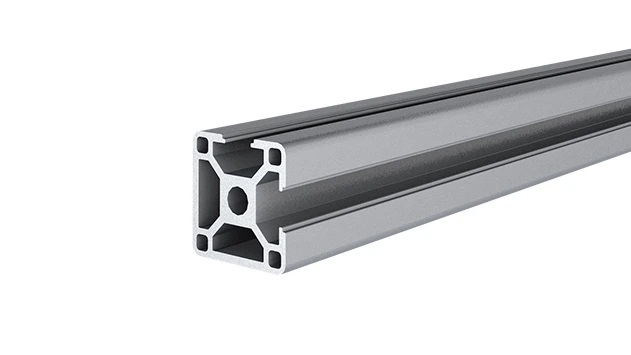
3030 is a 3.00 x 3.00CM fractional 30 series square extrusion T-slot profile with two side open T-slots, each side with 3.00cm face, 2 side with open slot, 2 side with closed face. The profile has align-a-grooves to assist in aligning connecting profiles.
In today's fast-paced manufacturing world, where production lines shift, product demands fluctuate, and workspace needs evolve overnight, the ability to adapt quickly isn't just a luxury—it's a survival skill. For small workshops and large factories alike, the struggle to keep up with changing requirements often boils down to one critical factor: flexibility . This is where modular workstations step in, and at the heart of their adaptability lies a unsung hero: the 3030b EU Standard Aluminum Profile . Far more than just a metal frame, this profile has become the backbone of modern, reconfigurable workspaces, offering a blend of strength, simplicity, and versatility that traditional materials can't match. Let's dive into why this unassuming 30x30mm aluminum extrusion is revolutionizing how we build, adjust, and optimize workstations across industries.
What Exactly Is the 3030b EU Standard Aluminum Profile?
First things first: let's break down the name. The "3030b" refers to its dimensions—30mm in width and 30mm in height—making it a compact yet robust choice for structural frameworks. The "EU Standard" tag ensures it meets strict European quality and safety benchmarks, from material composition to dimensional accuracy, which is a big deal for businesses prioritizing reliability. Unlike generic aluminum pipes, this profile is an aluminum extrusion , meaning it's shaped by forcing heated aluminum through a die to create a consistent, precision-engineered cross-section. This process results in a profile with a signature "T-slot" design—those long, narrow grooves running along its length—that's key to its modular magic.
But why aluminum? Steel might be stronger, and plastic cheaper, but aluminum strikes a perfect balance. It's lightweight (about a third the weight of steel), making it easy to handle during setup or reconfiguration. It's naturally corrosion-resistant, so it holds up in factories with humidity or occasional spills—no rust eating away at your workstation over time. And despite its lightness, it's surprisingly strong: the 3030b profile can support heavy loads, whether you're mounting tools, shelving, or even small conveyor systems. For anyone who's ever struggled to move a steel workbench or watched a plastic frame warp under weight, aluminum's advantages are clear.
The T-Slot Advantage: Why Accessories Make All the Difference
If the 3030b profile is the backbone, then aluminum profile accessories are the joints, muscles, and nerves that bring it to life. The T-slot design isn't just a design quirk—it's a modular masterpiece. Those slots allow you to slide in, lock down, or adjust a huge range of accessories without drilling, welding, or complicated tools. Let's say you need to attach a shelf to your workstation: grab a T-slot nut, slide it into the groove, bolt on the shelf bracket, and tighten with a hex key. Done. Want to add a light bar overhead? Use angle brackets and a few screws—no need to call a welder. This compatibility with accessories turns the 3030b from a static frame into a dynamic system that grows with your needs.
Common accessories include end caps (to smooth rough edges and prevent dust buildup), rubber strips (for noise reduction and sealing), and connectors—lots of connectors. There are 90° corner brackets for right angles, 45° brackets for slopes, and even 135° brackets for odd angles. Some connectors are fixed, others swivel; some are made of aluminum for strength, others of nylon for lightweight applications. The beauty is that these accessories are standardized, so you can mix and match from different batches or suppliers without worrying about compatibility. This interchangeability is what makes reconfiguration so quick: you're not stuck with custom parts—just a toolkit of modular pieces that snap together like a high-strength puzzle.

Quick Reconfiguration: Time, Cost, and Adaptability in One Package
Let's get to the heart of the matter: quick reconfiguration . What does that actually look like in a real workshop? Imagine you run a small electronics assembly line. One month, you're building smartwatches—small, delicate parts, needing compact workstations with ESD protection. The next month, a big order comes in for tablets, which are larger and require more workspace for screens and batteries. With traditional wooden or welded steel workstations, you'd either have to buy new ones (costly) or spend days modifying the old ones (time-consuming). With 3030b, it's a different story.
Here's how it might go: On Monday, your team uses hex keys to loosen the brackets holding the upper shelves on the smartwatch workstations. They slide off the shelves, remove the side panels, and reposition the legs to widen the work surface. By Tuesday, they're adding flow rack attachments to hold tablet cases, using T-slot nuts to secure the racks at waist height for easy access. By Wednesday, the workstations are fully reconfigured—no new materials, no downtime beyond a few hours. That's the power of quick reconfiguration: it turns "we can't take that order" into "we can start tomorrow."
The benefits go beyond speed. Reusing components means you're not wasting money on new frames or accessories. If a project ends, you can disassemble the workstation and repurpose the 3030b profiles and accessories for something else—a storage rack, a packing station, or a testing bench. Over time, this reduces long-term costs significantly. And let's not forget ergonomics: employees come in different heights, and tasks require different postures. With 3030b, you can adjust the height of a workbench by swapping out leg brackets, tilt a surface for better visibility, or add a footrest—all without rebuilding from scratch. Happy, comfortable employees are more productive, and 3030b makes ergonomic tweaks feel like second nature.
Real-World Applications: 3030b in Action Across Industries
To really understand the impact of the 3030b profile, let's look at how it's being used in the field. From electronics to automotive, medical to logistics, this profile is proving its worth in diverse settings. Below is a breakdown of real applications, the components used, and the key benefits reported by users:
| Industry | Application | 3030b Components & Accessories | Key Benefit of Reconfiguration |
|---|---|---|---|
| Electronics Manufacturing | Assembly Workstations for Circuit Boards | 3030b profiles, aluminum workbench tops, ESD-safe brackets, T-slot cable management clips | Switched from assembling 5-inch to 7-inch circuit boards by adjusting shelf spacing and workbench depth in 2 hours; no new workstation purchase needed. |
| Automotive Parts | Material Handling Racks for Small Components | 3030b frames, roller track guides, plastic roller wheels, adjustable dividers | Reconfigured rack dividers to fit new part sizes after a client design change; reduced part damage by 40% due to better fit. |
| Medical Device Production | Cleanroom Packaging Stations | 3030b profiles with anodized finish, aluminum honeycomb work surfaces, stainless steel caster wheels | Moved stations from a small cleanroom to a larger one by detaching casters, reassembling in the new space, and reattaching—done in 1 day with minimal disruption. |
| Logistics & Warehousing | Pick-and-Pack Turnover Trolleys | 3030b frames, fold-down shelves, swivel casters, height-adjustable handles | Adjusted trolley height from 80cm to 100cm to reduce for taller workers; cut injury reports by 25% in 3 months. |
In each case, the 3030b profile's adaptability wasn't just a convenience—it was a business enabler. Whether it was meeting tight deadlines, reducing costs, or improving safety, the ability to reconfigure quickly gave these businesses a competitive edge.
Choosing the Right Partner: Why a Reliable Lean System Supplier Matters
You could have the best profile in the world, but if your accessories are shoddy or your supplier is unresponsive, your reconfiguration efforts will hit a wall. That's why partnering with a trusted lean system supplier is just as important as choosing the 3030b profile itself. A good supplier doesn't just sell you aluminum extrusion—they provide a complete ecosystem. They'll have a full range of 3030b-compatible accessories in stock, so you're not waiting weeks for a bracket. They'll offer technical support: if you're stuck designing a custom workstation, their team can help you pick the right connectors or calculate load capacities. And they'll stand behind their products, ensuring the profiles meet EU standards and the accessories fit snugly into those T-slots.
What should you look for in a supplier? Start with certifications: Do their 3030b profiles meet EU norms like EN 755-9 (aluminum extrusion standards) or ISO 9001 (quality management)? Next, check their accessory range—do they carry everything from end caps to heavy-duty casters, or will you have to source parts from multiple vendors? Finally, ask about customization. Maybe you need a 3030b profile with extra T-slots for a specific project, or a custom length to reduce waste. A flexible supplier can accommodate these needs without inflating costs.
One electronics manufacturer I spoke with summed it up best: "We used to buy generic aluminum profiles from a local hardware store, but the slots were uneven, and the accessories never quite fit. Now we work with a lean system supplier, and it's night and day. Their 3030b profiles snap into their brackets perfectly, and when we needed a custom shelf height, they walked us through the math to make sure it was stable. Reconfiguration used to take a day; now it takes an hour." That's the difference a good supplier makes.
The Future of Workstations: Why 3030b Is Here to Stay
As manufacturing continues to shift toward small-batch production, customization, and agile workflows, the demand for flexible workspaces will only grow. The 3030b EU Standard Aluminum Profile isn't just a trend—it's a solution built for this future. Its combination of strength, light weight, and T-slot versatility makes it ideal for businesses that can't afford to be tied down by fixed infrastructure. Whether you're a startup scaling up or a legacy company modernizing your factory, this profile lets you build workstations that grow with you, adapt with you, and evolve with you.
And let's not overlook the human factor. Workstations aren't just tools—they're where people spend 8+ hours a day. A clunky, unchangeable workstation leads to frustration, inefficiency, and even injury. The 3030b profile, with its easy reconfiguration, puts control back in the hands of workers and managers. Want to move your tools closer? Adjust the shelf. Need more legroom? Raise the workbench. It's a small thing, but it adds up to a more engaged, productive team.
At the end of the day, the 3030b EU Standard Aluminum Profile is more than a piece of metal. It's a promise: that your workspace doesn't have to be a barrier to progress. It can be a partner, one that bends, adjusts, and grows as your business does. So if you're still struggling with rigid, outdated workstations, maybe it's time to take a closer look at that 30x30mm aluminum extrusion. It might just be the key to unlocking the flexibility your team needs to thrive in tomorrow's manufacturing world.