- Company Articles
- Products and Technology
- Application Cases
- 3060 National Standard Profile A in Telecommunication Equipment Assembly: Case Studies

3060 National Standard Profile A in Telecommunication Equipment Assembly: Case Studies
Related Product
3060 National Standard Profile A
Workbench, production line, logistic rack, warehouse rack Industry: Manufacturer workshop, Automobile, Electronic, Assembling, logistic
Introduction: The Evolving Needs of Telecommunication Assembly
In the fast-paced world of telecommunication equipment manufacturing, precision, flexibility, and efficiency aren't just buzzwords—they're the backbone of staying competitive. Every day, assemblers and engineers grapple with tight deadlines, frequent product iterations, and the need to adapt to new technologies. Traditional assembly setups, often built with fixed steel frames or generic workbenches, have long been a bottleneck: they're heavy, hard to reconfigure, and struggle to keep up with the industry's demand for agility. This is where modular aluminum profiles step in, and among them, the 3060 National Standard Profile A has emerged as a game-changer. Designed to balance strength, versatility, and ease of use, this profile isn't just a piece of metal—it's a tool that empowers teams to build, adapt, and innovate. In this article, we'll dive into what makes the 3060 National Standard Profile A unique, explore real-world case studies of its impact in telecommunication assembly, and uncover how it integrates seamlessly with aluminum profile accessories to transform workflows.
Understanding 3060 National Standard Profile A: More Than Just Aluminum
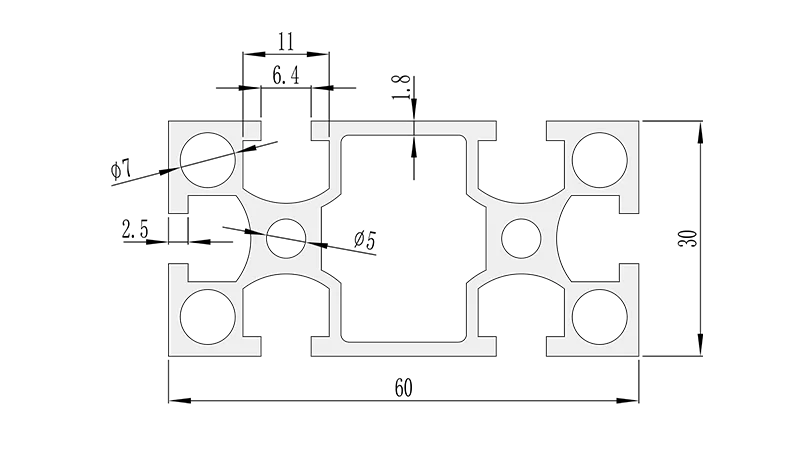
At first glance, the 3060 National Standard Profile A might look like any other aluminum extrusion, but its design is a testament to thoughtful engineering. Let's break it down: the "3060" refers to its cross-sectional dimensions—30mm in width and 60mm in height—making it wider than slimmer profiles (like 2020 or 3030) but more compact than larger ones (like 4080). This sweet spot in size means it strikes an ideal balance: sturdy enough to support heavy telecom components (think routers, fiber optic panels, or server enclosures) yet lightweight enough to be reconfigured without heavy machinery.
Made from high-grade aluminum alloy (typically 6063-T5), the profile boasts impressive mechanical properties: it's corrosion-resistant, which is crucial in factory environments where moisture or chemicals might be present, and it has a high strength-to-weight ratio. But what truly sets it apart is its T-slot design. Running along its length are precision-machined slots that allow for easy attachment of aluminum profile accessories—connectors, brackets, panels, or even roller tracks—without welding or drilling. This modularity is key for telecommunication assembly, where product lines change frequently. Imagine needing to adjust a workbench to fit a new router model or reconfigure a material rack to accommodate larger fiber optic cables; with traditional setups, this might take days and require specialized tools. With 3060 Profile A, it can be done in hours using simple hand tools and a set of compatible accessories.
Another often-overlooked advantage is its compatibility with national standards. Unlike proprietary profiles, the 3060 National Standard Profile A adheres to (unified dimensional standards), meaning components from different suppliers (like 90° aluminum profile connectors or end caps) will fit seamlessly. This reduces supply chain risks and ensures that manufacturers aren't locked into a single vendor—a critical factor for businesses looking to scale or adapt quickly.
Key Features That Make It Ideal for Telecommunication Assembly
Telecommunication equipment assembly isn't just about putting parts together; it's about creating environments that support precision, safety, and efficiency. Let's explore how the 3060 National Standard Profile A addresses these needs:
- Lightweight yet Durable: Aluminum's natural lightness makes the profile easy to handle during setup or reconfiguration, reducing the risk of workplace injuries. Yet, its alloy composition ensures it can support loads up to 200kg per linear meter—more than enough for most telecom components, including heavy server units or battery packs.
- Modular Flexibility: The T-slot design allows for infinite customization. Need to add a shelf to a workbench? Screw in a bracket. Want to attach a roller track for sliding components? Snap in a guide rail. This flexibility means assembly lines can evolve with product designs, not the other way around.
- Precision Engineering: Telecommunication parts require tight tolerances, and the 3060 Profile A delivers. Its extrusion process ensures consistent dimensions across batches, so accessories fit perfectly every time. This precision translates to stable workbenches and racks, reducing errors during assembly.
- Integration with Aluminum Profile Accessories: From 45° aluminum profile connectors that allow for angled structures to ESD-safe panels for sensitive electronics, the profile works harmoniously with a wide range of accessories. This ecosystem of parts turns a simple extrusion into a complete solution.
- Cost-Effective in the Long Run: While the initial cost might be higher than traditional steel, the profile's reusability and low maintenance (no painting or rust treatment needed) mean lower total cost of ownership. A single profile can be repurposed for multiple projects over its lifespan.
Case Studies: Real-World Impact in Telecommunication Assembly
Case Study 1: Streamlining Workbench Setup at a Fiber Optic Equipment Manufacturer
The Challenge: A mid-sized telecom manufacturer in southern China specialized in fiber optic patch panels and routers. Their assembly line relied on fixed wooden workbenches and steel racks, which had two major issues: first, reconfiguring the line for new product models took 3–5 days (delaying production), and second, the wooden surfaces weren't ESD-safe, leading to occasional static damage to sensitive components. With a surge in demand for 5G-compatible panels, the team needed a solution that could cut setup time and improve component protection.
The Solution: After evaluating several options, the manufacturer partnered with a supplier to transition to workbenches built with 3060 National Standard Profile A. The key components included:
- 3060 Profile A frames, cut to custom heights to match ergonomic guidelines (reducing technician fatigue).
- Aluminum honeycomb panels for the workbench tops, which are lightweight, rigid, and compatible with ESD mats.
- 90° aluminum profile connectors to join the vertical and horizontal beams, ensuring stability without welding.
- Adjustable shelves using T-slot brackets, allowing technicians to customize storage based on tool size.
The Results: The transformation was striking. Setup time for new product lines dropped from 5 days to just 8 hours—yes, hours. The modular design meant technicians could adjust shelf heights or add accessories (like cable management hooks) on the fly using hex keys. The ESD-safe surfaces also reduced static-related defects by 75%, saving the company an estimated ¥120,000 annually in damaged components. Perhaps most importantly, employee satisfaction improved: "I no longer dread product changes," one senior assembler noted. "Now, we just reconfigure the bench and get back to work—it's that simple."
Case Study 2: Optimizing Material Flow with Roller Tracks and 3060 Profile A Racks
The Challenge: A data center equipment assembler in Southeast Asia faced a different problem: material handling inefficiency. Their factory floor used manual carts to transport circuit boards, power supplies, and enclosures from storage to assembly stations. This led to bottlenecks—carts would pile up at busy stations, and technicians often wasted 20–30 minutes per shift waiting for materials. The team needed a way to automate material flow without investing in expensive conveyor systems.
The Solution: The answer lay in combining 3060 National Standard Profile A with roller tracks (a keyword from our list). The manufacturer designed gravity-fed material racks using the 3060 Profile A as the main frame, with roller tracks mounted along the shelves. Here's how it worked:
- The racks were built with a slight incline (5°), so components would slide gently along the roller tracks to the front of the shelf as items were removed—no manual pushing needed.
- 3060 Profile A's T-slots allowed for easy mounting of roller track brackets, which could be adjusted to fit different component sizes (from small circuit boards to large enclosures).
- Aluminum profile end caps were added to the rack edges to prevent components from slipping off, enhancing safety.
The Results: The impact on workflow was immediate. Material wait times dropped by 40%, freeing up technicians to focus on assembly rather than fetching parts. The racks also reduced the risk of component damage—items glided smoothly on the roller tracks instead of being jostled in carts. Over six months, the company calculated a 15% increase in daily assembly output, and the ROI on the rack system was achieved in under a year. "It's like having a silent helper," said the factory manager. "The materials just 'flow' to where they're needed, and we've cut down on so much wasted motion."
The Ecosystem: 3060 Profile A and Aluminum Profile Accessories
A profile is only as good as the accessories that bring it to life, and the 3060 National Standard Profile A shines here thanks to its compatibility with a vast ecosystem of aluminum profile accessories. Let's take a closer look at some key accessories and how they enhance its functionality in telecommunication assembly:
| Accessory Type | Function | Telecom Assembly Application |
|---|---|---|
| 90° Aluminum Profile Connector | Joins two profiles at a right angle | Building workbench frames or rack corners |
| 45° Aluminum Profile Connector | Creates angled joints (45°) | Designing sloped material chutes or ergonomic workbench edges |
| Aluminum Profile End Cap | Covers exposed ends of profiles | Preventing sharp edges (safety) and dust accumulation in T-slots |
| T-Slot Bracket | Attaches shelves, panels, or tools to T-slots | Adding adjustable storage to workbenches or mounting cable management clips |
| Roller Track Guide Rail | Creates sliding paths for components | Integrating into material racks or assembly line conveyors |
What's impressive is how these accessories work together seamlessly. For example, a workbench built with 3060 Profile A can use 90° connectors for the frame, T-slot brackets for a monitor arm, and end caps for safety—all without drilling or welding. This modularity not only speeds up initial setup but also makes it easy to upgrade or modify the setup later. A telecom manufacturer might start with a basic workbench and later add a roller track for component delivery, or attach an ESD wrist strap holder using a T-slot bracket. The possibilities are limited only by the team's needs.
Why 3060 National Standard Profile A Stands Out in a Crowded Market
With so many aluminum profiles available, why has the 3060 National Standard Profile A become a go-to for telecommunication assembly? Let's compare it to two common alternatives to see the difference:
- vs. Steel Frames: Steel is strong but heavy and requires welding. 3060 Profile A offers similar load capacity at 1/3 the weight and can be reconfigured in minutes. It also doesn't rust, reducing maintenance costs.
- vs. Smaller Profiles (e.g., 2020 or 3030): While smaller profiles are cheaper, they lack the load capacity needed for heavy telecom equipment. 3060 Profile A can support more weight without sacrificing flexibility.
- vs. Proprietary Profiles: Proprietary profiles often lock users into a single supplier. The 3060 National Standard Profile A's adherence to national standards means multiple suppliers offer compatible accessories, reducing supply chain risks.
In short, it's the profile that delivers "just enough" of everything telecom assemblers need: strength without bulk, flexibility without complexity, and compatibility without vendor lock-in.
Conclusion: Building the Future of Telecommunication Assembly
The telecommunication industry waits for no one, and assembly processes must evolve to keep pace. The 3060 National Standard Profile A isn't just a material solution—it's a strategic enabler that empowers manufacturers to be agile, efficient, and innovative. Through the case studies we've explored, we've seen how it transforms rigid workbenches into adaptable hubs, reduces setup times from days to hours, and turns chaotic material flow into streamlined efficiency. When paired with aluminum profile accessories like connectors, roller tracks, and end caps, it becomes a complete ecosystem that grows with your business.
Whether you're a small workshop producing custom telecom parts or a large manufacturer scaling up 5G production, the question isn't whether you can benefit from modular aluminum profiles—it's which profile will best fit your needs. For telecommunication assembly, where precision, flexibility, and durability are non-negotiable, the 3060 National Standard Profile A has proven time and again that it's more than up to the task. It's not just about building equipment; it's about building a better way to work.