- Company Articles
- Products and Technology
- Solution
- 3C Assembly Lines: Using 4040r EU Standard Aluminum Profile for Flexible Stations

3C Assembly Lines: Using 4040r EU Standard Aluminum Profile for Flexible Stations
Related Product
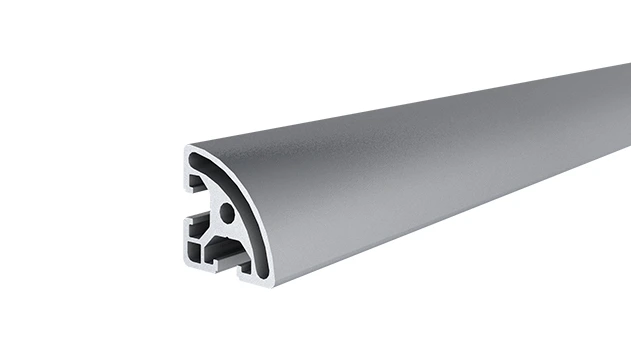
4040R EU Standard Aluminum Profile
4040R is a 4.00x4.00 CM fractional 40 series square extrusion T-slot profile with two side open T-slots, each side with 4.00cm face,the other side is round face. The profile has align-a-grooves to assist in aligning connecting profiles.
The 3C Manufacturing Challenge: Rigidity in a World of Rapid Change
Walk into any 3C (computers, communications, consumer electronics) assembly plant today, and you'll feel the pressure in the air. Phones, tablets, and wearables hit the market with shorter lifespans than ever—some models update every 6–8 months. Production lines that once ran the same process for years now need to pivot overnight to accommodate new designs, component sizes, or even entirely new products. Yet, many factories are still stuck with the same old rigid workstations: welded steel frames that take days to reconfigure, fixed shelving that can't adjust to taller components, and material flow systems that grind to a halt when a new part size comes through.
This mismatch between static infrastructure and dynamic demand creates real pain points. Workers strain to reach awkwardly placed tools on inflexible workbenches. Changeover times stretch into hours (or even days), eating into production deadlines. And when a design tweak requires a 2-inch taller shelf or a 10-degree angle adjustment on a conveyor, the answer too often is, "We can't do that without cutting metal." For 3C manufacturers, where margins are tight and speed is everything, this rigidity isn't just inefficient—it's a competitive liability.
Enter 4040r EU Standard Aluminum Profile: The Backbone of Flexible Stations
So, what if there was a building block that could adapt as quickly as your production needs? That's where the 4040r EU standard aluminum profile comes in. At first glance, it might look like just another metal bar—but this unassuming extrusion is a game-changer for 3C assembly lines. Let's break it down: "4040" refers to its cross-section (40mm x 40mm), a sweet spot for balancing strength and versatility. The "r" denotes rounded edges, a small detail that makes a big difference in safety (no sharp corners for workers to bump into) and ergonomics (easier to handle during setup). And "EU standard" isn't just a label—it means consistent quality, precise tolerances, and compatibility with a global ecosystem of accessories.
But the real magic of 4040r aluminum profile lies in its modularity. Unlike welded steel, it's designed to be built, taken apart, and rebuilt—all without cutting, welding, or specialized tools. Pair it with aluminum profile accessories like connectors, end caps, and brackets, and suddenly you're not just building a workstation—you're creating a system that can evolve with your needs. Need a taller shelf? Swap out a 10cm profile for a 15cm one. Want to angle a work surface for better ergonomics? Add a 45-degree joint. It's like building with industrial-grade Legos, but for factories.

Why 4040r Aluminum Profile Solves 3C's Toughest Problems
Let's get specific: What makes 4040r aluminum profile so well-suited for 3C assembly lines? It starts with flexibility, but that's just the beginning. Here's how it addresses the industry's most critical needs:
1. Lightning-Fast Changeovers When a new smartphone model requires a workbench with a deeper surface, you don't need to wait for a welder. With 4040r profiles and quick-connect aluminum profile accessories, a team can disassemble the old setup and rebuild the new one in under 2 hours. That's a 70–80% reduction in downtime compared to traditional steel stations, which often take 8–12 hours to modify (if they can be modified at all).
2. Customization Without Compromise 3C components come in every shape and size—from tiny circuit boards to bulky battery packs. 4040r profiles adapt to all of them. Need a material rack with 3 rows and 3 floors (like Material Rack B, a common 3C setup)? Use longer profiles and adjustable shelf brackets. Building a workstation for delicate ESD-sensitive components? Add an ESD workbench top and ground it via the profile's metal frame. Even specialized needs, like integrating roller tracks for smooth part flow, are easy—just attach roller track connectors to the profile's T-slots, and you're done.
3. Durability That Keeps Up With 3C's Pace Aluminum gets a bad rap for being "flimsy," but 4040r profiles are built tough. The EU standard ensures uniform wall thickness (typically 1.5–2.0mm), making them strong enough to support heavy tooling or stacks of components. And unlike steel, aluminum resists corrosion—critical in 3C plants where cleaning agents and humidity are common. This durability means your stations won't just flex with change; they'll last through years of it.
4. Ergonomics That Boost Worker Morale (and Output) Happy workers are productive workers, and 4040r profiles make ergonomics easy. Adjust workbench heights to match each operator's arm length. Angle surfaces to reduce neck strain. Add casters (via caster accessories) to make mobile workstations that follow workers, not the other way around. When a station fits the person, errors drop, fatigue decreases, and throughput goes up.
Building the Flexible Station: Workbenches, Roller Tracks, and Lean Systems
Let's zoom in on how 4040r aluminum profile transforms two of the most critical parts of any 3C assembly line: workbenches and material flow. These are the workhorses of production, and upgrading them with 4040r profiles unlocks immediate value.
Workbenches: From Static to Adaptive
A typical 3C workbench needs to handle tools, components, and sometimes even small assembly steps—all while keeping everything within arm's reach. With 4040r profiles, you're not limited to "one-size-fits-all" designs. Take the Workbench E (Single Deck–Without Caster), a popular base model. Start with 4040r legs, add a durable aluminum honeycomb panel top, and then customize: mount tool holders along the side using T-slot brackets, add a shelf above for component bins with adjustable height, or even integrate a small roller track section at the back to feed parts directly into the workspace.
What if you need to move the bench later? Just add casters (using caster installation bases) and lock them in place. Need to expand it? Connect another 4040r frame to the side with parallel aluminum joints. It's a workstation that grows with your needs, not against them.
Roller Tracks: Smooth Material Flow, No Reengineering Required
Material flow is the lifeblood of 3C assembly. Parts need to glide from storage to workbench to testing stations without getting stuck or damaged. Roller tracks are the unsung heroes here, but traditional steel tracks often fail when part sizes change. 4040r profiles fix this by acting as a universal foundation for roller track systems.
Using roller track placon mounts (like the ones designed for aluminum profiles), you can attach roller tracks directly to 4040r frames. Need to adjust the track width for wider circuit boards? Loosen the mounts, slide them along the T-slots, and retighten. Switching from plastic roller track guide rails (yellow for high-visibility, grey for low-key) to aluminum guide rails? The 4040r profile's standardized slots ensure a perfect fit, no drilling required. Even specialized components like swivel roller balls (1 inch or 0.5 inch) integrate seamlessly, letting workers slide parts in any direction without lifting.
Traditional vs. 4040r Aluminum Profile Stations: The Numbers Speak for Themselves
Still on the fence? Let's compare traditional welded steel stations with 4040r aluminum profile setups across key metrics that matter to 3C manufacturers:
| Metric | Traditional Welded Steel Stations | 4040r Aluminum Profile Stations |
|---|---|---|
| Setup/Changeover Time | 8–12 hours (requires welding/grinding) | 1–2 hours (tool-free with aluminum profile accessories) |
| Customization Options | Limited (fixed dimensions post-welding) | Unlimited (adjust height, width, angle, and add-ons anytime) |
| Durability | High (but prone to rust in humid 3C environments) | High (corrosion-resistant aluminum; EU-standard thickness) |
| Worker Ergonomics | Poor (static heights; sharp edges) | Excellent (adjustable heights; rounded edges; mobile options with casters) |
| Long-Term Cost | High (frequent replacements for new product lines) | Low (reusable profiles; only replace accessories for new needs) |
Lean System Integration: Reducing Waste, Boosting Efficiency
3C manufacturers live and die by lean principles—eliminating waste, streamlining flow, and continuous improvement. 4040r aluminum profile doesn't just support lean systems; it becomes their backbone. Here's how:
Eliminating Overproduction Waste With stations that adjust quickly, you can scale production up or down without idle infrastructure. No more building separate lines for "high-volume" and "low-volume" products—one modular setup handles both.
Optimizing Material Flow Roller tracks mounted on 4040r profiles create smooth, gravity-fed paths for components, reducing the need for manual carrying (a classic lean waste of motion). Workers spend less time walking and more time assembling.
Empowering Continuous Improvement Lean isn't a one-time project—it's a mindset. 4040r profiles let teams experiment with small adjustments (e.g., raising a shelf by 5cm to reduce bending) and see results immediately. This culture of experimentation leads to ongoing efficiency gains that add up over time.
Real Impact: A 3C Manufacturer's Success Story
Let's put this in context with a real-world example (names changed for privacy). A mid-sized smartphone manufacturer in Southeast Asia was struggling with its camera module assembly line. Every new phone model brought a different camera lens size, requiring the team to rebuild their inspection workbenches from scratch. The old steel stations took 10 hours to reconfigure, and the production line fell behind schedule almost every time.
They switched to 4040r EU standard aluminum profile workstations with roller track sections for feeding lens components. The results were striking: Changeover time dropped to 90 minutes. Workers could adjust their bench heights with a simple lever (using adjustable leveling feet), cutting down on back pain reports by 40%. And because the roller tracks could expand to fit larger lenses, scrap rates from dropped components fell by 25%. Within 6 months, the company recouped the investment in the new stations through faster production and fewer errors.
The Future of 3C Assembly: Flexible by Design
3C manufacturing isn't slowing down. If anything, the pace of change will only accelerate. Factories that thrive will be the ones that can adapt as quickly as their R&D teams design new products. 4040r EU standard aluminum profile isn't just a tool for today—it's an investment in tomorrow's flexibility.
Whether you're building workbenches, material racks, or roller track systems, the modularity of 4040r profiles and aluminum profile accessories ensures your assembly line never gets left behind. It's time to stop fighting against rigid infrastructure and start building with it. After all, in the world of 3C, the only constant is change—and with 4040r aluminum profile, you'll be ready for it.