- Company Articles
- Products and Technology
- Product knowledge
- 3C Assembly Lines: Using 4080B EU Standard Aluminum Profile for Equipment Frames

3C Assembly Lines: Using 4080B EU Standard Aluminum Profile for Equipment Frames
Related Product
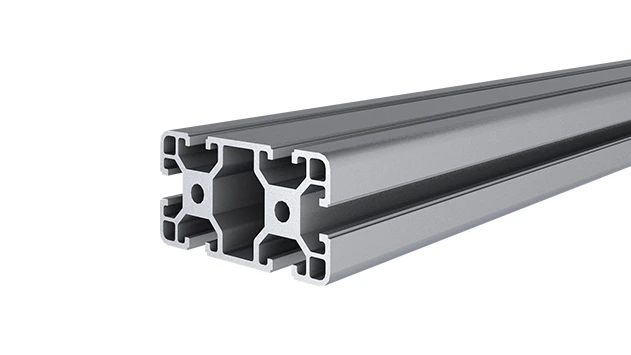
4080B EU Standard Aluminum Profile
4080B is a 4.00x8.00 CM fractional 40 series square extrusion T-slot profile with two side open T-slots, each side with 4.00cm face, two side with 8.00cm face. The profile has align-a-grooves to assist in aligning connecting profiles.
The Unsung Backbone of 3C Manufacturing: Why Equipment Frames Matter
Walk into any 3C (computers, communications, consumer electronics) factory, and your eyes will likely be drawn to the sleek robots, flashing screens, and workers in crisp uniforms assembling the smartphones, laptops, and smartwatches we can't live without. But behind all that action—quietly holding everything together—is something far less glamorous but infinitely critical: the equipment frames. These unassuming structures are the backbone of assembly lines, supporting workbenches, flow racks, conveyors, and tool holders. They're the reason components move smoothly from station to station, tools stay within arm's reach, and workers can focus on precision instead of wrestling with wobbly setups.
Here's the thing about 3C manufacturing: it's a world of extremes. Products are tiny (think microchips smaller than a fingernail) yet demand pinpoint accuracy. Production cycles are lightning-fast (new phone models launch yearly, if not sooner), requiring assembly lines to reconfigure on the fly. And the pressure to cut costs while boosting output? It's relentless. In this environment, your equipment frames can't just be "good enough." They need to be strong but lightweight, rigid but flexible, durable but easy to modify. Choose the wrong material or profile, and you're looking at frequent breakdowns, costly retooling delays, or even compromised product quality.
For years, manufacturers leaned on steel frames. They're strong, sure, but they're also heavy—making them a nightmare to move or reconfigure. Welding or drilling steel to adjust a workbench height? That's hours of downtime. Then there's corrosion; in factories with strict humidity controls (common in 3C to protect sensitive electronics), steel rusts, weakening joints and contaminating components. It was clear: the industry needed a better solution. Enter aluminum extrusion profiles—and in particular, the 4080B EU Standard Aluminum Profile. It's not just a material upgrade; it's a game-changer for how 3C assembly lines operate.
Aluminum Extrusion Profiles: The Lean System Advantage
Before diving into why the 4080B stands out, let's talk about aluminum extrusion profiles as a category. Unlike steel, which is often cut or welded into shape, aluminum profiles are "extruded"—pushed through a die to create consistent, complex cross-sections. This process allows for intricate designs, like the T-slots that run along the length of most profiles. These slots are genius: they let you attach brackets, shelves, wheels, or panels with simple bolts or t-nuts, no drilling or welding required. Need to add a tool holder to a workbench? Slide a bracket into the T-slot, tighten a screw, and you're done. Want to lower a flow rack shelf by 5cm? Loosen the bolts, adjust, and retighten. It's modularity at its finest—and modularity is the heartbeat of a lean system.
Lean manufacturing isn't just a buzzword in 3C; it's survival. With product lifecycles shorter than ever, assembly lines must adapt quickly to new models, component sizes, or production volumes. Steel frames fight against this flexibility. Aluminum extrusion profiles it. They're lightweight (about 1/3 the weight of steel), so reconfiguring a line doesn't require a forklift or a team of workers. They're corrosion-resistant, thanks to aluminum's natural oxide layer, which keeps frames looking and performing like new even in controlled factory environments. And because they're pre-engineered, you're not reinventing the wheel every time you build a new workstation or rack. It's no wonder that forward-thinking manufacturers are swapping steel for aluminum—and when they do, the 4080B EU Standard Aluminum Profile is often their first choice.

What Makes the 4080B EU Standard Aluminum Profile Special?
Let's break down the numbers first: "4080B" refers to the profile's cross-section dimensions—40mm in width and 80mm in height. The "EU Standard" tag means it adheres to strict European manufacturing tolerances, ensuring consistency in size, strength, and finish across every piece. But why 40x80mm? Why not 30x30 or 40x40, which are also common aluminum profiles? The answer lies in the unique demands of 3C assembly equipment.
3C equipment frames need to strike a balance. They must be narrow enough to fit into tight assembly line layouts (factories are rarely spacious) but tall enough to provide stability for heavy loads. A 40x80mm profile hits that sweet spot. The 80mm height gives it exceptional vertical rigidity, so a workbench loaded with circuit boards, testing equipment, and tools won't wobble during operation. The 40mm width keeps it slim, so you can line up multiple workstations without wasting precious floor space. And because it's an extrusion, the internal structure is optimized for strength—hollow, with reinforcing ribs that distribute weight evenly, preventing bending or warping even under constant use.
Material matters too. The 4080B is typically made from 6063-T5 aluminum alloy, a grade prized for its excellent combination of strength, machinability, and corrosion resistance. T5 tempering (artificial aging) gives it a tensile strength of around 180 MPa—strong enough to support a fully loaded flow rack or a conveyor system moving components all shift long. And unlike steel, it's easy to cut, drill, or mill on-site if you need a custom length, though most suppliers offer pre-cut options to save time.
But the real star of the show is the T-slot design. The 4080B usually features two or three T-slots along its length (depending on the manufacturer), each sized to accept standard M6 or M8 bolts and accessories. This means you can mix and match components—aluminum profile accessories like brackets, hinges, or panel mounts—without worrying about compatibility. Want to attach a roller track to a flow rack? There's a T-slot bracket for that. Need to mount an ESD (electrostatic discharge) mat to a workbench top? Slide a panel holder into the T-slot. The slots turn the 4080B from a simple beam into a versatile building block, capable of becoming almost anything you need it to be.
4080B in Action: Key Applications in 3C Assembly Lines
Let's get specific. How exactly do manufacturers use the 4080B EU Standard Aluminum Profile in their assembly lines? Let's walk through three critical applications: workbenches, flow racks, and conveyor frames. These are the workhorses of 3C production, and the 4080B shines in each.
Workbenches: Where Precision Meets Comfort
A 3C assembly workbench isn't just a table. It's a command center. Workers stand (or sit) here for hours, assembling delicate components like camera modules or circuit boards. The bench needs to hold tools, magnifying glasses, ESD wristband connectors, and sometimes even small testing equipment. It must be stable (no shaking when using a precision screwdriver), adjustable (to match worker heights), and durable (to withstand daily use). The 4080B is ideal for this.
Most 4080B workbenches feature a frame made from 4080B profiles for the legs and side rails, with a top made of aluminum honeycomb panel or ESD laminate. The T-slots in the 4080B legs let you attach adjustable footrests, tool hooks, or even cable management trays. Need to raise the bench by 10cm for a taller worker? Swap out the leg extensions—no welding, no cutting. Some manufacturers offer "Workbench E (single deck-without caster)" models built on 4080B frames, designed for stationary use where stability is paramount. Others add casters (via caster accessories that fit into T-slots) for benches that need to move between stations. Either way, the 4080B's rigidity ensures the workbench top stays flat and steady—critical for assembling components that are smaller than a grain of rice.
Flow Racks: Keeping Components Moving
In 3C assembly, time is money—and nothing wastes time like hunting for components. Flow racks solve this by storing parts (like screws, connectors, or display panels) in sloped lanes, so the next part slides forward automatically as the previous one is taken. The rack itself needs to support the weight of dozens of component bins, while the slope must be consistent to ensure smooth flow. Enter the 4080B.
A typical "Material Rack B (3 row and 3 floor)" design uses 4080B profiles for the vertical posts and horizontal supports. The 80mm height of the 4080B provides the vertical strength needed to hold multiple floors of bins, while the T-slots make it easy to attach roller tracks (like "38 aluminum roller track yellow with side guide") at the perfect angle. Side guides prevent bins from sliding off, and the T-slot connections let you adjust the track slope in minutes if parts start jamming. Unlike steel, the 4080B's light weight means even a fully loaded 3-row, 3-floor rack can be moved (with casters) if the assembly line layout changes. It's lean, it's efficient, and it keeps components where workers need them—when they need them.
Conveyor Frames: The arteries of the Assembly Line
Conveyors move partially assembled products from one station to the next—say, from PCB soldering to display mounting. They need to be straight, level, and strong enough to support the weight of products and carriers. Steel conveyor frames are overkill here; they're heavy and hard to adjust. The 4080B is Goldilocks-perfect: strong enough to support roller tracks or belt systems, light enough to align easily, and modular enough to extend or shorten as production needs change.
4080B profiles form the side rails of many 3C conveyors, with cross-braces (often 4040 profiles) for stability. T-slots allow for easy mounting of roller track placon mounts (like "roller track placon mount for aluminum profile flat" or "center support bracket"), which hold the roller tracks in place. If a conveyor needs to be extended by 2 meters for a new production run? Add two more 4080B sections, connect them with internal straight aluminum joints, and you're ready. No cutting, no welding—just plug-and-play. It's this ease of modification that makes the 4080B a favorite for conveyor systems in fast-paced 3C factories.
How Does 4080B Compare to Other Aluminum Profiles?
To understand why the 4080B is a top choice, let's compare it to two other common aluminum profiles used in manufacturing: the 4040 EU Standard (40x40mm) and the 3030 EU Standard (30x30mm). The table below breaks down their key specs and best uses:
| Profile Type | Dimensions (WxH) | Typical Material Thickness | Max Load Capacity (Vertical) | Best For |
|---|---|---|---|---|
| 3030 EU Standard | 30mm x 30mm | 1.5-2.0mm | Up to 150kg per linear meter | Light-duty equipment: small shelving, tool holders, or workbenches for lightweight tasks. |
| 4040 EU Standard | 40mm x 40mm | 2.0-3.0mm | Up to 300kg per linear meter | Medium-duty applications: small workbenches, single-level flow racks, or light conveyors. |
| 4080B EU Standard | 40mm x 80mm | 2.5-3.5mm | Up to 500kg per linear meter | Heavy-duty 3C equipment: multi-level workbenches, large flow racks, conveyor frames, or equipment stands. |
As you can see, the 4080B outperforms smaller profiles in load capacity, thanks to its taller height and thicker walls. For 3C assembly lines, where workbenches hold heavy tools, flow racks store dozens of component bins, and conveyors move products all shift, this extra strength is critical. The 4040 is great for lighter tasks, but when you need a frame that can handle the demands of high-volume 3C production, the 4080B is worth the slightly higher cost. It's an investment in reliability—and in manufacturing, downtime costs far more than the price of a better profile.
Case Study: A 3C Manufacturer's Switch to 4080B Frames
From Steel Frustration to Aluminum Efficiency
Let's look at a real-world example (names changed for privacy). A mid-sized electronics manufacturer in Shenzhen, China, was struggling with its old steel workbenches and flow racks. Their main pain points?
1.
Reconfiguration delays:
When launching a new smartphone model, they needed to lower workbench heights by 10cm to accommodate smaller components. With steel frames, this required unbolting the entire bench, cutting new legs, and rewelding—taking 8 hours per bench, and they had 12 benches. That's 96 hours of downtime.
2.
Weight issues:
Their steel flow racks were so heavy that moving them to rearrange the assembly line required a forklift and two workers, risking damage to floors and racks.
3.
Rust problems:
In their humidity-controlled factory, steel racks were starting to rust at the joints, leaving tiny rust particles that occasionally contaminated circuit boards—costing them $50,000 in scrap last year.
They decided to switch to aluminum extrusion profiles, and after researching options, chose the 4080B for their workbenches and flow racks. The results were dramatic:
-
Faster reconfigurations:
Lowering workbench heights now takes 15 minutes per bench (loosen T-slot bolts, adjust legs, retighten). For 12 benches, that's 3 hours total—down from 96.
-
Easier mobility:
4080B flow racks with casters can be moved by one worker, no forklift needed. They rearranged their line in a day instead of a week.
-
No more rust:
After 18 months, the aluminum frames still look brand-new, with zero contamination issues.
The manufacturer estimates they've saved $120,000 in downtime and scrap costs alone in the first year. And because the 4080B frames are modular, they've been able to add new accessories (like tool holders and ESD mats) without buying new equipment. It's a classic example of how the right material choice—like the 4080B—isn't just a purchase; it's a long-term investment in efficiency.
Why Choose 4080B for Your 3C Assembly Line?
At the end of the day, the 4080B EU Standard Aluminum Profile isn't just a piece of metal. It's a tool for building smarter, more adaptable assembly lines. For 3C manufacturers, it checks all the boxes:
-
Strength for heavy loads:
80mm height and 6063-T5 alloy mean it can handle workbenches, flow racks, and conveyors with ease.
-
Flexibility for lean systems:
T-slots and modular accessories let you adapt quickly to new products or production needs.
-
Lightweight for mobility:
Easy to move, rearrange, and install—saving time and labor.
-
Durability for the long haul:
Corrosion-resistant, low-maintenance, and built to last decades.
In an industry where every second and every cent counts, the 4080B isn't just a profile—it's a competitive advantage. It's the foundation that lets 3C manufacturers build assembly lines that are as agile, precise, and efficient as the products they create.
Final Thoughts: Investing in the Right Foundation
3C manufacturing is all about precision, speed, and innovation. But even the most advanced robots and skilled workers can't perform at their best if they're supported by outdated, rigid equipment frames. The 4080B EU Standard Aluminum Profile isn't the flashiest technology in the factory, but it's one of the most impactful. It's the quiet partner that lets assembly lines adapt, grow, and thrive in a fast-changing industry.
If you're in 3C manufacturing and still using steel frames, ask yourself: How much time are you losing to reconfigurations? How much money is tied up in scrap from rust or contamination? How many opportunities are you missing because your line can't adapt quickly enough? The answers might surprise you—and they might just lead you to the 4080B. After all, great products deserve great foundations.