- Company Articles
- Products and Technology
- Solution
- 3C Assembly Solutions: Why Aluminum Workbench A is a Top Choice

3C Assembly Solutions: Why Aluminum Workbench A is a Top Choice
Related Product
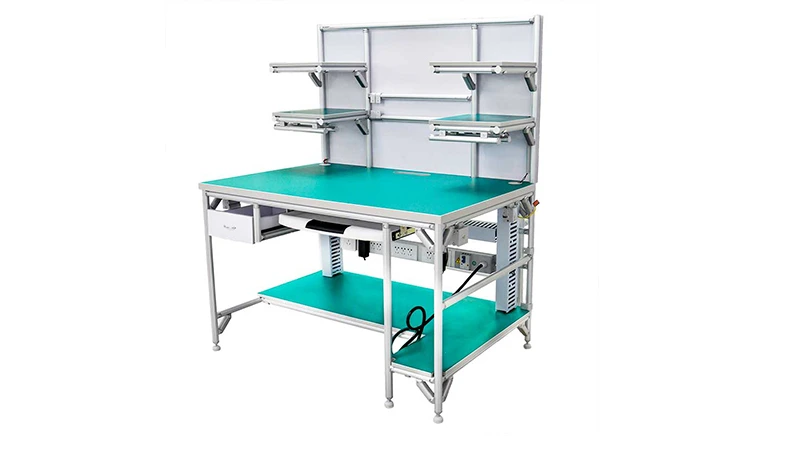
Aluminum Workbench A
Aluminum tube workbench is more flexible and durable, compared with traditional PE/ABS coated steel tube. It is easy to assemble, anti corrosion, rust protection, and recycle use after disassemble.
Walk into any 3C manufacturing facility—whether it's churning out the latest smartphones, sleek laptops, or high-precision wearables—and you'll quickly realize one thing: the assembly line's backbone isn't just the robots or the conveyor belts. It's the workbench. That unassuming surface where technicians spend hours piecing together tiny components, where engineers troubleshoot prototypes, and where the gap between design and mass production narrows to a few millimeters. For decades, workbenches in 3C plants have been treated as afterthoughts—heavy, rigid, and barely adaptable to the industry's breakneck pace of change. But today, a new standard is emerging: Aluminum Workbench A. More than just a table, it's a solution built for the unique chaos of 3C assembly, where flexibility, precision, and worker-centric design aren't just nice-to-haves—they're survival tools.
The Hidden Challenges of 3C Assembly Lines
To understand why Aluminum Workbench A matters, let's first dive into the daily hurdles of 3C manufacturing. Unlike automotive or appliance production, where product cycles span years, 3C products evolve in months—sometimes weeks. A factory assembling 5.5-inch phone screens in January might shift to 6.7-inch models by summer, requiring entirely new tooling, part bins, and workspace layouts. Traditional workbenches, often made of steel or wood, weren't built for this. Welded steel frames mean reconfiguring a line takes days (and a team of contractors). Wooden surfaces warp under the weight of heavy equipment, and neither material offers protection against electrostatic discharge (ESD)—a silent killer of microchips and circuit boards that can turn a $500 component into scrap in seconds.
Then there's the human element. 3C technicians often stand for 8–10 hour shifts, hunched over workbenches that are either too high, too low, or cluttered with tools that never seem to be within reach. Material flow is another headache: small parts bins get stacked haphazardly, and moving components from one station to the next involves awkward bending or walking, eating into precious time. By the end of the day, fatigue sets in, errors creep up, and productivity stalls. It's no wonder plant managers joke that their biggest bottleneck isn't the machinery—it's the very surfaces their teams rely on.
The Problem with "Good Enough" Workbenches
For years, manufacturers accepted these pain points as unavoidable. "Good enough" workbenches were cheaper upfront, and switching to something better felt like a luxury. But "good enough" comes with hidden costs. A 2023 study by the Manufacturing Performance Institute found that poorly designed workstations in electronics assembly lines lead to a 15% increase in errors and a 22% higher turnover rate among technicians—both of which hit the bottom line hard. Static damage alone costs the electronics industry $5 billion annually, much of it preventable with proper ESD protection. And when a new product launch requires reconfiguring 20 workbenches, the downtime can delay production by weeks, letting competitors steal market share.
Enter Aluminum Workbench A. Designed from the ground up with 3C's unique demands in mind, it's not just a upgrade—it's a complete rethinking of what a workbench should be. Let's break down why it's quickly becoming the top choice for forward-thinking 3C plants.

Design Flexibility: Built on Aluminum Profile
At the core of Aluminum Workbench A's adaptability is its use of aluminum profile—a material that's revolutionized industrial design in recent years. Unlike steel, which requires welding or heavy tools to modify, aluminum profiles are lightweight, modular, and infinitely configurable. The workbench's frame is constructed from precision-extruded aluminum rails with T-slots running their length, allowing accessories like shelves, tool hooks, and part bins to be added or rearranged in minutes. Need to mount a microscope on the left side for morning shifts and a barcode scanner on the right for afternoons? Just slide a bracket into the T-slot and tighten a screw. No drilling, no welding, no waiting for maintenance.
This modularity is a game-changer for 3C's rapid product cycles. Consider a factory transitioning from smartwatch to tablet assembly. Smartwatches require tiny, delicate components—think 0.5mm screws and micro-LED displays—so the workbench might need shallow bins, magnifying lamps, and anti-fatigue mats. Tablets, on the other hand, have larger casings and heavier batteries, calling for sturdier shelving and integrated scales. With Aluminum Workbench A, this switch takes hours, not days. Technicians can adjust the height (from 70cm to 90cm) using hand cranks, swap out accessories, and reposition the entire bench using built-in handles—all without specialized training. It's like having a workbench that can "learn" new tasks, just like the team using it.

Aligned with Lean System Principles
3C manufacturing thrives on lean principles—eliminating waste, streamlining workflows, and empowering workers to drive continuous improvement. Aluminum Workbench A isn't just lean-friendly; it's lean by design. Traditional workbenches often become magnets for waste: unused tools pile up, excess inventory sits on shelves "just in case," and awkward layouts force technicians to take extra steps to grab parts. Aluminum Workbench A attacks these inefficiencies head-on.
Take "5S" organization—a cornerstone of lean manufacturing. The workbench's T-slot system makes "Sort" (removing unnecessary items) and "Set in Order" (organizing tools by frequency of use) effortless. Tool holders can be positioned exactly where the hand naturally reaches, reducing motion waste. Shelves are sized to fit standard 3C part bins, so there's no extra space for "junk drawers." Even the work surface itself is designed to minimize clutter: integrated cable management channels keep power cords and USB cables from tangling, and optional pegboards with color-coded hooks ensure every tool has a home. One plant in Shenzhen reported a 30% reduction in "hunt time" (the minutes spent looking for tools) after switching to Aluminum Workbench A—adding up to 120 extra productive hours per technician annually.
But lean isn't just about organization; it's about adaptability. Aluminum Workbench A's lightweight frame (about 60% lighter than steel equivalents) makes it easy to rebalance assembly lines as demand shifts. During peak seasons, benches can be grouped into U-shaped cells to reduce material travel time. During lulls, they can be spread out for more spacious prototype work. This flexibility turns "fixed" assembly lines into dynamic ecosystems that respond to orders in real time—no more overproducing parts to keep idle workers busy.
ESD Workstation Protection: Guarding the Invisible Threat
For 3C manufacturers, static electricity is the ultimate silent enemy. A single electrostatic discharge—even one too weak for a human to feel—can fry a microchip's delicate circuits, leading to products that fail quality checks or, worse, malfunction after reaching customers. Traditional workbenches offer little defense: wooden surfaces generate static, and steel frames, while conductive, often lack proper grounding. Aluminum Workbench A, however, is engineered as an esd workstation from the start.
The work surface is made of a specialized ESD-safe laminate that dissipates static charges at a controlled rate (typically 10^6 to 10^9 ohms), preventing sudden voltage spikes. The aluminum frame is grounded via a built-in wire that connects to the facility's earth grounding system, ensuring any static buildup in the technician's body (from moving chairs or synthetic clothing) is safely discharged. Even the accessories—from tool mats to bin dividers—are ESD-rated, creating a complete "static-free zone" around the workstation. For plants assembling components like CPUs or camera modules, this isn't just a feature—it's compliance. Many 3C brands now require suppliers to meet IEC 61340 standards for ESD protection, and Aluminum Workbench A checks every box, reducing the risk of costly rejected shipments.
Maria, a senior technician at a Guangzhou-based phone manufacturer, puts it best: "Before, I'd get nervous every time I reached for a motherboard. One wrong move, and the whole batch could be ruined. Now, with the ESD workstation, I focus on my work, not worrying about static. It's like having a safety net I can't see but know is there."
Streamlining Material Flow with Integrated Roller Track
In high-volume 3C assembly, every second spent moving parts from bin to bench adds up. Technicians might handle hundreds of components per hour—from screws and connectors to display panels and batteries. Manually lifting or sliding these parts across a workbench wastes energy and increases the risk of drops. Aluminum Workbench A solves this with integrated roller track systems that turn the workstation into a mini conveyor belt for parts.
The roller track is embedded along the workbench's rear edge, featuring smooth-rolling steel or plastic wheels that let bins glide effortlessly from one end to the other. Need to pass a tray of circuit boards to the next station? Just push it along the track—no bending, no lifting. For smaller components, like SIM card trays or camera lenses, optional dividers turn the track into organized lanes, ensuring parts don't mix or get damaged. In one Shanghai factory assembling smart speakers, integrating roller track into Aluminum Workbench A reduced manual material handling by 45%, cutting down on repetitive strain injuries and freeing technicians to focus on precision tasks.
The roller track also plays nice with other lean tools, like kanban systems. Empty bins can be sent back along the track to the warehouse with a simple push, triggering a restock signal. Full bins arrive just-in-time, keeping inventory levels low and workspaces clutter-free. It's this kind of seamless integration—between the workbench, the workers, and the supply chain—that makes Aluminum Workbench A more than a standalone product; it's a hub that connects every link in the assembly process.
Mobility and Stability: Caster Wheels for Dynamic Lines
One of the most underrated features of Aluminum Workbench A is its caster wheel system—a detail that transforms static workstations into mobile hubs. Traditional workbenches are anchored to the floor, making it nearly impossible to reconfigure lines without heavy machinery. Aluminum Workbench A's lockable caster wheels change that. Each bench is mounted on four heavy-duty casters (two with brakes) that glide smoothly over factory floors, even when loaded with 200kg of tools and components. Need to deep-clean the line overnight? Unlock the casters and roll the benches aside in minutes. Want to bring a workstation to a maintenance area for repairs? No need for a forklift—just push it there.
But mobility doesn't mean sacrificing stability. When the brakes are engaged, the casters lock into place, preventing even the slightest wobble during precision tasks like soldering or component alignment. This balance of mobility and stability is a game-changer for 3C plants that need to pivot quickly. During product launches, for example, engineers can wheel a workbench from the R&D lab directly to the assembly line, testing new processes with real production teams before scaling up. It's this "lab-to-line" agility that helps manufacturers shorten time-to-market by weeks.
| Feature | Traditional Steel Workbench | Aluminum Workbench A |
|---|---|---|
| Weight | 150–200kg (hard to move) | 60–80kg (movable with casters) |
| Reconfiguration Time | 2–3 days (requires tools/welding) | 1–2 hours (tool-free adjustments) |
| ESD Protection | Minimal (no grounding, static-generating surfaces) | Full (grounded frame, ESD laminate, compliant with IEC 61340) |
| Material Flow | Manual handling only | Integrated roller track for bin movement |
| Durability | Prone to rust, chipping paint | Corrosion-resistant aluminum, scratch-proof surface |
Durability That Stands Up to 3C's Demands
3C factories are tough environments. Workbenches endure daily punishment: heavy tools dropped on surfaces, chemicals from cleaning agents, and the constant vibration of nearby machinery. Aluminum Workbench A is built to take it. Its aluminum profile frame resists corrosion, even in humid factory settings, and the ESD laminate surface is scratch-proof and easy to clean—just wipe it down with a damp cloth at the end of the shift. Unlike wood, which warps, or steel, which rusts, aluminum maintains its shape and strength for years, reducing the need for frequent replacements.
Take the example of a Dongguan-based manufacturer that switched to Aluminum Workbench A five years ago. Their old steel workbenches needed replacement every 2–3 years due to rust and warping. Today, the aluminum benches still look and function like new, with only minor wear on the caster wheels (easily replaceable with off-the-shelf parts). Over time, this durability translates to lower total cost of ownership—saving the plant over $100,000 in replacement costs alone.
Customization: Built for Your Unique Process
No two 3C assembly lines are identical. A plant making drones has different needs than one assembling VR headsets. Aluminum Workbench A embraces this diversity with a wide range of customization options. Need a taller bench for standing work? Adjust the leg height. Want to add a second tier for tool storage? Bolt on an aluminum profile shelf. Require a specialized fixture for testing circuit boards? The T-slot system lets you mount custom jigs in minutes.
Even the color can be tailored to match factory aesthetics or safety protocols (e.g., red for ESD zones, blue for testing areas). For plants with strict cleanroom requirements, Aluminum Workbench A can be ordered with smooth, crevice-free surfaces that prevent dust buildup. It's this "build-your-own" approach that ensures the workbench adapts to your process—not the other way around.
Case Study: XYZ Electronics Cuts Errors by 28% with Aluminum Workbench A
XYZ Electronics, a mid-sized 3C manufacturer in Suzhou, was struggling with high defect rates (12% of units failed final testing) and low technician morale. Their assembly line used 10-year-old steel workbenches that were hard to adjust, lacked ESD protection, and forced workers to bend repeatedly to reach parts. In 2024, they replaced 30 workstations with Aluminum Workbench A, prioritizing ESD features, roller tracks, and adjustable heights.
The results were striking: Within three months, defect rates dropped to 8.6%, driven by fewer static-related failures and more precise assembly. Technician turnover fell by 15%, with workers citing "less fatigue" and "more control over my workspace" as key reasons for staying. Most notably, XYZ was able to launch their new smartwatch line two weeks ahead of schedule, thanks to the workbench's quick reconfiguration time. "We used to dread product launches because of the line changes," said XYZ's production manager. "Now, we look forward to them—Aluminum Workbench A turns chaos into order."
Why Aluminum Workbench A Stands Out from Competitors
There are other aluminum workbenches on the market, so what makes Aluminum Workbench A the top choice? It comes down to the details. Many competitors use thin, low-grade aluminum that bends under heavy loads. Aluminum Workbench A uses high-strength 6063-T5 aluminum profile, the same alloy used in aerospace components, ensuring it can handle the weight of 3C tools and equipment without flexing. Its ESD protection is also certified to IEC 61340-5-1 standards, not just "claimed" as ESD-safe. And while some workbenches offer caster wheels, Aluminum Workbench A's casters are rated for 100,000 rolls—meaning they'll outlast the bench itself in most cases.
Perhaps most importantly, Aluminum Workbench A is backed by a supplier network that understands 3C's urgency. Need replacement parts overnight? Local distributors stock everything from caster wheels to ESD laminates. Want to customize a batch of benches for a new product launch? The manufacturer offers rapid prototyping and 2-week lead times—critical in an industry where delays cost market share.
Conclusion: The Workbench as a Catalyst for Change
In the fast-paced world of 3C manufacturing, success hinges on the ability to adapt, protect, and empower. Aluminum Workbench A delivers on all three fronts. Its aluminum profile frame offers unmatched flexibility, its lean system alignment cuts waste and boosts productivity, its esd workstation features guard against invisible threats, its roller track streamlines material flow, and its caster wheels turn static lines into dynamic ecosystems. It's not just a workbench—it's a tool that transforms how 3C teams work, reducing stress, errors, and downtime while increasing innovation and speed.
As 3C products continue to shrink in size and grow in complexity, the workbench will only become more critical. Manufacturers that invest in solutions like Aluminum Workbench A aren't just buying furniture—they're investing in a future where their assembly lines are as agile, resilient, and human-centered as the products they build. In the end, the best workbench isn't the one that does the job today—it's the one that evolves with you tomorrow. And for 3C assembly, that future starts with Aluminum Workbench A.