- Company Articles
- Products and Technology
- Product knowledge
- 3C Assembly Workstations: Enhancing Flexibility with 4040E EU Standard Aluminum Profile

3C Assembly Workstations: Enhancing Flexibility with 4040E EU Standard Aluminum Profile
Related Product
4040E EU Standard Aluminum Profile
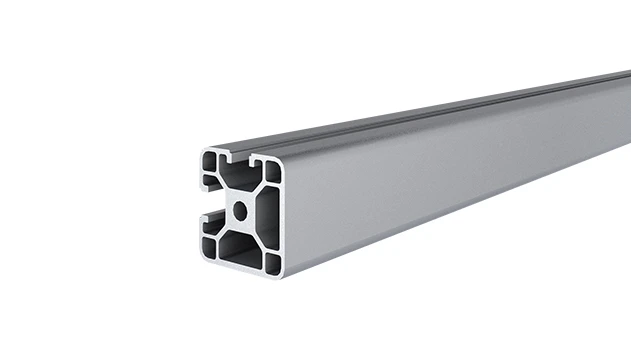
4040E is a 4.00x4.00 CM fractional 40 series square extrusion T-slot profile with two side open T-slots, two side with closed face, each side with 4.00cm face. The profile has align-a-grooves to assist in aligning connecting profiles.
Walk into any 3C manufacturing facility—where smartphones, laptops, and tablets come to life—and you'll notice a quiet chaos beneath the surface. New models roll out every few months, each with slightly different components, assembly steps, or tool requirements. Workers huddle around workstations, adjusting clamps, rearranging bins, or even dismantling entire setups to make space for the next product line. It's a world where rigidity is the enemy, and adaptability isn't just a nice-to-have—it's the difference between meeting deadlines and falling behind.
For years, manufacturers relied on traditional workstations: heavy steel frames bolted to the floor, wooden benches that warped under tool weight, or generic plastic setups that cracked under daily use. These worked… until they didn't. When a new phone model required a taller bench for ergonomic assembly, or a laptop line needed extra shelving for tiny screws and connectors, the answer was often, "We'll have to order a custom one." And "custom" meant weeks of waiting, high costs, and a workstation that'd be obsolete in six months anyway.
But what if there was a better way? A system that could grow, shrink, pivot, and reconfigure as quickly as your product roadmap? Enter the 4040E EU Standard Aluminum Profile—a humble yet revolutionary building block that's quietly transforming how 3C assembly lines operate. Lightweight but tough, modular by design, and infinitely customizable, this aluminum profile isn't just a material upgrade. It's a flexibility game-changer.
First Things First: What Is 4040E EU Standard Aluminum Profile?
Let's start with the basics. The 4040E is part of the EU standard aluminum extrusion profile family—a series of lightweight, high-strength aluminum bars with a square cross-section (40mm x 40mm, hence "4040"). The "E" denotes its specific groove design, optimized for compatibility with a wide range of accessories. Think of it as a grown-up version of tinker toys, but for industrial use: strong enough to support heavy tools, but easy enough for a single worker to assemble with basic hand tools.
What makes it stand out? Unlike generic aluminum pipes, the 4040E is engineered with precision. Its smooth, uniform extrusion ensures consistent quality across every piece, so you never have to worry about a "dud" profile throwing off your build. And because it's EU-standard, it plays nice with hundreds of off-the-shelf accessories—from brackets and hinges to casters and roller tracks. No more hunting for custom parts or modifying components to fit.
Why 4040E Aluminum Profile Solves 3C Assembly's Toughest Headaches
3C manufacturing isn't just about building products—it's about building adaptively . Let's break down how the 4040E addresses the industry's most common pain points:
1. Flexibility That Keeps Up With Product Cycles
When a new smartwatch model hits the production line, it might require a shallower workbench to fit its smaller components. A laptop update could need extra shelf space for battery modules. With traditional setups, this meant days of downtime: unbolting steel frames, sawing wood, or waiting for a custom order. With 4040E, it's a 30-minute job.
Take Maria, a production supervisor at a mid-sized 3C plant in. "Last quarter, we switched from assembling 10-inch tablets to 12-inch ones," she recalls. "Our old wooden workbenches were fixed at 80cm height—too low for the new assembly steps. We used 4040E to build adjustable-height workbenches: just loosened the bolts, raised the frames to 90cm, and re-tightened. The team was back to full speed by lunch."
The secret? 4040E's modular design. Profiles connect via lightweight but sturdy aluminum profile accessories like internal rotary aluminum joints, which let you pivot or extend sections without welding or drilling. Need to add a shelf? Slide a bracket into the profile's T-slot, lock it with a screw, and you're done. Need to shrink the workstation? Disconnect a few joints, remove a section, and reattach—no power tools required.
2. Durability That Outlasts "Disposable" Workstations
Wooden benches warp in humid factory environments; plastic cracks under the weight of power tools; even steel, while strong, rusts over time (especially near cooling fans or cleaning stations). The 4040E, though, is built to last. Its aluminum alloy resists corrosion, so it holds up in dusty, damp, or temperature-fluctuating spaces. And unlike steel, it's lightweight—so workers can reposition workstations without straining their backs, but tough enough to support 150kg+ of tools and materials.
"We used to replace plastic workbenches every 18 months," says Li Wei, a facility manager at a Shenzhen-based electronics manufacturer. "The corners would chip, the surfaces would scratch, and they'd get wobbly after moving them once or twice. Our 4040E workstations? We've had them for three years, and they still look new. We even repurposed some from a phone line to a tablet line—just swapped the accessories, and they were good as gold."
3. Space-Saving Design for Crowded Floors
3C factories are often tight on space. Every square meter counts, especially when you're juggling multiple product lines. Traditional workstations, with their fixed frames and bulky builds, eat up valuable real estate. The 4040E, though, is a space minimalist.
Consider flow racks—those sloped shelves that let materials glide from top to bottom, reducing picking time. With 4040E, you can build slim, vertical flow racks that tuck into wall corners or fit between larger machines. Add roller track (yes, the same roller track you'll find on conveyor systems) to the shelves, and suddenly, bins of screws or circuit boards slide smoothly to the front, no bending or stretching required.
"Our old steel flow racks were 60cm deep—we could only fit two per aisle," Li Wei adds. "The 4040E ones? We slimmed them to 40cm, so now we have three. That's an extra 15% storage space without expanding the factory."

Real-World Wins: 4040E in Action
Let's dive into three common 3C assembly setups where the 4040E shines brightest:
Workbenches: Ergonomic, Custom, and Built for Workers
A 3C assembly worker spends 8+ hours a day at their workstation—so comfort isn't optional. 4040E workbenches adapt to people , not the other way around. Need a bench that tilts 15° for better visibility when soldering? Add adjustable hinges. Want to mount a magnifying lamp or electrostatic discharge (ESD) mat? Slide the accessories into the T-slot and lock them in place.
Take the Workbench E (single deck, without caster)—a popular 4040E-based design. It starts as a basic frame, but manufacturers often tricked it out: adding tool hooks along the side, a bin rail for small parts, or even a cable management tray to keep power tools and chargers organized. "Our team used to waste 10 minutes a day untangling cords," says Maria. "Now, cords run through the 4040E's T-slot, so they're hidden and out of the way."
Flow Racks: Streamlining Material Movement
In 3C assembly, "time is parts per minute." The faster components move from storage to the line, the higher the output. Flow racks built with 4040E and roller track make this seamless. Imagine a shelf where bins of phone screens glide down to the assembler as they're needed—no more walking to the back of the rack to grab the next bin.
For example, Material Rack B (3 row, 3 floor)—a 4040E staple—uses plastic roller track guide rails (yellow or grey, depending on the factory's color-coding system) to create gravity-fed lanes. "We used to have two workers dedicated to restocking parts," says Li Wei. "Now, the flow rack does the work: when a bin empties, the next one slides down automatically. We reassign those workers to quality checks, and our defect rate dropped by 8%."
Turnover Trolleys: Mobile Storage That Fits Any Space
Between shifts, factories need to move partially assembled products, tools, or waste bins. Traditional steel trolleys are heavy and clunky—workers avoid using them, leading to piles of materials accumulating on the floor. 4040E changes that with lightweight, nimble turnover trolleys.
These trolleys use caster wheels (often with brakes for stability) and slim 4040E frames, so they glide through narrow aisles. When not in use, they stack vertically to save space. "We used to have 10 steel trolleys taking up half the break room," Maria laughs. "Now we have 15 4040E trolleys—they stack 3-high, so they tuck into a corner. And because they're light, even our smallest team member can push a loaded one."
How 4040E Stacks Up Against Traditional Materials
| Feature | Traditional Steel | Wooden Benches | 4040E Aluminum Profile |
|---|---|---|---|
| Weight (per meter) | 8-10kg (hard to move) | 4-6kg (but fragile) | 2.5-3kg (light + strong) |
| Reconfig time | 4-8 hours (requires welding/drilling) | 2-4 hours (often permanent) | 30 mins-1 hour (tool-free adjustments) |
| Lifespan | 5-7 years (prone to rust) | 1-2 years (warps, scratches) | 10+ years (corrosion-resistant) |
| Cost (over 5 years) | High (initial + replacement + maintenance) | Very high (frequent replacements) | Low (one-time purchase + reusable parts) |
Fitting Into Lean Manufacturing: Less Waste, More Value
Lean manufacturing isn't just a buzzword in 3C—it's a survival strategy. The goal: eliminate waste (time, space, materials) to focus on value-adding work. 4040E aligns perfectly with this ethos.
Consider "muda" (waste) like overproduction or waiting. With rigid workstations, teams often overstock parts to avoid stopping production during reconfigurations. With 4040E, reconfigurations are fast, so just-in-time (JIT) delivery works better: parts arrive exactly when needed, reducing inventory waste.
Or "mura" (inconsistency). Traditional setups lead to uneven workstations—one bench might be 2cm taller than the next, forcing workers to adjust their posture. 4040E's precision extrusion ensures every workstation is identical, cutting down on ergonomic injuries and quality errors.
"We adopted lean principles last year, and 4040E was the missing piece," says Li Wei. "Before, we had 'hidden waste'—workers walking 10 extra steps to grab tools because benches weren't positioned right. Now, we reconfigure workstations daily to keep tools and parts within arm's reach. Our line efficiency jumped 20% in three months."
The Accessories That Make 4040E Unstoppable
A 4040E profile alone is useful, but it's the aluminum profile accessories that unlock its full potential. Here are the unsung heroes that turn basic frames into smart workstations:
- Internal Rotary Aluminum Joints: These allow 360° rotation, so you can pivot shelves, fold down work surfaces, or angle tool racks for better access. No more "one-and-done" setups—adjust on the fly.
- Roller Track Guide Rails: Plastic or aluminum rails that attach to 4040E frames, turning shelves into gravity-fed flow racks. Yellow rails for "urgent parts," grey for "standard use"—color-coding that keeps teams organized.
- Caster Wheels with Brakes: Lockable wheels that turn static workbenches into mobile stations. Great for "follow-the-product" assembly lines, where workers move with the unit instead of staying in one spot.
- ESD Mats and Brackets: 3C components are sensitive to static electricity. 4040E works with ESD-safe mats (attached via T-slot brackets) to ground workers, preventing costly damage to microchips.
The Bottom Line: Flexibility Isn't Optional Anymore
In 3C manufacturing, the only constant is change. New products, new components, new efficiency goals—your workstations need to keep pace. Traditional materials trap you in the past; 4040E EU Standard Aluminum Profile propels you forward.
It's not just about saving time or money (though it does both). It's about empowering workers: giving them tools that adapt to their needs, not the other way around. It's about building factories that can pivot overnight, not over weeks. And in a industry where every second counts, that's the edge that wins.
So the next time you unbox a new smartphone or laptop, take a moment to appreciate the quiet revolution happening on the assembly line. Chances are, a 4040E aluminum profile played a role in getting it from blueprint to your hands—flexible, durable, and ready for whatever comes next.