- Company Articles
- Products and Technology
- Product knowledge
- 3C Product Assembly Workbenches: Building with 3060 National Standard Profile A

3C Product Assembly Workbenches: Building with 3060 National Standard Profile A
Related Product
3060 National Standard Profile A
Workbench, production line, logistic rack, warehouse rack Industry: Manufacturer workshop, Automobile, Electronic, Assembling, logistic
In the fast-paced world of 3C product manufacturing—where smartphones, laptops, and smartwatches are assembled with precision down to the millimeter—the assembly workbench isn't just a table. It's the unsung hero of production lines, the steady foundation that turns chaos into order, and the silent enabler of the sleek, high-tech devices we rely on daily. But not all workbenches are created equal. In an industry where a single misplaced component can derail an entire batch, and where production lines must pivot overnight to meet new product launches, manufacturers are increasingly turning to a game-changing solution: workbenches built with 3060 National Standard Profile A . This aluminum extrusion profile isn't just a material choice; it's a strategic investment in flexibility, durability, and precision. Let's dive into why this profile has become the gold standard for 3C assembly, how it integrates with essential accessories, and why it's redefining what a workbench can do.
The 3C Manufacturing Challenge: Why "Good Enough" Workbenches Fall Short
To understand the need for advanced workbenches, let's start with the realities of 3C production. Imagine a typical day on the floor: technicians assemble 500 smartphones per hour, each requiring over 100 components—from 0.5mm-thin circuit boards to fragile OLED screens. Every second counts, and downtime due to a wobbly workbench or a misplaced tool can cost thousands of dollars. Traditional workbenches, often made of wood or generic steel, struggle here. Wood warps under the weight of heavy equipment, steel rusts in humid factory environments, and both lack the adaptability to reconfigure when a new model (say, a foldable phone with a completely different assembly process) hits the line.
Then there's the threat of electrostatic discharge (ESD). In 3C manufacturing, static electricity is a silent killer: a single electrostatic spark can fry a microchip, rendering an entire device useless. The EPA estimates that ESD causes over $50 billion in annual losses for the electronics industry, much of it preventable with proper ESD-safe workspaces. Traditional workbenches rarely integrate ESD protection seamlessly, forcing manufacturers to jury-rig solutions like separate grounding mats or anti-static sprays—band-aids that often fail in the long run.
And let's not forget lean manufacturing. Today's 3C plants live by the principles of lean: eliminate waste, optimize flow, and empower teams to improve processes continuously. A rigid, one-size-fits-all workbench is the antithesis of lean. If a technician needs a side shelf to hold a new tool, or if a production line needs to shrink by 2 feet to make room for a new conveyor, traditional workbenches can't keep up. They're bolted down, welded together, and impossible to modify without halting production for hours (or days).
Enter 3060 National Standard Profile A . This aluminum extrusion profile, with its standardized 30mm x 60mm cross-section, was designed to solve these exact pain points. It's strong enough to support heavy equipment, flexible enough to reconfigure in minutes, and compatible with a ecosystem of accessories that turn a basic frame into a custom-tailored assembly station. Let's break down what makes this profile so special.
What Is 3060 National Standard Profile A? The Basics
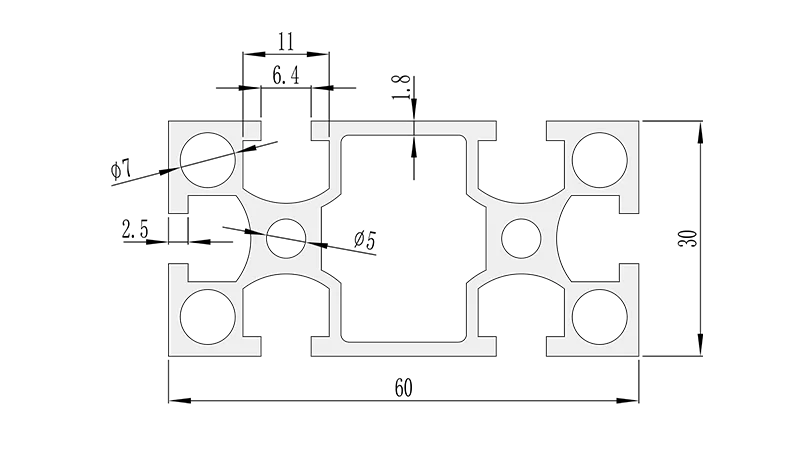
At its core, 3060 National Standard Profile A is an aluminum extrusion—a long, uniform piece of aluminum shaped by forcing heated metal through a die. The result? A lightweight but incredibly strong profile with a distinct cross-section: 30mm wide, 60mm tall, and featuring T-slots along its length. These T-slots are the secret sauce. They're not just grooves; they're the connection points that allow accessories to snap, slide, and lock into place without welding, drilling, or specialized tools. Think of it like a grown-up version of building blocks, but for industrial manufacturing.
Why aluminum? For starters, it's lightweight—about 1/3 the weight of steel—making the profile easy to handle during assembly and reconfiguration. But don't let the lightness fool you: aluminum extrusion is surprisingly strong. Thanks to its hollow, ribbed internal structure, 3060 Profile A can support up to 200kg per linear meter, more than enough for the heaviest 3C assembly tools, including precision screwdrivers, thermal cameras, and automated component feeders. It's also corrosion-resistant, a must in factories where humidity levels are tightly controlled (to prevent static) but can still take a toll on metal over time. Unlike steel, aluminum doesn't rust, and unlike wood, it won't warp or rot—meaning a workbench built with this profile can last 10+ years with minimal maintenance.
The "national standard" part matters too. In manufacturing, consistency is key. A 3060 Profile A from one supplier will fit perfectly with accessories from another, because the dimensions, slot sizes, and tolerances are standardized. This interoperability eliminates the headache of "will this part fit?" and allows manufacturers to mix and match components to create exactly what they need. Whether you're buying from a local supplier or importing from abroad, you can trust that the profile will align with your existing setup.
But the real magic happens when you pair this profile with aluminum profile accessories . These aren't just nuts and bolts—they're purpose-built components that turn a simple extrusion into a fully functional workbench. Let's explore the most essential ones.
Aluminum Profile Accessories: The Building Blocks of Customization
If 3060 Profile A is the backbone of the workbench, then aluminum profile accessories are the muscles, joints, and nerves that bring it to life. These small but mighty components enable everything from adjusting the height of a shelf to adding a fold-down writing surface, all without a single weld. Let's walk through the must-haves for any 3C assembly workbench:
Connectors: The Glue That Holds It All Together
Without connectors, a 3060 Profile A is just a long aluminum stick. Connectors are what let you join profiles at angles, build frames, and add layers to your workbench. The most common types include 90° angle codes (for corner joints), 135° connectors (for angled shelves), and T-joints (for adding crossbars). What's impressive is how they work: most slide into the T-slots of the profile and lock in place with a hex key, creating a tight, rattle-free connection. Unlike welding, which requires skilled labor and leaves permanent marks, connectors allow for easy disassembly. Need to shorten the workbench? Loosen the connectors, remove a section of profile, and re-tighten—done in 10 minutes.
End Caps: Protection and Polished Finishes
The ends of aluminum extrusions can be sharp, which is a safety hazard in a busy factory. End caps—plastic or rubber covers that snap onto the ends of the profile—solve this. They also prevent dust, debris, and liquids from getting inside the extrusion, which could damage internal components over time. Many end caps come in colors (like black or gray), adding a clean, professional look to the workbench—small details that boost technician morale and make the workspace feel intentional.
T-Slot Rubber Strips: Quiet, Secure, and Anti-Slip
The T-slots in the 3060 Profile are great for attaching accessories, but when nothing is in them, they can collect dirt or create a gap where small tools might fall. Rubber strips slide into the slots, filling the space and creating a non-slip surface. They also dampen vibrations—important when assembling delicate components, as even a slight shake can misalign a part. For ESD-sensitive areas, conductive rubber strips are available, adding an extra layer of static protection.
Hinges and Handles: Adding Mobility and Flexibility
For workbenches that need fold-down sections (like a temporary shelf for overflow materials) or flip-up tool panels, aluminum hinges are a game-changer. These hinges attach directly to the profile via T-slot connectors, allowing sections to swing open or closed smoothly. Handles, meanwhile, make it easy to move modular components—like a detachable tool cart that can be wheeled from one workbench to another. Both are designed to withstand the daily wear and tear of a factory floor, with durable materials that resist chipping or breaking.
Together, these accessories transform 3060 Profile A from a static material into a dynamic system. Want a workbench with a height-adjustable top? Use height-adjustable feet (another common accessory) and telescoping profile sections. Need a side rail to hold bins of screws? Attach a crossbar with T-joint connectors and bin holders. The possibilities are nearly endless—and that's exactly why 3C manufacturers love it.
Beyond Basic Workbenches: Building an ESD Workstation for 3C Precision
In 3C manufacturing, static electricity is enemy number one. A single static discharge can damage a microchip beyond repair, and with components getting smaller (today's smartphone chips have transistors just 3nm wide—smaller than a virus), the risk is higher than ever. That's why a workbench built with 3060 Profile A isn't just about flexibility—it's about safety, too. When configured as an ESD workstation , it becomes a fortress against static, protecting both components and technicians.
So what makes a 3060 Profile A workbench an ESD workstation? It starts with the materials. While the aluminum profile itself is conductive, ESD workstations take it further by adding specialized surfaces: ESD-safe worktop mats made of rubber or vinyl that dissipate static charges, and ESD floor mats to ground technicians as they stand at the bench. These mats connect to the workbench frame via grounding wires, which in turn connect to the factory's main grounding system—ensuring any static buildup is safely channeled away from components.
Accessories play a role here, too. ESD wrist straps (which technicians wear) can be anchored directly to the workbench via T-slot-mounted grounding points. Tool holders with conductive liners prevent tools from accumulating static, and bin dividers made of ESD-safe plastic keep small components (like resistors or capacitors) protected. Even the casters (if the workbench is mobile) are ESD-rated, with conductive wheels that prevent static from building up as the bench is moved.
Compliance is another key factor. The most widely recognized standard for ESD protection is ANSI/ESD S20.20, which sets strict requirements for grounding, surface resistance, and personnel training. Workbenches built with 3060 Profile A and ESD accessories are designed to meet these standards out of the box. For example, the surface resistance of the worktop mat should measure between 10^6 and 10^9 ohms (low enough to dissipate static, but not so low that it causes a shock), and the grounding system must have a resistance of less than 10^8 ohms. Manufacturers can even request certification from suppliers, ensuring the workstation meets or exceeds industry requirements.
The beauty of using 3060 Profile A for ESD workstations is that the static protection integrates seamlessly with the rest of the bench. There's no need for separate, clunky grounding equipment—everything is built into the frame. When you reconfigure the workbench (say, adding a new shelf), the grounding system moves with it, because the accessories are designed to maintain conductivity. This integration reduces the risk of human error (no more forgetting to plug in a separate grounding mat) and ensures consistent protection across the entire production line.
Lean Manufacturing in Action: How 3060 Profile A Supports Continuous Improvement
3C manufacturing isn't just about building products—it's about building better processes. Lean manufacturing, with its focus on eliminating waste (muda) and empowering teams to improve workflows, has become the backbone of successful 3C plants. And at the heart of lean is adaptability. A production line that can't change can't improve, and that's where 3060 Profile A workbenches shine. Their modular design aligns perfectly with lean principles, making them ideal for everything from 5S organization to rapid changeovers.
Take 5S—the Japanese methodology for workplace organization (Sort, Set in Order, Shine, Standardize, Sustain). A cluttered workbench violates the "Set in Order" principle, leading to wasted time searching for tools. With 3060 Profile A and aluminum profile accessories, technicians can design their workbench to fit the 5S mindset: dedicated slots for every tool (using T-slot tool holders), labeled bins for components (attached via side rails), and even color-coded sections for different stages of assembly. If a technician realizes a tool would be easier to reach on the left instead of the right? No problem—just loosen the connectors, move the holder, and retighten. The workbench adapts to the process, not the other way around.
Changeovers are another area where modular workbenches excel. In 3C, new product launches are constant—think of how often smartphone models are updated. Each new model may require a slightly different assembly process: a larger battery, a different camera module, or a new type of connector. With traditional workbenches, reconfiguring for a new model could take hours (or days) of downtime. With 3060 Profile A, it's a matter of swapping out accessories. Need to add a fixture for a larger screen? Attach a new crossbar with a lean pipe joint (a versatile connector that joins aluminum profiles to lean pipes, adding even more flexibility). No need to dismantle the entire bench—just modify the section that needs changing.
Waste reduction is another lean benefit. Traditional workbenches are often overbuilt, using more material than necessary, or underbuilt, requiring frequent replacements. 3060 Profile A strikes the perfect balance: its aluminum construction is lightweight but strong, so you're not paying for excess material, and its durability means you won't be replacing it every few years. Plus, when a workbench does reach the end of its life, aluminum is 100% recyclable—aligning with the "green manufacturing" goals many 3C companies now prioritize.
Perhaps the most powerful lean advantage, though, is employee empowerment. Technicians are the ones who know the assembly process best—they see the bottlenecks, the inefficiencies, and the small tweaks that could make a big difference. With a modular workbench, they don't have to wait for engineering or maintenance to make changes. They can grab a hex key, adjust a shelf, or add a bin holder themselves. This sense of ownership leads to more engaged teams and a constant stream of small improvements that add up to big gains in productivity.
Case Study: Building a 3060 Profile A Workbench for Smartphone Assembly
To put all this into perspective, let's walk through a real-world example: building a workbench for smartphone final assembly. This is a high-precision process, requiring technicians to attach screens, batteries, and back covers with minimal force (to avoid damaging components) and maximum efficiency. Here's how 3060 National Standard Profile A, aluminum profile accessories, and ESD features come together:
Step 1: The Frame
The base of the workbench is a frame made from 3060 Profile A: four vertical legs (1.2m tall), connected by horizontal rails at the top and bottom. The width is 1.5m (to accommodate a standard assembly mat) and the depth is 0.8m (enough space for tools and components without being too wide to reach across). Height-adjustable feet are added to level the bench on uneven factory floors, and ESD casters (with locks) are optional for mobility.
Step 2: The Worktop
The top surface is an ESD-safe aluminum honeycomb panel (lightweight but rigid), secured to the frame with T-slot connectors. A 5mm-thick ESD rubber mat is laid over the panel, grounded via a wire that connects to the frame (which is itself grounded to the factory's ESD system). The mat is yellow (a common ESD color code) to signal that this is a static-sensitive area.
Step 3: Tool and Component Storage
On the left side of the bench, a vertical 3060 Profile A rail is attached using 90° angle codes. This rail holds:
- A tool panel with slots for precision screwdrivers, tweezers, and pry tools (attached via T-slot tool holders)
- Three plastic bins (color-coded: red for screws, blue for connectors, green for adhesive strips) mounted on bin holders
- A small LED light bar (powered via a USB port on the bench) to illuminate the work area
Step 4: Cable Management
No assembly workbench is complete without cable management. A horizontal 3060 Profile A rail runs along the back of the bench, with cable clips (aluminum profile accessories) that hold power cords, USB cables, and ESD wrist strap wires. This keeps cables off the worktop, preventing tangles and reducing trip hazards.
Step 5: Quality Control Add-Ons
At the end of the bench, a small shelf is added using a
lean pipe joint
to connect a lean pipe to the frame. This shelf holds a magnifying glass (for inspecting small components) and a tablet stand (for displaying assembly instructions or quality checklists). The joint allows the shelf to be rotated out of the way when not in use.
The result? A workbench that's tailored to smartphone assembly, with every tool and component within arm's reach, static protection built-in, and the flexibility to adapt if the assembly process changes. And because it's built with standard components, any technician can adjust it—no special training required.
Comparing Traditional vs. 3060 Profile A Workbenches: The Numbers Speak
Still not convinced that 3060 Profile A is worth the investment? Let's look at the data. Below is a comparison of a traditional wooden workbench, a generic steel workbench, and a 3060 Profile A workbench built with aluminum profile accessories and ESD features, based on real-world manufacturing scenarios:
| Feature | Traditional Wooden Workbench | Generic Steel Workbench | 3060 Profile A Workbench |
|---|---|---|---|
| Initial Cost | $200–$300 | $400–$600 | $600–$800 |
| Expected Lifespan | 2–3 years (warps, rots) | 5–7 years (rusts, bolts loosen) | 10+ years (aluminum resists corrosion/wear) |
| ESD Protection | None (requires add-on mats, $50–$100/year) | Minimal (steel conducts, but no integrated grounding) | Built-in (grounded frame, ESD mat, $0 annual add-ons) |
| Reconfiguration Time | 8+ hours (requires cutting, drilling, or replacing) | 4–6 hours (welding or bolted modifications) | 15–30 minutes (loosen/tighten connectors) |
| Weight Capacity | 100–150kg (top surface) | 200–300kg (top surface) | 300–400kg (top surface, thanks to aluminum's strength-to-weight ratio) |
| Maintenance Cost/Year | $100–$150 (sanding, repainting, replacing warped parts) | $50–$100 (rust treatment, tightening bolts) | $10–$20 (occasional hex key tightening, cleaning) |
| Waste Reduction Potential | Low (fixed design leads to process waste) | Medium (some adjustability, but limited) | High (modular design eliminates wasted space/time) |
When you factor in lifespan and maintenance, the 3060 Profile A workbench quickly becomes the most cost-effective option. Over 10 years, a wooden workbench would need to be replaced 3–5 times (costing $600–$1,500), while a steel workbench would need replacement once (costing $400–$600). The 3060 Profile A workbench? One initial investment of $600–$800, plus $100–$200 in maintenance over a decade. Add in the savings from reduced downtime during reconfigurations and lower ESD-related defects, and the ROI becomes undeniable.
The Future of 3C Assembly: Where 3060 Profile A Goes Next
As 3C manufacturing evolves—with trends like Industry 4.0, miniaturization, and sustainability shaping the future—so too will the tools that power it. 3060 National Standard Profile A is poised to keep up, thanks to its adaptability and compatibility with emerging technologies. Here's what we can expect to see next:
Smart Workbenches with IoT Integration
Imagine a workbench that can track how long each assembly step takes, alert managers to bottlenecks, or even order replacement components when stock runs low. With 3060 Profile A, adding IoT sensors is simple: mount a sensor module to the frame via T-slot connectors, connect it to the factory's network, and start collecting data. For example, a pressure sensor under the worktop could detect when a technician is working on a device, logging the time spent. A camera mounted on a hinged arm could check for defects in real-time, sending alerts if a component is misaligned. The modular design means these smart features can be added incrementally, without replacing the entire bench.
Lightweight, High-Strength Alloys
Aluminum extrusion technology is advancing, with new alloys that offer even better strength-to-weight ratios. Future 3060 profiles could be lighter (reducing shipping and installation costs) while supporting heavier loads (allowing for more equipment on the bench). Some manufacturers are already experimenting with carbon fiber-reinforced aluminum, which could push lifespan to 15+ years.
Sustainable Accessories
As 3C companies prioritize eco-friendly manufacturing, aluminum profile accessories are following suit. We're seeing more accessories made from recycled plastic or biodegradable materials (for non-load-bearing parts like end caps). Even packaging is getting greener—suppliers are using recyclable cardboard instead of foam, and minimizing plastic wrap.
At the end of the day, though, the core appeal of 3060 Profile A will remain the same: it's a tool that empowers manufacturers to build better. Better workbenches, better processes, and better products. In an industry where precision and speed are everything, that's not just an advantage—it's a necessity.
Conclusion: Why 3060 National Standard Profile A Is the Future of 3C Assembly
In the world of 3C manufacturing, where every second and every component counts, the assembly workbench is more than just a piece of equipment. It's a strategic asset that can make or break production efficiency, product quality, and employee satisfaction. Traditional workbenches—wooden, steel, or generic—simply can't keep up with the demands of modern 3C production: the need for ESD protection, the requirement for rapid reconfiguration, and the push for lean, waste-free processes.
That's where 3060 National Standard Profile A comes in. This aluminum extrusion profile, paired with aluminum profile accessories , offers the perfect blend of strength, flexibility, and durability. It's lightweight enough to adapt, strong enough to last, and compatible with a ecosystem of components that turn a basic frame into a custom ESD workstation —or any other type of bench a manufacturer needs. Whether you're assembling smartphones, laptops, or smartwatches, a workbench built with this profile doesn't just support the process—it enhances it.
From reducing ESD-related defects to cutting changeover times from hours to minutes, from empowering technicians to make on-the-fly improvements to lasting 10+ years with minimal maintenance, 3060 Profile A is more than a material choice. It's a commitment to excellence—a way to build not just better workbenches, but better manufacturing operations. And in an industry that never stops evolving, that's the most valuable tool of all.